Here’s a puzzle for you. Is this an early sketch of Sutter’s Fort?
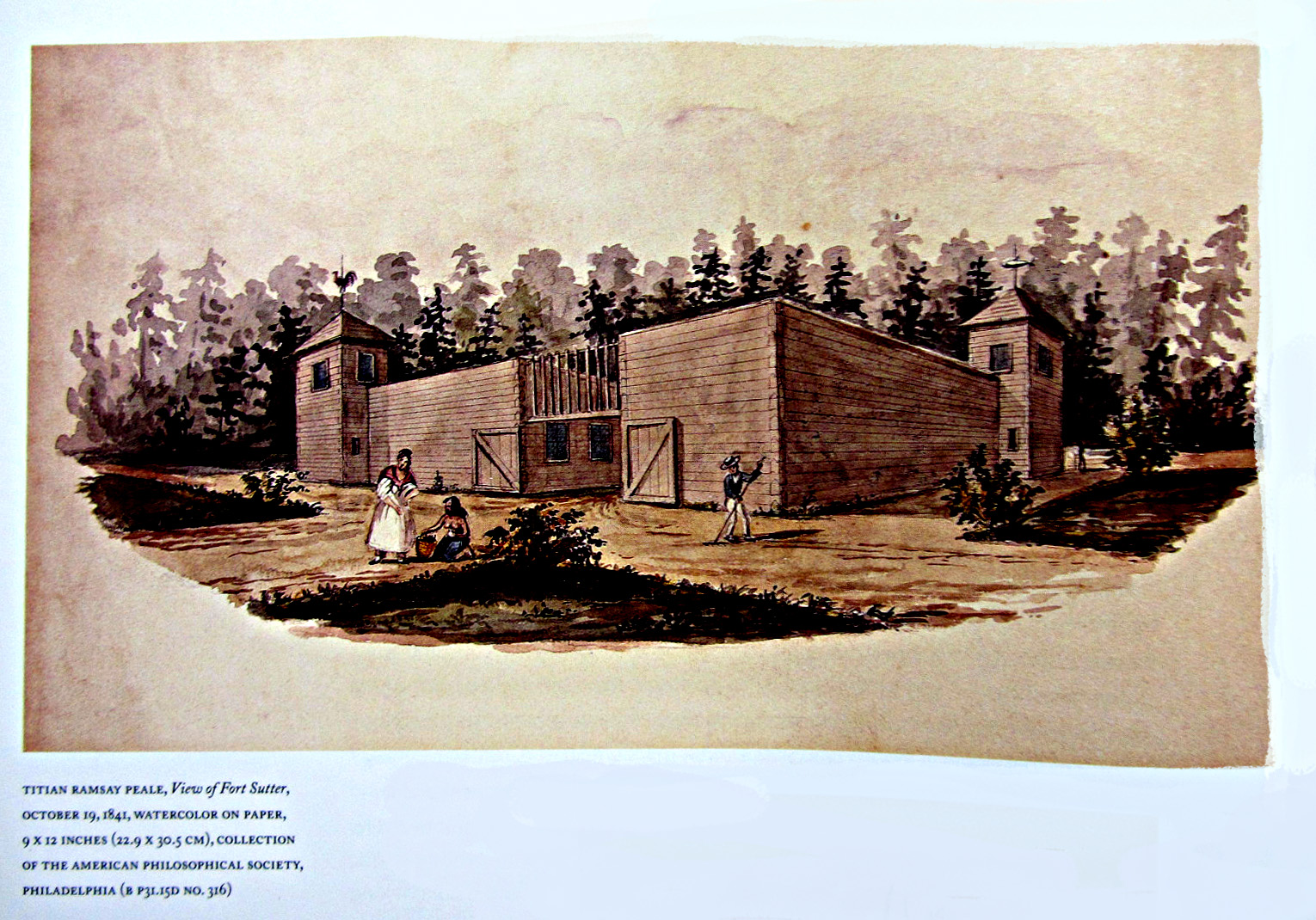
It looks kind of like Sutter’s Fort, but not big enough. It’s captioned “View of Fort Sutter.” But is that really what it is?
I had never seen this picture before. A couple of weeks ago I had a pleasant conversation with a gentleman at the Tehama County Museum History Rendezvous, who asked if I knew anything about it. I didn’t. He kindly shared these pictures with me.
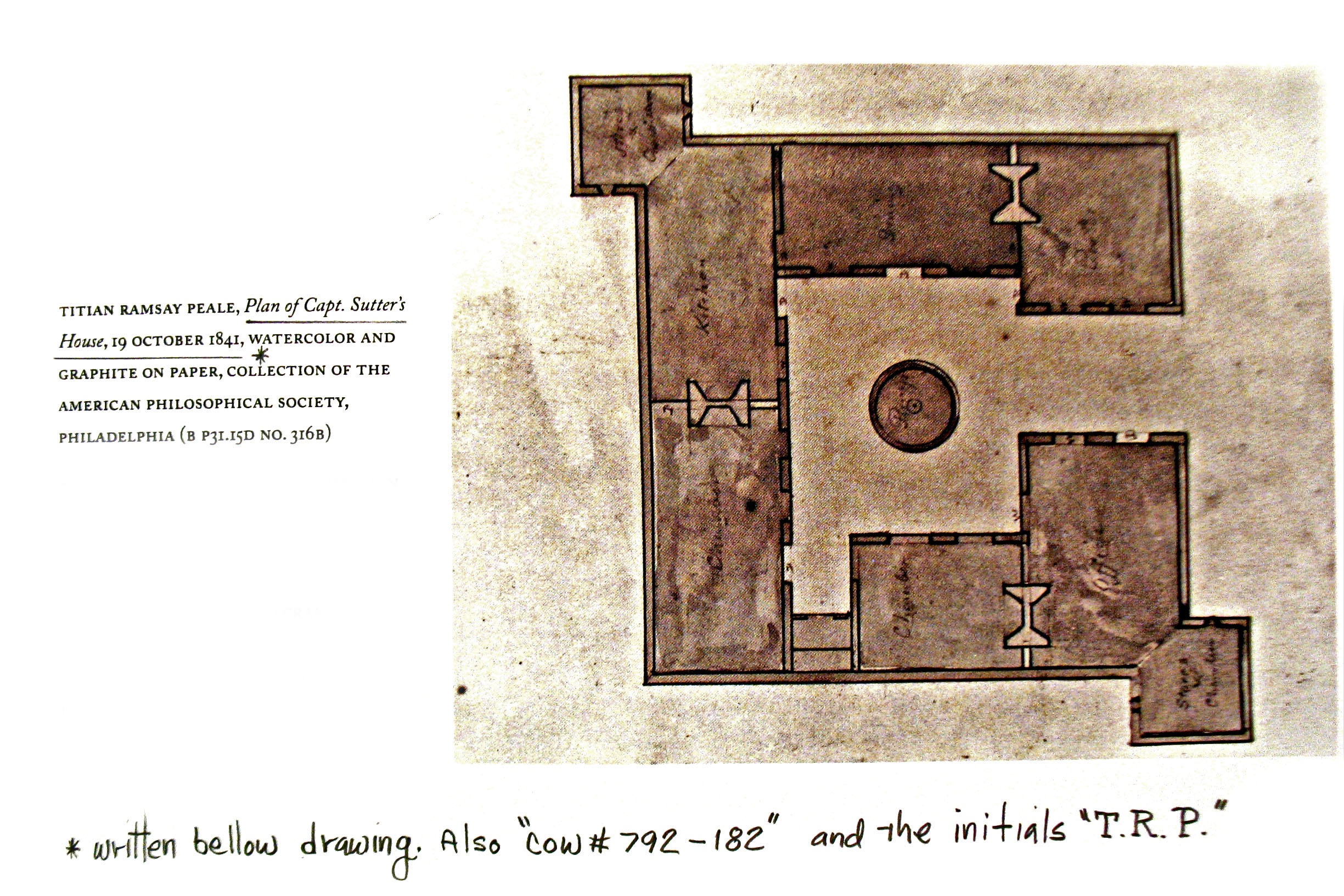
The two drawings are by Titian Ramsey Peale, an artist who accompanied the U.S. Exploratory Expedition (also know as the Wilkes Expedition) on its round-the-world tour from 1838-1842. Titian Peale was the son of American polymath painter Charles Wilson Peale. (I love it that Peale named his sons Raphaelle, Rembrandt, Rubens and Titian, after his favorite artists, although I do not recommend that anyone name their son Titian today.)
In the fall of 1841, as the Wilkes Expedition explored San Francisco Bay, Captain Ringgold took some men into the Sacramento Valley. They explored the Sacramento River as far north as the Feather River and visited with John Sutter at his settlement of New Helvetia. The date on these two sketches is October 19, 1841. Is this what Sutter’s Fort looked like at that date?
Probably not. Captain Sutter was in negotiations to acquire Fort Ross. He had need of anything and everything he could get from the Russians: lumber, nails, fittings, tools, agricultural equipment, weapons, livestock, boats — everything. With all that, he told Peale and Ringgold, he planned to build himself a fort.
Why did he need a fort? John Bidwell, who arrived just a month later in mid-November 1841, later stated that Sutter felt threatened by the Mexican-Californians, who had begun to sense that they didn’t need a foreigner in their midst who was gathering other foreigners around him. As Bidwell said, “These threats were made before he had begun the fort, much less built it, and Sutter felt insecure.”
Titian Peale wrote in his journal that Sutter met the expedition and “conducted us to his house.” He says that Sutter “is now building extensive corrals and houses of adobes.” But nothing about a fort.
You can imagine Sutter, hospitable and expansive, telling his visitors about his grand plans to acquire Fort Ross and all its accoutrements, and then build a fort that would secure his position in the heart of California. Peale in response creates a picture of what that fort might look like, with its bastions that resemble those at Fort Ross. “Yes,” says Sutter, “that’s just what I need, except I will make it even bigger and better.” And so he did.
It’s only my conjecture, but it fits what we know of Sutter’s early situation and of the explorers who visited him in 1841. If you are interested in learning more about the Wilkes Expedition, you can read Sea of Glory, America’s Voyage of Discovery: The U.S. Exploring Expedition, 1838–1842 by Nathaniel Philbrick (New York: Viking, 2003). It’s a fascinating tale of exploration from the Americas to Antarctica to the islands of the South Pacific, although the account is skimpy when it comes to the expedition in California. If you really want to get into it, the Smithsonian has made Wilkes’s own account (all five volumes) available online. California is in volume 5.



 goldfields