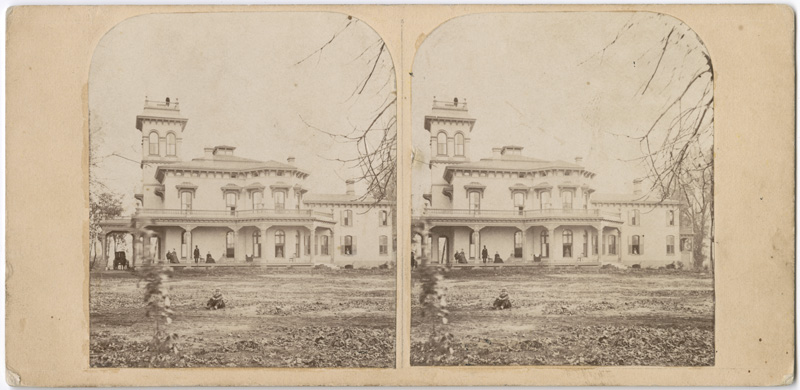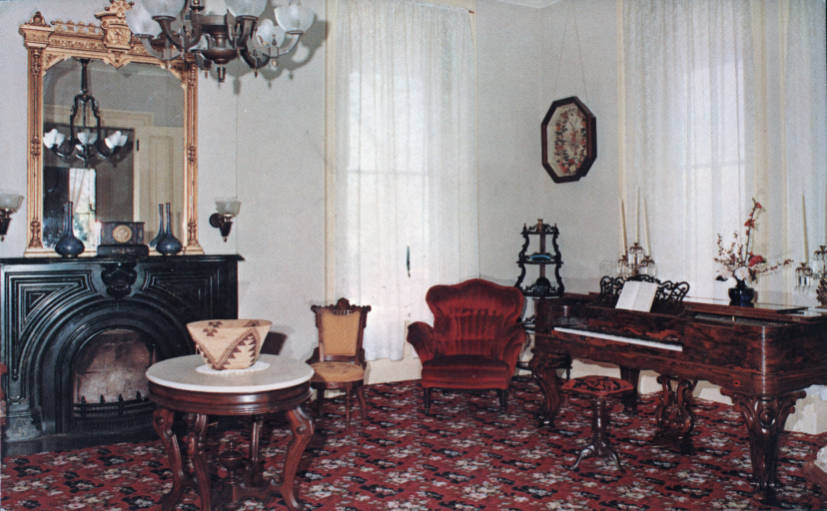
New Year’s Day in Bidwell Mansion, 1869


Postcard from the John Nopel Photograph Collection, Meriam Library. California State University, Chico.

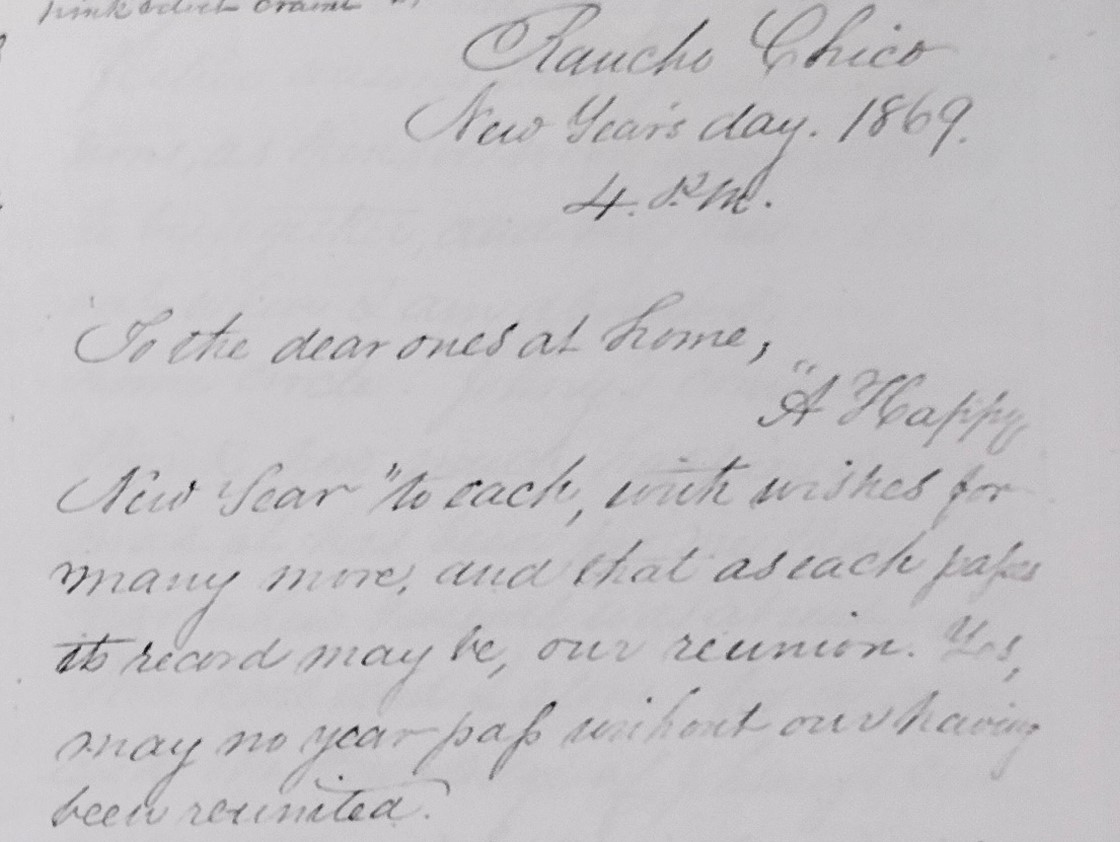
Picture Annie Bidwell, sitting by the fireplace in the newly finished Bidwell Mansion, writing a New Year’s Day letter to “the dear ones at home” in Washington D.C.

She misses her family, and she is sometimes lonely when “the General” is away on business and her brother Johnny is out. “But,” she insists, “I do not allow real home-sickness even to thrust his nose into the door of my heart, lest his body follow, and he drive me out.”

And so she describes her surroundings:

Were you to look in on me today you would see a cheerful house, parlor with bright wood fire, velvet carpet, crimson reps furniture, bouquet of lovely flowers gathered by me this A.M. from the garden, handsome rose-wood marble centre table covered with books, stereoscope & views, folding-doors open into the large dining room, carpeted with a rich new “body Brussels” carpet, a lovely carpet; green rep carved walnut furniture, bright wood fire – centre table filled with fruit, almonds & raisins.

The carpeting and furniture had been purchased in San Francisco. By “rep” Annie is referring to the upholstery fabric. Rep was a woven fabric usually made of silk, wool, or cotton used for upholstery, drapes, and sometimes men’s clothing like waistcoats. According to Collins dictionary, a Brussels carpet was a worsted carpet with a heavy pile formed by uncut loops of wool on a linen warp. A body Brussels carpet had a woven pattern over the entire body, whereas on a tapestry Brussels carpet the pattern was printed. It was an expensive and elegant choice.

Annie was justly proud of the delicious fruits grown on Rancho Chico: figs, grapes, pears, apples, almonds and raisins were enjoyed well into the winter months, a luxury unknown before she came to California.

As fine Muscat & Black Hamburg grapes as summer or Autumn vines produced, preserved in sawdust, enormous & delicious pears which I daily wish Papa could enjoy together with the figs and apples. The almonds and raisins Sallie would prefer, but the cream with our preserved fruits alone would suit Mamma. “I wish Mamma had this cream!” “I wish Papa had these figs & pears!” “ I wish Sallie had these almonds & raisins,” is my constant exclamation.

Posted in Uncategorized | Leave a comment

Christmas Wishes from the Bard of Butte

Alexander Preston Longley 1824-1912

Pres Longley, the “Bard of Butte,” wrote many columns and poems for the newspapers. This column appeared in the Weekly Butte Record on December 26th, 1868. It’s lengthy, so I am just going to give you the beginning, and the part addressed “to the juvenile readers of the Record about Santa Claus.”

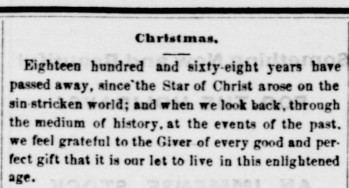
Eighteen hundred and sixty-eight years have passed away, since the Star of Christ arose on the sin-stricken world; and when we look back, through the medium of history, at the events of the past, we feel grateful to the Giver of every good and perfect gift that it is our let to live in this enlightened age.

In spite of the troubles of this old world, Pres encouraged his readers to live in gratitude and good cheer. He then tells a story for his juvenile readers, of a “lazy girl” who hung up her stocking on Christmas Eve, and found nothing in it in the morning but the following two lines:

Your stocking is dirty, I’ll put nothing in it,
Till you wash out the dirt; ’twill take but a minute.

But another girl, who kept her stockings clean, had better luck, and here is her poem:

This young lady found “a gold specimen and a piece of poetry” in her stocking. Now that’s something I would like to find in my stocking, a nugget of gold, “as pure and as bright / as the stars that illumine the darkness of night.”

The ocean's great billows have rolled o'er its bed,
And murmured sad dirges as though it were dead,
Till they sang themselves hoarse, then rolled far away,
Still leaving it wrapped in its mantle of clay.
Then take it and keep it – ‘tis fresh from the mine,--
And, like this bright token, endeavor to shine.
Dec. 25th, 1868 SANTA CLAUS

May we all “endeavor to shine” and make this world a better place. Have a merry and joyful Christmas!

Posted in Uncategorized | 2 Comments

Christmas with the Bidwells

Enjoy this vignette from 2021, in which the Bidwells entertain guests, General Bidwell and his friend tell the story of a Christmas feast at Sutter’s Fort, and the cook is in despair.

Posted in Uncategorized | Leave a comment

Today in History — The First California Legislature

California’s first capitol in San Jose

On Monday, December 17, 1849, the California legislature met for the first time in San Jose. They were actually scheduled to meet on December 15th, but it had rained steadily since October, and the roads were so muddy that many of the delegates had trouble reaching San Jose. At last on the 17th they had a quorum and could begin deliberations.

Keep in mind that California was not actually yet a state. But the people wanted statehood and they were anxious to get an established government and code of laws, so they forged ahead. General Bennet C. Riley, the military governor of California, had called a Constitutional Convention, which was held in Monterey in September. Elections were held in November and 36 Assemblymen and 16 Senators were elected.

During that first session, Assemblyman John S. Bradford asked his fellow legislators to write down some particulars about themselves. Thirty members complied and penned brief autobiographies of themselves. Here is John Bidwell’s:

Born Chautauqua Co. N.Y. 5 Aug. A.D. 1819 — emigrated to Penn. – thence to Ohio — thence to Missouri — thence in 1841 to California — Single — term in Senate one year — Democrat — etc. etc. J. Bidwell

Since all but two members were born outside California, they always indicated their home state. The two native-born senators were Mariano Guadalupe Vallejo and Pablo de la Guerra who wrote their statements in Spanish. Bidwell was the earliest immigrant from the States, having arrived in 1841. Several of the men had only arrive in California in 1849, just months before their election to the legislature.

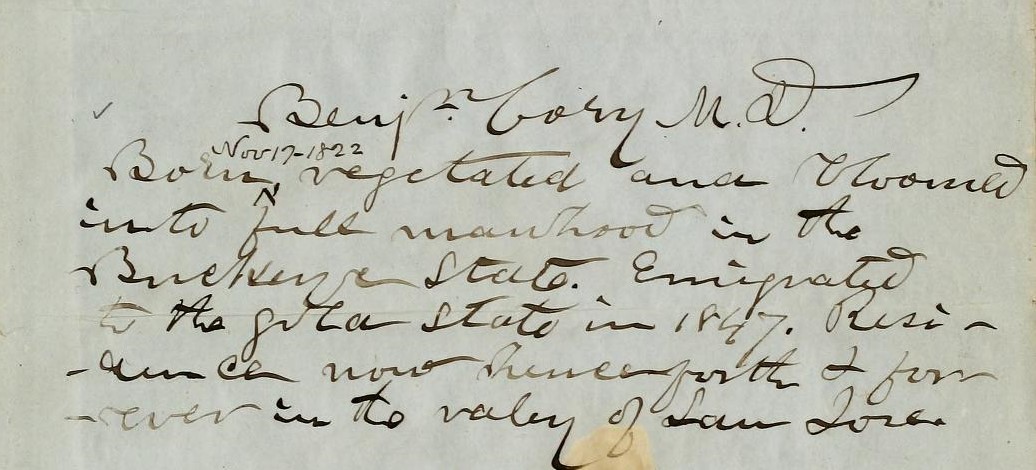
Some of the men added a touch of humor to their statements. Here is Benjamin Cory:

Benj’n Cory M.D. Born Nov. 17, 1822 vegetated and bloomed into full manhood in the Buckeye State. Emigrated to the golden state in 1847. Residence now henceforth and forever in the valey of San Jose.

Dr. Cory did indeed reside the rest of his life in San Jose, and after a long and successful career died in 1873.

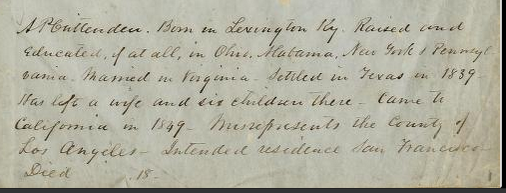
Here is Alexander P. Crittenden:

A.P.Crittenden. Born in Lexington Ky. Raised and educated, if at all, in Ohio, Alabama, New York & Pennsylvania. Married in Virginia. Settled in Texas in 1839. Has left a wife and six children there. Came to California in 1849. Misrepresents the County of Los Angeles. Intended residence San Francisco. Died 18-

He even left a space for his death date — a death that became more famous than his life, when he was shot by his lover, Laura Fair, as he sat by his wife on the Oakland-San Francisco ferry in 1870. But that is a tale for another time.

Posted in Uncategorized | 2 Comments

Rancho del Llano Seco

Come to the Annual Meeting of the Association for Northern California Historical Research and hear archaeologist Greg White talk about his investigations at Rancho del Llano Seco. This new book, and all of ANCHR’s books, will be available for purchase. The event is free!

Read Dan Barnett’s review of the book in the Chico Enterprise-Record.

Posted in Uncategorized | Leave a comment

Christmas Shopping with Annie Bidwell

At the end of her diary for the year 1904, Annie Bidwell listed the Christmas gifts she gave that year. She doesn’t record where she bought these gifts, but elsewhere she mentions shopping at Oser’s and at Hibbard and Sommer’s. Here is a sampling of her purchases:

She gave her sister Sallie a Spanish head scarf and an asparagus fork. Sallie’s husband Tom was given a music cabinet, and their son Willie $4 for an “electric water motor.” I’m not sure what that was, unless it was a motor for a toy boat.

The servants were given $3 each and $3 worth of candy, but some other employees were given more; $5 for Florence Proud (cook), a scarf pin for Fred Petersen (head gardener) and a sapphire ring for his daughter. $3 in 1904 is the equivalent of $90 today.

She doesn’t record what she gave Reuben Messinger, who was a jack-of-all-trades, who could drive her coach, fix her furnace, and put ducks on the table. But she gave “Reuben’s wife – blue silk embroidered jabot” and “Baby Ruby – gold necklace.” Annie was very fond of little Ruby Messinger.

Four favorite young ladies — Edna Canfield, Helen Sommer, Ruby Hart, and Mary Entler — were each given an embroidered collar and tie. Each of these accessories cost $1.50. Helen Sommer Gage, who was later interviewed about her childhood in Chico and her relationship with the Bidwells, was 16 years old at the time.

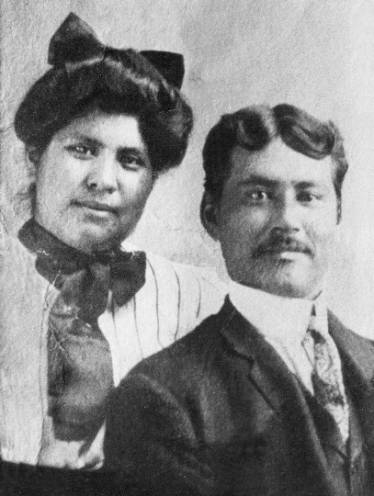
Maggie Lafonso received a “handsome jabot of blue silk and white lace.” Maggie, as Annie undoubtedly knew, was the granddaughter of John Bidwell and a Mechoopda woman. Annie relied on her as a liaison with the Indians on the rancheria and as a co-worker in Christian good works. I have told her story here.

Maggie Lafonso and her husband Joseph Mitchell

Annie sent John Bidwell’s sister Laurinda Jay a “white silk shawl” and her husband Wesley a “muffler, black & red.”

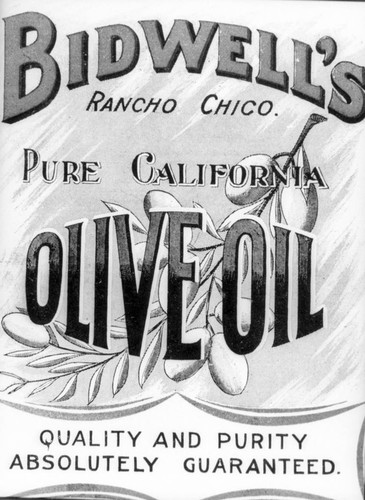
Several friends, such as cousin Dr. Ella Gatchell and attorney Franklin Lusk, were given olive oil, no doubt Bidwell’s Olive Oil produced on Rancho Chico. Her friends in San Francisco, the Hirshfelders, received a half-dozen bottles of olive oil and a whole keg of olives.

The most generous gift listed was to “Mrs. Hobart,” who was given “a corner lot in our new Sub.Div on Esplanade.” Emroy Bidwell Hobart was the daughter of John Bidwell’s half-brother Daniel. In 1904 she was a widow and had lost her house in a fire, so giving her a lot to build on was a timely gift.

Posted in Uncategorized | Leave a comment

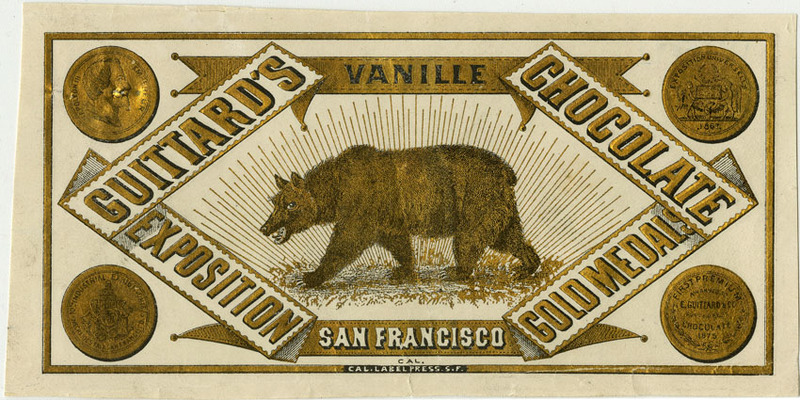
Guittard Chocolate

Courtesy of California State Archives

For over forty years I have been using Guittard chocolate to make bonbons, truffles, and hand-dipped chocolates at Christmas time. Guittard chocolate is the best! Superb quality!

I knew that the Guittard Chocolate Company was an old California manufacturer of fine chocolate, but I didn’t know how old and how historic. Today, while listening to a podcast from the King Arthur Baking Company, I learned something more about the history of my favorite chocolate, direct from Etienne Guittard’s great-great-great-great granddaughter.

Etienne Guittard founded his business in San Francisco in 1868. He was born in Tournus, France in 1838 and came to California to seek his fortune, probably sometime in the early 1860s. (I can’t find a date anywhere.) He brought with him chocolate from his uncle’s factory to trade for mining supplies, and for three years prospected for gold in the Sierras. He realized that the chocolate that he had brought with him was every bit as desirable as gold, and so returned to France to acquire the knowledge and equipment he needed to go into the chocolate-making business in San Francisco.

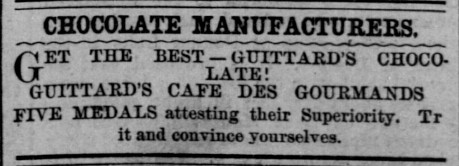
In addition to making and selling cocoa and chocolate, M. Guittard also dealt in coffee, tea, and spices, and even yeast and baking soda, all necessary items for a good kitchen.

Daily Alta California 14 October 1875

The business was a great success, and for 31 years Etienne Guittard led his growing company. He died at the age of 61 in 1899, passing the company on to his son Horace C. Guittard. Today Gary Guittard is CEO of the Guittard Chocolate Company, the oldest continuously family-owned chocolate company in the United States.

San Francisco Call 12 July 1899

You can buy chocolate chips made by Guittard in most grocery stores. They cost a little more than other brands, but they are worth it. Their chips and cocoa and couverture “buttons” can also be purchased through their website.

When I first started dipping chocolates many years ago, it was not possible for the home cook to buy directly from the Guittard company. They referred me to a candy company in Southern California (I lived in Bakersfield back then) and that manufacturer has kindly been filling my order for 10-pound bars of chocolate ever since. It’s quite something to see (and smell!) a 10-lb. bar of chocolate.

That’s how I do it.

I have been cutting back on production in the last few years, and now the price of chocolate has doubled or tripled, so I probably won’t do much this year. But the Guittard Chocolate Company carries on, still producing the best chocolate ever.

Posted in Uncategorized | 3 Comments

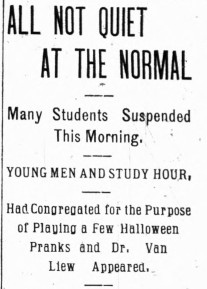
Chico Halloween

Chico Record 1 November 1910

News stories about Halloween from the late 19th and early 20th centuries in Chico don’t mention anything about trick-or-treating. Instead it is all parties and pranks. The parties were put on by families and churches, and featured fall decorations (lots of pumpkins and cornstalks), games like apple bobbing, and treats. Even Annie Bidwell got into the spirit and hosted a party for her teenage guest, Harriet Alexander, and Harriet’s young friends. I’ve written about that party before.

Annie’s party was fun, but decidedly decorous. The pranks were anything but.

Chico Weekly Enterprise 3 November 1899
Chico Weekly Enterprise 8 November 1901

The prank mentioned most often was the unhinging of gates and depositing them elsewhere. Other popular bits of casual vandalism were switching signs, depositing rubbish on porches, and stuffing chimneys with sacks, as reported in this story from 1907. The pranksters were mostly boys and young men, with girls sometimes joining in the fun.

Chico Weekly Enterprise 8 November 1907

The Normal students were the students at Chico State, then a teacher’s college, or “normal” school. John Bidwell was not amused. He wrote in his diary in 1899, “Last night being Halloween the Normal students cut up shamefully.” But sometimes they needed to blow off some steam, and that’s how they did it back in the day.

Posted in Uncategorized | Leave a comment

Murder at the Mansion — in print!

Back in March I wrote a series that I called “Murder at the Mansion,” the true story of the brutal murder of Billy Simpson, a Rancho Chico employee, for the gain of a few dollars. That story has now been published in the Butte County Historical Society‘s quarterly The Diggin’s. If you are a member of the BCHS (and if not, why not?) then you will be receiving it shortly in your mailbox.

The printed version contains a significant update to the story. By contacting California State Archives, I was able to obtain the San Quentin mug shots of the two perpetrators, who entered the prison in the year 1900. At the time, John Richards was 19 years old and Steve Thompson was 21. The census taken that year listed their occupations (before they went to prison) as teamster for John and laborer for Steve.
The photos are contained in the San Quentin State Prison Records (1880-1920), 46 volumes of photographs of inmates. The photos are not available online — I was able to acquire them by sending a request to reference@sos.ca.gov. They kindly copied the photos and mailed them to me. That’s what librarians do!

I am grateful to the state archives for preserving these mug shot books. What would historians and researchers do without archives!

Posted in Uncategorized | Leave a comment

Passengers Made to Pungle!

Whenever I am looking for a particular story in an old newspaper, I always come across something else, every bit as interesting. This one introduced me to a new word — pungle.

Northern Enterprise 10 October 1873

The story appeared in the Northern Enterprise (which later became the Chico Enterprise) on October 10, 1873. Here’s the story:

The overland mail stage, driven by Chas. McConnell, was attacked near Buckeye this morning by four masked men armed with shot guns and revolvers. They sprang from ambush, one man taking the lead horses by the bits, one the wheelers, another covered McConnell with a double-barrelled gun, while the fourth man politely invited the passengers out from the coach and demanded Wells, Fargo & Co.’s treasure box and what little loose coin they had on hand.

They all submitted quietly. Wells, Fargo & Co.’s box contained nineteen hundred and ninety-two dollars and thirty-five cent. About two thousand dollars was taken from passengers. One Chinaman had one thousand dollars around his waist, in a belt, which the robbers got. The other passengers had smaller sums, and are now here without a dollar. Sheriff Hull and a posse of men are on their track and it is hoped they will be speedily captured and brought to justice.

According to the Merriam-Webster Dictionary, “pungle” means “to make a payment or contribution (of money).

Pungle is from the Spanish word póngale, meaning “put it down,” which itself is from the verb poner, meaning “to put” or “to place,” and, more specifically, “to wager” or “to bet.” Merriam-Webster.com

“Pungle” is an authentic California Gold Rush term, first showing up in 1851 in the Daily Alta California, in the context of betting. (Thank you, OED).

Posted in Stagecoaches, Uncategorized | Leave a comment