A cold, clear morning in January 1848. Jim Marshall goes out early to check the tailrace of the sawmill that he is building for John Sutter on the American River. The night before he had turned the water from the river into the tailrace to deepen and widen it. Each morning he inspected it to see if it had become deep enough to adequately carry off the water from the waterwheel.
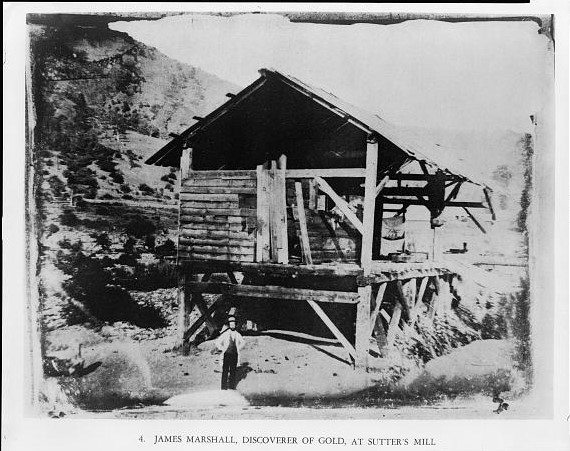
On January 24 Marshall noticed some bright and shiny flecks of metal in the water. Could it be gold? He was sure that it was, and tests proved him right. And so the stampede for riches that we call the California Gold Rush was on.
Was Jim Marshall the first to find gold in California? His name would go down in history as the discoverer of gold in California. But he wasn’t the first to find gold.
There was Jennie Wimmer, wife of Marshall’s assistant and cook for the men building Sutter’s Mill. She had seen gold mined in Georgia and had told the men that she was sure that the sparkles she saw on the river bottom were gold. But they ignored her.
Before Jennie there was Margaret Hecox, who came to California with her family in 1846. Coming down the Yuba River, she and another woman went to wash clothes.
We were busy at our washing down near the stream, when something brightly gleaming in the water attracted our attention. It looked like sands of gold. I gathered my apron full of the shining specks and carried it to Mr. Hecox, saying I thought it was gold. He laughed at me and seemed to consider it a good joke. This made me angry and I threw it away. I have always been sorry that I did not keep it and wait until I could have it tested. I am sure now that it was gold.
In 1844 Pablo Gutierrez and John Bidwell went searching for gold in the mountains. Pablo recognized the landscape, the soil, and the rivers as being like that of the gold-mining regions of Mexico. But before they could get the equipment they needed, the short-lived rebellion called the Micheltorena War intervened. The Californios rebelled against the new governor — Manuel Micheltorena — and his henchman sent up from Mexico City. Sutter sided with the Mexican government and took Bidwell, Pablo Gutierrez, and a troop of Indian soldiers along with him. Pablo was captured while carrying messages and hanged as a spy.
Before Pablo Gutierrez, there was Jean Baptiste Ruelle, a French-Canadian fur trapper who discovered gold in the San Fernando Hills in 1841. Bidwell later wrote:
The first gold discovery in California so far as I know, was made in 1841 by “Juan Baptiste Ruelle,” at a place in the mountains about 30 miles N.E. from the Mission of San Fernando. He was a Canadian trapper but had lived in New Mexico, and worked in Placer Mines. His discovery in California created no excitement whatever, owing to the fact no doubt of the very small yield.
No doubt there were others who found a bit of gold, but never cashed in on their find. Everybody knew about Ruelle’s mine, and everybody knew the earnings were hardly worth the work. The great rush for gold would have to wait until Jim Marshall picked those few shining flecks out of the tailrace on January 24, 1848.
It was a discovery that would utterly change the landscape, the people, and the culture of California.
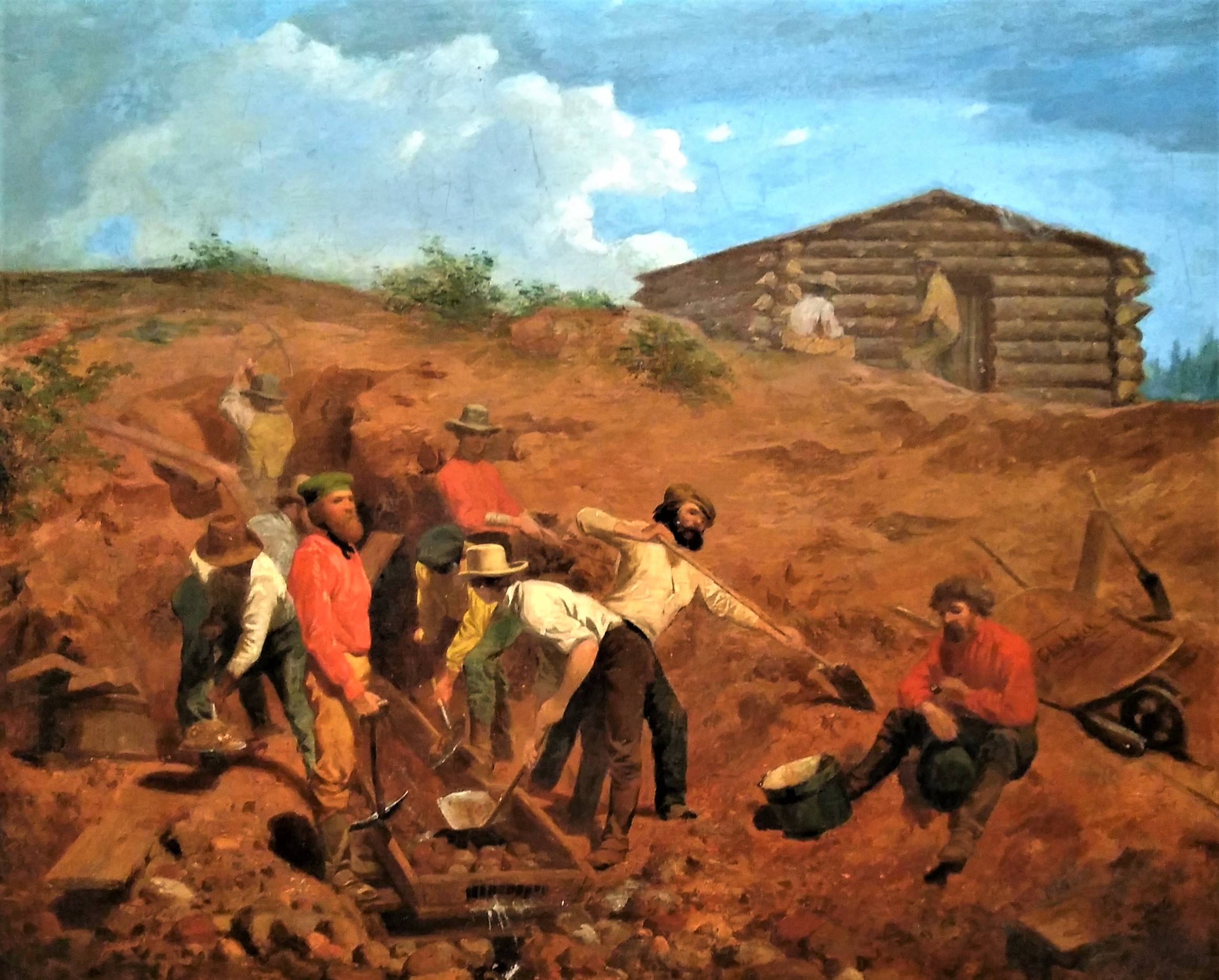


 goldfields