
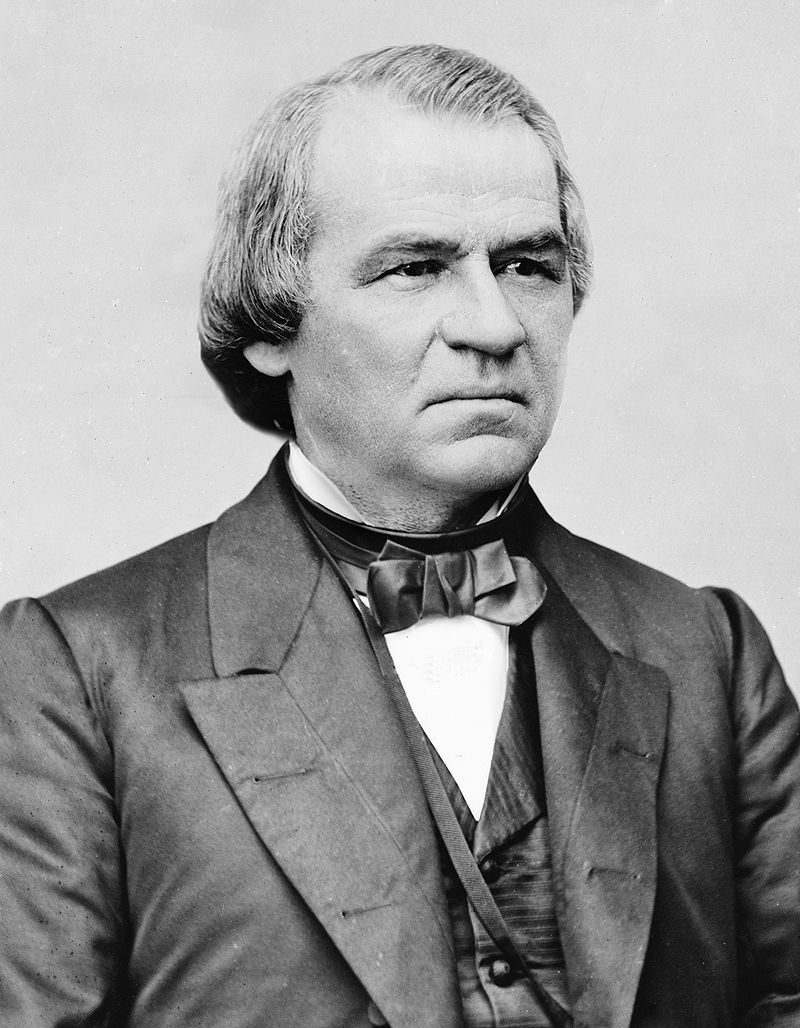
In March 1868 John Bidwell was in Washington D.C., awaiting his wedding day. Back home in California, the brother of his bride-to-be, John R. Kennedy, had been left in charge of Rancho Chico. Concerned about business on the ranch, Bidwell wrote frequently to Annie’s brother.
In Washington, the news was all about the impeachment of President Andrew Johnson, the first impeachment of a U.S. president to ever take place. John Bidwell had served as a congressman in the previous term of 1865-67, but he had not run for re-election and was happy to be out of politics. He had his opinions though. He wrote:
If Andrew Johnson had as much ability and patriotism as he has of stubbornness, he would be the greatest man living. As it is he is blindly rushing along the giddy verge of ruin, and will sacrifice anybody or anything in order to crush the party who elected him to office. He cannot succeed. But I cannot add more in the way of politics, except to say, that men of all classes are glad that the President cannot carry Gen. Grant from the path of duty; and consequently there is no danger of war should the President in his stubborn blindness to carry his points, attempt to use the military power. Grant now in this important crisis stands between the President and people.
The ambition of men has ever been the bane of popular liberty – ambition triumphant results in monarchy – oppression. Is not human nature the same in all ages? How fortunate it is that under our form of government there are so many checks to the Executive power. How favored are we as a people that the President cannot offer Grant any higher position. Grant is as high as he can be under any President – the only higher step he can take is to be President himself. If Andy Johnson could make Grant obey him and not the law, he would carry his points at all hazards – who knows what he might do? But I must close. I never know when to stop when I get on politics.
Johnson had fired Edwin Stanton from his cabinet position as Secretary of War, contrary to Congress’s Tenure of Office Act, which made it unlawful for a president to dismiss a cabinet secretary without the consent of the Senate that had confirmed him. Johnson made General Ulysses S. Grant, who was serving as commanding general of the Army, his interim Secretary of War, but when the Senate reinstated Stanton, Grant resigned. Johnson was furious with Grant, but could do nothing to shake him. The Senate was outraged at Johnson’s high-handed moves, and sought his impeachment.
There were eleven articles of impeachment, but most of them revolved around Johnson’s violation of the Tenure of Office Act. Johnson was acquitted by one vote and he remained in office, although his influence was diminished. The Tenure of Office Act was repealed 20 years later.
Bidwell was a firm believer in the Constitution of the United States of America. “How fortunate it is that under our form of government there are so many checks to the Executive power,” he wrote, and who would disagree? But it makes you wonder if anything has changed for the better in 156 years.





 goldfields