Hidden away in a back gallery at the Haggin Museum in Stockton are three genre paintings of everyday life in early California. The prominent galleries at the front of the Haggin Museum hold an impressive collection of European (mostly French) and American art collected by the wealthy Haggin and McKee families. Some familiar names among the artists are Rosa Bonheur, Pierre-Auguste Renoir, and Albert Bierstadt. But it is the California paintings by lesser known names that I want to highlight here.
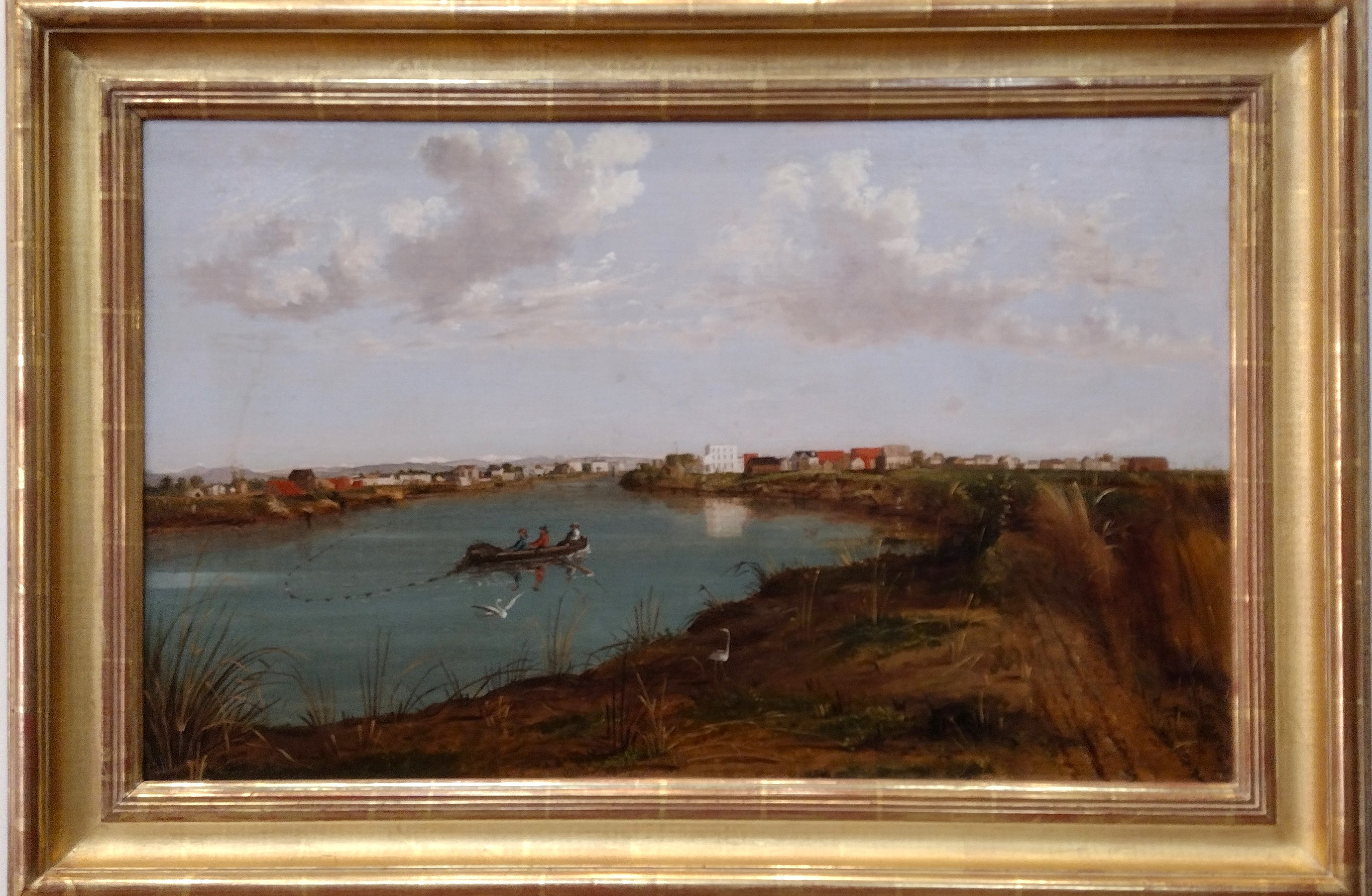
The label for the painting of Stockton reads:
Completed in 1858 by Albertus Del Orient Browere for a sketch he made of the town in 1854, this painting depicts Stockton as viewed from the south bank of the Channel looking east. Charles Weber’s home, the St. Charles Hotel, and the City Brewery are all identifiable in this view of Gold Rush Stockton.
Three fishermen in a rowboat and two egrets are in the foreground, while small buildings line the channel behind them. Stockton was the jumping-off point for the southern mines of the Mother Lode. I am guessing that the large white building is the hotel. And isn’t Albertus Del Orient Browere an impressive name!
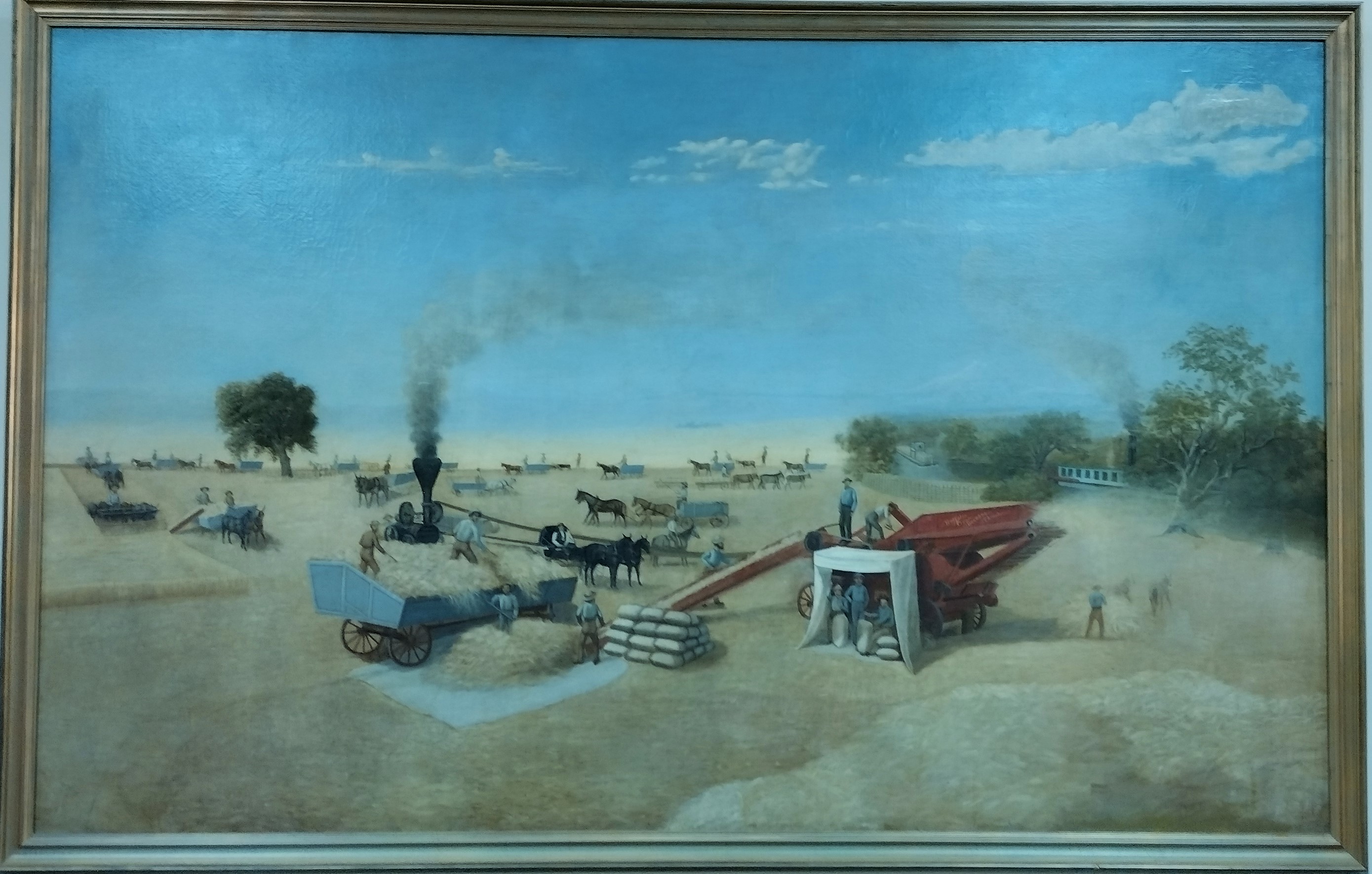
This painting (1875-1876) depicts a scene on the ranch of Dr. Hugh J. Glenn, for whom Glenn County is named. Dr. Glenn’s holding were huge, 55,000 acres. He had 6000 acres dedicated to growing wheat, earning him the nickname of the “Wheat King of California.” He was also prominent in politics. In the painting you can see the Sacramento River and two steamboats on the right, and faintly in the distance, Mt. Shasta. What looks like a locomotive is a steam engine for driving the thresher. I like the little tent, giving just three men a bit of shade in the hot sunshine. The man in the carriage may be Dr. Glenn himself.
The third painting, by Eugene Camerer, is my favorite because so much is going on in it.

The three men relaxing in the foreground are watching two other men trying to lift a wheel caught in a stream, while the driver and his assistant urge the six mules forward. The over-loaded wagon is burdened with shovels, a keg of something undoubtedly alcoholic, and a variety of heavy boxes. It reminds me of the adventures of Ed McIlhaney, who had a mule-packing outfit (but no wagon) taking good to the mines. On one trip his first mule was loaded with “twenty gallons of whisky in two ten-gallon kegs each.” The other five mules were loaded with “250 pounds each of sugar, coffee, bacon, rice, and potatoes” and a few other items. His most memorable trip involved packing a billiard table to Rich Bar.
So there you have it, from the Haggin Museum, a little look into life in 19th century California.


 goldfields