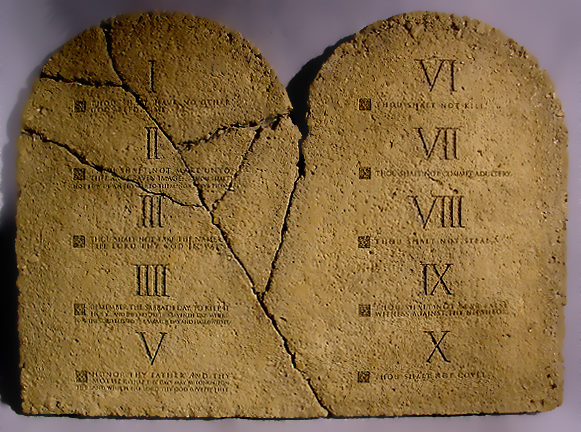
I was listening to a podcast from This American Life (April 20) about the Ten Commandments in today’s world. The host, Ira Glass, began the story with examples of other versions of the ten commandments that people have come up with, such as The Miner’s Ten Commandments. Someday it would be fun to write about those.
He mentioned the ten commandments for history writers, and as an amateur historian, I thought I should find out what those are. More than one version is out there — the first one I found is by William B. Hesseltine (1902-1963), a noted American historian who taught at the University of Wisconsin. In my online search, I didn’t find his original ten, but I found a “revised and enlarged” version.
1. Thou shalt not use the passive voice.
2. Thou shalt not use the present voice.
3. Thou shalt not quote anything thou canst say better thyself. Thou shalt not quote to carry thy story. Thou shalt, in short, quote only to season thy story.
4. Thou shalt not pass judgments on mankind in general nor shalt thou pardon anyone for anything.
5. Thou shalt cite material to the standard source.
6. Thou shalt combine footnotes whenever possible.
7. Thou shalt strike thy reader hard with thy first sentence.
8. Thou shalt not use slang–nor split thy infinitives.
9. Thou shalt not use the first or second personal pronoun either explicitly or implicitly.
10. Thou shalt not use the rhetorical question to avoid an intelligent transition.
Someone added these next six commandments, which are helpful, but wordy and too specific. I like the first ten for their concision. Here are the rest of them anyway.
11. Thou shalt set down things as they happen; thou shalt have no references later in time than the subject thou art dealing with.
12. Thou shalt be neither a no-er nor a not-er–i.e., thou shalt avoid negations whenever possible.
13. Thou shalt never use THIS for THE, nor THE for A.
14. Thou shalt never spell MEDIEVAL or RENAISSANCE incorrectly.
15. Thou shalt always capitalize Middle Ages, Renaissance, and Crusades when such terms refer to a specific historical period.
16. Thou shalt never capitalize medieval or renaissance when they are used as adjectives; neither shalt thou capitalize the names of centuries.
Which of these commandments am I guilty of breaking? #1 — It’s easy to fall into the passive voice as a way of sidestepping responsibility. #3 — I am editing a book with many violations of this commandment (i.e.; far too many quotations) so my job is to work them into the narrative. #10 — See how I started this paragraph with a rhetorical question? Probably shouldn’t do that.
I like #7. I am not by nature a hard-hitting writer so I’ll keep this in mind. I went looking through some history books on my shelf for a great first sentence. Here is Jon Meacham in And There Was Light: Abraham Lincoln and the American Struggle: “The storm had come from the south.” That’s from the prologue (p. xvii). Chapter One begins: “The roads were rough, the conversation unusual.” (p. 5) Those are sentences, short and punchy, that pull the reader in.
Next time: The Ten Commandments of historian Hugh Trevor-Roper


 goldfields