Whenever I am looking for a particular story in an old newspaper, I always come across something else, every bit as interesting. This one introduced me to a new word — pungle.
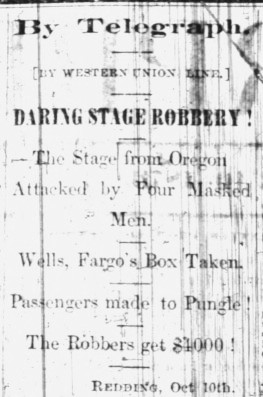
The story appeared in the Northern Enterprise (which later became the Chico Enterprise) on October 10, 1873. Here’s the story:
The overland mail stage, driven by Chas. McConnell, was attacked near Buckeye this morning by four masked men armed with shot guns and revolvers. They sprang from ambush, one man taking the lead horses by the bits, one the wheelers, another covered McConnell with a double-barrelled gun, while the fourth man politely invited the passengers out from the coach and demanded Wells, Fargo & Co.’s treasure box and what little loose coin they had on hand.
They all submitted quietly. Wells, Fargo & Co.’s box contained nineteen hundred and ninety-two dollars and thirty-five cent. About two thousand dollars was taken from passengers. One Chinaman had one thousand dollars around his waist, in a belt, which the robbers got. The other passengers had smaller sums, and are now here without a dollar. Sheriff Hull and a posse of men are on their track and it is hoped they will be speedily captured and brought to justice.
According to the Merriam-Webster Dictionary, “pungle” means “to make a payment or contribution (of money).
Pungle is from the Spanish word póngale, meaning “put it down,” which itself is from the verb poner, meaning “to put” or “to place,” and, more specifically, “to wager” or “to bet.” Merriam-Webster.com
“Pungle” is an authentic California Gold Rush term, first showing up in 1851 in the Daily Alta California, in the context of betting. (Thank you, OED).


 goldfields