Annie’s Diamond Ring

At the end of March 1867 John Bidwell’s term in Congress was over and he was ready to return to California. He was anxious to get back to Rancho Chico to look after his business interests, but his love for Annie Kennedy made him reluctant to leave Washington, D.C. He still hoped to win her heart and her hand in marriage.

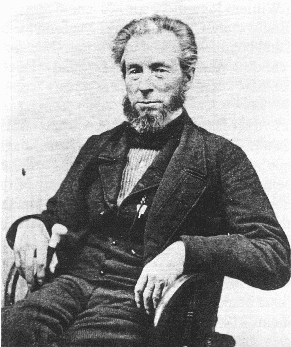
John Bidwell in 1867, at the time he was courting Annie.

John Bidwell in 1867, at the time he was courting Annie.

On March 28, 1867, he wrote Annie from New York, from whence he was about to sail for California. In his lengthy letter to her he writes:

You remember the California diamond which I showed you? Well, I have had it cut and set into a ring. It is beautiful and proves to be a diamond of the first water. It is not off color as I feared it would be, but perfectly clear. It is worth $125, so the jeweler told me today.

Diamonds had been discovered at Cherokee in Butte County in May of 1864, and possibly even earlier. Presumably one of these diamonds was given to Bidwell before he left for Washington, or sent to him while he was there. It was certainly big news that diamonds had been found in California. but not enough have ever been found to make mining diamonds profitable, so I am told.You can read a bit more about diamonds in California here.

In his letter to Annie, Bidwell coyly hovers around the subject of what to do with the ring:

I wish I knew what to do with it. Can you make any suggestion? The diamond was a present to me. I can neither sell nor give it away, can I? What is custom or etiquette about such things? I would give it away, if the one to whom I would be willing to give it, would or could with propriety accept it.

John Bidwell was not so ignorant of etiquette that he didn’t know what kind of gifts were proper for a lady to receive from a gentleman.  A lady did not accept jewelry from a man who was not her father, husband, or fiancé. To do so was an indication that she considered herself in a special relationship with the gentleman. So John’s questions are a test of Annie’s affections. If she accepted the ring, it would be a sign that her heart was softening toward him.

But would you not like to see the ring? Could you not with propriety wear it? (I ask no pledge or promise, nor would it be the token of any pledge or promise.) Could you not wear it, until some other ring [he means from someone else, if he should be so unlucky] shall consummate a pledge, and then return it to me?

For Annie’s reply, look for the next blog entry.
Posted in Annie Kennedy Bidwell, diamonds | Leave a comment

The Bear Flag Proclamation

Said to be a photo of William B. Ide, although nobody is positive about that.

Said to be a photo of William B. Ide, although not positive.

William B. Ide arrived at Sutter’s Fort in October 1845 as part of the Grigsby-Ide wagon train. He took his family north, where built a cabin for his family on the ranch of Robert Thomes. It was men from the Grigsby-Ide Party, plus some other American trappers and hunters, who made up the group called the “Osos,” or Bears, and Ide became the commander of the group.

Rumors were circulating among the Americans that the Mexican-Californians were planning to drive the unwelcome interlopers out. Although the Californios may have been wary of the Americans, they were in no position to make them leave, since they had few soldiers or weapons to fight with. But the Americans were anxious to secure a claim to the lands they had settled, and decided to take matters into their own hands.

On Sunday morning, June 14, 1846, the Bears took over the Sonoma garrison without firing a shot, and told General Mariano Guadalupe Vallejo that they were in charge now. Vallejo offered no resistance, and they sent him under guard to Sutter’s Fort. They then began to consider their next move.

Ide was all for carrying their objective forward boldly and sat down to write a proclamation setting forth their grievances and aims. His proclamation begins:

TO ALL PERSONS, INHABITANTS OF THE COUNTY OF SONOMA AND COUNTRY AROUND REQUESTING THEM TO REMAIN AT PEACE; TO PERSUE THEIR RIGHTFUL OCCUPATIONS,– WITHOUT FEAR OF MOLESTATION.

The Commander-in-chief at Sonoma gives his inviolable pledge to all persons in California, not found bearing arms, or instigating others to take up arms against him, that they shall not be disturbed in their persons, property, religion, or social relations to each other, by men under his command. He hereby most solemnly declares the object of his movement to be,–first, to defend our women and children, and his brave companions in arms, who were first invited to this country by a promise of lands on which to settle themselves and families; who were promised a Republican government; who, when having arrived in California, were denied even the privilege of buying or renting lands of their friends; who, instead of being allowed a participation in, or of being protected by a Republican government, were oppressed by a military despotism; . . . .

and so on. Ide was evidently mislead, back in Missouri, about what was on offer in California by the Mexican government. The full text of his proclamation, as set down in his biography by Simeon Ide, can be read here. There were other writings by Ide, but this is the version that has survived.

According to John Bidwell, William B. Ide was busy writing bombastic proclamations nearly every day and posting them on the flagstaff. The whole thing looked unnecessary to him.

Inasmuch as Fremont did not pretend to be acting in the name of the United States, and as we Americans did not know of any danger here that threatened us, Mr. Ide conceived the idea that it would be a good time to establish an independent republic here, and that was about the tenor of his numerous proclamations.

Bidwell arrived at Sonoma from Sutter’s Fort on July 3rd, two weeks after the takeover. The next day Fremont arrived with his company of exploration. Fremont, in support of the revolution, asked Ide, Bidwell, and P.B. Reading to act as a committee “to draw up a plan of organization.” They couldn’t agree on their report.

Mr. Ide wished to report all his proclamations as our report. P. B. Reading wanted to report something else. I disagreed with both. The result was, each agreed to make a separate report and submit them to Lieutenant Gillespie, which we did. He chose my report,–said it was just the thing. My report was simply this:

The undersigned hereby agree to organize for the purpose of gaining and maintaining the independence of California.

Bidwell’s report was adopted and all the men present, about 150, signed it. They organized into companies and off they marched to Sacramento, and then Monterey, where they learned that the United States was already at war with Mexico.


Posted in bear flag, William B. Ide | Leave a comment

Bidwell and the Bear Flaggers

BearFlag2


The flag was not used at the time, or at any time, to march under, or for any other purpose,–had no political significance whatever. It was not recognized as having been adopted or used for any political purpose or adopted by any authority whatever. I doubt whether Fremont ever saw it. There never was a “bear-flag party,”–known as such party at the time.

(John Bidwell. “The Bear Flag: More Light on an Historic Incident.” Overland Monthly, May 1895. This article can be viewed at the University of Michigan archive, http://quod.lib.umich.edu/m/moajrnl/)

John Bidwell had a decidedly low opinion of the “Bears.” As far as he was concerned, they were a shiftless bunch of hunters and trappers, incited by Fremont into starting a war for which their was no justification. Bidwell was convinced that California would come under American rule by peaceful means eventually, and that there was no reason or authority for Fremont to start a war. As he told Rockwell Hunt, “If there every was an unjust war in this world, it was that war. It was an unjustifiable war.”

As for the flag:

The bear flag was left at Sonoma. Neither did we march under the bear flag at any time, nor under the American flag, or any flag, till we arrived at Monterey and found the American flag flying there, and organized the California Battalion of Mounted Rifleman, and Fremont was made lieutenant-colonel in command by Commodore Stockton, who brought the first authentic news of the war with Mexico. And there we raised, and for the first time, the American flag.

The bear flag was eventually donated to the Society of California Pioneers, who displayed in their Pioneer Hall. It was destroyed in the fire that followed the San Francisco earthquake of April 1906. A replica hangs in the Sonoma Barracks, at Sonoma State Historic Park.

For more about Bidwell and the Bear Flag, see also https://nancyleek.wordpress.com/2014/12/12/the-bear-flag-story/ 

Posted in bear flag, Fremont | Leave a comment

Pres Longley, the Bard of Butte

In 2013 John Rudderow and I published a collection of poems by Alexander Preston Longley (1834-1912), an old-time miner and a resident of Butte Creek Canyon. The Miner Poet: Poems of Pres Longley contains 100 of his poems and a biographical introduction.

Pres’s poems are a window into the interests and concerns of the men who lived in “the days of old, the days of gold, the days of ’49.” Here is one of his early poems, published in The Golden Era on February 8, 1857. It was meant to be sung, but I don’t know what tune goes with it. The poem was signed with his pen name, ALP, a rearrangement of his initials and an indication of his mountain home.

THE MINER’S WISH

O, give me a cot in Dorado’s fair clime,

Where the sound of the pick and the shovel do chime,

Where the miners go forth to collect the bright ore;

With this, and dear L. N., I’d wish for no more.

Chorus—

O’ I’m loving her so wherever I go,

It makes my heart beat, and my blood for to flow;

But the d’il’s in her eye, and I cannot tell why

She loves every other much better than I.

O, give me a home in these mountains so grand,

Where the tall pines and cedars in majesty stand,

And the breeze sighing through them with musical roar;

With L. N. to share it, I’d wish for no more.

Chorus—I’m loving &c.

O give me a claim on a murmuring stream,

Where the golden sands gleam in morning’s first beam;

I’d take out the dust till my pockets ran o’er,

Live happy with L. N., and wish for no more.

Chorus—I’m loving &c.

By field and by flood I’ve wandered afar,

In peril, in danger, in peace and in war;

But if L. N. would love me, I’d ramble no more,

‘Till we both passed away to a far brighter shore.

Chorus—I’m loving &c.


Posted in Pres Longley | Leave a comment

New Year’s Day with John and Annie

The Bidwells typically spent New Year’s Day making and receiving visits, as was the custom in their day. Very often they were in San Francisco on January 1. Here is an entry from Bidwell’s diary for 1879:

Wednesday, January l. San Francisco
Weather – Bright mild day. Etc.etc. -Purchased gloves $l.75 -Called on:
John Swetts to see John Muir – he was at San Jose – at Gen. McDowell’s &
saw Miss Crozier etc. Dr. Ord etc = At Dr. Woodhull’s & saw cousin Maggie,
Maj. Egan, Mr. Crozier – etc. = at Mr. Parrott’s & saw Mr. & Mrs. P. and
daughters, & Gen McDowell, & Mr. Pease, etc. = at Gibbs’ & saw Mrs. G. &
Mrs. Kane & Mr. Whittel = At Oakland and saw Misses Thomes, H.Bay & wife,
& Nounse &wife =
Visit – Spent evening at Judge Morrison’s & saw Moiyner [?] & Eyre boys.

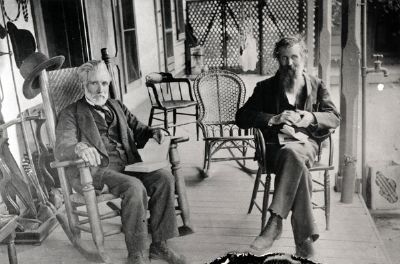
John Swett and John Muir 1912

John Swett and John Muir 1912

I can’t identify all these people, but some are still well known. Everyone will recognize the name of John Muir. John Swett was a close friend of Muir’s and from 1863-67 served as the California State Superintendent of Public Instruction. Teachers might like to know that he founded the California Teachers Association.

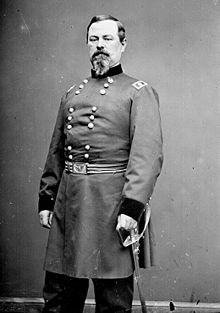
General Irvin McDowell during the American Civil War

General Irvin McDowell during the American Civil War

General Irvin McDowell is unfortunately best known for his defeat at the First Battle of Bull Run. After the Civil War he served as commander of the Division of the Pacific, and upon retirement he took up landscape design and became Park Commissioner for the city of San Francisco.

If you enjoy driving around the Presidio, as we did last Saturday, and admiring the views of the Bay and the Golden Gate, you can thank General McDowell for laying out the roads with an eye to the landscape. He died in 1885 and is buried in the National Cemetery in the Presidio.

Lois MacDonald, in her book on Annie Bidwell, is a great help in identifying some of the other names in this diary entry. “Cousin Maggie” was Annie’s cousin and childhood friend, Maggie Ellicott. She was married to a Dr. Woodhull who was attached to the U.S. Army at the Presidio.

Mr. and Mrs. George W. Gibbs were well-to-do residents of Washington, D.C. who had relocated to the West Coast. Mrs. Kane was Mrs. Gibbs’ mother. Augusta Gibbs was a frequent visitor at Bidwell Mansion, and she invited the Bidwells to stay at their home in San Francisco. According to Lois MacDonald, “Annie was rather annoyed with John in that he preferred the independence of staying at a hotel when on business in San Francisco, even (it seemed to her) begrudging the time to be social and call on the Gibbs when he was in the city.”

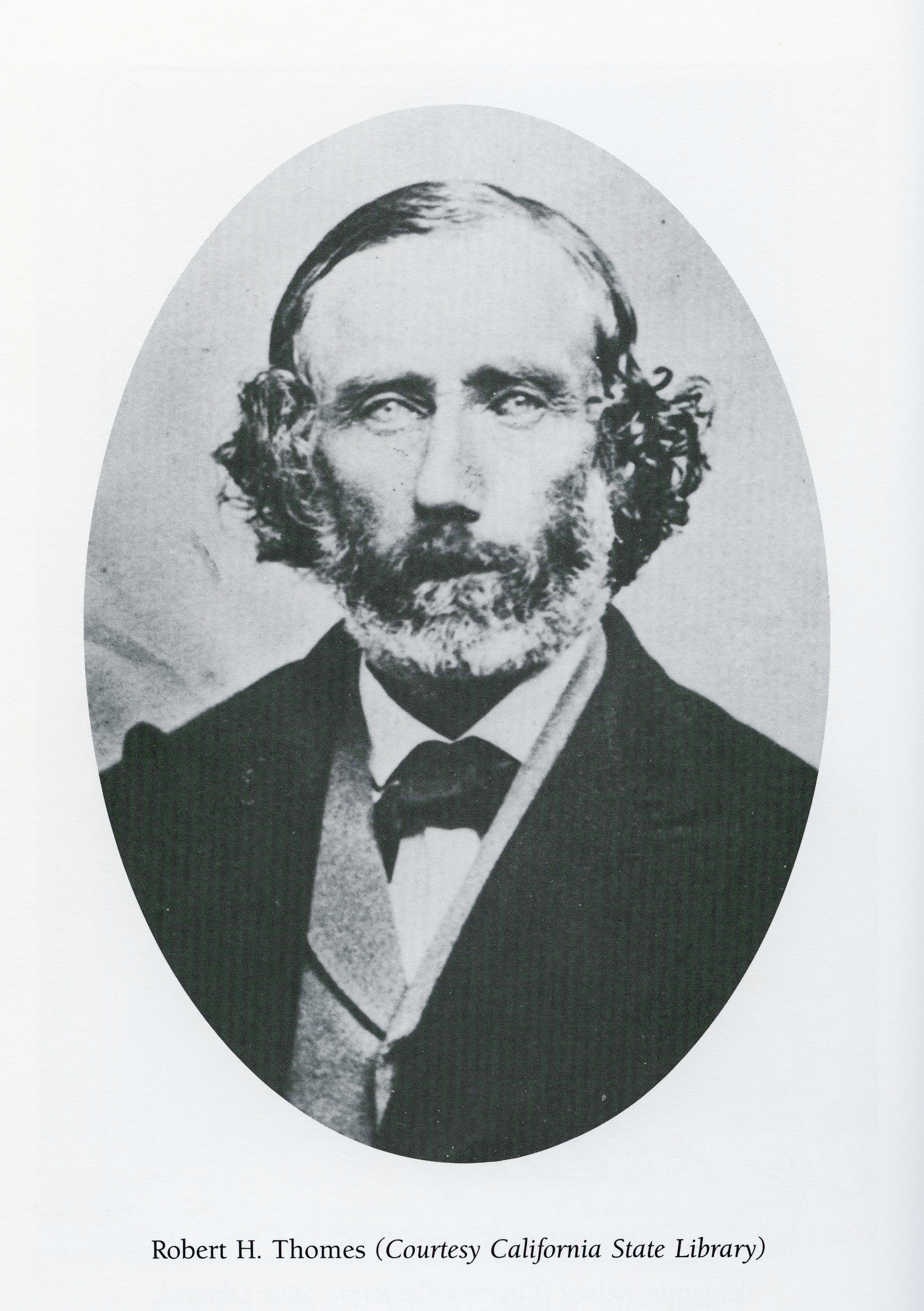
robert-h-thomes-1And finally, the Misses Thomes were the daughters (there were four) of John Bidwell’s old companion on the trail, Robert H. Thomes. He was a wagon-maker and carpenter by trade who went into partnership in Monterey with Albert Toomes, who had come to California in 1841 by the southern route.

Thomes acquired Rancho Los Saucos in present-day Tehama County in 1846. After his death in 1878 John Bidwell was heavily involved in settling Thomes’ estate. There is a portrait of Robert H. hanging in the hallway of the Kelly-Griggs House in Red Bluff.


Posted in John Muir, Robert Thomes | Leave a comment

Dr. James O’Brien of Butte County

So on Saturday my husband and I took our two granddaughters to San Francisco to visit the Museum of the Society of California Pioneers (and the Walt Disney Family Museum) at the Presidio. What a beautiful day! Gorgeous view of the Bay!

The museum display is small, but has a choice selection of artifacts from the Gold Rush era. Some were common items that miners and pioneers would have used, like revolvers, children’s toys, money belts, a tin cup and a battered hat. Another group was made up of items from the high life in San Francisco—gold and ivory-topped canes, an invitation engraved on silver, a gold toothpick.

One item that caught my eye was labeled “Amputation Kit of Dr. James O’Brien, Butte Co. physician, 1849. Gift of Dr. Rafael G. Dufficy.” I couldn’t take a photo of the kit, but here is a similar one. It contained several knives, a tourniquet with a brass turning device, and a large bone saw about the size and shape of a meat cleaver. (Which indeed is what it was.)

Not the kit that I saw, but similar.

Not the kit that I saw, but similar.

Who was Dr. O’Brien? The only record I have found is in Wells & Chambers History of Butte County, which states that he was the first superintendent of the Butte County Hospital, appointed on August 12, 1858. I wonder when he first came to Butte County?

Posted in James O'Brien | 10 Comments

Christmas with Annie Bidwell

In 1903 Annie Bidwell described the Christmas celebration at the Indian Rancheria on December 24th, and a party she hosted at Bidwell Mansion for friends and family on the 29th. Here are the entries from her diary:

Thurs., December 24

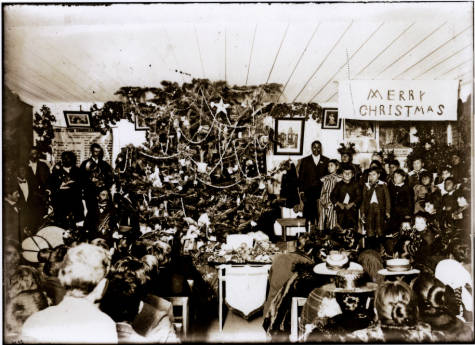
Indian Christmas festivities this evg.  Attended Indian Christmas celebration their Chapel this evening. Took Ida Bohlender & Eva with me. Indians conducted all the services except short address by myself at their request. Santa Wilson, Pablo Silvers, Wm. Conway, Jas. Nichols, Elmer Lafonso and Maggie sang exquisitely as a choir, such hymns! I was overcome completely by the grand surprise. Maggie sang solo – Jerusalem. Eva Kennedy accompanied her with piano. Elmer Lafonso sang solo -“Flee as a bird to Your Mountain,” Eva accompanying on piano. Elmer sang delightfully. Santa Wilson read Matthew’s and Luke’s account of birth of our Lord – & read it well. Lily recited, & Martha, Bernie. Indians distributed presents from the tree. Susunny (Johnny Stack) gave me beautiful little basket which held candy, oranges & cakes for Christmas dinner.

Christmas_celebration_in_old_Indian_church(1)

Christmas celebration in old Indian Church–no year.

Tues., December 29th:

Events: Mansion decorated for Christmas Presbyterian Church Social. Prof. Merriam, Mr. Gibson committee on tree. Mr. G. & 2 daughters decorated tree beautifully. Fred made shrubbery garden of Hall and staircase – pretty & unique. It was said that 300 persons were present this evening! Such a happy party!

Games in rooms upstairs, in upper hall, & dining. Library & parlor & lower hall filled with older persons. Crowd of gentlemen who filled Library, evidently happy. Abundance of ice-cream & cake for all. Fine singing – sacred music by young people. Solo by Ruby Hart & others. Guest dispersed by ll O’C with exclamations of delight over their happy Evening.

Note the plentiful cake and ice cream—yum! And games in many of the rooms. I wish I knew what games they played. Maybe Charades or Dumb Crambo, or Twenty Questions, all popular parlor games of the era. In the entry about the Indian celebration she is evidently very proud of the talents displayed by her Indian friends.


Posted in Uncategorized | Leave a comment

If You Go to San Francisco . . . .

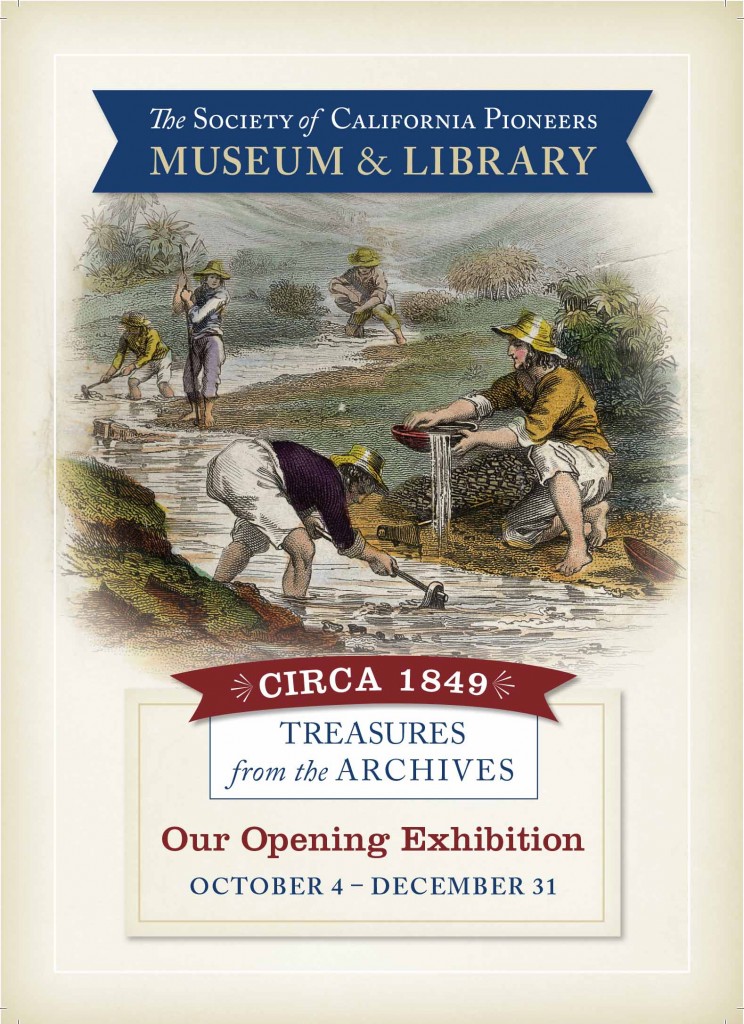
Be sure to go to Pioneer Hall at the Presidio. The Society of California Pioneers has a new museum location, and their opening exhibit is Circa 1849: Treasures from the ArchivesThe exhibit is only on until December 31, so make your plans to go soon.SoCP_NewExhibition_POSTCARD2-744x1024


These are rarely-seen treasures–photographs, paintings, manuscripts and artifacts from the Gold Rush. Pick axes and shovels, pistols and rifles that the miners used, and evening clothes, even a gold toothpick, for the ones who struck it rich.  Read the San Francisco Chronicle review here.

The new museum location at the Presidio will have a changing display of materials from their collections. In January they will be showing old daguerreotypes and ambrotypes. If California history fascinates you, then put the Society of California Pioneers on your list of places to visit. And if your ancestor came to California before 1850, if you are the descendant of a true 49er, then you can join the Society. But for a Johnny-come-lately like me, I’ll just have to be a visitor.


Posted in Uncategorized | Leave a comment

The Bear Flag Story

BearFlag2 Most of us know the story of how the California flag came to be. But do you know that it might have had quite a different bear on it?

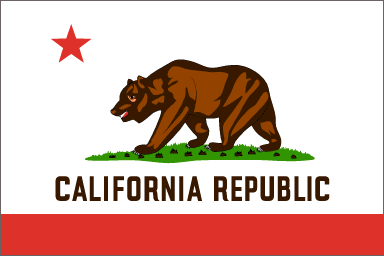
In June 1846 a group of Americans banded together to take over the Sonoma garrison and arrest General M. G. Vallejo. Needing a flag as a symbol of their revolution, they quickly painted a bear on a length of fabric, added a star, a red border on the bottom, and the words “California Republic,” and sent it up the flagpole on the plaza.

grizzly

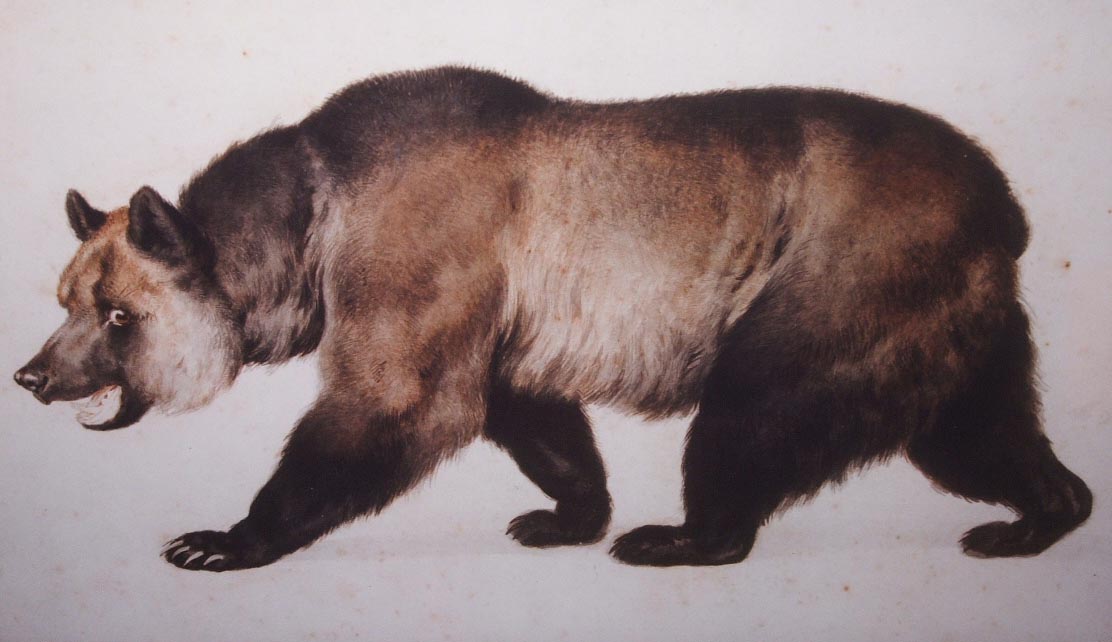
Painting of a grizzly bear by Charles Nahl.

This flag became the basis of the official California flag as we know it today. California_state_flagThe bear on the flag as we see it now is based on a painting of a grizzly by Charles Nahl. But it might have been different.

John Bidwell told his story of early days in California many times. One such account appeared in the Overland Monthly magazine in May 1895.

John Bidwell was at Sutter’s Fort when “los Osos” took over Sonoma. A few days after the incident he left Sutter’s Fort to join Fremont in Sonoma.

On my arrival in Sonoma there was a flag on the old Mexican flagstaff. I paid little attention to it, nor did anyone else, as far as I know. It had a design of some kind on it, which the Mexicans called cochino (pig). The boys, however, told me at the time how it happened to be there. It was the result of mere sport or pastime of the men. . . . One of the men had suggested that they put up a flag on the old Mexican flagstaff. Another suggested that they paint something on it. . . . One said, “Paint a grizzly bear.” Another said, “Paint him standing up with his paw raised, about to crush a coyote.” But no one was artist enough for that task.

grizzly-bear-standingSo we might have had a grizzly rampant on the flag, if any of the men had been an artist. But a bear on all fours was the best that William Todd (a nephew of Mary Todd Lincoln) could manage.

A piece of common cotton cloth was found, perhaps a couple of yards long. “Bill” Todd found a part of a keg of old reddish paint and tried to paint a bear, and this was the now famous “bear flag.”

And that is how we got a walking, not a standing, bear on the California flag.

Posted in bear flag | 1 Comment

Time Capsule Contents Revealed

DSCN3291[1] DSCN3296[1]The “time capsule” found in the base of the pioneer monument in Chico was opened today at Bidwell Mansion State Historic Park.

The box is made of copper and was sealed with lead solder. Inside was a paper scroll, yellowed and fragile, and two rolls of straw padding. I don’t think there is anything under the scroll and padding, but it is hard to tell. There might be some coins or other small artifacts in there.

The box is now on display in the Visitor’s Center, so if you would like to take a look, you can go anytime BMSHP is open, Friday-Monday, 11-5.

The contents were not taken out of the box at this time because of the fragile nature of the scroll. A curator from State Parks will be coming in December to deal with it.

Was this really a time capsule? Was it ever intended to be opened? Time capsules usually have a notice somewhere that says, “Open in 50 years” or some other time period. But nothing like that was found. Perhaps those who erected the monument intended it to remain in the base, as part of the dedication. Cornerstones of public buildings often have something similar concealed in a cavity.

Either way, it will be interesting to find out what is on the scroll. Stay tuned!


Posted in Uncategorized | 2 Comments