Gray on Grasshoppers

George Moses Gray continues his recollections about California grasshoppers:

When I told the General about it [i.e., Indians harvesting grasshoppers] he said, “I have eaten a great many good grasshopper pancakes,” and told me the following story.

He said, “When I lived in the Adobe house two men from the East were staying with me overnight. They had pancakes for breakfast. As they finished easting Nopaney, his cook and housekeeper, came in and said, ‘General, no more pancakes. Grasshopper meal all gone.’ One of the men said, “‘What! We have not been eating grasshoppers, have we?’ The General said, ‘You certainly have.’ They both said, ‘We don’t believe it.'”

The General said, “Nopaney, bring in the can you had the meal in.” She did and the General knocked on the bottom of the can and poured the contents on to a plate and passed it around, and when they saw the little pieces of legs, they believed him and said they were good anyway.

Nopaney wouldn’t have called Bidwell “General” at that time. I don’t know what she would have called  him, but he was a Major in the California Battalion back when he lived in the adobe house.  But by the time Gray knew Bidwell, everyone called him General, so that’s the term Gray used.
Posted in grasshoppers | Leave a comment

Hoppers on the Move!

Here in Northern California the grasshoppers are plentiful this year, and they are hungry and looking for a good meal.  According to a news report on KNVN:

The farm advisor from the UC Cooperative Extension says the young grasshoppers are making their way down from the foothills in search of anything green they can eat.  “They’ll strip vegetable crops and vegetable gardens,” Joseph Connell, the UC Cooperative Extension Farm Advisor said.

Connell says the larger than average population this year is due mostly to the wet spring in 2011.  “Last year was a nice wet year, lots of feed. We had a chance for the population to build up. They lay eggs in the fall, those hatch in the spring so we got a lot more hoppers this year,” Connell said.

I haven’t noticed a lot of grasshoppers on my place, but I have chickens, and that may be keeping the population down.

The California Indians would not have seen a big grasshopper year as a bane, but a boon.

George M. Gray, Bidwell’s ranch manager, reminisced about the Indians and grasshoppers in 1938 for the Sandy Gulch News.

The year 1882 was a grasshopper year. They hatched up in the foothills and came down in to the vineyards by the millions and started in eating the leaves, stripping the vines clean as they traveled west. . . .

One day I saw the squaws and two old Indians hurrying up to the vineyard as fast as they could go. I watched to see what they were going to do. The Indian men cleaned off the dry grass from a spot eight feet square and dug three holes about two feet across and three feet deep, and the squaws went over to the creek and cut a handful of willow brush and went around a four acre piece of land driving the grasshoppers to the center where the holes were, and drawing nearer all the time.

The two men had made a fire of dry brush and were heating four round stones. When the others had the grasshoppers driven into the holes they rushed up and covered up the holes, then put the hoppers into sacks and put the hot stones into the sacks too, and rolled the stones back and forth and in a few minutes they had a quart or more of nice fine well cooked grasshopper meal.  One of the old men with his face smiling all over, said to me, “Dis be a fine good year. Lots of grasshoppers.”

So now, if you are infested with grasshoppers, you know what to do. Don’t poison them—eat them!

Posted in grasshoppers | Leave a comment

Annie Stands Up for her Standards

Then as now, it was a cultural advantage to have a college in Chico. John and Annie Bidwell frequently attended lectures and entertainments on campus, and they also frequently played host to visiting performers and lecturers. Lois McDonald wrote the following in her biography of Annie:

“One year the Bidwells housed the male chorus from the University of California at the mansion, then managed to make a statement in the midst of the concert by rising abruptly from their seats and walking out in the middle of a choral number which happened to be a drinking song. Almost certainly it would have been Annie who initiated that move, and John followed her, for it is doubtful that John Bidwell would have relished making a scene, especially over so trivial a matter. To Annie, students could never be exposed too often to high standards of behavior, and especially among their mentors, which Annie conceived herself and John to be. (Annie Kennedy Bidwell: an intimate history, p. 361)

You have to give Annie credit for consistency. She never feared or failed to make her position clear.

Posted in Uncategorized | Leave a comment

On the Trail Again

Last year I followed the Bidwell-Bartleson Party day by day as they crossed the continent from Missouri to California. If you are interested in their journey, check my past blog entries for May through November 2011.  John Bidwell kept a daily journal of the expedition; his entry for May 19, 1841 reads:

“Wednesday, 19th. This morning the wagons started off in single file; first the 4 carts and 1 small wagon of the missionaries, next 8 wagons drawn by mules and horses, and lastly, 5 wagons drawn by 17 yoke of oxen. . . . Our course was west, leaving the Kanzas no great distance to our left, we traveled in the valley of the river which was prairie excepting near the margin of the stream. The day was very warm and we stopped about noon, having traveled about 12 miles.” (Bidwell-Bartleson Party, p. 28-29)

So began Bidwell’s historic journey to California, a journey that set the course of the rest of his eventful life.

Posted in Bidwell-Bartleson Party | Leave a comment

“Old Hutch” on Politicians

For anyone interested in the history of Chico State, When Chico Stole the College, by “Old Hutch” (W.H. Hutchinson), is a fun and very short introduction.  I read it when I was researching Bidwell and the formation of Chico Normal School. Old Hutch was a colorful character and a lively writer, and I was struck by the pertinence of this passage to today’s political situation:

“In those unenlightened times [the 19th century], the legislature met every other year, unless some dire emergency demanded a short interim session. Even so, there were those who were wont to arise and proclaim that no person’s property or purse was safe when the legislature was in session. Now it meets all year, every year, except for numerous paid recesses, which increases its hazards.”

That might explain why California is in such difficulties today.  And look at the number of candidates in the June Primary! It must be worthwhile to be a legislator, even if it’s not so good for the state of the state.

Posted in Uncategorized | Leave a comment

How the College Came to Chico

After several years of petitioning by citizens in northern California, the state legislature authorized a branch of the State Normal School to be built somewhere north of Marysville. As soon as they did so, every city, town and hamlet in the region began putting itself forward as the ideal location. Redding, Red Bluff, and Chico were the foremost contenders, but a number of other towns made their bids as well. Oroville, Gridley, Colusa, Willows, Orland, Old Shasta, and even Concow all joined in the contest.

In 1887 a Site Selection Committee made its way northward from Sacramento to inspect the various candidates. At each town they were welcomed lavishly with speeches, tours, banquets, and bands. In Chico their train was met by a committee of prominent citizens, but John Bidwell was not among them. He was on a trip to Washington, D.C., followed by a quick trip across the Atlantic to London. He kept in touch by telegraph.

Bidwell’s manager in Chico wired for instructions, and Bidwell replied: “I will give ten acres on the east side of the Shasta Road near Sandy Gulch.”  The Shasta Road is now the Esplanade, and Sandy Gulch is Lindo Channel, so the site he was proposing was about 2 miles north of his Mansion, at what is now 11th Ave.

The committee didn’t care for this site however, and his manager asked the General for further instructions. Bidwell wired back: “You may take anything on my farm but my dooryard.”

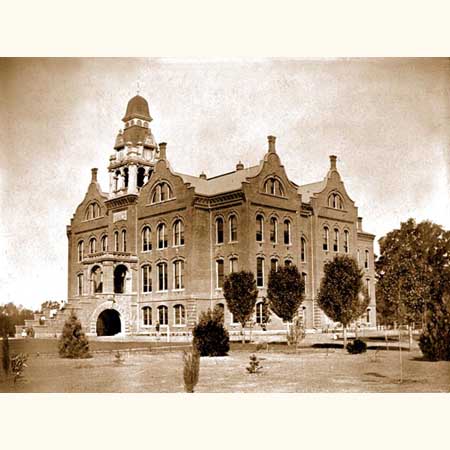
They came pretty close to the dooryard, which is why Bidwell Mansion sits on the edge of the Chico State campus today. They chose 8 acres of Bidwell’s cherry orchard, on the south side of Chico Creek, just west of his nursery. Today Bidwell Presbyterian Church  is located where the nursery once stood, and Trinity Hall sits on the site of the original Normal School building.

Posted in Chico State College, Uncategorized | Leave a comment

Bidwell and Chico Normal School

John Bidwell secured a State Normal School for Chico by donating a piece of his ranch as the initial site for the school. But his involvement in bringing a college to Chico goes back several years earlier.

In February 1880, when there was only one normal school in the state, in San Jose, Bidwell met with other interested members of the community to discuss bringing a teachers’ college to Chico. The committee adopted a resolution, which they presented to the legislature, requesting a branch school in Chico. Out of the subsequent discussion came a recommendation from the Assembly Committee on Education that five state normal schools be established at San Jose, Santa Rosa, Los Angeles, Nevada City, and Redding. (How did Chico get left out?)

A bill was put forward and defeated in 1881, although in that same year a normal school was established in Los Angeles. The idea was revived in 1883, but that bill too was defeated.

(Notice how the recommended cities reflect the balance of population in California at the time. It’s heavy on northern California, with only one site selected for southern California. Today about half of the 23 campuses of the California State University system (depending on where you draw the line) are in southern California.)

It wasn’t until 1887 that the state legislature decided to establish a new normal school, to be located “in some county north of the city of Marysville.” John Bidwell was determined to get the school for Chico.

Next: How Chico Won the College

Posted in Chico State College | Leave a comment

What’s Normal about a Normal School?

It used to be common for teacher’s colleges to be called “normal schools.” The term has an odd ring to it, since the first meaning of “normal” that comes to mind is “typical, usual, average, ordinary.” We speak of “normal behavior,” or “a normal childhood,” or “normal size,” for instance.

But “normal school” did not mean a typical or ordinary college, it meant a specific kind of college, one intended to train its students to be teachers. The term was taken from the French “ecole normale,” meaning a school that trains teachers to specific standards, or norms.  So a normal school is one that sets classroom and curriculum standards for education and educates teachers to adhere to those standards.

The term “normal school” was prevalent in the 19th century but had gone out of use pretty much by the mid-20th century.  The California system of State Normal Schools changed its name to the State Teachers College system in 1921, and in 1935, as other subjects and professions were added, it was again renamed and became the California State College system.

Posted in Uncategorized | Leave a comment

Happy Anniversary, Chico State!

This year California State University Chico is celebrating its 125th anniversary. So Happy Quasquicentennial, Chico State! (Not wanting to confuse some of their students, Chico State isn’t using the nifty word “quasquicentennial” for a 25 + 100 years celebration. But it’s a fun word to know.)

Chico State began as a State Normal School in 1887. It’s the second-oldest former Normal School in the state.

When I heard Chico State described as the second-oldest campus in the California State University system, I thought, Wait a minute! Wasn’t Chico State the third teacher’s college founded in California? How could it be the second oldest?

It’s both! The first state normal school was founded in San Jose in 1862. Next came Los Angeles in 1882. Later the teacher’s college in Los Angeles joined the University of California system (Berkeley was the first public California university), and dropped out of the state college system. So that moved Chico State up into second place.

Aren’t you glad you know that?  Next time: What’s “normal” about a Normal School?

Posted in Uncategorized | Tagged , | Leave a comment

Bidwell’s Gold Discovery–part II

When John Bidwell headed off to the Feather River to mine for gold, he didn’t just jump on his horse and go. There was planning to do, and Bidwell was always a man who planned carefully before taking a course of action. In his 1877 Dictation he stated:

“On reaching Chico (he actually meant his cabin on Butte Creek, a few miles south of the future site of Chico), an expedition was organized but it took some time to get everything ready. We had to send twice up to Peter Lassen’s mill to obtain flour, meat had to be dried, and we had to send to Sacramento for tools.

“In our party were Mr. [William] Dickey, [John] Potter, John Williams, William Northgraves, and myself. We passed near Cherokee and up on the North Fork.

“In nearly all the places we prospected we found the color. One evening while camped at White Rock, Dickey and I in a short itme panned out about an ounce of fine gold. The others refused to prospect and said the gold we had obtained was so light that it would not weigh anything. At this time we were all unfamiliar with the weight of gold dust but I am satisfied that what we had would have weighed an ounce.

“At length we came home and some of the men went to the American River to mine. Dickey, Northgraves and I went to what is now Bidwell’s Bar and there found gold and went to mining.”

I expect it took at least two weeks to get everything together for their expedition. No point in going up the river without enough food or the proper tools. All the names Bidwell mentions were men who had settled in the vicinity. William Dickey at the time owned Rancho del Arroyo Chico, a 22,000 acre Mexican land grant that he had acquired in 1844.   Bidwell would make it his own after the Gold Rush.

Posted in Gold | 1 Comment