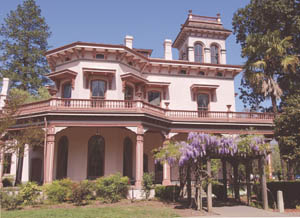
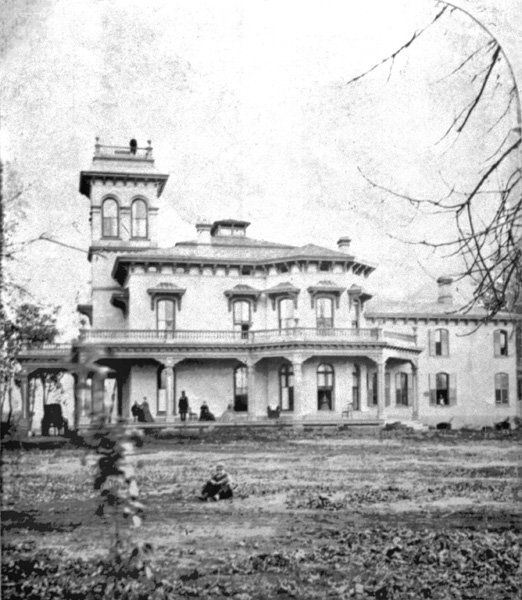
Bidwell Mansion: A History of Narrow Escapes

Would you like to know more about the history of Bidwell Mansion?  David Nopel and David Veith have written a wonderful article about the changing fortunes of this icon of Chico history in the Chico News & Review. Check it out.

Bidwell Mansion circa 1870. Photo courtesy of Special Collections, Meriam Library, CSUChico.

The Mansion has been saved before from decline and destruction. We can do it again.

The article includes a never-before-published photo of the Mansion under construction. The photo, which is in private hands, shows a corner of Bidwell’s old two-story adobe next to the Mansion, which has scaffolding around it. I’d post the photo here, but I don’t know if I’m allowed to do that.

Go take a look at the article, if you haven’t seen it already. It will make you grateful for those who preserved a central part of Chico’s heritage for us. I hope it will also make you want to add to the effort to save the Mansion again.

Posted in Uncategorized | Leave a comment

Save the Mansion

Here’s a nice video from KCHO on Bidwell Mansion State Park—

Closing State Parks: Bidwell Mansion

I was going to embed it, but I looks like I don’t know how. But click on the link and find out why John Bidwell was so important to California history, and why the Mansion is a treasure that we need to preserve.

Posted in Bidwell Mansion | Leave a comment

The Discovery of Gold

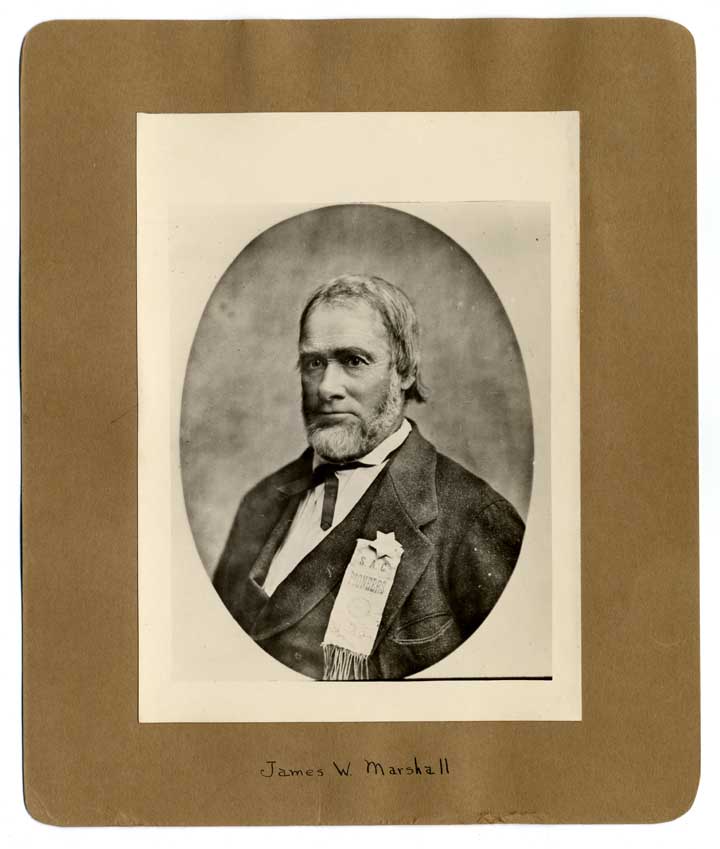
Today marks the 162nd anniversary of the discovery of gold in California by James Marshall, an incident which touched off the California Gold Rush and changed the course of history.

James Marshall in old age

John Bidwell was intimately involved in the discovery of gold. As John Sutter’s business manager, Bidwell drew up a contract between Sutter and James Marshall for the building of a saw mill in August of 1847.  Sutter had a need for plenty of lumber to build his new project, a town he planned to call Sutterville, located a few miles south of Sutter’s Fort. He contracted with Marshall to supply him with lumber and Marshall selected the site at  Coloma on the south fork of the American River for a mill. The idea was to float the lumber 45 miles down the river to Sutterville.

John Bidwell had looked the location over in the summer of ’47 and didn’t think much of it. He was sure that the river was too wild and dangerous to make the transport of lumber practicable,  but Robert Semple, who was with him on this inspection tour, thought the plan was feasible.

In January of 1848 the mill was nearly completed. On the morning of January 24th  Marshall went out to inspect the tailrace and noticed some bright sparkles under the water. He gathered up the tiny pieces. They looked like gold, and he quickly set out for Sutter’s Fort to show his find to Sutter.

Sutter and Marshall tested the metal. They bit it, hammered it, weighed it against silver, and dropped it in nitric acid. It passed all the tests. Sutter didn’t want the news to get out until after his crops were planted, so he swore James Marshall to secrecy.

Other than Marshall’s workmen, who certainly had an idea that something was up, the next man to find out about the gold discovery was Bidwell.  In January 1848 he was at his new property on Little Butte Creek, digging an irrigation ditch and planning a fruit orchard. Wanting to acquire some fruit trees and grapevines, he set out for Mission San Rafael by way of Sutter’s Fort.

“The very spring that gold was discovered, I was preparing to set out my farm, and had dug the first irrigating ditch in the Sacramento valley. As soon as I got my ditch ready and the ground prepared, I went over to San Rafael and Sonoma to get my trees. I crossed over to San Francisco and reported the discovery of gold. I believe I was the first man to tell the news in San Francisco.”

This was not the first time John Bidwell had heard about gold in California. Stay tuned to learn more about Bidwell’s search for gold, and how he missed out on being the man who discovered gold in California.

Posted in Uncategorized | Leave a comment

BMA Annual Meeting

Please join the members of the Bidwell Mansion Association for our Annual Meeting on Sunday, January 29, 2012, at the Bidwell Mansion Visitor Center.  This is a free event, and if you are not already a member of the BMA, it’s a chance to join the group and meet with other history buffs.

There will be refreshments at 6 p.m. and the meeting will begin at 6:30 p.m. Our speakers this year are Marti Leicester and David Nopel on the topic of “The Humboldt Wagon Road.”   They have a book coming out soon from Arcadia Publishing.

The Humboldt Road was a pet project of John Bidwell’s. He envisioned a freight and passenger route that would connect San Francisco, the Sacramento River, and Chico to the gold and silver mines in Idaho and Nevada. Bidwell financed and constructed the road to carry the products of his ranch to the mines, and transport lumber, minerals, and passengers across the Sierra Nevada and down into California.

Come to the annual meeting next Sunday and find out more about this fascinating piece of California history.

Posted in Uncategorized | Leave a comment

More from Nordhoff

Charles Nordhoff toured California in the early 1870’s. In a previous post I quoted from his description of Rancho Chico, an establishment which he greatly admired. He also quoted General Bidwell on life at Rancho Chico in the 1850’s.

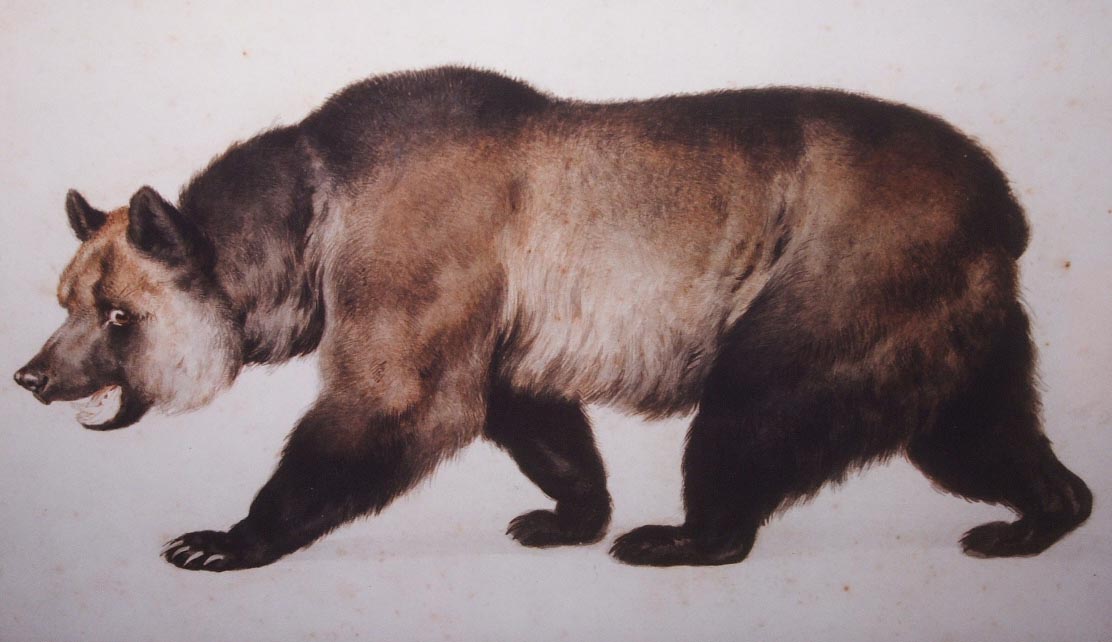
“General Bidwell, who lives at Chico, above Marysville, told me that fifteen years ago he had seen six grizzly bears lassoed and shot on his place by his men in one day””and it was not a very good day for grizzlies either.”

“So late as 1853 antelope and elk abounded on his pastures; the former, as well as deer, used to graze quietly with his cattle, and venison was a constant dish on his table. Before the gold discovery, trappers used to catch the beaver and otter on the Sacramento and Yuba rivers; but these creatures have, of course, disappeared with the elk.”

What a wealth of wildlife disappeared from California in less than two decades!

Posted in Uncategorized | Leave a comment

Speaking to Groups

I love to speak to groups—it’s a lot of fun to talk about John Bidwell and his world. It’s a real treat to interact with folks who love history. So if you know anyone looking for a speaker, send me a note at bidwellbook (at) gmail.com.

Diane was trying to line me up as a speaker for a group she belongs to, the Chico (insert political party here) Women. I thought it would be great to talk to a group about John Bidwell’s political career. After all, he was the “man too good to be governor.” He tried to get elected as governor of California four times, in four decades, with four different political parties! Talk about persistence! But he never made it, and that’s too bad, because he would have made a great governor.

And I won’t be speaking to the Chico (insert political party here) Women, either. Their rules state that all speakers must be members of their party. I vote in every election, but I am not registered with any party. I am happy to be an independent voter. So I don’t qualify as a speaker according to their rules.

But if you know another group that is not so persnickety, just let me know. I’ll be there.

Posted in Uncategorized | Leave a comment

Stirling City

I gave a talk in Stirling City yesterday to the Stirling City Historical Society. What a nice bunch of people! My friend Diane invited me to speak to them, and she and her husband David drove Jim and me up there.

I had never been to Stirling City, which is on “The Ridge” above Magalia, which is above Paradise. Once upon a time it was the site of the Diamond Match sawmill, but that closed down in 1958. It has a lovely park (Merlo Park), lots of old wooden buildings, and cross streets named after minerals in order of their hardness: Diamond, Quartz, Granite, Lava, Slate, Mica, and Gypsum. A great way to name streets, if you ask me.

The SCHS meets in the Community Hall, which originally was a small movie theater. An addition on the side holds the kitchen. The tiny projection booth is still there. The projectionist must have had to use a ladder to get into it—there aren’t any stairs.

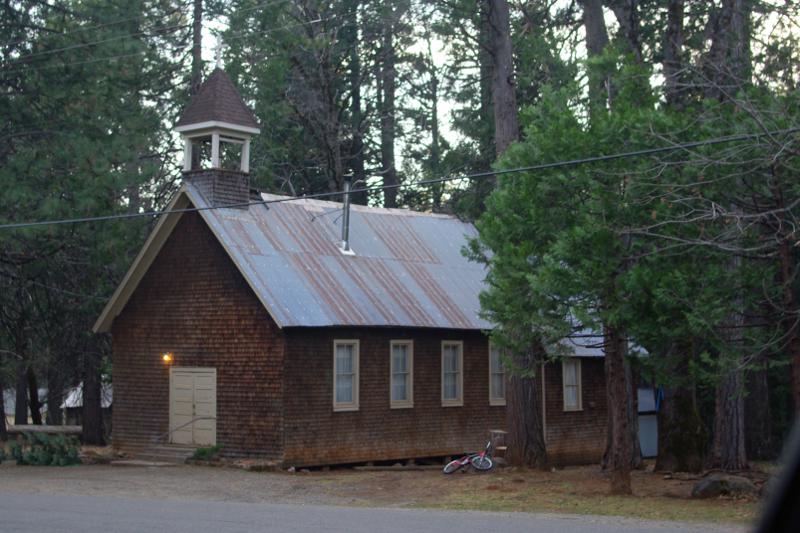
There is not much of a connection between John Bidwell and Stirling City, since he died before it came into existence, but Annie Bidwell financed the building of the Little Brown Church. It was originally a Presbyterian church, but now is used inter-denominationally. I didn’t get to see the inside, but I hear it is quite charming.

I’m looking forward to going back to Stirling City next summer, when the park is open, to take my grandkids on a picnic.

Posted in Uncategorized | Leave a comment

A Visit to General Bidwell’s Rancho

Did you know that in General Bidwell’s day, Rancho Chico was the premier agricultural showcase in the state? Anyone visiting California, who was interested in farming, came to Chico. Here is an excerpt from an 1873 book by Charles Nordhoff, California: For Health, Pleasure, and Residence:

“Forty miles above Marysville, on the California and Oregon Railroad, and on your way to Mount Shasta, lies Chico, near which place is the “rancho” of General Bidwell, formerly a member of Congress from this State.  It is one of the old Spanish grants, and contains twenty thousand acres of fine land. Its possessor came to this country in 1842, and he has been farming here on a large scale for fifteen years. Twenty thousand acres of fair, smooth land, with a brook running through it, which would be called a river in New England, and which drives a flour-mill on the estate, is a property worth seeing. We saw one field of wheat of a thousand acres; a field of oats which contained I believe, four hundred acres, and in which a man was quickly lost to sight, so high were the oats; and cattle scattered over what seemed a boundless plain.

The estate has sixty miles of substantial board fence; dozens of miles of private roads; a vineyard of three hundred acres, from which General Bidwell proposes to make not wine but raisins–in which I wish him the best success; and the crops consisted, when I saw them, of twenty-five hundred acres of wheat, about seven hundred of barley, and nearly as much oats.

Over one hundred acres are, besides this, in orchard; and the almond was here as large as a good-sized apple tree; the pomegranate was planted for screens; the fig and the English walnut had grown to stately trees; and cherries, peaches, plums, apricots, and apples, all were thrifty, and so laden with fruit that they threatened to break down.

300 horses, 1500 head of fine cattle, 3000 sheep, and 2000 hogs make up the inventory of General Bidwell’s live stock; and a hundred men are fed by him daily the year round, and make up his constant working force.”

Posted in Uncategorized | Leave a comment

Saving Bidwell Mansion

Welcome to 2012! Here’s hoping that the year ahead will be a happy, healthy, and prosperous one for all of us.

2012 will be an important year for Bidwell Mansion. Either it will be closed by the Department of Parks and Recreation on April 1st, or supporters of Bidwell Mansion will keep it open through their own fund-raising efforts.

You can help to keep the Mansion open. There are two ways to contribute money toward the $100,000 that is needed by March 31st to keep the Mansion open for the coming year. Money can be donated either to the state’s Contingent Fund, or to the Bidwell Mansion Community Project. In both cases money donated will be used to keep the mansion open.

To donate to the Contingent Fund, make out a check to California State Parks with “SAVE THE MANSION” on the memo line.  Mail it to Bidwell Mansion SHP,  525 The Esplanade, Chico, CA 95926.

To donate to the Bidwell Mansion Community Project, make out a check to NVCF (North Valley Community Foundation) and write Bidwell Mansion on the memo line.  Mail to North Valley Community Foundation, 3120 Cohasset Road No. 8, Chico, CA  95973. For more news about the project, check out the website at http://www.savebidwellmansion.org/

Bidwell Mansion is far too important a part of the community of Chico and the history of California to be allowed to close. To quote the Chico News & Review:

“The mansion is the most visible link to Bidwell’s legacy, which includes blazing the California Trail, participating in the Bear Flag Revolt, founding the city of Chico, pioneering agriculture in the state, donating land for the normal school that would become Chico State University, and bringing back California’s statehood papers from Washington, D.C., in 1850. Chicoans have made strong arguments as to the mansion’s significance to California.

“If you wanted to teach children, or adults even, about California history and you were to make up a fictitious character who would be in the right place at the right time for all these significant events, you really couldn’t do better than John Bidwell,” said Amber Drake, guide supervisor at Bidwell Mansion State Historic Park. “I’m sad to think that we don’t get to keep telling these kids about the story of their state.”

Don’t let our history fade away!  Please join the Bidwell Mansion Association and the Bidwell Mansion Community Project in saving the mansion for now and forever.
Posted in Uncategorized | Leave a comment

California Christmas, 1841

By Christmas Day 1841, John Bidwell had been at John Sutter’s settlement for about a month. Sutter had enthusastically hired Bidwell and planned to send him off to the coast to oversee his acquisitition of Fort Ross. Bidwell described Sutter’s “Fort” as he first saw it when he was asked to contribute to a history of Colusa County:

“The settlement, if it could then be so designated, was in an embryo state. No crops had been raised; grain had been sown, but owing to an unprecedentedly dry season, it had failed to mature.”

(Then, as now, the weather was unpredictable, and marginal for growing wheat without irrigation.)

“There was no such thing as bread, so we had to eat beef, and occasionally game, such as elk, deer, antelope, wild geese, and ducks. Our Christmas dinner that year was entirely of ducks.” (Colusa County, p. 37)

 Just ducks for Christmas dinner! But they wouldn’t go hungry, for there was no shortage of ducks and geese along the river that winter.

So safe at last in California, John Bidwell enjoyed a merry Christmas with John Sutter, Jimmy John, Mike Nye, and Sutter’s motley household of vaqueros, Kanakas, and Indians.

I hope you have a very merry holiday season too, whether it’s ducks for dinner, or turkey, ham, or roast beef. Or even vegetarian (which wasn’t an option for Bidwell.) Thanks for reading my blog. I’ll be back in 2012 with more adventures of John Bidwell and others in northern California.

Posted in Uncategorized | Leave a comment