California Here I Come

“As the time approached I became very anxious about the expedition but supposed a few would go with me. Finally I could not find a single member of the company that was sure to go.  I went forward with my preparations however and to the extent I could I purchased an outfit which consisted of a wagon and some provisions, a rifle and ammunition.  At almost the last moment every one abandoned the idea of crossing the plains.  I cast about however and found in Platte County a man by the name of Henshaw who was willing to go.  He was old, quite an invalid, and nearly helpless. He had a fine black horse that he allowed me to dispose of. I sold him for a yoke of young cattle and a one-eyed mule for Henshaw to ride.” (California 1841-8, p. 4)

In April 1841 John Bidwell was preparing to hit the trail for California, in spite of the fact that everyone else had dropped out of the Western Emigration Society. Of all those who  signed the pledge to journey together to California, only John Bidwell actually followed through. Other members of the Bidwell-Bartleson Party had not been a part of the Western Emigration Society.

Why George Henshaw, “old, quite an invalid, and nearly helpless,” wanted to undertake the rigors of the trail remains a mystery. Probably he hoped to regain his health in California’s salubrious climate. At any rate, he survived the trek, although he did not stay in California. He traveled back east in 1842 and nothing more is known of him.

Posted in Uncategorized | Leave a comment

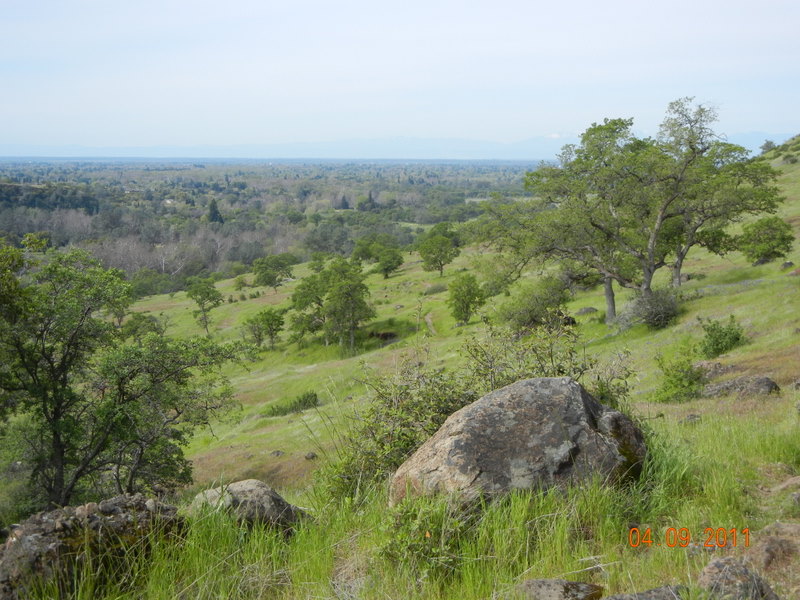
The View from Bidwell Park

Upper Bidwell Park

Upper Bidwell Park

Is it any wonder that John Bidwell wanted to stay when he saw country like this on his first journey through Northern California in 1843?

Posted in Uncategorized | Leave a comment

The Western Emigration Society falls apart

During the winter of 1840-41, some five hundred people in Platte County, Missouri joined the Western Emigration Society and signed a pledge to emigrate to California in the spring. This idea was met with great resistance by the local merchants. who went to work to defeat the movement.

“They used all possible means fair and unfair to accomplish that end. They argued against it, denounced it, and ridiculed it. Everything they heard unfavorable to California they reported against it and published their statements in all the nearest papers. . .

“During the winter I made two trips to Jackson Co. to see parties who had promised to join our company as well as to gather information respecting California and the route leading to it. But the skies began to be overcast. The exertions of our enemies began to have its effect. The first great excitement had somewhat cooled down.

“Just at this time [in March 1841], and it overthrew our project completely, was published the letters of Farnham in the New York papers and republished in all the papers of the frontier, at the instigation of the Weston merchants and others. Our company soon fell to pieces notwithstanding our pledge was as binding as language could make it. Well do I remember the concluding clause which was to the effect, if not in the exact language “That we pledge to each other our lives, our fortunes, and our sacred honor.” (California 1841-48, p. 4-6)

Thomas J. Farnham, whose reports from California had this chilling effect on the members of the Western Emigration Society, really had very little experience in California. An explorer and adventurer, he arrived in Monterey in 1840 and became involved with Isaac Graham and other Americans who had been arrested by the Mexican authorities for their attempt to overthrow the government. Taking Graham’s side, Farnham wrote to the newspapers about the black-hearted cruelty of the Mexican authorities. He doesn’t seem to have seen anything of California beyond Monterey, and didn’t comment on the land or the climate. But his comments about the Mexicans certainly gave would-be emigrants second thoughts about the advisability of venturing to California. All of a sudden, everyone in Missouri got cold feet and backed out. Everyone except John Bidwell.

Posted in Western Emigration Society | Leave a comment

The meanest man in California

The other thing I wanted to see at the Bancroft was the manuscript of Bidwell’s 1877 dictation for Hubert Howe Bancroft, in which Bidwell recounts his experiences during his 1841 journey to California, the Mexican War, and the Gold Rush. I had looked at it on microfilm, but the microfilm is hard to read and doesn’t copy very well. So I wanted to see the original and check a couple pages.

It turns out that there is a transcript of the manuscript, so I requested a photocopy, and it came in the mail today. The transcript does contain some errors, but as long as you keep that in mind, it is certainly easier to read than the microfilm.

Here is an interesting excerpt:

Here Bidwell stopped dictating and told me [the scribe S. S. Boynton] the story of his return to Marsh’s ranch. He said Marsh was dead and gone and he didn’t know that it was best to tell the real facts in all instances. [At the time of dictation Marsh had been dead for 21 years, but Bidwell may have felt it was improper to speak ill of the dead.]

As he told it to me he returned to the place wet, tired, and hungry [and] told Marsh he must stay all night but could start for Sutter’s next day. Marsh received him very coldly, gave him a piece of dried beef saying his cook was sick. While cooking the meat on the coals Marsh’s cook carried in the Doctor’s supper consisting of antelope meat, beans, tortillas, etc. Bidwell expressed deep feeling about Marsh but refused to let me take any more notes. (p. 43)

No wonder Marsh’s treatment still rankled after all those years! After Bidwell’s arduous trek over the Sierra Nevada, a trip to San Jose where he spent three days in jail, and his return to Marsh’s ranch in the November rains, Marsh’s insensitive behavior and callous lies were like a slap in the face to Bidwell. It’s no surprise that when he sent news of his trip back to friends in Missouri, he called Marsh “the meanest man in California.”

Posted in John Marsh | Leave a comment

A Visit to the Bancroft Library

I went to the Bancroft Library on Monday. on the way home from Livermore (where I have a brand-new grand-daughter) to Chico. I love to visit the Bancroft—the reading room is so quiet, so academic, so civilized. It feels like a real library.

I wanted to see two things—Bidwell’s journal of his trip to California in 1841, and the manuscript of his 1877 dictation for Hubert Howe Bancroft.

The journal is not the original one that he kept on the trail to California—that one is long gone. This is the only extant copy of the first printed version. Bidwell rewrote his journal while supervising the work at Fort Ross, and sent it back to friends in Missouri to tell them about the trip, and about conditions in California. Since this little book is missing its title page, we don’t know just who printed it, or where or when, but it probably came out sometime between 1843 and 1845. The thin paper it is printed on is fragile, but has held up well over the years.

The copy in the Bancroft was used as a guidebook by George McKinstry, who came to California in 1846. He made a couple notes in the margins. Next to Bidwell’s entry for July 3rd he notes, “We camped at this spring Monday July 6th 1846.” Under the entry for September 16th, in which Bidwell tells about how they abandoned their wagons and packed all their gear on their animals, he writes, “We cooked our supper & breakfast with fires made from the remains of these wagons.”

If you want to read this journal for yourself, you can find it in the library. It was reprinted in 1937 with the title A journey to California, with observations about the country, the climate, and the route to the country by John Bidwell. It can also be found in The Bidwell-Bartleson Party, by Doyce B. Nunis. Nunis collected all the documents and memoirs from the first overland trek to California, and John Bidwell’s accounts form the most extensive part of his book.

Posted in Uncategorized | Leave a comment

The Western Emigration Society

During the winter of 1840-41 John Bidwell, who had lost his land to a claim jumper, taught school in Missouri and got ready to move on. The tales of fur trader Antoine Robidoux and the letters of John Marsh extolling the beauties of California generated a great deal of interest among the Missourians. During that winter Bidwell and others organized the Western Emigration Society.

“A pledge was drawn up in which every signer agreed to purchase a suitable outfit, and to rendezvous at Sapling Grove in what is now the state of Kansas, on the 9th of the following May, armed and equipped to cross the Rocky Mountains to California. We called ourselves the Western Emigration Society, ans as soon as the pledge was drawn up every one who agreed to come signed his name to it, and it took like wildfire.” (Bidwell Dictation 1877.)

Why wait until May to travel? For the simple reason that no progress could be made until the grass was grown up enough to support horses and oxen. Travel could not begin while there was still snow on the ground and the animals had nothing to eat. This left a window of about 6 months for travel, which might seem like plenty, but any delay in starting or holdup along the way could jeopardize the lives of the pioneers. An early start and steady progress were essential if the pioneers wanted to reach their goal safely.

Posted in Western Emigration Society | Leave a comment

Join the BMA!

You can help maintain Chico’s foremost historical landmark by joining the Bidwell Mansion Association. The BMA supports the restoration, preservation, and interpretation of Bidwell Mansion State Historic Park.

Member benefits include receiving a newsletter, The Mansion, where you can read about upcoming events and historical tidbits, and a discount of 10% on merchandise in The General’s Store. The store has lots of wonderful items for sale, including books, souvenirs, animal finger puppets, jewelry, t-shirts, hats, and tote bags.

Join now and your name will be entered in a members-only drawing for dinner at Bidwell Mansion. I was lucky enough to win last year and it was a wonderful occasion, with a delicious dinner and a private tour of the Mansion. Other events throughout the year include a birthday party for John and Annie, Annie’s tea party, and a members-only holiday tour of the Mansion.

Membership categories are:
Student, Senior Citizen $10
Individual $20
Family $35
Sustaining $50
Patron $75
Life Member $100

Send me a note at bidwellbook@gmail.com, and I’ll get you signed up. Respond before April 2nd to get your name in the drawing for dinner at the Mansion!

Posted in Uncategorized | Leave a comment

Bidwell and Sutter

“Sutter was a man who treated everybody well, especially strangers. He had unbounded confidence in other men–in fact, too much, at times. Everyone was welcome at his table, and at his fort. . . He treated me with great consideration, gave me employment by sending me to Bodega, the Russian settlement, to take charge of his business there. It was quite a charge, considering that I was a very young man and an entire stranger.” (Dictation, 1891, p. 11)

John Bidwell was 22 years of age when Sutter sent him off to the coast to take charge of Fort Ross. They had known each other for five weeks. Evidently Sutter sized up Bidwell quickly and saw in him the kind of man he needed to take care of his business. For his part, Bidwell admired, and later imitated, the hospitality and generosity of Sutter, but he could also be annoyed by what he saw as Sutter’s weakness and gullibility.

“I never left his employ but that he wanted me to return. He was peculiar man, however. He would seem to have more confidence in stranger than in those more intimate with him. For instance: a fellow named Kinney came across the plains–a ruffian always fully armed, and continually threatened to shoot people, so that no one dared cross him. Sutter employed him and put him in charge of his farm. The first thing the rascal did was take 75 mares belonging to Sutter and brand them with his own name. Sutter declared that he must give the mares up, but could not get anyone to go up and deal with the fellow. I told him I would, and I did.

“I had to go pretty well armed, but went quietly. I told him that he was to bring every one of those mares down and rebrand them. I stayed there until it was done. It was quite an undertaking, as I had no assistance.” Bidwell relished telling this story as a example of his “self-possession,” as he called it, his ability to confront an opponent and calmly face him down.

John Bidwell rarely lost his temper, and this self-possession served him well. But a subsequent incident involving Sutter and Kinney made him about as angry as he had ever been in his life.

Kinney decided to leave the country, but told Sutter that he must have provisions. He offered to pay with what he insisted was a “fine rifle.” Bidwell tried it out and had a blacksmith take it apart. It was cracked inside and “utterly worthless.” He told Sutter, and Sutter agreed not to take the gun. Yet the next morning he came to the office and told Bidwell, “Give Mr Kinney credit for $100.” “Captain Sutter, what is that for?” “Well, I have taken the rifle; he said it was a good gun.”

It was Bidwell’s word against Kinney’s, and Bidwell knew he was right. He couldn’t believe that Sutter could back down in this way, and he saw it as an insult to his own integrity. “I left his employ immediately. I did not know where to go to. Walked perhaps ten miles, revolving in my mind as to how I could get out of California. I had stood by Sutter many times when his life was in danger, and could not understand why he should believe a stranger’s word before mine. I returned that night and Sutter begged me to remain.”

It is easy to picture John Bidwell stomping out of Sutter’s office in a fury and tramping over the fields, angrily playing the incident over and over in his mind. The affable Sutter was adept at diplomacy, but disliked confrontation. In avoiding an argument with a well-armed ruffian, he instead managed to insult and alienate his best friend. Luckily for Sutter, John Bidwell couldn’t think of any other place to go, and came back to Sutter’s settlement. He never fully trusted him after that, though.
Posted in John Sutter | Leave a comment

A Healthy Clime

One of the attractions of California down through the ages has been its healthy climate. While still in Missouri, John Bidwell had met a fur trader named Antoine Robidoux who described California as a place of “perennial spring and boundless fertility.” Bidwell and his friends asked every question they could think of about California.

“Generally the first questions which a Missourian asked about a country was whether there was any fever and ague. I remember his answer distinctly. He said that there was but one man in California that had ever had a chill there, and it was a matter of so much wonderment to the people of Monterey that they went eighteen miles into the country to see him shake. Nothing could have been more satisfactory on the score of health.” (Echoes of the Past, p. 109)

The “fever and ague” that so worried the Americans was malaria, which at that time was endemic in Missouri and other parts of the United States. Malaria was a plague, laying low otherwise healthy men and women. People did not know that the disease was carried by mosquitoes. It was prevalent near marshes and swamps, and along rivers and streams. When people settled along waterways, for transportation purposes, they made themselves available to malaria carrying mosquitoes at the same time.

In his report from California Bidwell wrote:

“Health–the country is acknowledged by all to be extremely healthy; there is no disease common to the country; the fever and ague are seldom known. I knew a man to have several chills, but he had been intoxicated several days in succession.” (A Journey to California, 1841.) Bidwell doesn’t mention which came first, the drinking or the shaking, but in either case he didn’t much approve of the cause or the cure.

Posted in Uncategorized | Leave a comment

A Journey to California, 1841

Bodega, Port of the Russians
Upper California, March 30th, 1842

Most Esteemed Sir:–Owing to circumstances I am compelled to abridge my journal and likewise a description of the country so far as I have been able to travel. By perusing the following pages you will learn most of the particulars of all my travels since I left the United States.

So wrote John Bidwell in 1842 to an unknown recipient, possibly Elam Brown, with whom he had boarded in the winter of 1840-41. Evidently he had promised before he left on his travels to keep a journal and send it back east for his friends who were eager to know more about California and how to get there.

During his spare time in February and March of 1842 he copied out the journal and added his observations of California. But how did he get the copy back to his friends in Missouri? He couldn’t just pop it in the mail. He probably sent it east with Joseph Chiles, another member of the Bidwell-Bartleson Party. Chiles had arranged with General Mariano G. Vallejo to build a grist mill near Sonoma, and returned to Missouri via the Santa Fe Trail during the summer of 1842. But it might have gone later with someone else. It’s difficult to say.

Sometime in 1843, ’44, or ’45 the journal was published as a pamphlet, by an unknown printer, without Bidwell’s permission. This became the first overland guidebook to California. Only one copy is still in existence–the copy carried by George McKinstry when he emigrated to California in 1846. It now resides in the Bancroft Library at UC Berkeley.

How many other copies were printed and came west will never be known. But George McKinstry became Bidwell’s partner in running a store at Bidwell’s Bar. When they met, sometime between 1846 and 1849, McKinstry must have exclaimed, “You’re the man who wrote the guidebook that got me here!” to which Bidwell would have said, “I never told anyone they could print that thing!”

Posted in Uncategorized | Leave a comment