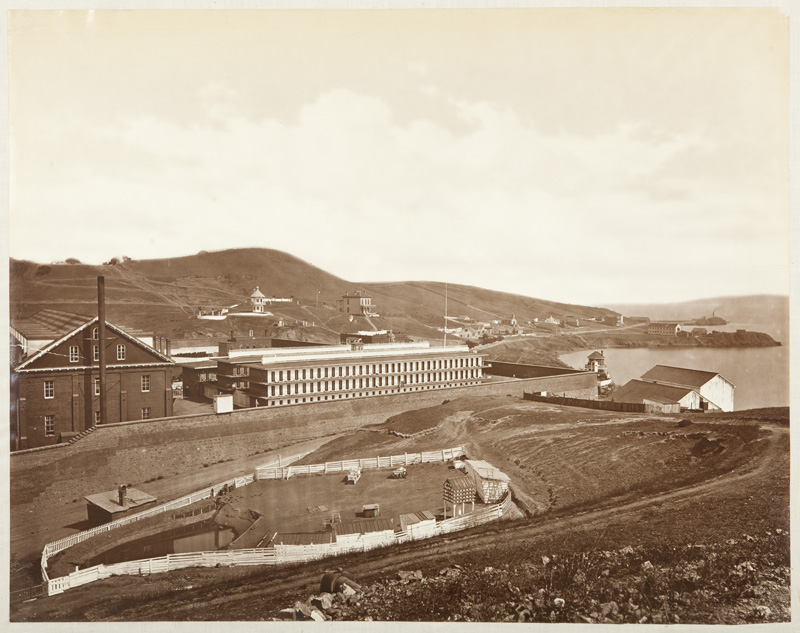
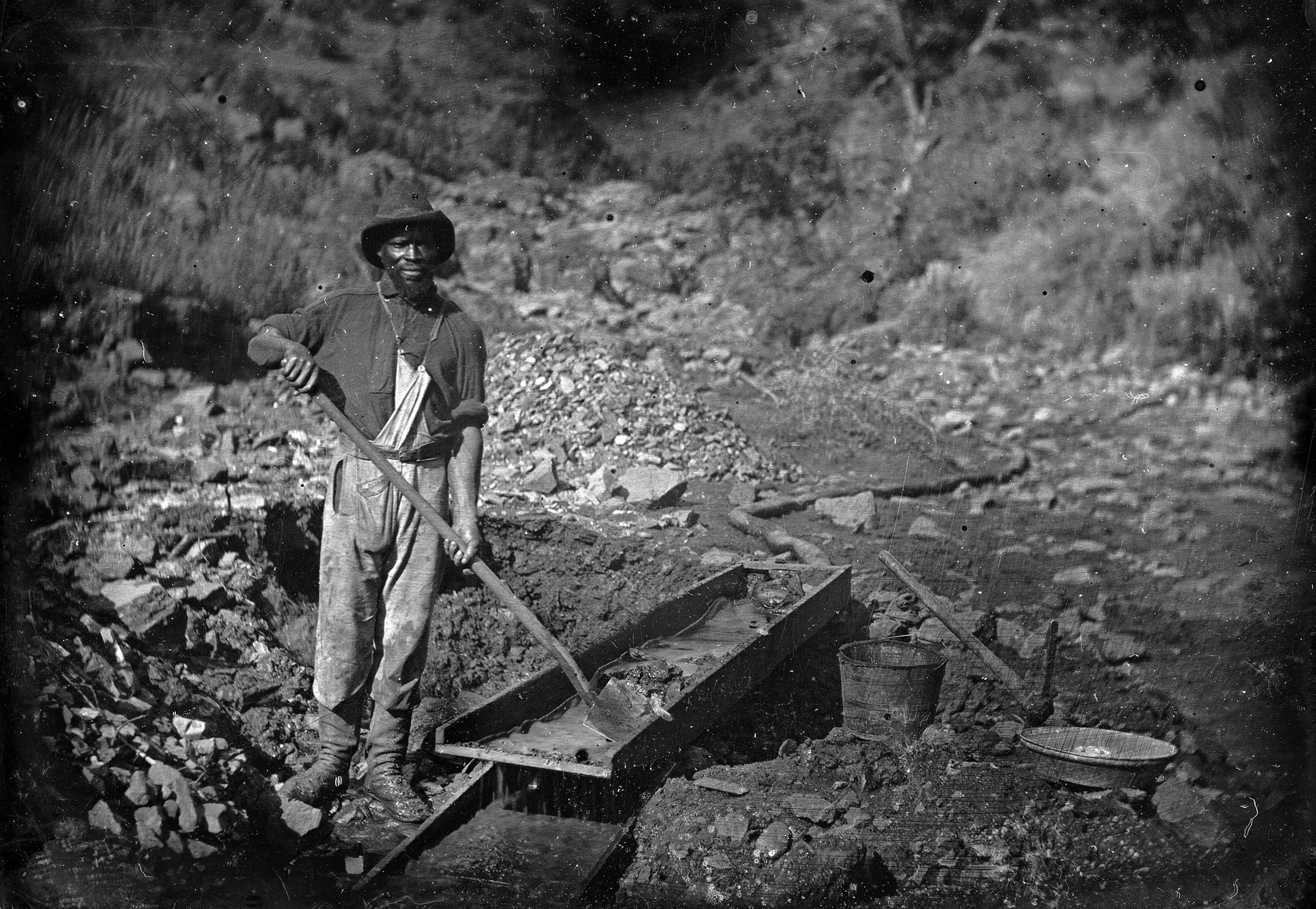
Photo by Carleton E. Watkins, ca. 1874. California State Library History Room
Charles E. Bolton, aka Black Bart, entered San Quentin State Prison on November 21, 1883. It had only been eighteen days since his arrest. Justice was swift in those day.
While in prison Bart wrote letters to his family in Missouri and to Reason McConnell, the stage driver of his last holdup, and others to whom he felt he owed an apology. He intended to be a model prisoner in hopes that he could shorten his six-year sentence. At first he worked in the prison laundry, but his intelligence and good behavior soon promoted him to a position in the hospital pharmacy.
Bart spent three years working as a pharmacist and became proficient at compounding medications. The last year of his term he worked as a trusty in the warden’s office. His fine even penmanship appears in prison records from that time.
After serving four and a half years of his sentence, Bart was released on January 21, 1888.
Where would he live? How would he support himself? What had become of all his ill-gotten gains? Could he lay his hands on any of it?
Next time: Black Bart disappears — to where?
To read more about Black Bart: There are several books about the life and crimes of that fascinating bandit, Black Bart. I have been using Black Bart: The Search Is Over, by Robert E. Jernigan and Wiley Joiner, but there are many other books.
And of course it’s all online too. Check out the website www.blackbart.com for Bart’s history, including a list of all his robberies.
Previously I have written about Black Bart’s stagecoach robberies in Butte County, where I live. You can read those here and here and here and here.
FX07 was the code that brought down Black Bart. It was a laundry mark. In the day when men had their shirts, detachable collars and cuffs, handkerchiefs, and other items of clothing cleaned at a laundry, the items were marked in an inconspicuous place with an indelible marker to identify the owner.
At his twenty-eighth and last robbery on November 3 1883, Black Bart was wounded and left behind a number of articles as he escaped, including a handkerchief labeled FX07. Detective Harry Morse, who had been hired to work full-time on the Black Bart case, suspected it came from a laundry in San Francisco. It would take time to canvass all the laundries — there were 91 in the City. After a few days he matched it to the Ferguson and Biggs California Laundry at 113 Stevenson Street. The laundry identified FX07 as belonging to Charles E. Bolton, a mine owner.
Posing as a mining man and acquaintance of Bolton, Morse persuaded the laundry agent to give him Bolton’s address. Continuing the deception, he met with Bolton and got him into the office of Detective James Hume. Bolton claimed to be T.Z. Spaulding, an honest citizen and mine owner. But the masquerade fell apart when the detectives searched his rooms at the Webb House hotel and found more items with the FX07 mark. Black Bart was caught.
Bart was identified by a man who had seen him at the scene of his last robbery. The stage driver recognized his distinctively deep voice. The net was closing in.
Photographs were taken, the only photos we have of Black Bart. He doesn’t look like a stagecoach robber. With his well-groomed gray mustache, his curly-brimmed bowler, his good-quality coat and overcoat, and his walking stick, he looks like a prosperous businessman.
Realizing that the jig was up, Charles Boles, alias Charles Bolton, alias Black Bart the Po8, confessed to multiple stage robberies. He recalled every detail of every crime. He revealed how he had planned his robberies and how he had evaded capture. He offered to show the lawmen where he had hidden the gold from his last holdup. $5000 in gold was recovered.
On November 17th Bart appeared before a judge in Calaveras County and pleaded guilty to the one last robbery that led to his arrest. He was never tried for the other 27 holdups. This deal was in the interests of all concerned.
Bart got a sentence of six years in prison, much less than most stage robbers got. That he never carried a loaded gun and never harmed passengers or drivers was taken into consideration.
He avoided a lengthy trial. So did the witnesses and detectives who awaited their shares in the reward money. They got their reward much sooner than they would have if Bart had gone to trial.
Law enforcement lost track of Charles E. Boles, the gentleman bandit known as Black Bart, after his release from San Quentin Prison on January 21, 1888.
During March he was seen in Stockton, Oakdale, and Modesto. He was last spotted in Visalia, staying at the Palace Hotel. After that he disappeared. Some later stagecoach robberies were attributed to him, but they were not consistent with his usual methods. He seemed to have vanished.
Boles had a wife and daughters living in Hannibal, Missouri, but they never heard from him.
Where did he go?
A likely answer can be found in this book: Black Bart: The Search is Over, by Robert E. Jernigan and Wiley Joiner, published by Shalako Press in 2015. I bought the book at The Bookworm, the used and new bookstore in Oroville conveniently located next door to the Pioneer Museum. An expanded version of the book has been published under the title Black Bart’s Resting Place: In Everlasting Sleep, by the same authors.
Over the next few posts I’ll be telling you about the authors’ conclusions about Bart and where he ended up. But let’s start with the “why.” Why did Charles E. Boles, an intelligent and well-educated man, turn to a life of crime?
He was born in England in 1829 and the family emigrated to the United States in 1831. In 1849 Charles and two brothers joined the California Gold Rush. Returning to Illinois in 1854, Charles married and took up farming. He served as a Union soldier in the Civil War. Upon his discharge in 1865 he returned to his farm and his wife and children, only to find that his wife had a baby boy that was not his. He soon left for the mining fields of Idaho and Montana.
According to Jernigan and Joiner:
Charles had a good-paying claim [in Silver Bow, Montana] and was doing well when two members of the Wells Fargo Company approached him and made an offer to buy his claim, advising him it would be beneficial to his well-being to sell. Charles informed them his claim was not for sale. The two agents bought up all the lesser claims around Charles’s claim, thereby shutting off his water. He could no longer mine his claim. Under the threat of violence, Charles left his Montana claim, vowing to get even someday. {p. 89]
This story may come from a newspaper interview with Charles Boles (who went by the name Charles Bolton in California). The authors don’t always cite their sources, so I am not sure. But such an event could lead to lasting animosity toward Well, Fargo & Co. And certainly Black Bart targeted the Wells, Fargo strongbox on the coach. He didn’t rob passengers.
Wells, Fargo owed him, he thought, and he would make them pay.
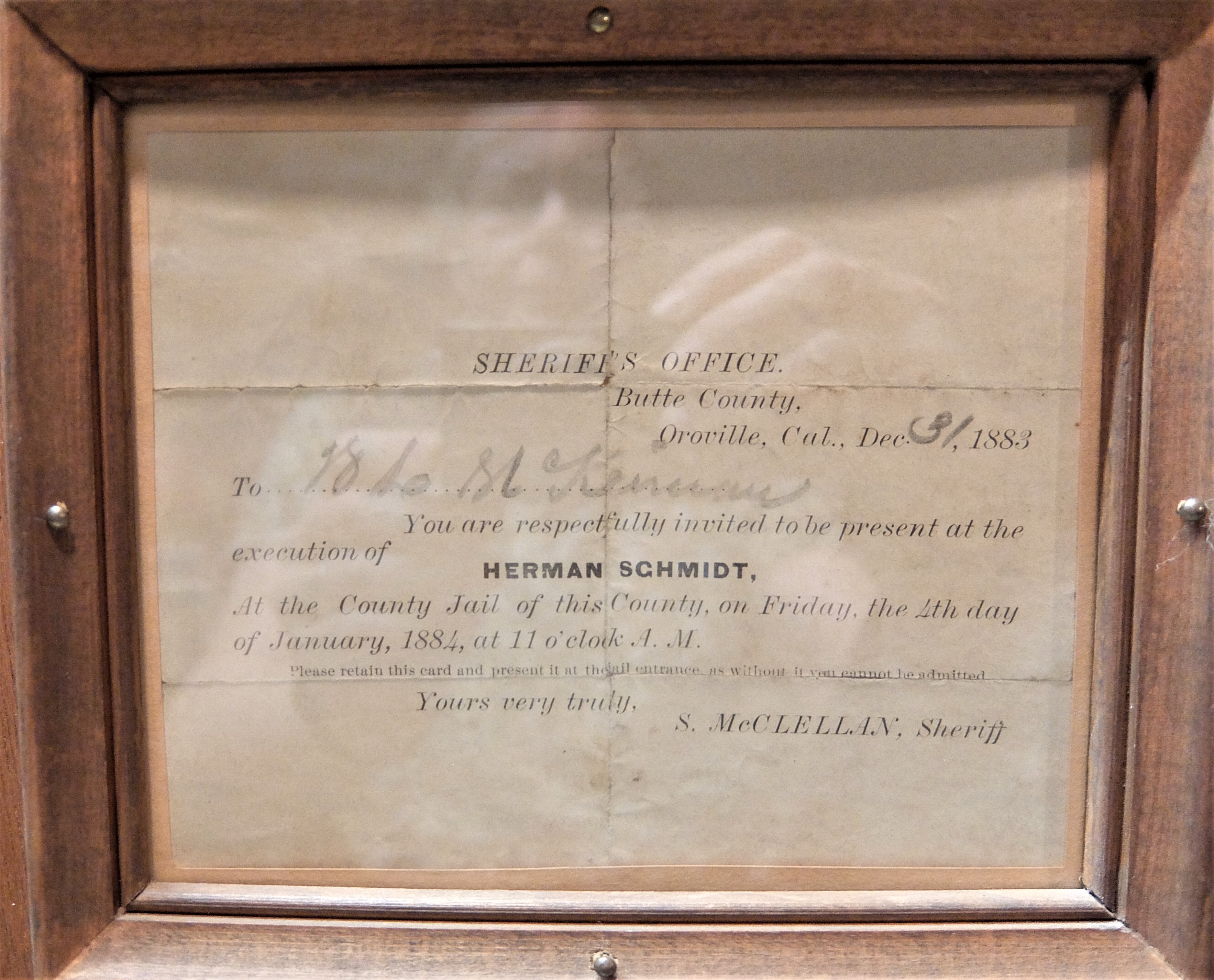
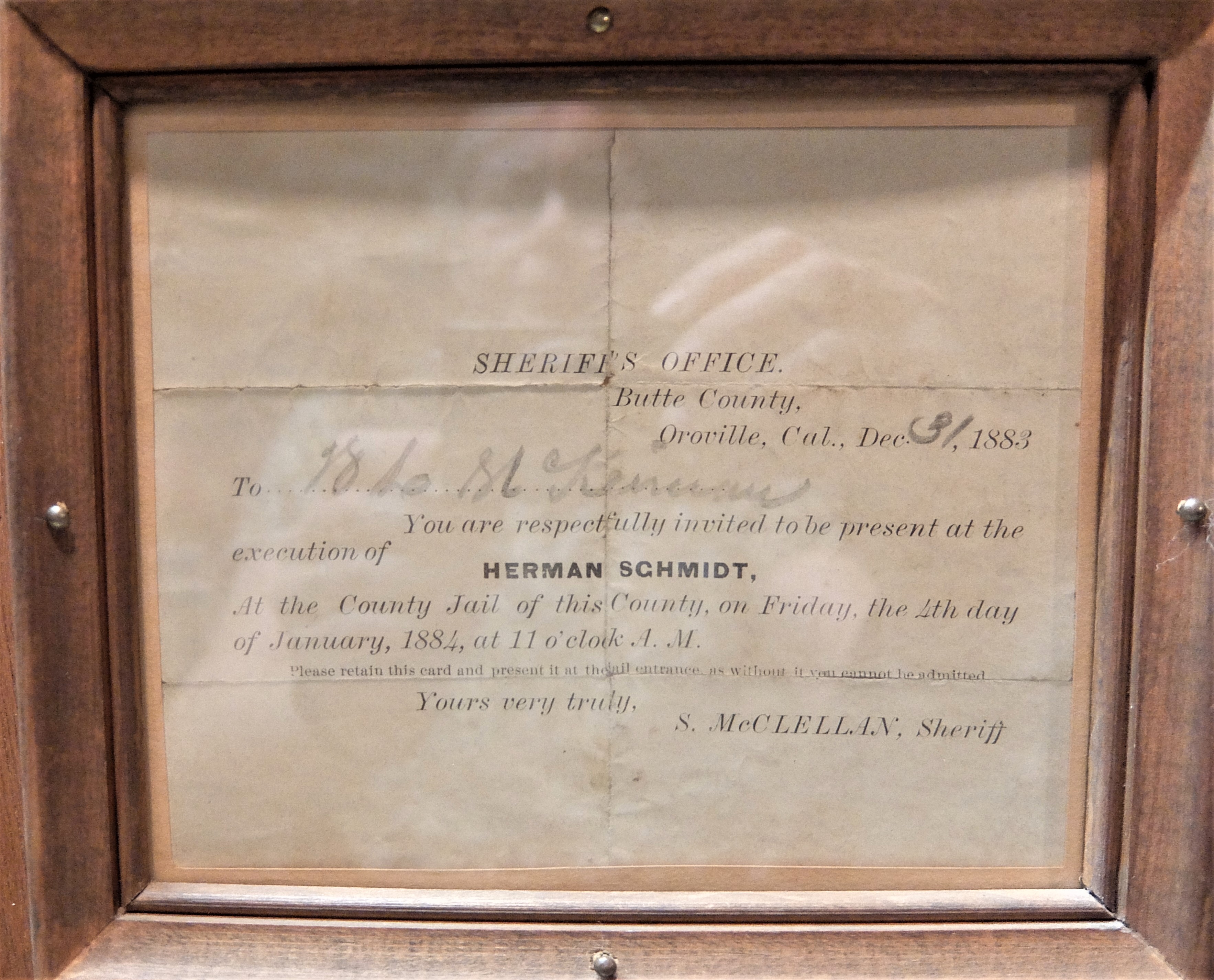
Not the sort of invitation you are likely to get in the mail today—
This invitation to a hanging resides in the Pioneer Memorial Museum in Oroville. It was donated by Viola Pacheco of Redding, California. I can’t make out who the invitation was issued to — it looks like the last name might begin with McK. These notices were sent to law enforcement officials in the area and other notable citizens.
Butte Record July 1 1882
Herman Schmidt was guilty of murdering his wife, 32-year-old Lena Schmidt. Lena was a widow and the mother of four children under the age of seven when she married Herman in Stockton. After their marriage they moved to Chico, where they opened the Opera Saloon on Main Street.
Schmidt was known for beating his wife and the children. On the night of June 24, 1882 he entered the saloon and saw his wife sitting at a table, drinking a glass of beer with a customer. He fatally shot her at close range, then tried to commit suicide by poison, but survived the attempt.
He tried to go home to his house on Wall St., but was detained for intoxication and placed in the Chico jail. When it was discovered that the murderer was in the jail, a lynch mob assembled, so Schmidt was transported to the county jail in Oroville.
Schmidt was due to be hanged in August 1882, but some technicality (I’m not sure exactly what) delayed the execution. After two trials and two appeals to the California Supreme Court, his execution finally took place on Friday, January 4, 1884.
The crime is a sad tale of thwarted hopes, domestic abuse, jealousy and drunkenness, ending in senseless murder.
If you are interested in a full account of the life of the murderer, the crime, and his execution, you can read it in The Weekly Butte Record for January 12, 1884.
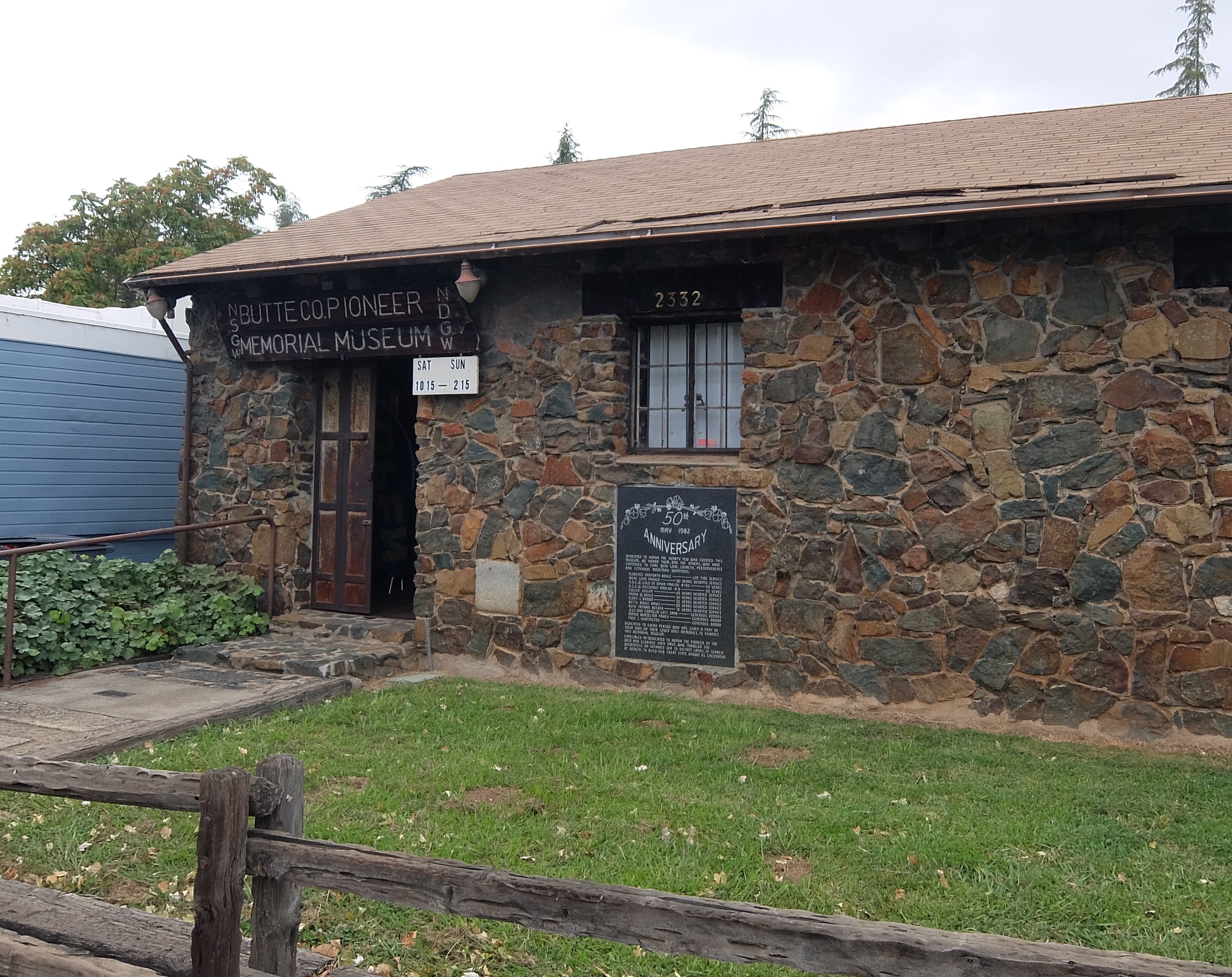
Yesterday I visited the Butte County Pioneer Museum in Oroville. Open on Saturdays and Sundays from 10:15 to 2:15, it’s worth visiting to get a flavor of old-time life in a town that gained its wealth from gold-mining.
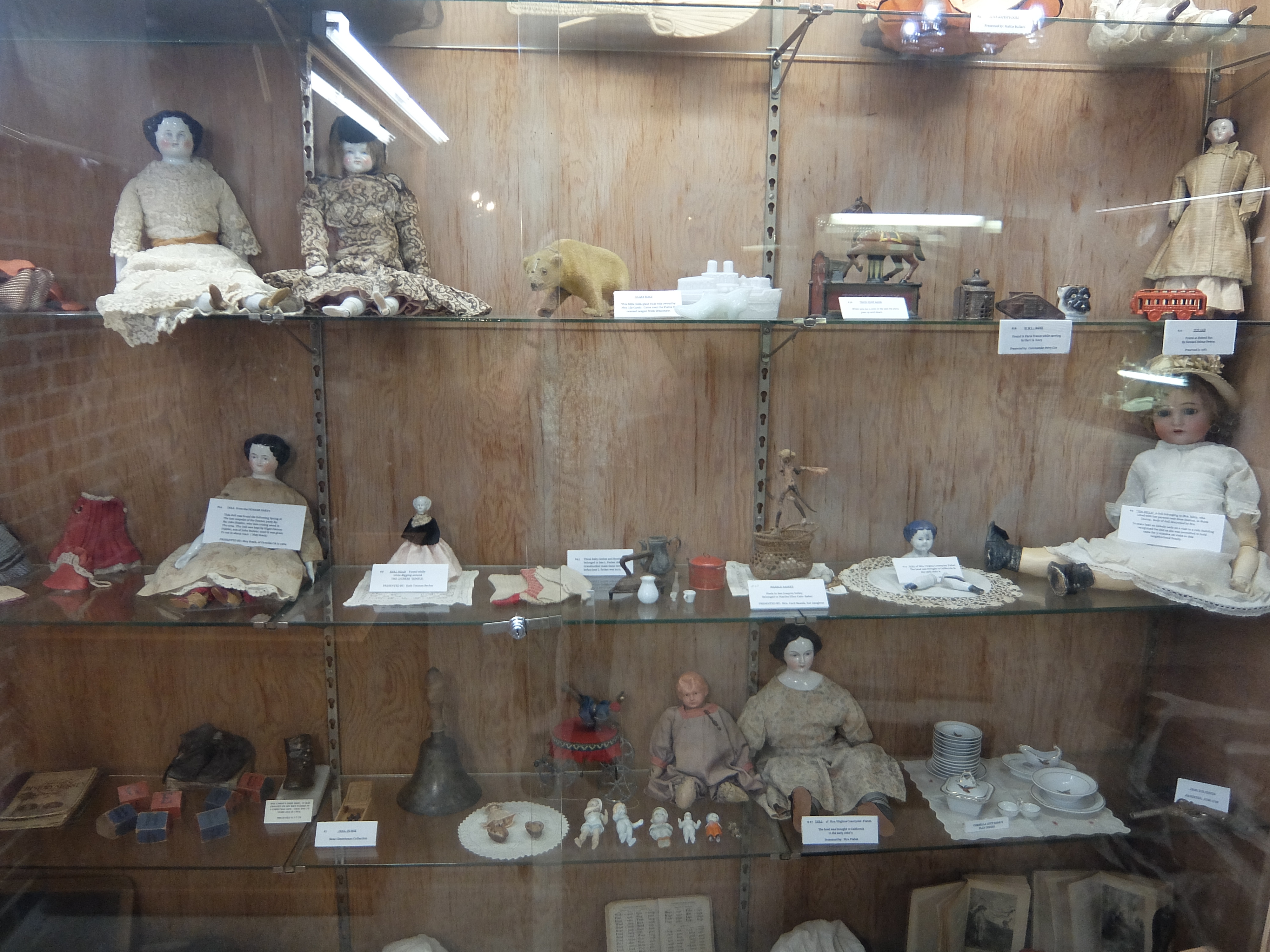
The stone building is the original museum, but a long extension on the back gives room for many more displays. There is a great selection of mining tools, including a replica of the 54 pound Dogtown Nugget, and a lovely display of antique dolls.
Great collection of native baskets too, some local, and some from far away.
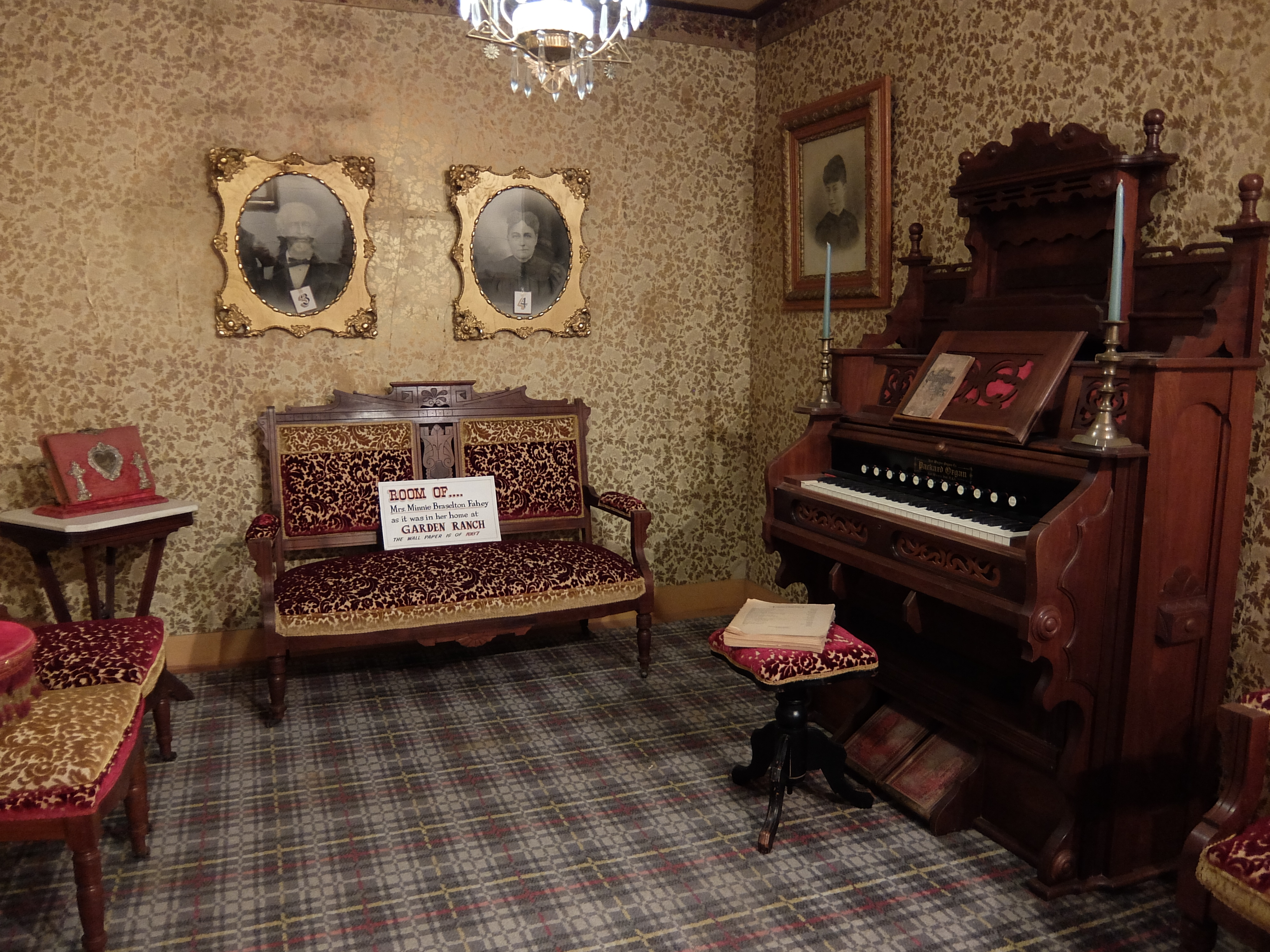
Several rooms are set up to show life in a 19th century home — parlor (with the original wallpaper), kitchen, bedroom, and children’s room, plus an apothecary shop, blacksmith’s shop, and stage office.
But wait! There’s more! in the basement is an old fire engine, a linotype machine, a tribute to Ishi, and a section honoring Florence Danforth Boyle and her family, who were instrumental in establishing the museum. Florence was the author of Old Days in Butte, an invaluable resource for local history.
And then there is this — not something you are likely to get in the mail nowadays. Herman Schmidt was hanged in Oroville for the murder of his wife.
Invitation to a hanging
There is something to interest everyone at the Pioneer Museum.
Who are these three gentlemen? The photograph was taken at the Chico photography studio of H.H. Frye, but the three men are not identified. The photo was brought to a committee meeting of the Association for Northern California Historical Research (ANCHR). A mystery! Time for some historical research!
On the back of this photograph, in tiny neat pencil writing, it reads, “Helltown, Ca.” A clue! I knew that the man to share it with was John Rudderow — if anyone would recognize them he would.
And he did. John lives in Butte Creek Canyon, near the site of the mining camp known as Helltown. The history of Helltown, Diamondville, and Centerville are his domain.
These three gentlemen are two brothers and their cousin, who was raised with them as a brother. On the left is Charles Francis Nicholl (1858-1921) and on the right is John Gault Nicholl ( 1854-1920), sons of John Nicholl and Helen Gault Nicholl. In the center is James Milton Brotherton Nicholl (1866-1947). James, or Jimmy as he was known, was the son of James and Ellen Brotherton. Ellen, who was sister to John Nicholl, died giving birth to James and he was raised by his uncle and aunt.
Chico Weekly Enterprise 7 July 1886
John Nicholl, the father, was an immigrant from Ireland who came to California in 1849. In 1852 he went back east and in 1853 he married Helen Gault.
He returned to California and to mining. Helen and their little son John joined the father in 1857. By then John senior had a homestead and mineral claim in Butte Creek Canyon. He raised cattle and grew fruit on a lovely little ranch he called “Sunnyside.”
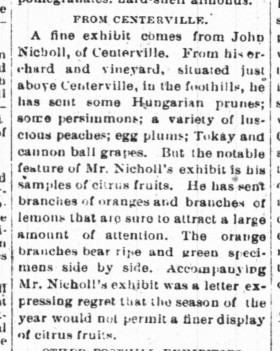
John Nicholl became famous in the county for his outstanding fruit orchard, especially his citrus fruit.
His three sons kept the ranch going after his death in 1890. None of them ever married. I’m told their mother kept a tight rein on her boys.
Even though California was a free state, slavery certainly existed here. Slaveholders brought their slaves with them from the South, and they did everything they could to hold on to their “property.”
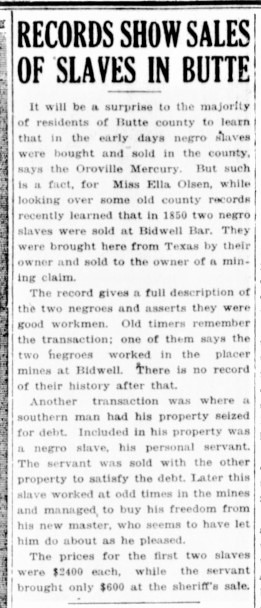
Chico Record 18 October 1917
But were slaves bought and sold in California?*
Up until now I hadn’t seen much proof, but I am not surprised to find out that it happened, as evidenced by this article in the Chico Record, October 18th, 1917. It actually must have happened a lot, as men came and went in the goldfields.
The article says that “two negro slaves” were brought to California from Texas (probably in 1849) and in 1850 they were sold to the owner of a mining claim at Bidwell Bar. The two black men didn’t have any say in the transaction, of course.
They are described as “good workmen” and since their price was $2400 each, they were valuable workers indeed. $2400 today would be about $59,400, according to Measuring Worth.
It’s likely that their “owner” took the gold that they mined and the money he made from selling them, and headed back to Texas with his profits.
The article notes that “there is no record of their history after that” but they had a better chance of getting their freedom in California than they would have had in Texas.
The other transaction recorded in this article is of a servant sold to satisfy a southern man’s debt. Again, the man who was sold didn’t have any say in the matter. He was sold for $600, a more typical price. Alvin Coffey was trying to earn $600 so that he could buy himself, that being what his “owner” had paid for him.
I haven’t gone to the Butte County Hall of Records to look up this transaction but that is something that would be worth doing.
My thanks to Craig Wisti, who posted this item on Facebook in the Butte County Pictures and Information feed.
*In this post I am only writing about African American slavery. Native California Indians, especially children, were bought and sold, and women were sex-trafficked.
The first test of the California Fugitive Slave Act (enacted in April 1852) came shortly after its passage. Three men, Carter Perkins, Robert Perkins, and Sandy Jones, were seized on the night of May 31, 1852, by the sheriff of Placer County and several other white men, including the man who claimed them as his fugitive slaves.
Charles S. Perkins, a white man from Bolivar County, Mississippi, had brought Carter Perkins, an enslaved man, with him to California in 1849. The other two men soon followed, and all three were put to work mining for gold. In the spring of 1851 Charles Perkins desired to return to Mississippi, so he left his three slaves in charge of John Hill, and told them that after another six months of work they would be freed.
Sacramento Daily Union 3 June 1852
In November 1851 John Hill told the three that their time was up. They were free men. But evidently he didn’t give them any deeds of emancipation; they just went off, confident in the assurance that they could now be numbered among the free blacks of California. They continued mining, with good success.
Then Charles Perkins returned.
You can see from this news item that the three men were doing well — they had a wagon, a span of mules, and $400. It also verifies that the men had been promised their freedom in exchange for a certain period of labor. On the other hand, it has their state of origin wrong, and since they worked for Perkins and Hill until November 1851, it can hardly be said that they “sloped soon after they landed.”
Sacramento Daily Union 12 June 1852
Members of the free black community and sympathetic white supporters raised money to engage three prominent attorneys to defend the alleged fugitives — Cornelius Cole, Joseph Zabriskie, and Joseph Winans. The lawyers drew up a writ of habeas corpus to bring the three men before Judge Aldrich. The judge ruled that they were fugitive slaves under the new law and handed them over to Charles Perkins. He took them to San Francisco, intent on getting them on board a steamer and taking them back to Mississippi.
The attorneys and supporters of the three black men were not done yet. They decided to fight the case on the basis that the law was unconstitutional. They rescued the men from the steamship where they were being held. A second writ of habeas corpus was obtained and the men were held in jail until the case could be heard by the California Supreme Court.
Unfortunately for the three former slaves and their attorneys, the case was heard by Justices Murray and Anderson, both of whom were from southern states. Not only did the judges have no sympathy for the plight of the defendants, but their pro-slavery opinions made it a nearly foregone conclusions that no argument against the fugitive slave law would be accepted.
According to Rudolph M. Lapp, author of Blacks in Gold Rush California (1977), the defense:
contended that the state Fugitive Slave Law of 1852 was an ex-post facto law designed to protect slaveowners long after the time intended by the state’s constitution. The court decided that no law could possibly impair the rights to slave property guaranteed by the federal constitution, since to do otherwise would violate the rights of the slave states.
Lapp, p. 146
This was the expected decision from any judge raised in the South. Nothing was going to interfere with Southern property rights. The two Justices found the law constitutional and valid, and they returned the three men to the custody of the man who claimed them as his property.
Mr. Perkins promptly put Carter Perkins, Robert Perkins and Sandy Jones on a ship and started back for Mississippi. But that is not quite the end of the story.
Writing to a friend back East, a Marysville anti-slavery man named W. C. Ellis reported that the three men escaped from custody at Panama. They were never seen again, and one can hope they found freedom in Central America.
This is the story of the case that led to the enactment of the California Fugitive Slave Law.
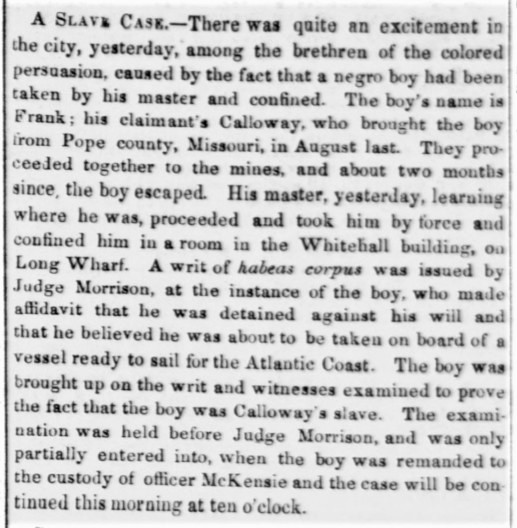
In 1850 a man named John Calloway brought an enslaved man named Frank from Missouri to California. Frank was eighteen years old. He worked at mining for several months and then ran away in January 1851. He found his way to San Francisco where for the next two months he mingled with the free black population and enjoyed his freedom.
Daily Alta California 31 March 1851 Note that Frank is always described as a “boy.”
Calloway tracked him down and had Frank held prisoner on a ship at Long Wharf, planning to take him immediately back to the South.
Long Wharf, San Francisco
It seems that Frank had friends who knew what had happened to him, because an affidavit was prepared on his behalf and delivered to Judge Morrison, who issued a writ of habeas corpus to have Frank brought before him.
Frank claimed he was being held against his will prior to being taken back to Missouri. Frank’s free black friends found him a defense attorney, Samuel W. Holladay. Mr. Calloway claimed that Frank was his property, but had no papers to prove it. At some point Frank admitted that he had been a slave in Missouri, but since blacks were not allowed to testify in court, the judge ruled that his testimony was inadmissible under state law.
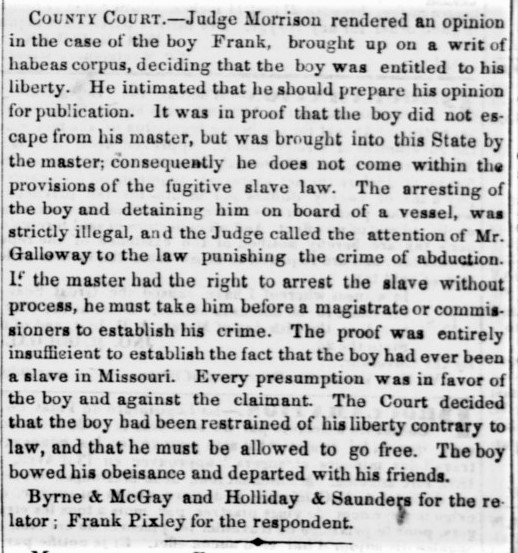
Was Frank a runaway as defined by the federal Fugitive Slave Act? Judge Morrison ruled that Frank could not be considered a fugitive because he had not crossed state lines to escape. Calloway had freely brought him to California; Frank had not escaped to California, but only in California, therefore the 1850 Fugitive Slave Law did not apply to his case.
Daily Alta California 02 April 1851
Such an outcome was anathema to Southerners in California. It meant that enslaved persons brought to California would now consider themselves free. Nothing could prevent them from running away. It endangered the slaveholder’s right to his “property.” It was not to be tolerated.
A bill was introduced in the legislature by Henry A. Crabb, originally from Tennessee. It stipulated that any persons “held to labor or service” who had been brought to California before it became a state, and who refused to return to their former state upon the demand of their owner, would be “deemed fugitives from labor” and could be forcibly made to return. It put no time limit on how long a slaveowner could stay in California with his “property.”
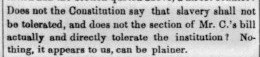
The editor of the Daily Alta California saw in this law a direct conflict with the state constitution.
Daily Alta California 18 February 1852
The pro-slavery faction was strong in Sacramento, and the bill passed the state Senate by a fourteen to nine vote. It had a twelve-month limit, but this would be renewed twice, so that the law was in force for three years.
Not all future fugitive slave cases would have the happy outcome of Frank’s case, and we do not know what happened to him after he was freed, but we can still rejoice in his freedom.
As a student of history, I knew about the federal Fugitive Slave Act of 1850. What I didn’t know about until recently was that California had its own Fugitive Slave Law, enacted in 1852, to deal with the unique circumstances of free and enslaved blacks in California.
Boston poster, April 1851. From Wikipedia.
The Fugitive Slave Act of 1850 was part of the Compromise of 1850. Brokered by Henry Clay, it was part of a parcel of acts that gave the Northern states and the Southern states each something they wanted, in exchange for something they didn’t want, but were reluctantly willing to compromise on. California came into the Union as a free state, but since it was the 31st state, it upset the 15/15 balance between North and South. In exchange the South got a toughened fugitive slave law that required both state officials and ordinary citizens to cooperate in the capture and return of men and women who fled from enslavement.
The Fugitive Slave law required that “when a person held to service or labor in any State or Territory of the United States . . . shall hereafter escape into another State or Territory of the United States, the person or persons to whom such service or labor may be due, . . . may pursue and reclaim such fugitive person . . . ”
And it wasn’t just officers of the law who were required to comply with this law or face a penalty. The law stated that “all good citizens are hereby commanded to aid and assist in the prompt and efficient execution of this law.”
The Fugitive Slave Law was not popular in the Northern states. Many found it cruel and offensive. Even for those citizens who were not anti-slavery, who had no objection to slavery in the Southern states, they still didn’t want to be compelled to participate in the capture of escapees.
How did this law play out in California, far from the Underground Railroad? Slaves were not escaping from Mississippi to California. They were going north to Canada or south to Mexico. So And why would the Golden State need its own version of the law?
The Constitution of California, written in 1849, stated that “neither slavery nor involuntary servitude, unless for punishment of a crime, shall ever be tolerated.” Nevertheless, slaveholders were allowed to bring slaves into the state so long as the slaveholders were “sojourners,” not planning to settle permanently.
Many Southerners brought slaves with them, usually only one or two or three, to work in the mines, to serve as domestics, or to be hired out as cooks, or servants, or laborers. No matter whether they stayed in California for one year or five, they didn’t think they were going to settle in California. Nearly everyone who came to the state planned to get rich quick and go home to live an easier life. They considered themselves “transients” or “sojourners” and they regarded the blacks they brought with them as their lawful property. Property they could take back with them to the South and servitude.
Bringing slaves to California, and keeping them enslaved, was largely tolerated in California. What happened when an enslaved person escaped?
Find out next time, when we look at the case of a young enslaved man named Frank.














 goldfields