Even though California was a free state, slavery certainly existed here. Slaveholders brought their slaves with them from the South, and they did everything they could to hold on to their “property.”
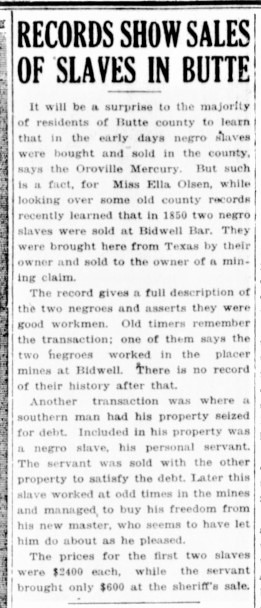
Chico Record 18 October 1917
But were slaves bought and sold in California?*
Up until now I hadn’t seen much proof, but I am not surprised to find out that it happened, as evidenced by this article in the Chico Record, October 18th, 1917. It actually must have happened a lot, as men came and went in the goldfields.
The article says that “two negro slaves” were brought to California from Texas (probably in 1849) and in 1850 they were sold to the owner of a mining claim at Bidwell Bar. The two black men didn’t have any say in the transaction, of course.
They are described as “good workmen” and since their price was $2400 each, they were valuable workers indeed. $2400 today would be about $59,400, according to Measuring Worth.
It’s likely that their “owner” took the gold that they mined and the money he made from selling them, and headed back to Texas with his profits.
The article notes that “there is no record of their history after that” but they had a better chance of getting their freedom in California than they would have had in Texas.
The other transaction recorded in this article is of a servant sold to satisfy a southern man’s debt. Again, the man who was sold didn’t have any say in the matter. He was sold for $600, a more typical price. Alvin Coffey was trying to earn $600 so that he could buy himself, that being what his “owner” had paid for him.
I haven’t gone to the Butte County Hall of Records to look up this transaction but that is something that would be worth doing.
My thanks to Craig Wisti, who posted this item on Facebook in the Butte County Pictures and Information feed.
*In this post I am only writing about African American slavery. Native California Indians, especially children, were bought and sold, and women were sex-trafficked.
The first test of the California Fugitive Slave Act (enacted in April 1852) came shortly after its passage. Three men, Carter Perkins, Robert Perkins, and Sandy Jones, were seized on the night of May 31, 1852, by the sheriff of Placer County and several other white men, including the man who claimed them as his fugitive slaves.
Charles S. Perkins, a white man from Bolivar County, Mississippi, had brought Carter Perkins, an enslaved man, with him to California in 1849. The other two men soon followed, and all three were put to work mining for gold. In the spring of 1851 Charles Perkins desired to return to Mississippi, so he left his three slaves in charge of John Hill, and told them that after another six months of work they would be freed.
Sacramento Daily Union 3 June 1852
In November 1851 John Hill told the three that their time was up. They were free men. But evidently he didn’t give them any deeds of emancipation; they just went off, confident in the assurance that they could now be numbered among the free blacks of California. They continued mining, with good success.
Then Charles Perkins returned.
You can see from this news item that the three men were doing well — they had a wagon, a span of mules, and $400. It also verifies that the men had been promised their freedom in exchange for a certain period of labor. On the other hand, it has their state of origin wrong, and since they worked for Perkins and Hill until November 1851, it can hardly be said that they “sloped soon after they landed.”
Sacramento Daily Union 12 June 1852
Members of the free black community and sympathetic white supporters raised money to engage three prominent attorneys to defend the alleged fugitives — Cornelius Cole, Joseph Zabriskie, and Joseph Winans. The lawyers drew up a writ of habeas corpus to bring the three men before Judge Aldrich. The judge ruled that they were fugitive slaves under the new law and handed them over to Charles Perkins. He took them to San Francisco, intent on getting them on board a steamer and taking them back to Mississippi.
The attorneys and supporters of the three black men were not done yet. They decided to fight the case on the basis that the law was unconstitutional. They rescued the men from the steamship where they were being held. A second writ of habeas corpus was obtained and the men were held in jail until the case could be heard by the California Supreme Court.
Unfortunately for the three former slaves and their attorneys, the case was heard by Justices Murray and Anderson, both of whom were from southern states. Not only did the judges have no sympathy for the plight of the defendants, but their pro-slavery opinions made it a nearly foregone conclusions that no argument against the fugitive slave law would be accepted.
According to Rudolph M. Lapp, author of Blacks in Gold Rush California (1977), the defense:
contended that the state Fugitive Slave Law of 1852 was an ex-post facto law designed to protect slaveowners long after the time intended by the state’s constitution. The court decided that no law could possibly impair the rights to slave property guaranteed by the federal constitution, since to do otherwise would violate the rights of the slave states.
Lapp, p. 146
This was the expected decision from any judge raised in the South. Nothing was going to interfere with Southern property rights. The two Justices found the law constitutional and valid, and they returned the three men to the custody of the man who claimed them as his property.
Mr. Perkins promptly put Carter Perkins, Robert Perkins and Sandy Jones on a ship and started back for Mississippi. But that is not quite the end of the story.
Writing to a friend back East, a Marysville anti-slavery man named W. C. Ellis reported that the three men escaped from custody at Panama. They were never seen again, and one can hope they found freedom in Central America.
This is the story of the case that led to the enactment of the California Fugitive Slave Law.
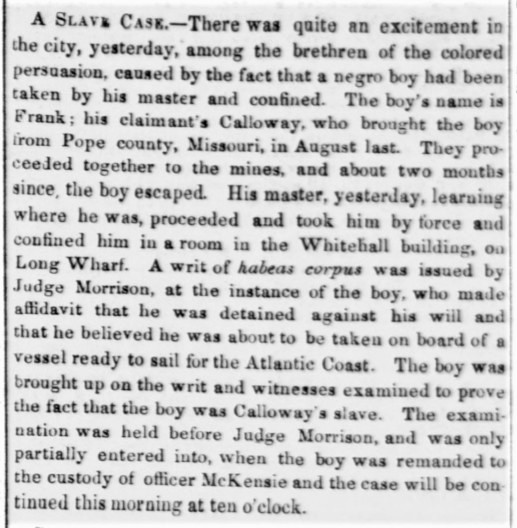
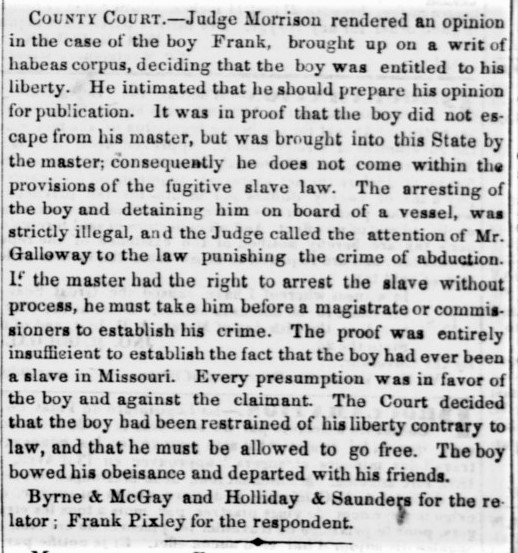
In 1850 a man named John Calloway brought an enslaved man named Frank from Missouri to California. Frank was eighteen years old. He worked at mining for several months and then ran away in January 1851. He found his way to San Francisco where for the next two months he mingled with the free black population and enjoyed his freedom.
Daily Alta California 31 March 1851 Note that Frank is always described as a “boy.”
Calloway tracked him down and had Frank held prisoner on a ship at Long Wharf, planning to take him immediately back to the South.
Long Wharf, San Francisco
It seems that Frank had friends who knew what had happened to him, because an affidavit was prepared on his behalf and delivered to Judge Morrison, who issued a writ of habeas corpus to have Frank brought before him.
Frank claimed he was being held against his will prior to being taken back to Missouri. Frank’s free black friends found him a defense attorney, Samuel W. Holladay. Mr. Calloway claimed that Frank was his property, but had no papers to prove it. At some point Frank admitted that he had been a slave in Missouri, but since blacks were not allowed to testify in court, the judge ruled that his testimony was inadmissible under state law.
Was Frank a runaway as defined by the federal Fugitive Slave Act? Judge Morrison ruled that Frank could not be considered a fugitive because he had not crossed state lines to escape. Calloway had freely brought him to California; Frank had not escaped to California, but only in California, therefore the 1850 Fugitive Slave Law did not apply to his case.
Daily Alta California 02 April 1851
Such an outcome was anathema to Southerners in California. It meant that enslaved persons brought to California would now consider themselves free. Nothing could prevent them from running away. It endangered the slaveholder’s right to his “property.” It was not to be tolerated.
A bill was introduced in the legislature by Henry A. Crabb, originally from Tennessee. It stipulated that any persons “held to labor or service” who had been brought to California before it became a state, and who refused to return to their former state upon the demand of their owner, would be “deemed fugitives from labor” and could be forcibly made to return. It put no time limit on how long a slaveowner could stay in California with his “property.”
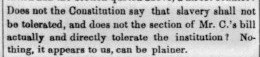
The editor of the Daily Alta California saw in this law a direct conflict with the state constitution.
Daily Alta California 18 February 1852
The pro-slavery faction was strong in Sacramento, and the bill passed the state Senate by a fourteen to nine vote. It had a twelve-month limit, but this would be renewed twice, so that the law was in force for three years.
Not all future fugitive slave cases would have the happy outcome of Frank’s case, and we do not know what happened to him after he was freed, but we can still rejoice in his freedom.
As a student of history, I knew about the federal Fugitive Slave Act of 1850. What I didn’t know about until recently was that California had its own Fugitive Slave Law, enacted in 1852, to deal with the unique circumstances of free and enslaved blacks in California.
Boston poster, April 1851. From Wikipedia.
The Fugitive Slave Act of 1850 was part of the Compromise of 1850. Brokered by Henry Clay, it was part of a parcel of acts that gave the Northern states and the Southern states each something they wanted, in exchange for something they didn’t want, but were reluctantly willing to compromise on. California came into the Union as a free state, but since it was the 31st state, it upset the 15/15 balance between North and South. In exchange the South got a toughened fugitive slave law that required both state officials and ordinary citizens to cooperate in the capture and return of men and women who fled from enslavement.
The Fugitive Slave law required that “when a person held to service or labor in any State or Territory of the United States . . . shall hereafter escape into another State or Territory of the United States, the person or persons to whom such service or labor may be due, . . . may pursue and reclaim such fugitive person . . . ”
And it wasn’t just officers of the law who were required to comply with this law or face a penalty. The law stated that “all good citizens are hereby commanded to aid and assist in the prompt and efficient execution of this law.”
The Fugitive Slave Law was not popular in the Northern states. Many found it cruel and offensive. Even for those citizens who were not anti-slavery, who had no objection to slavery in the Southern states, they still didn’t want to be compelled to participate in the capture of escapees.
How did this law play out in California, far from the Underground Railroad? Slaves were not escaping from Mississippi to California. They were going north to Canada or south to Mexico. So And why would the Golden State need its own version of the law?
The Constitution of California, written in 1849, stated that “neither slavery nor involuntary servitude, unless for punishment of a crime, shall ever be tolerated.” Nevertheless, slaveholders were allowed to bring slaves into the state so long as the slaveholders were “sojourners,” not planning to settle permanently.
Many Southerners brought slaves with them, usually only one or two or three, to work in the mines, to serve as domestics, or to be hired out as cooks, or servants, or laborers. No matter whether they stayed in California for one year or five, they didn’t think they were going to settle in California. Nearly everyone who came to the state planned to get rich quick and go home to live an easier life. They considered themselves “transients” or “sojourners” and they regarded the blacks they brought with them as their lawful property. Property they could take back with them to the South and servitude.
Bringing slaves to California, and keeping them enslaved, was largely tolerated in California. What happened when an enslaved person escaped?
Find out next time, when we look at the case of a young enslaved man named Frank.
I am getting around to some wonderful North State communities in the next few months. I love to talk to folks about history and am always happy to give presentations or sign books. Here’s what I have on my calendar:
Thursday, September 1: Orland Friends of the Library. 10 a.m. at the Orland Free Library meeting room. I’m looking forward to seeing old friends in Orland where I used to work as a children’s librarian.
Saturday, September 10: Chico History Museum, 10 a.m. The museum has a good slate of upcoming speakers. Come and see my presentation on Alvin Coffey.
Saturday, September 10: Tehama Museum History Keepers Rendezvous, 9 a.m. – 2 p.m. Loads of local history from local authors and their books. You may have noticed that I have two events scheduled on the same day. Not sure how I did that, except that I thought one of them was the following week. Not having a split personality, I will just have to do the best I can to be both places on the same day.
Thursday, September 22. Colusa Friends of the Library, 6:00-7:00 p.m. I have never been to the Colusa County Library, so as a dedicated library lover, I am looking forward to this one.
Saturday, October 15: Dairyville Orchard Festival. 10:00 – 4:00 at Lassen View Elementary School. Authors, crafters, artisans, and plenty of yummy food. Check it out!
Wednesday, November 9: Book-signing at the Chico Branch of the Butte County Library, 4:00-5:00 p.m., sponsored by the Chico Friends of the Library. My hometown library! Come and say “Hi!”
If you would like to have me come and speak to your group, just let me know. Put it in the comments or email me at goldfieldsbooksca@gmail.com. I don’t charge a fee, unless you want to help me pay for gas.
I love to talk to students and classes too. Let your California and U.S. History teachers know.
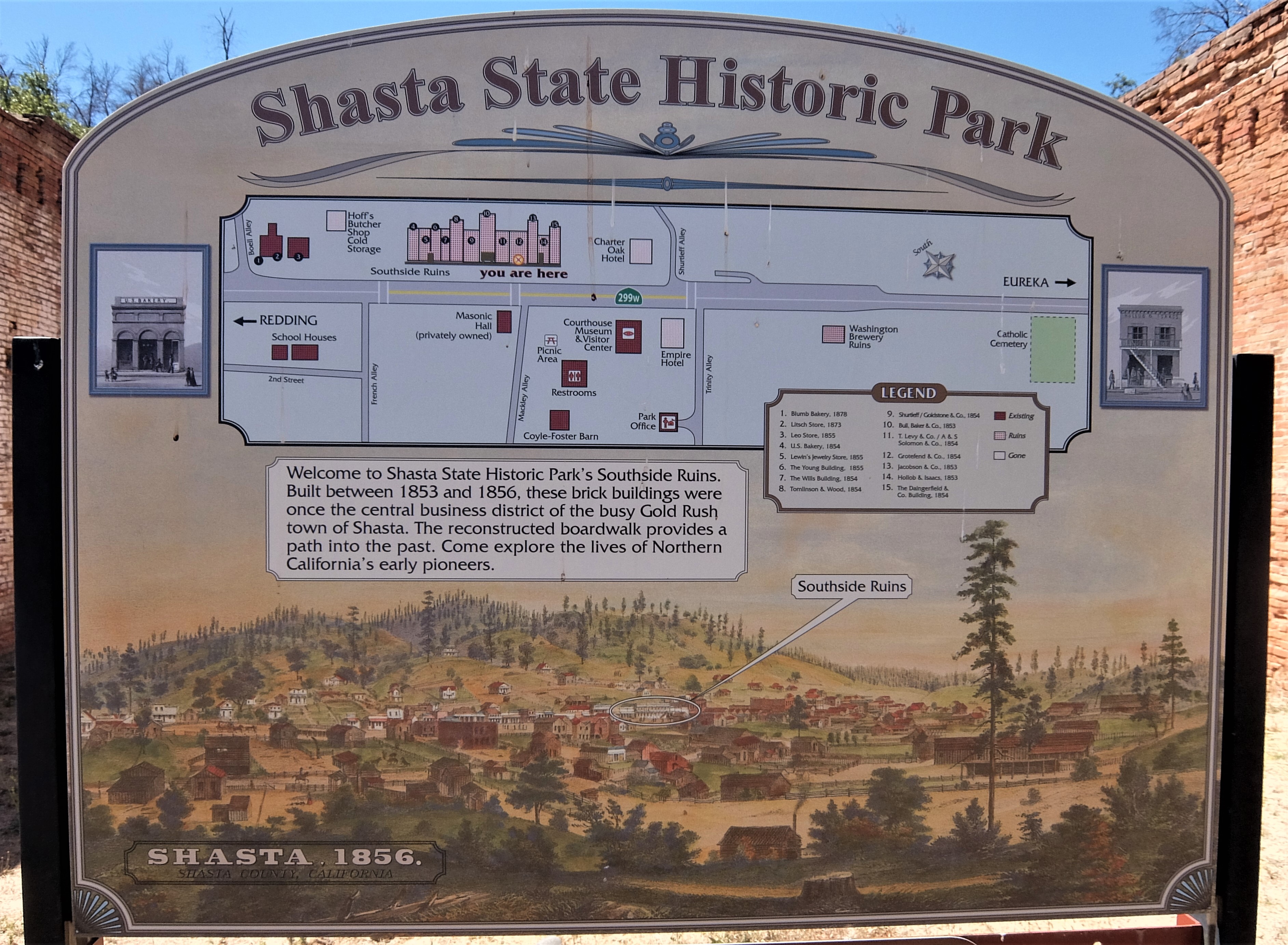
Last May I posted about a visit to Shasta State Historic Park, but at the time the Courthouse Museum was not open. Well, guess what? It’s open now, Thursday through Sunday. It’s a great time to visit. We went there today.
State Parks staff are still working on the exhibit in one of the rooms, so the upgrade is not complete. But there is still plenty to see. The town of Shasta has a rich history and the state park does a good job of bringing it to life.
We visited the courthouse museum first, where I left a copy of my Alvin Coffey book for them to consider putting in the gift shop. Alvin is featured in one of the museum’s displays.
Life could be wild and woolly in old Shasta. Here is a display about the Ruggles brothers, who held up a stagecoach. They used the pistol in the holdup and used the ax to bust open the strongbox. You can see that they didn’t get away with it and justice was swift.
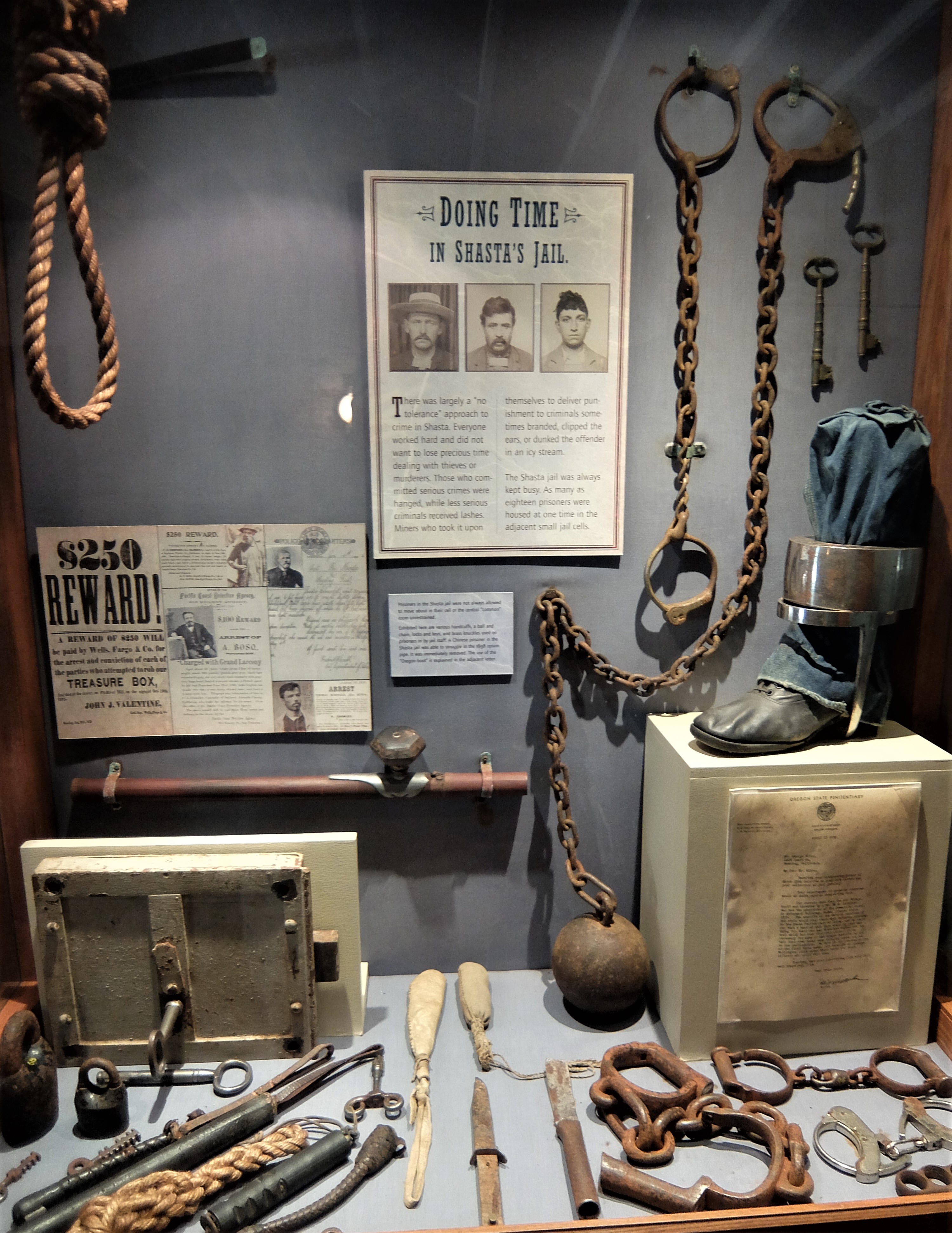
Downstairs you can see the jail, with an appropriate collection of leg irons, handcuffs, nooses, truncheons, and a horrible hobble called an “Oregon boot.” The gallows is just outside.
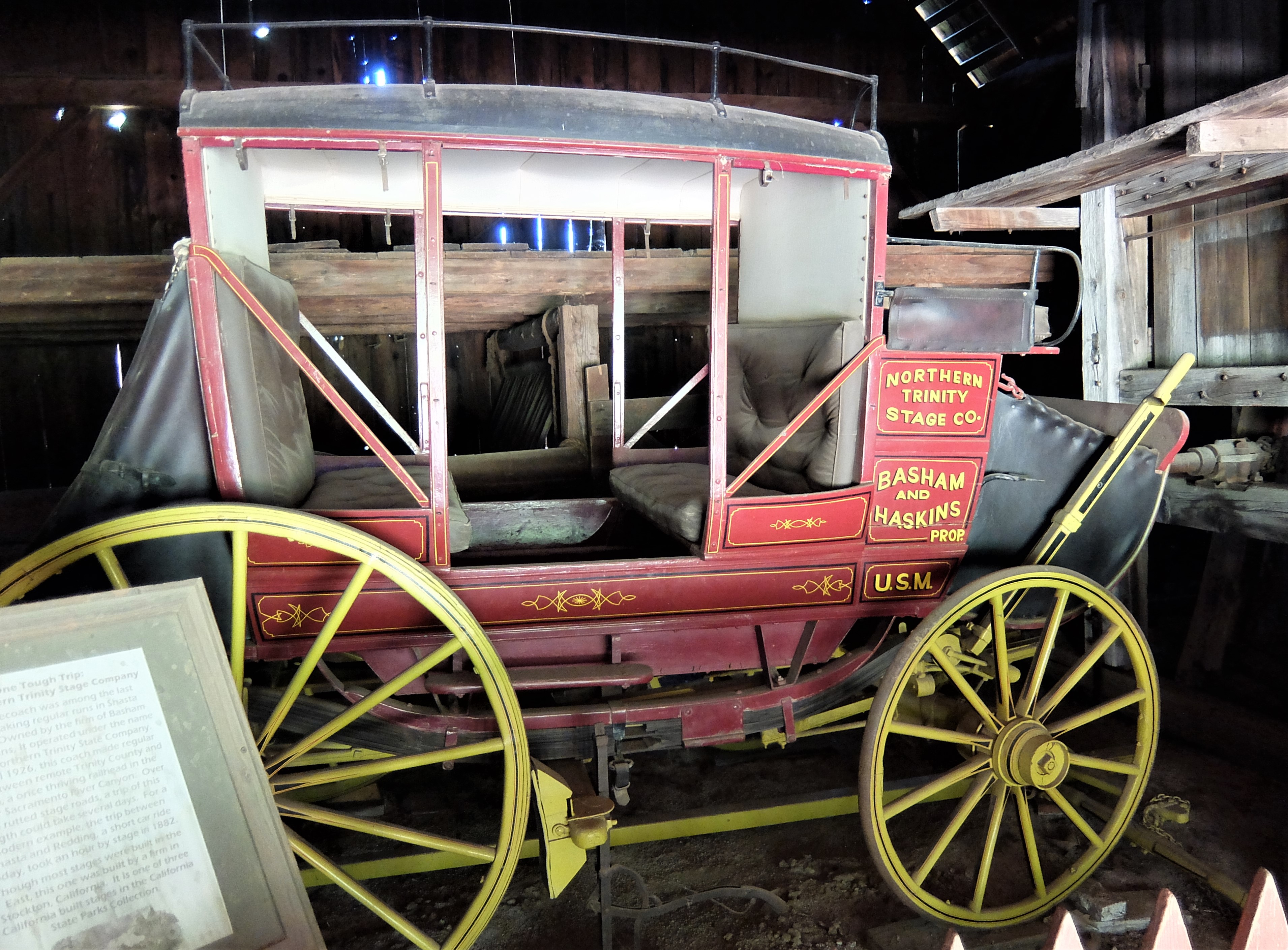
It’s not all display cases at Shasta State Historic Park. We ate our picnic lunch in the wide shade of a leafy oak tree, then went inside the barn to admire a handsome stagecoach that once plied the route from Trinity County to the Sacramento River.
After that we ran across the road to see the “Southside Ruins,” the remains of the brick fire-proof buildings that once were a central feature of Shasta, the “Queen City of the Northern Mines.” It’s all well worth a visit. You can even get lunch or an ice cream at Shorty’s Eatery, open under new management.
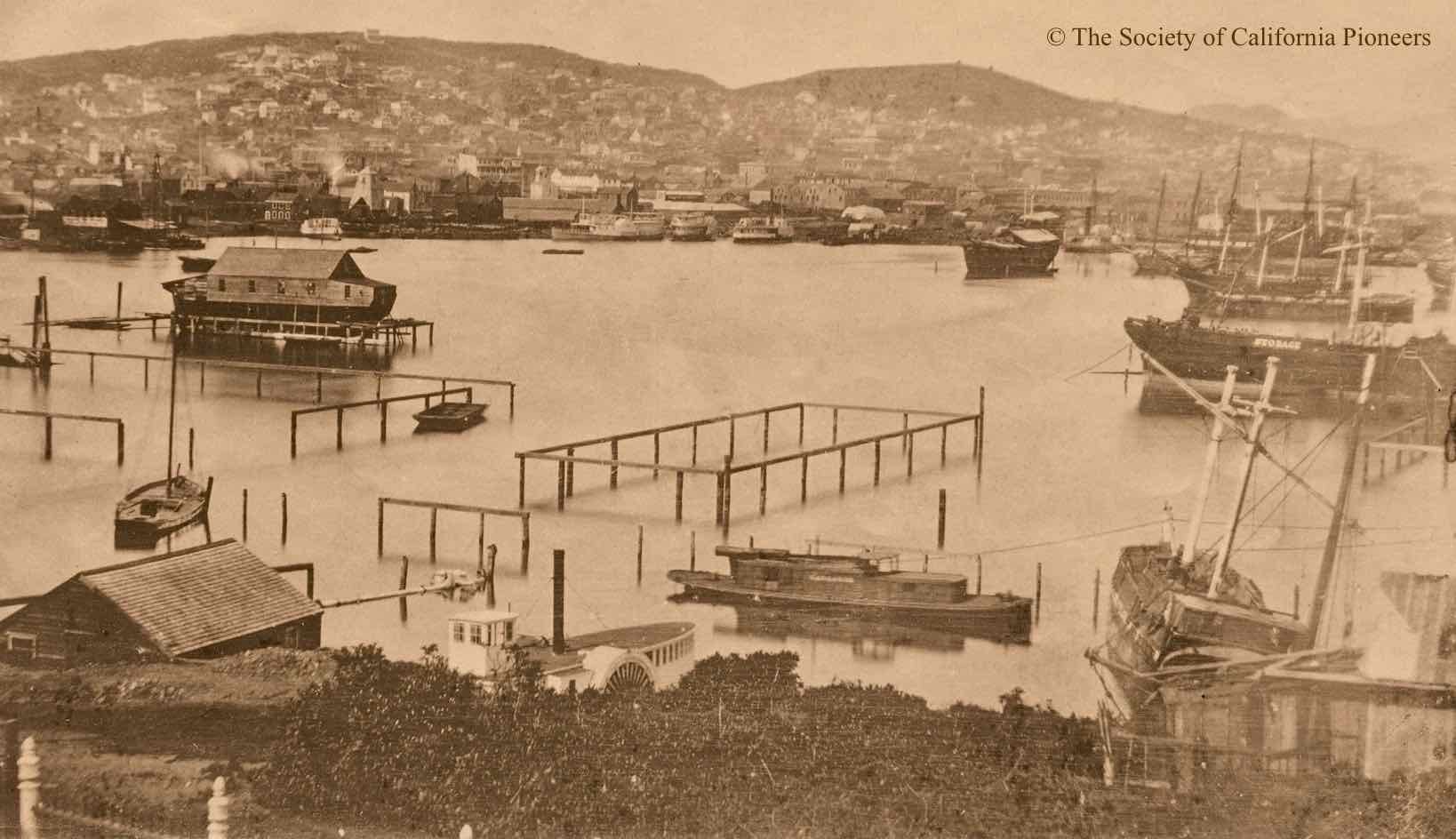
The Society of California Pioneers has an online exhibit of a fabulous panorama of San Francisco Bay in 1853. Take a look.
The panorama is a series of five photographs taken by William Shew. The first panel shows a collection of buildings, mostly wooden. Two are signed Sutter Iron Works and Sutter House (a hotel), showing just how much Sutter’s name was identified with California. The second picture shows the bay with water lots marked out by stakes. These were bought and sold even before they were filled in with debris and became buildable lots. A white steamship by the shore was probably functional, unlike most of the sailing ships in the next three panels.
All that water has long since been filled in and forms downtown San Francisco.
The rest of the panorama shows scores of vessels, almost all abandoned by their crews, gone to the goldfields. Some of those ships would be used for storage or their timbers repurposed for building on shore.
The Society of California Pioneers has one of only two sets of these photos. The other belongs to the Smithsonian.
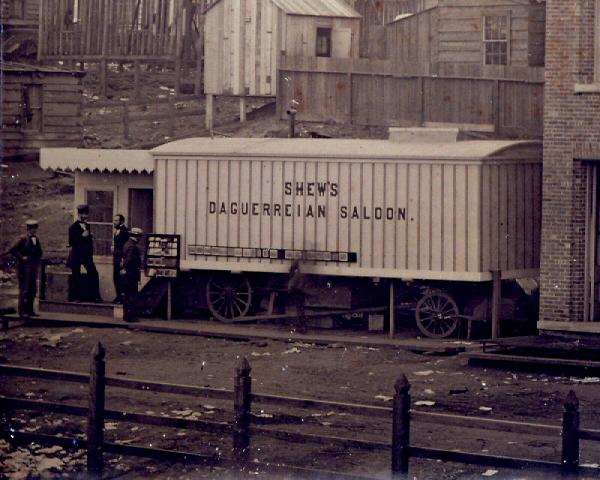
The photographer was William Shew, who came to San Francisco in 1851 and set up shop in a wagon — his “Movable Daguerreotype Saloon.” Later he would move his business to a fire-proof building.
Daily Alta California 8 August 1857
And just in case you are shopping for a daguerreotype of yourself or a loved one, here is his price list, as of 1857.
Mr. Shew boasted in another advertisement of “taking likenesses of children almost instantly.” So for only $3 you could have your toddler immortalized in a daguerreotype.
According to Measuring Worth, that would be about $100 today. But well worth it!
Sebastian Keyser was granted Rancho Llano Seco in 1844 but he never lived there and never made improvements on the land. Why did he take title to a piece of land he never intended to use?
No one knows. But one can speculate. Keyser didn’t have ambitions to be a farmer, like Bidwell. He could have raised cattle and horses, but that wasn’t the life he was accustomed to. Rancho Llano Seco was a long way from Sutter’s Fort and it’s possible he knew he would miss the action and the conviviality of life at the fort.
It wasn’t unusual for a man to take a land grant that was available and hold it until he found a more desirable place. Bidwell tried two other locations until he was able to acquire the land he really wanted all along, Rancho Chico. In 1845 Keyser found a better place too.
When Pablo Gutierrez died in 1845, John Sutter put his land grant on the Bear River up for sale. It was bought by the partnership of William Johnson and Sebastian Keyser. This was an advantageous location, closer to Sutter’s Fort and the first settlement that emigrants from the States came to in California. Emigration was increasing; at Johnson and Keyser’s ranch there was traffic, people to meet and money to be made.
1846 was a busy year on the California Trail. It is famously the year of the Donner Party disaster, but before they were trapped in the Sierra snows, several other parties came in. One of those parties included the Rhoades family, parents and 12 children.
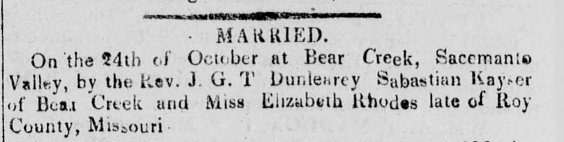
This group arrived at Johnson’s Ranch on October 5, 1846. Sebastian Keyser married 18-year-old Mary Elizabeth Rhoades on October 24, 1846, less than three weeks after she arrived in California. He was twice her age.
Californian 12 December 1846
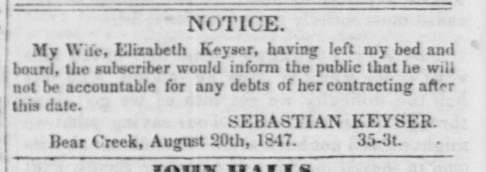
Keyser was a rough customer and the marriage seems not to have been a happy union. Six months later Elizabeth left Sebastian. He placed a notice in the San Francisco newspaper.
California Star 4 September 1847
But she “returned to make him happy” later that year, at least that is the way Bancroft’s Pioneer Register puts it. She bore him a child in 1848 and twins in 1849, but none of the children survived infancy. (Information on the children is from Familysearch.com)
Keyser sold his interest in Johnson’s Ranch to his partner in 1849 and left the ranch. His wife’s sister Sarah had married William Daylor who had a ranch on the Cosumnes River. I assume the sisters wanted to stay close to each other. Keyser settled on Daylor’s Ranch and ran a ferry on the river.
He drowned in the river in January 1850. Did Elizabeth shed many tears? Somehow I doubt it.
Writing to Edward Kern in 1851, George McKinstry included Keyser when he wrote “The old Sacramento crowd are much scattered by death and disaster since you left.”
Elizabeth Rhoades Keyser remarried three times and had three more children who lived. She died in Kings County, California, in 1899, 49 years after her first husband.
An Old-Time Mountain Man with His Horse by Frederic Remington
Sebastian Keyser was a native of Austria and a rough-and-ready mountain man in the employ of the Hudson Bay Company when he met John Sutter in 1838. Sutter was making his way to the Oregon Territory when he met Keyser and Nicolaus Allgeier at a fur trappers’ rendezvous in the Rockies. No doubt the three men found a commonality in the German language that they shared.
They traveled together to the Willamette Valley. Sutter was anxious to get to California, so he took ship to Hawaii. It was easier to travel by ship to California than by land, although Sutter would end up taking a roundabout trip to get there. Arriving in Hawaii, the only transport he could find was a ship bound for Sitka which would eventually make its way to California. He probably told Keyser and Allgeier that if they ever looked him up in California, he would be happy to have them join his venture.
Keyser and Allgeier made their way to Sutter’s land grant in 1840 or possibly 1841. Sutter was in need of tough men like those two. He was trying to establish a post near the confluence of the Sacramento and American Rivers, but the local Nisenan and Miwok Indians resented his presence and made off with his cattle and horses. Enlisting men like Keyser gave Sutter what his biographer, Albert Hurtado, called “Sutter’s Praetorian Guard.” It was unlikely that the Indians would be able to eject Sutter from the valley; “too many hard men with weapons stood in the way.”
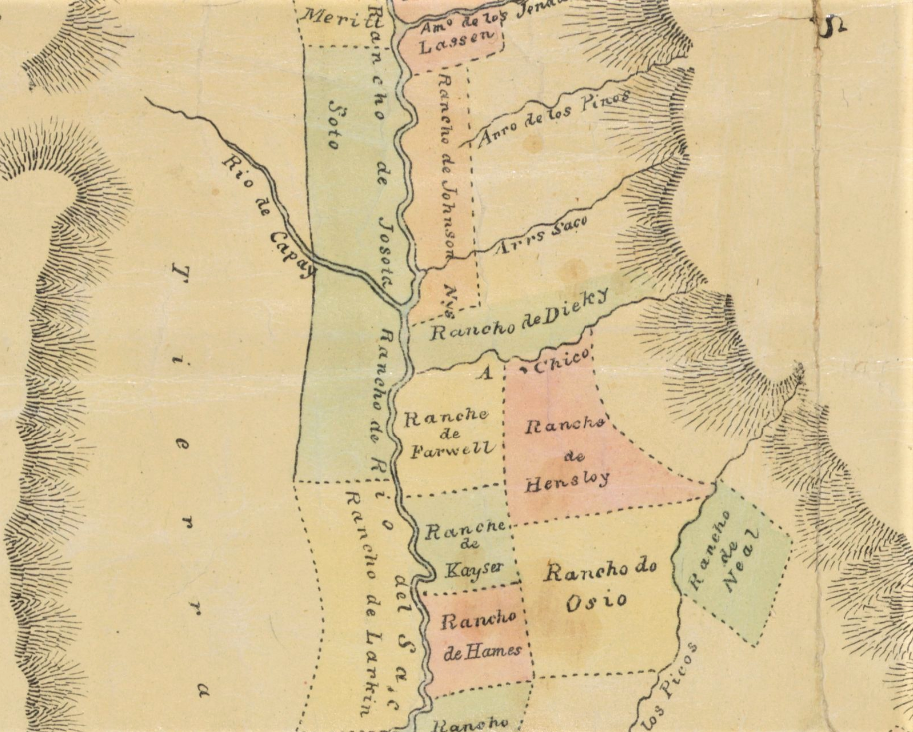
Working for Sutter was fine, but what nearly all men wanted was land of their own. Sutter assisted Keyser in acquiring a land grant from the Mexican government. In 1844 Keyser got Rancho Llano Seco on the east side of the Sacramento River, shown here in a detail from a map drawn by John Bidwell.
You can see “Rancho de Keyser” just below “Rancho de Farwell.” “Rancho de Dickey” on the north side of what is labeled A[rroyo] Chico is the later Rancho Chico acquired by Bidwell. Keyser had explored the area and selected his future rancho in 1843, accompanied by William Dickey and Swedish naturalist G. M. Waseurtz af Sandels.
Mapa del Valle del Sacramento detail. California State Library
Llano Seco means “dry plain,” although there are plenty of wetlands on the ranch. Sebastian Keyser never occupied the ranch and never made improvements on it, in fact he turned right around and sold it to Edward Farwell in November 1844, four months after he was given the deed.
Next Time: The Rest of the Story of Sebastian Keyser
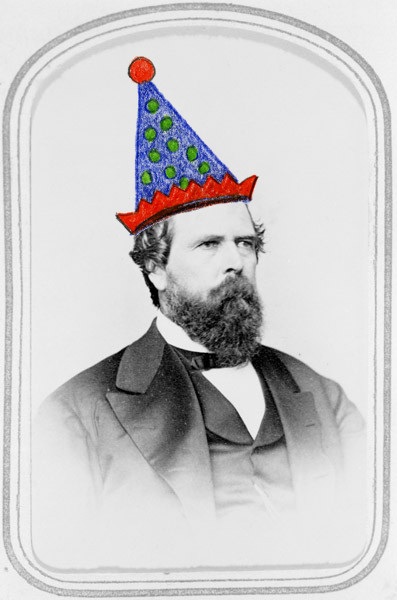
August 5th marks the 203rd birthday of John Bidwell, California pioneer and founder of Chico. So wish him a “Happy Birthday!” (wherever he is), and maybe pay a visit to his home, Bidwell Mansion State Historic Park, sometime soon. It is now open for tours on Wednesday, Saturday, and Sunday.
Looks pretty good for being over 200, doesn’t he? Evidently, he was the type that ages well. According to Annie Bidwell’s diary entry for August 5, 1893:
General’s birthday. 74 – Scarce a gray hair in his rich brown hair, and not a bald place! Dressed in white today he is the picture of freshness, roses on his cheeks & happiness in his eyes, and fun & wisdom in his conversation.
What a pleasant hour we have passed at dinner table. General, Col. Royce, Prof. H. W. Henshaw & self! Funny stories and scientific & social conversation. How the watermelons suffered! Had four large ones, blackberries, peaches, plums, & enormous nectarines, the first of latter of the season.











 goldfields