Death in Downieville

In Camp and Cabin with John Steele — part 3.
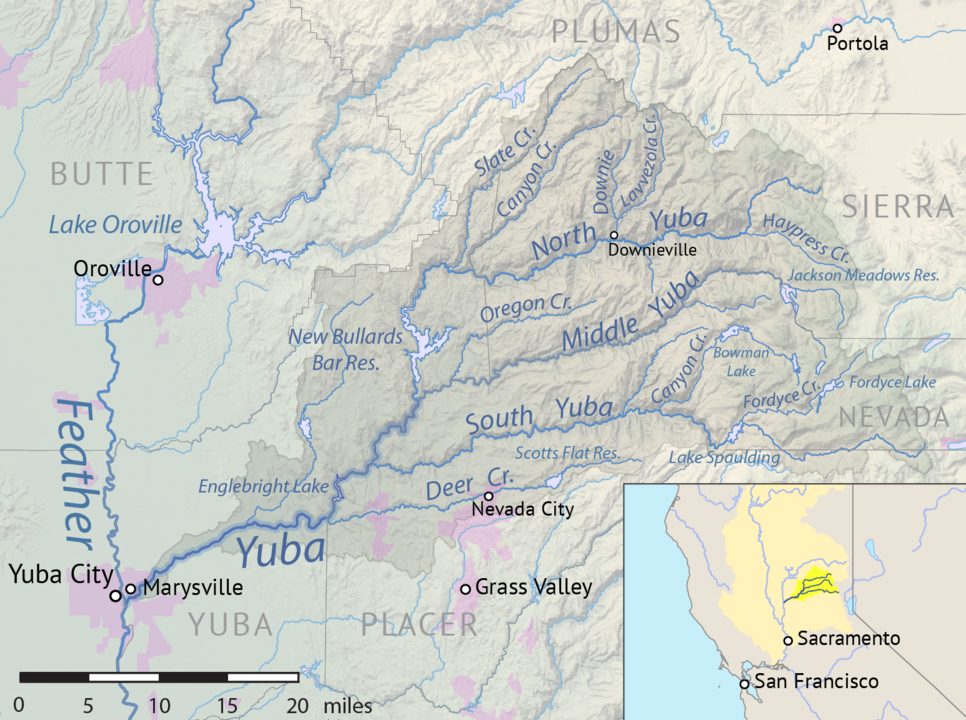
Map of the Yuba River. By Shannon1 – Own work, CC BY-SA 4.0, https://commons.wikimedia.org/w/index.php?curid=47084527

Leaving Nevada City in January 1851, John Steele and several other men headed over the snow-covered ridges, aiming for Big Meadows and the North Fork of the Feather River. They didn’t seem to realize that this was a crazy and dangerous thing to do in the middle of winter.

When the morning of our departure dawned, a misty rain made us hesitate until 10 a.m., and then, like a train of pack mules, we filed up the mountain. Besides our blankets, some extra clothing, rifles and ammunition, Donnelley and I carried a pick and a spade, pan for washing gold, frying pan, and tin cups; and bread, flour, and bacon enough to last two weeks. (p. 151-152)

Three days later they camped near Downieville, “a mining village at the forks of the North Yuba.” One of the men came into camp saying, “I reckon somebody has struck it rich down there, and covered up their prospect hole so as to hide it.” Curiosity impelled investigation.
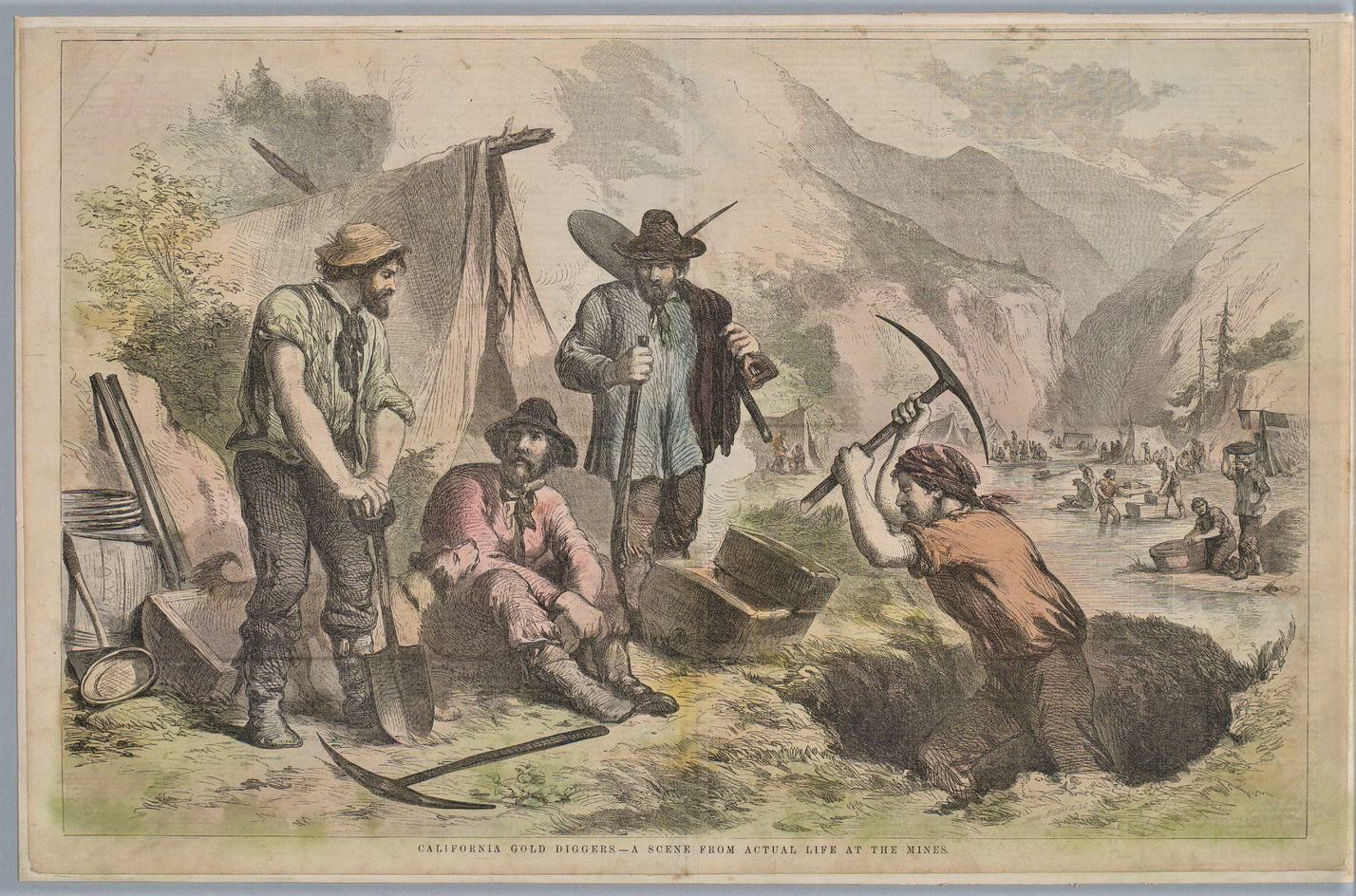
California Gold Diggers. Bancroft Library

With picks, shovels, and pans, three of us accompanied him to the bottom of a deep, wild glen; not that we intended to “jump” any one’s claim, but as a possible clue to diggings above and below on this side of the river. There was no snow, and on the mossy bank of a rill could be seen the outlines where the ground had been broken; but the turf was so nicely adjusted that but few traces were visible.

Spading away the soft earth to the depth of about three feet, we found — not a gold mine, but that which made us start back in horror — a blue shirt sleeve on the arm of a corpse.

Gently the body was uncovered and raised to the surface; water was brought and, washing away the mire, disclosed the features of a young man, of probably twenty years; about five feet in height; dark brown hair; his only clothing a blue woolen shirt, dark brown pantaloons, and heavy boots.

His pockets were empty and there was nothing about him to reveal his name. Traces on each side of his head indicating where a bullet had passed through, were the only marks of violence upon his person. Evidently he had been murdered a few days since and his body concealed in this wild glen. (p. 155-56)

The men took the body to Downieville. No one could identify the murdered young man. He was buried there in Downieville in a nameless grave. Mournfully Steele contemplated the father, mother, brothers, and sisters who would wait in vain for the return of their loved one, never knowing his fate.
Posted in John Steele, Uncategorized | Leave a comment

In Camp and Cabin with John Steele — 2

John Steele was a well-educated, Bible-reading, poetry-loving, and seemingly mild-mannered young man. But in the California goldfields a man had to be prepared for anything. Sometimes the answer to a problem was a pistol.

Once he and his friends had earned enough to buy their own tools, they went prospecting on their own and did pretty well, until Steele got sick. Weeks later, after his recovery, he went back to Nevada City to collect the back wages owed him by his first employer, a Mr. Dinkler.

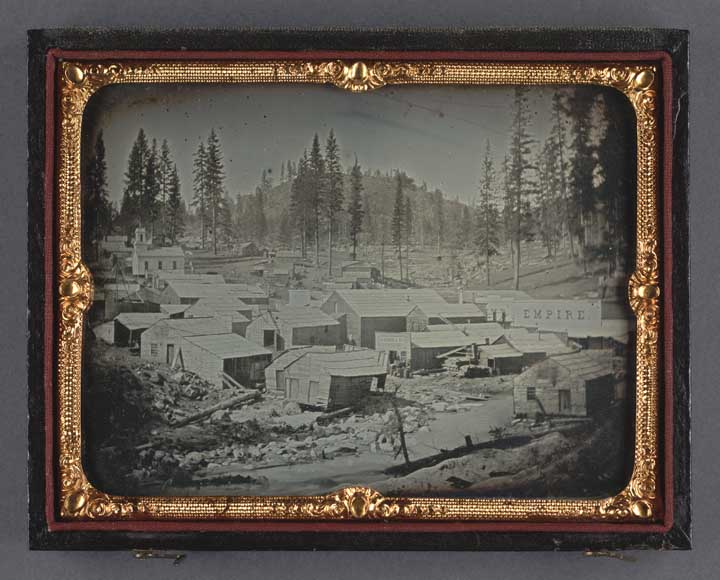
Nevada City in 1852. California State Library

Dinkler turned out to be a slippery character.

When I quit work for Mr. Dinkler he paid me only part of my wages, saying, when he had time to wash the gravel, within a few days, he would pay the rest. Weeks had passed, and now, after three days’ failure to find him, I began to suspect he was trying to evade me. . . Again and again, when a time was set to meet him, where his workmen said he expected to be, he failed to appear. It was reported that though he had taken large quantities of gold from his mines, he would never pay a dollar if he could help it. (p. 146)

Finally Steele caught the elusive Mr. Dinkler early one morning at his mine. He claimed to not have the gold on him, and Steele countered that any shopkeeper would loan it to him. They went to a shop.

I explained to the merchant the circumstances, that I was about to leave, and would he not be so kind and obliging as to loan the money to Mr. Dinkler for a few days.

“Certainly,” said the merchant, “I could advance the money, but I believe he has it, and if he won’t pay you without trouble, he won’t pay me.”

This seemed to settle the matter and a look of satisfaction came over Dinkler’s face as he turned to go out. There was still another resort, and I resolved to frighten him into payment.

I sprang before him to the door, and presenting a pistol, with a loud voice ordered him to “Stop! Now sir, I’m going away this morning, but this matter must be settled first; you can pay it now, or never have another chance.”

His voice trembled as he shouted, “Don’t! Don’t shoot!” And springing to the counter, upon which stood scales for weighing gold, he drew from his pocket a large buckskin purse of the shining metal, weighed out the amount of my claim, and handed it to me. (pp. 147-48)

The drama and the shouting attracted a crowd of men, who gathered round and told Dinkler, “No, Fred, it’s your treat; you intended to cheat that boy out of his wages; now you shall treat the crowd; set out the cigars.”

And that’s how John Steele got his wages, and all the other men got their cigars.

Posted in John Steele, Uncategorized | 2 Comments

In Camp and Cabin with John Steele

John Steele was eighteen years old when he caught a case of gold fever. He made the overland trek from Wisconsin to California in 1850. A diligent diarist, he kept a journal on the trail and during his three years in California. Much later in life he turned his journals into two books: Across the Plains in 1850 and In Camp and Cabin. The experiences he relates are typical of the gold seeker: adventure, tedium, peril, humor, and plenty of everyday detail. Join me as I highlight a few of Steele’s adventures.

It was late September when Steele and his trail mates arrived in California and passed through Nevada City, “which was little else than a row of canvas-covered houses on either side of the emigrant road in the valley of Deer Creek.” (Across the Plains in 1850, p. 224)

They had no money, tools, or provisions, and they were hungry, so they immediately began looking for work.

Having ascertained that wages, for those who worked in the drifts on Coyote Hill, were sixteen dollars a day, we felt happy at the prospect. Gold seemed to be abundant everywhere, except in our pockets, and we had faith to believe they would soon be replenished.

In Camp and Cabin, p. 120 (Lakeside edition, see below)

Steele could find no one to hire him that first morning. At noon he went to a bakery and bought a little loaf of bread “only a fair-sized biscuit.” The price was 50 cents and Steele only had 35 cents in his pocket, but the baker took pity on him. “Take the loaf; fifteen cents is nothing in California.”

The next day Steele decided to look for work in the deep mines. “In anticipation of immediate work, and of probably descending into some damp, cool shaft, I put on my wamus of striped bed-ticking, such as was then worn in the lead mines of Wisconsin.” Good move, as we shall see.

You can still buy a wamus. Here is a Universal Works Wamus Lightweight Jacket

And what is a “wamus”, I hear you ask. Not a word I am familiar with, but the dictionary definition is “a heavy cardigan jacket, loosely knit and belted, or a durable, coarse, outer jacket.”

Hearing a man say that he had just finished his shaft, and was redy to begin drifting, I applied to him for work. My boyish appearance was not assuring, and my sun-burnt face told that I had just arrived at the mines. He eyed me for a moment and inquired, “What do you want a day?”

“Just what you think I’m worth; in fact, I wouldn’t mind working for my board until I get acquainted.”

He simply said, “No,” and went on counting a pile of blocks for timbering. (p. 123)

Wrong answer. The next minute came another man asking for work, “a slender, sickly-looking man.” He said he wanted sixteen dollars a day and was hired. (Never undersell yourself.)

Approaching another shaft, which indicated readiness to begin drifting, I inquired, “Do you want a drifter?”

“Yes, what’s your wages?” “Sixteen dollars a day.”

“That seems pretty steep.” “It’s for you to say.”

“Where are you from?” “Wisconsin.”

Just then a stranger to us both chimed in, “When you see a boy from Wisconsin wearin’ them togs, he’ll do in the mines anywhere.”

“All right,” said the mine owner, “go to work and we’ll see how it pays.” (p. 124)

Wearing his wamus jacket, the uniform of a Wisconsin lead miner, paid off for Steele, although he had no mining experience whatsoever. From talking to miners he had learned something of the trade, and he successfully secured the timbers at the bottom of the shaft and mined it for three weeks. The mine paid out handsomely and the mine owner cheerfully paid Steele for his work. It was the beginning of his mining career.

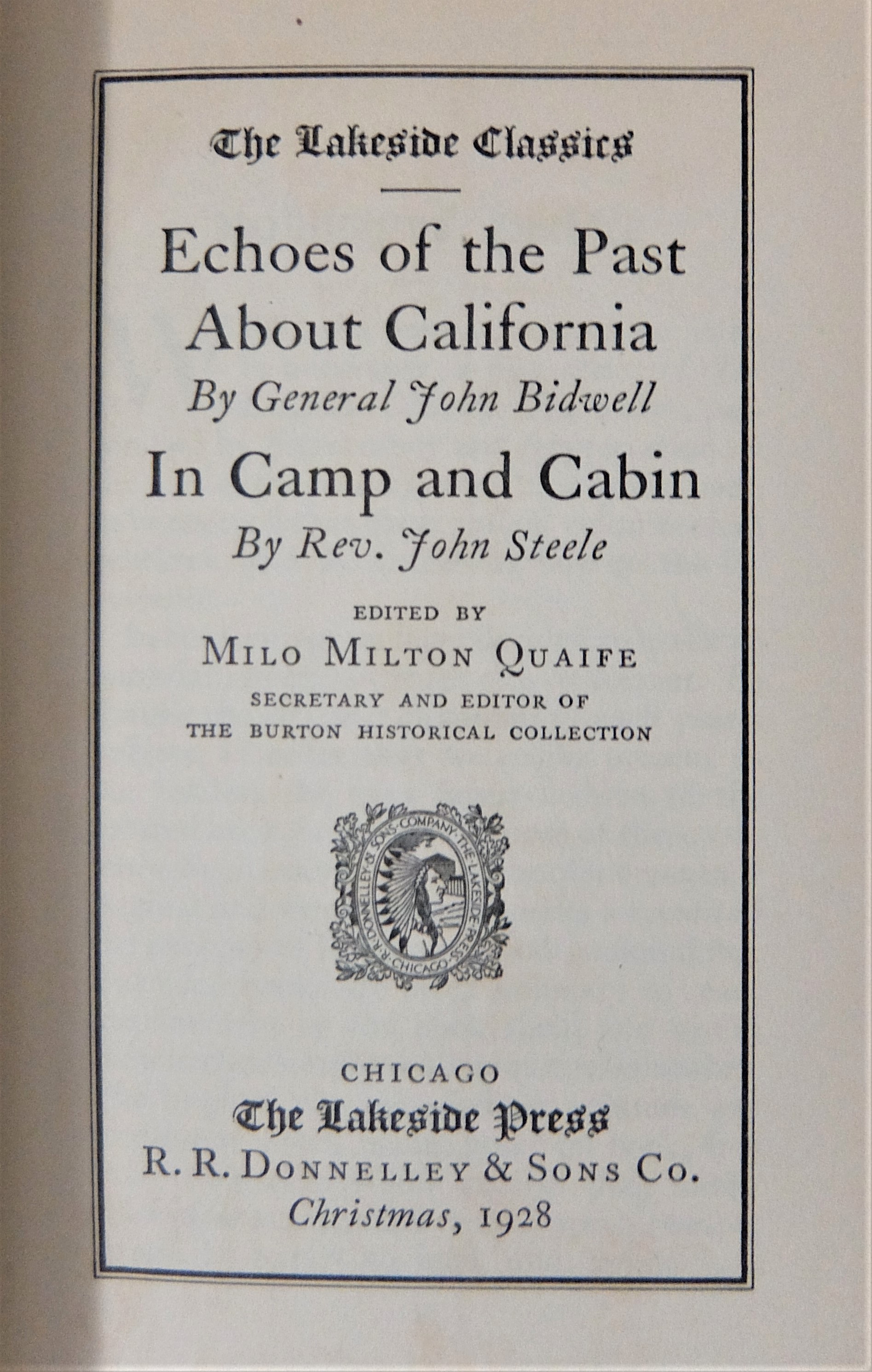
(I am using the Lakeside Classics edition, published in 1928. Steele’s account is bound together with Echoes of the Past About California, by General John Bidwell.)

Posted in John Steele | 1 Comment

William B. Lorton the the Goldfields

It’s a shame that William B. Lorton’s California journals are lost. He was such a lively and candid writer — I am sure his tales of adventures in the goldfields would be a delight to read. Unfortunately they are lost in the sands of time.

We do get a glimpse of Lorton in northern California from the journal of another gold seeker — Dr. Charles R. Parke of Pennsylvania. Parke and his company had taken the northern route and arrived at Sacramento on September 15, 1849. They went north to mine on the Feather River and staked their claim “5 miles above Bidwell’s Bar and half a mile above Oregon Bar.” (quoted in Troubadour on the Road to Gold, p. 279.) They called their claim Union Bar; the location is now under Lake Oroville (or maybe not, with this dry year).

William Lorton arrived in the spring of 1850, as recorded in Parke’s diary, and met up with his cousin David Cairnes.

May 8. Dave Carns accidentally met his cousin today. He left Illinois last year in the Holt [Knox] Company train. Arrived in Salt Lake last summer, where they spent six weeks, sold their oxen, and bought mules and horses, and with a guide took the South Trail for California with one hundred horses. Thermometer today stand 900 in the shade.

Lorton had some good tales to tell.

May 15. Mr. Lorton (Carns’ cousin) entertained us today with many anecdotes about the Mormons.

And he hadn’t lost his musical talent.

June 8. Had some fine vocal music last night from Mr. Lorton, reminding me of home.

A week later some of the men went off seeking the fabled “Gold Lake” but failed to find that phantom source of riches. Parke, Cairnes, Lorton and the rest of the Union Bar Company built a dam to divert the middle fork of the Feather River. All their hard work yielded a poor return, so they left for Sacramento.

September 6. Left Feather River in August in company with Capt. Sampson and Wm. B. Lorton and came to this city where I have been loafing until a few days ago . .

Dr. Parke practiced medicine for a few months and then returned to the States. Lorton stayed on in California until 1853 or ’54, when (according to his obituary) he returned to New York City “with a handsome fortune.” He went into the business of making clocks. He planned to turn his journals into a book, but never completed the project. (Too bad!)

William B. Lorton died in 1893.

Here is a sketch he made of himself in the goldfields, all skin and bones and bushy hair.

Posted in William B. Lorton | 1 Comment

William B. Lorton in Salt Lake City

William B. Lorton arrived at the Mormon community in the Salt Lake Valley on August 8, 1849. To visit Salt Lake City was a deviation from the Oregon-California Trail, but one that many took in order to trade goods. The Mormons (members of the Church of Jesus Christ of Latter-day Saints) had only been in their new settlement for two years, yet they had thriving farms and a growing population.

Salt Lake City in 1850

If Lorton’s company had pressed on, it was not too late in the season to cross the Great Basin and the Sierra Nevada mountains. But they lingered for over a month, recuperating their livestock and inquiring about the different routes. They considered over-wintering at Salt Lake City.

Brigham Young warned all emigrants that his people could not support any guests over the winter. He also predicted that anyone setting out for California by way of the Humboldt River would surely die along the way. And it is true that the California Trail was strewn with dead cattle and marked by the graves of pioneers, although many forty-niners made it through safely, if not easily. And then there were the tales told of the Donner Party. What if they made it across the desert, only to be trapped in the mountains?

Brigham Young urged Lorton’s company and others to instead take the southern route through Utah down to the Old Spanish Trail. He had his reasons — the Mormon settlers were in need of a year-round route to the ocean. So far only a couple of pack trains had made that trip — what he needed was a wagon road. He offered a trail guide to accompany them if they would take their wagons southward and break a new wagon road through to southern California.

August 14th. Never was I in [such] a delema before, or ever before struck so forcibly that it was necessary to do something, & that immediately. I now fancied I see the blues coming rappidly towards me, & the horrors grinning at me with a double row of teeth, & what makes it worse, everybody was in the same fix. No one knew what to do.

To cross the trackless desert [via the Southern Route] was burying yourself alive, & to go the Northern rout rushing in to a grave yard & riding over dead bodies. Word comes that the fort hall road is so lined with carrion that new rodes had to be made, & the stench so stifleing as to almost stop the breath, & so thick are they, you can almost step from one to another. The grass is nearly all ate up & thus alkali.

p. 175

A dilemma indeed! They can’t stay where they are, and either route could mean their deaths.

It wasn’t all gloom and indecision though. Lorton boarded with a friendly Mormon family and attended church meetings and concerts.

August 22nd. Have singing at sister Pratts & pritty girls.

p. 181

On September 24th Lorton bade farewell to his hosts and headed south to join several wagon trains that were planning to take the southern route. It was a long, terrible journey, arguably much worse than what they would have faced on the northern route. At last, in early January 1850, they arrived in southern California.

Lorton’s journal ends mid-sentence with the January 16th entry at Mission San Gabriel. The next volume is missing, so little is known of his adventures in California, a great loss.

San Gabriel Mission, by Edwin Deakin
Posted in Uncategorized, William B. Lorton | Leave a comment

William Lorton and the “Stampede Company”

William Lorton experienced more than his share of stampedes while on the overland trail. Difficulties with cattle continued to dog his company. On July 19th, while traveling along the Sweetwater river, they experienced three stampedes in one day. At noon he sat down to write in his journal (the spelling is his own):

While I wrote the above [about sage hens, antelope, and hares], sitting in the waggon at noon, a “stampeed” occurred. We halted at dinner upon a high hill. . . . We had all eaten dinner. Some were lying under the waggons assleep. Others set between the wheels & others in the wagons the same as myself. They say a saddle horse belonging to packers frightened them [the oxen]. The hind teams attached to wagons commenced & as quick as electricity they were all dashing down the steep hill.

Capt. Talors little boy was run over by waggon & oxen, another had a hand run over, another knocked in the head, another run over the leg, others knocked down, cattle became entangled in chains and wheels, axels broke, wheels passed over oxen, & 1 ox was dragged way down the hill under the box with feet up. He had a horn broke off & otherwise injured. Broken horns lay all around . . .

Troubadour on the Road to Gold, p. 141

And that wasn’t the end of it.

In less than 2 hours after writing the above we had 2 more “stampedes” 1 was caused by a dead ox laying beside the road. The other was caused by nothing at all. At night while caraling, we could hardly unyoke them & with difficulty & risk of life they could be held from stampeding the approaching teams.

p. 142
Wagons forming a corral by Independence Rock, with cattle going to drink in the Sweetwater

He wasn’t exaggerating when he said that it was “worth your life” to go into the corral. A heavy crazed ox is a danger to life and limb.

The next day the mood was somber.

July 20th. Long faces, under lips, grave faces, sorriful countenances, cross men, moody mannered & discouraged. A great many felt as if a curse had been put upon them. Hundreds of other comp [companies] have not seen a stampeed & nothing appears to frighten them, while our comp. is known along the whole rout by the [name of] the stampeed comp.

p. 142

It was a tough journey, but after this he doesn’t mention any more stampedes, so maybe the oxen settled down.

Posted in William B. Lorton | Leave a comment

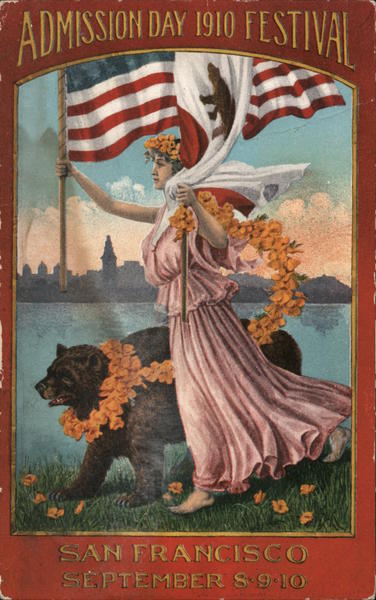
Happy Admission Day!

Don’t let September 9th go by without a salute to California, the 31st state of the Union.

To read about John Bidwell’s participation in the admission of California, both in Washington D.C. and San Francisco, see these posts: Bidwell’s Admission Day and Miss Crosby’s Blue Umbrella.

Posted in Admission Day | Leave a comment

Stampede! — William Lorton’s Journal

William Lorton was a frequent witness of one of the most dangerous events on the prairie — a stampede. Anything could set the cattle off — a carcass, or lightning, or a dog barking — and sometimes it seemed like nothing at all would set them running. Here he is, describing a stampede on June 4th:

3 o’clock P.M., as I am standing or walking by the side of the wagon the cry of men, the noise of prancing cattle meets our startled ears. You turn & look & lo & behold the hind teams running towards us like magic & as quick as lightning the spirit of “stampede” runs along the whole train. I turn as quick as possible & find 4 teams within a few rods of me with scarcely room to escape. I pulled off my hat & succeeded in turning a team coming full split on our near side. They geed off & come come in contact with the hind part of our Ark [i.e., wagon] & [it] knocked them all down in a heap.

Did ever man think cattle could make such speed. All still a minute before & now all confusion, & none can give the cause.

On they come like a mighty avalanch toward us, chains rattling, wheels grating, wagons cracking, piles of oxen upon oxen. Men thrown down, cattle run over, & all in the utmost confusion. Our oxen are not backward in the chase. Takes it [the wagon] as quick as a wink, & the first thing known, they are off. We all run after it, but we might as well stop! for the fleetest steed could not out run these terrified animals.

When it is all over, surprisingly, only one cow was injured and had to be shot. All the rest recovered, animals and men alike, although Lorton says, “women were in some of the wagons & what must have been their feelings.”

Illustration of a Stampede
Posted in William B. Lorton | Leave a comment

William B. Lorton on the Trail

The eminent historian of the American West, Dale Morgan, called The diary of William B. Lorton “the finest Forty-niner diary I have ever laid eyes on.” Having known Dale Morgan many, many, many years ago when I was a student and he was the historian in residence at the Bancroft Library, I don’t need any other recommendation than that.

But until now Lorton’s 1849 journal was unavailable to readers. It stayed in family hands until the 1950s, when Morgan was able to borrow it for the Bancroft Library at UC Berkeley. Later it was donated to the Bancroft and Morgan began on a transcript of the minuscule handwriting in the four small volumes. He intended to publish it but was unable to finish the task before his death in 1971.

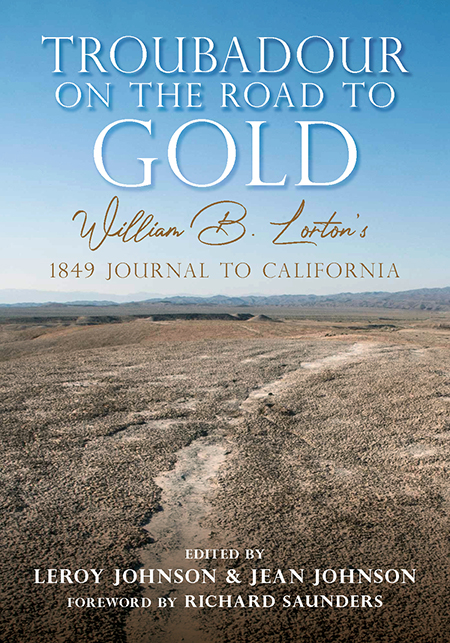
The torch was passed to overland trail enthusiasts and historians LeRoy and Jean Johnson. They have completed the monumental task of editing the journals, complete with comprehensive notes, maps, and photographs. They are careful to preserve his idiosyncratic spelling while clarifying his frequent abbreviations.

Lorton liked keeping a diary, and filled his with all those minutiae which bring an age to life. He had a most visit eye for details, and a quick ear too; I have seen no diary which in a comparable way evokes for the modern reader the sound of things on the trail in 1849.

Dale L. Morgan, March 14, 1961

The title of Troubadour on the Road to Gold refers to Lorton’s talent for entertaining his companions around the campfire with popular songs of the day, especially what he called “Negro melodies.” The book is published by the University of Utah Press.

William B. Lorton was a 20-year-old New Yorker who was in Illinois when he heard about gold in California. He made his way to St. Joseph, Missouri, one of the the starting points for wagon trains to California. Here is the description of St. Jo on May 8, 1849:

In a town like St. Jo at the present time, [there is] everything to attract the eye. Boats are now going up to the [Council] bluffs. Our goods are here, & as we have come 100 miles out of our way, wagons are perfectly ram[ed], jamed, cramed, in among the cattle & mules that croud its st[reet]s. Teems are formed in a line by the hundreds, numbered, awaiting their turns to cross the ferry. There is only 2 flat boats, crossing night & day. . . Some have waited 3 weeks for their turn, others have went out on the suburbs & camped almost discouraged. Corn is selling at 50 cts. A great many persons are out of funds, & have to let their cattle nearly starve. (p. 53)

What a ruckus it must have been. More from Mr. Lorton coming soon.

Posted in Book Reviews, Uncategorized, William B. Lorton | 2 Comments

The “Most Unique” Adventures of John Scott, Black Pioneer

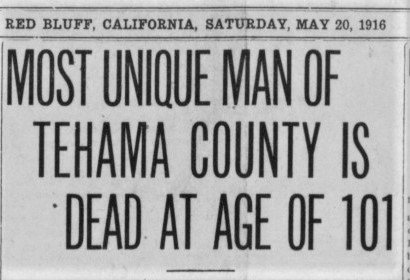
The obituary of John Scott, black pioneer of Tehama County, reads like an adventure novel. I wish I could find more information about him. So far the only two sources are his obituary in the Red Bluff Daily News (May 20, 1916) and an entry in Black Pioneers in Tehama County California History by Grace Alice Brambley Jackson.

John Scott was born into slavery in Virginia in 1815. When he was about 23 years old he escaped and joined a band of Cherokee Indians. He traveled with them on the Cherokee “Trail of Tears” to the Indian Territory in 1838. Using the Indian Territory as his base, he made forays into Tennessee, Kentucky and Missouri to rescue his enslaved brother, sister-in-law and friends, conducting them on the “underground railroad” to Canada.

After about five years of freedom, he was captured. His old owner could not be located, so he was sold to a Lieutenant Hoskins of the U. S. Army. With Hoskins he joined Colonel John C. Fremont’s expedition to California in 1845, which gave him his first sight of Tehama County, where he would later settle. (I could not confirm the names Hoskins or Scott as members of Fremont’s expedition.)

He served with Lt. Hoskins in the Mexican War, in which the lieutenant was killed and Scott was wounded. After the war he was returned to Hoskins’ widow, but he soon ran away from her and from slavery, never to be enslaved again. He joined a wagon train headed for California sometime in the early 1850s.

At first he located at Copper City in Calaveras County. According to his obituary:

Scott discovered a rich gold mine but under the existing laws he could not file on it or claim ownership because of the fact that he was a Negro. Two Copper City gamblers found out about Scott’s discovery, and learning he could not hold the property decided to take it away from him. In the fight that followed the attempt, Scott killed one of the men. At that time and in that place a colored man was merely tolerated at best and when it became known he had killed a while man his life was to say the least, a poor insurance risk, and he immediately left for parts elsewhere. A reward of several thousand dollars was offered for his capture but he was never caught.

After his escape. he spent a few years in Oregon and Utah, then returned to California about 1869 and settled in Tehama County. He married Margaret Bell in 1865, but in the 1880 census of Red Bluff, he is listed as a widower. At that time he was living with his four children: Lillie (18), William (13), and twins Andrew and George (11). His race is given as “Mu” for mulatto. He farmed on property on Reed’s Creek just south of Red Bluff.

Photo courtesy of the African American Museum & Library at Oakland

In his elder years he was known as “Uncle John” Scott. His obituary noted that “locally he was always prominent among the members of his race and has always been accorded a respect amounting almost to reverence by those who knew him best.” His 100th birthday was celebrated with a grand picnic in the oak grove on his property and attended by family and friends, both black and white.

Just imagine the stories the man could tell!

Posted in Uncategorized | 1 Comment