Titus Hale came to California in 1849 at the age of fifteen. He and his father, Israel Hale, traveled the overland route from May to October, arriving in California by way of the Lassen Trail. While others in their wagon train went to the “Redding diggins”, Titus and his father made their way to Sacramento. Titus’s recollection of early days in Sacramento are a short but entertaining look at the life of a young forty-niner.
The first few days in Sacramento I spent in looking after the team that the cattle did not stray away. On election day [November 13] I went to Sutterville, looking for the steers. It rained and I went into a bakery to get my dinner, which consisted of 50 cents worth of ginger cake.
Two Indians came in and asked for Vino, after they drank, they tendered the baker $1.00, he demanded $4.00, — $2.00 per drink — as the Indians refused to pay he pulled out an Allen revolver and began to shoot. Now everyone knows that the safest place to stand when an Allen’s is fired is right in front of the gun. I got out as quickly as possible. It is unnecessary to say that the Indians were not injured, although the man fired five shots at them at a distance of not more than five feet.
After this little experience I went into the house where the election was held. Captain Sutter was there and they were having a boisterous time, they insisted on my voting. I suggested that I was rather too young, but that made no difference, but when I told them that if I must vote I would vote for Burnett, they concluded that I was not eligible.
Ethan Allen (not related to the Revolutionary War hero) had a long career as a firearms manufacturer in New England. His company made a 4-barrel, 5-barrel, and 6-barrel pepperbox revolvers. Evidently they did not have a reputation for accuracy.
1845 Allen & Thurber pepperbox pistol
John Sutter himself was a candidate for governor, so it is not surprising that Titus’s vote was rejected when he said he would vote for Peter H. Burnett. Sutter lost, and Burnett won, although Burnett made a poor showing as governor.
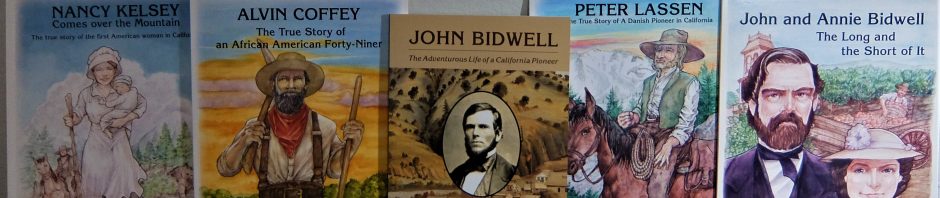
If you are interested in the Bidwells — especially if you are a 3rd or 4th grade teacher doing Butte County or California history — don’t forget that I have a read-aloud YouTube video of my book John and Annie Bidwell: The Long and the Short of It.
Get a peek into Bidwell Mansion and see their story told through my words and the fabulous illustrations of Steve Ferchaud.
I concentrate on stories of northern California, and this isn’t one, but who can resist a good dog story? It’s the story of Dorsey, a dog who carried the mail in the mining camps of San Bernardino County.
Dorsey was a stray dog in the Calico mining camp until he was adopted by the town’s postmaster, Everett Stacy. The dog accompanied Stacy on visits to his brother Alwin, who ran the general store in nearby Bismark, another mining camp about a mile and a half away. One day Everett had an urgent message for his brother but didn’t want to make the three-mile round trip himself, so he tied a note to Dorsey’s collar and told Dorsey to “Git!” The dog headed out on the steep and rugged trail alone. When Dorsey returned to Calico with a reply from Alwin the following day, his career as the official mail carrier between Calico and Bismark began.
Dorsey was outfitted with a mail bag with two straps that buckled around his neck and chest and delivered the mail to the miners at Bismark every day. According to a news article that appeared in the San Francisco Chronicle in 1885:
Every day, just about the time the stage is due, Dorsey wakes up from his nap, stretches himself and walks into the Post office. When the stage has arrived and the Bismarck letters have been put into Dorsey’s mailbag, the Postmaster says, ‘The mail is ready,’and Dorsey soberly walks up to have the bag fastened on. Then he starts off’ on a little trail which he has worn for himself over the hills. If he meets a stranger he makes a long detour, for he knows that he is engaged on important business and he don’t want to run any risk of having trouble. He stays in Bismarck over night and returns with the mail the next day in time for the outgoing stage. He has never missed a connection, lost a letter or been behind time. He is immensely popular with the miners, whose mail he carries so faithfully and every evening at Bismarck the miners order an extra beefsteak for the canine carrier.
San Jose Mercury-News 8 October 1885, reprinted from the San Francisco Chronicle
Dorsey’s mail-carrying career only lasted about a year. Everett Stacy gave Dorsey to W. W. Stow, the owner of the Bismark mine. Dorsey lived out his retirement years in canine comfort at the Stow mansion in San Francisco.
Today Calico is a park and a ghost town, officially designated as “California’s Silver Rush Ghost Town.” If you are ever near Barstow, you can visit it. Dorsey has also been the subject of a song by Kenny Rogers and a picture book by Susan Lendroth.
Ann Eliza Brannan’s letter to her sister in September 1848 is a snapshot of life in California at the beginning of the Gold Rush. She was the wife of Sam Brannan, early pioneer and entrepreneur. They had come to San Francisco by ship in 1846, part of the Mormon migration to the West, and had stayed on, even when Brigham Young told Sam that the Salt Lake Valley and not California was the place for Mormons.
Then gold was discovered in the American River, and Sam saw his opportunity to get rich. Between mining and merchandising, he made a fortune. Just as they were beginning to accumulate wealth, Ann Eliza wrote to her sister:
I am quite contented and happy for the time being; that is, until we make our fortunes, but we would never think of settling here for life, and I rather think that two or three years will find us in New York or some wheres there abouts where we can enjoy life. That is, if we have good luck as at present, but now is the time for making money.
Scoundrel’s Tale: The Samuel Brannan Papers, ed. by Will Bagley (1999), p. 278
Sam wasn’t the only one making money; Ann Eliza was doing her part. A woman, by plying her needle, could get rich.
You will hardly believe me when I tell you that this summer that in a little more than three months I have cleared five hundred dollars by making and getting made cheap clothing.
Pants and shirts, such as you would get in N.Y. 25 cents for making I am given $1.50 cents and they have only one pocket in them as women can make five or six pairs a day.
Whip up a pair of pants with only one pocket, one size fits all, and men would snap them up as fast as she could sew them.
San Francisco had its drawbacks when it came to the better things of life. Ann Eliza told her sister that if she came, “to bring every garment to last you a year or so” because good fashionable ladies’ clothing was in short supply, and “plenty of dried fruit of every description.” Their diet was undoubtedly lacking in variety.
The Brannans’ luck held out for some time, and Sam became the richest man in California. Ann Eliza still longed for the civilized amenities of East Coast life, and when they divorced, due to Sam’s drinking and womanizing, she left California for good. But she never again had to sew miner’s pants to earn a living.
I wanted to know more about Alvin A. Coffey than I could find online, so I sought out this book about his life: The Torturous Road to Freedom: The Life of Alvin Aaron Coffey, by Jeannette Molson and Eual D. Blansett, Jr. It is a thoroughly researched biography of Coffey, with information gathered from his own account and letters, accounts by people who knew him, overland journals, and newspaper articles. It is especially strong on genealogy.
The author, Jeannette Molson, is the great-great-granddaughter of Alvin and Mahala Coffey and this book is a tribute to her resilient ancestors. The book was published in 2009.
Alvin Coffey made three overland trips to California, returning twice to Missouri by sea. The first trip was made with his master, Dr. William Bassett. Alvin worked mining gold in the Shasta Mines until they had accumulated $5,500. Alvin did the work, Bassett got the money. At night Alvin would work for himself — washing clothes and mending boots for miners. By this after-hours work he earned $616, which Dr. Bassett kept for himself on their return to the States.
After being sold to Mary Tindall, Alvin convinced her son Nelson to let him return to California to earn the money to buy his freedom. He must have had a reputation for perfect honesty, since Nelson believed him when he said, “If I tell you that I will send you the money, I will do so.” And that is how it happened.
In California he earned $1000, by mining and by running a laundry. He sent for his Deed of Emancipation, promising to send the money when he received his freedom papers, which he promptly did. Then he went to work to earn another $3000 to redeem his wife and five children.
Alvin Coffey’s deed of emancipation describes him as “a bright mulatto with grey eyes and bushy hair, heavy set, weighing above 180 pounds, about five feet ten inches high. Scar on his left cheek.” Molson writes that the term “bright mulatto” indicates that he was “very light-complected.” He was taller than average, and “heavy set” probably describes his muscular physique. He was certainly a good-looking man, and smart enough to make his way on “the torturous road to freedom.”
According to the back cover, Andy Mark’s new book promises “Thrills, Chills & Mills.” You could say that it also features Spills, ‘Villes, and even Kills. In Stories of the Humboldt Wagon Road he tells the history of the road from Chico, through Jonesville, to Prattville, and all the way to Susanville, with many a stop along the way at wayside watering holes and busy sawmills. Here are the loggers, the miners, and the families who ranched and ran hotels along the road.
Andy has garnered his stories primarily from newspaper accounts of the day from the 1860s, when work on the road began, up through the 1890s. The road was a vital link in the region, opening up the mountains to mining, logging, and summer recreation. Accidents were common on the road, and there are accounts of snowbound travelers, runaway teams, and overturned wagons. Not to mention stagecoach robberies and encounters with grizzly bears. Whether human or animal, some of the creatures met on the road were dangerous.
Perhaps even more dangerous than travel on the wagon road were trips down the flume that ran through Chico Creek. The book features a number of exciting stories of upsets in the flume and falls from great heights.
A trip down the flume on a raft was a quick and easy way to get to town and the scenery on view was magnificent, but a weakened flume section or a collision with a log jam could mean injury or worse. It was a tempting but perilous means of transportation.
Andy has a great interest in local history and it is clear that he knows the landscape and the layout of the Humboldt Wagon Road. As the author of The West Branch Mill of the Sierra Lumber Company (History Press 2012) he brings his expert knowledge of logging in the Sierra Nevada to this effort. Journey the road with him and find out what adventure awaits on this historic route.
Alvin Aaron Coffey arrived in California in the fall of 1849 in company with his master, Dr. William Bassett. Coffey was born into slavery in 1822 or 1824 in Mason County, Kentucky, the property of Margaret Cooke. Bassett was his third master, who promised him that he could earn the money to buy his freedom, and the freedom of his wife and children, in the goldfields of California. It was a promise that Dr. Bassett would not keep.
Coffey told his story in his Autobiography and Reminiscence of Alvin Aaron Coffey, recorded in 1901 for the Society of California Pioneers. You can read it here. He was the only African-American member of the SCP. Members had to have come to California before 1850, and Coffey was a genuine forty-niner.
Most of his short autobiography is an account of that 1849 overland journey.
When we got pretty well down the Humboldt to a place called Lawsons Meadow, which was quite a way from the sink of the Humboldt, the emigrants agreed to divide there. . . . We camped a day and two nights, resting the oxen, for we had a desert to cross to get to Black Rock where there was grass and water.
(His use of the name Lawson shows how out pronunciation of Lassen’s name has changed.)
Starting to cross the desert to Black Rock at 4 o’clock in the evening we traveled all night. The next day was hot and sandy. . . . A great number of cattle perished before we got to Black Rock. When about 15 miles from Black Rock, a team of four oxen was left on the rad just where the oxen had died. Every thing was left in the wagon. I drove our oxen all the time and I knew about how much an ox could stand. Between 9 and 10 o’clock a breeze came up and the oxen threw up their heads and seemed to have new life. At noon we drove into Black Rock.
The oxen perked up at the scent of water. They still had a long way to go and Coffey mentions wolves, the dangers of hot springs to cattle, poor feed, and hard traveling. They came down Deer Creek to the Sacramento Valley and then went up to Redding Springs and began mining. In 1851 they returned to Missouri, where Coffey hoped to buy his freedom and reunite with his wife and children.
I worked thirteen months for him in California. I saved him [earned for him] $5,500 in gold dust. I saved $616 of my own money in gold dust. Going home in 1851 we went by the way of New Orleans. He said, “Let us go to the mint and have out gold coined.” He kept my money (616 dollars) and when we got up into Missouri, he sold me for a thousand more.
My labor on his farm [before they went to California] amounted to $360, I made $5500 for him in California, he kept my $616 I had saved and sold me for $1000; in this way clearing $8,876 clear profit.
Some say slavery is not profitable!
Coffey persuaded his new owner to allow him to return to California to earn money to purchase his freedom, and returned to the goldfields in 1854. By 1856, he had earned $1000, enough to purchase his freedom. He continued mining and working at other jobs until he had earned another $3,500. In 1857 he returned to Missouri and came back to California with his wife and three sons. Another son was born free in California in 1858.
The Coffey family first settled in Shasta County, and then later bought a farm in Tehama County. During the Modoc War, Coffey provided livestock to the U.S. Army and served as a teamster. Alvin A. Coffey died in the Home for Aged Colored People that he had helped to found in Oakland in 1902. The following obituary and tribute appeared in the Red Bluff Daily News.
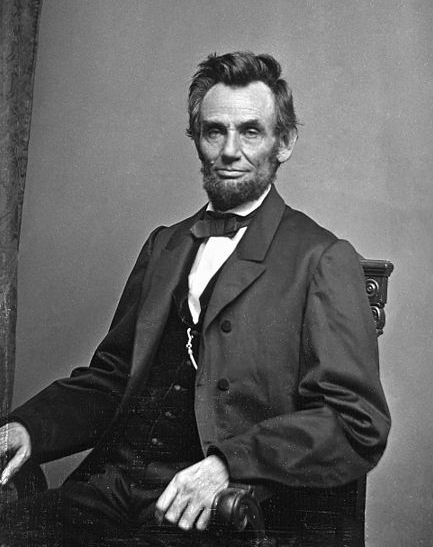
John Bidwell believed fervently in the Union cause. In 1864 he was a California delegate to the Republican National Convention in Baltimore on June 7-8, where Lincoln was renominated for president. Bidwell was in the delegation sent to the White House to inform Lincoln of his renomination.
Upon his return home, he spoke to the Butte County “Lincoln and Johnson Club” on August 10th, 1864, about his experiences. He was pleased to have met with President Lincoln and gave this description, as reported in the Weekly Butte Record:
While at the Capitol, I had the pleasure of several interviews with the President. I found him to be a man possessed of that great and most precious of all natural gifts, plain common sense. Still he was not exactly the man I had expected to see. I had been told that he was continually inclined to jest, and that he did not appear to appreciate the magnitude of our national troubles. Suffice it to say that much injustice has been done Mr. Lincoln in reference to his personal traits. What are called jokes should in most instances be styled apt illustrations. He is calm, reflective, quite fluent in speech, and evidently feels the weight of the responsibility resting upon him. The more I saw of him the better I was pleased, and the more he looked like a President.
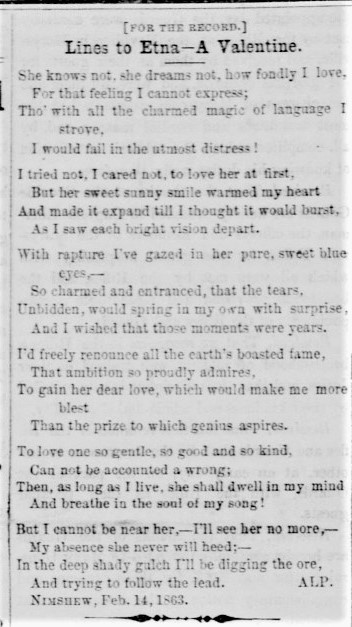
Here is a Valentine poem from our own Bard of Butte, first published in the Butte Record on February 28, 1863. He signs himself ALP, his nom de plume based on the initials of his name, Alexander Preston Longley,
When did John Bidwell discover gold on the Feather River?
As you can see from the following timeline, he made more than one discovery, culminating in finding rich deposits at Bidwell’s Bar. It is also interesting to notice how much traveling Bidwell did in the six months between January and July 1848.
Sources:New Helvetia Diary, two dictations by John Bidwell for H.H. Bancroft in 1877 and 1891, and letters written by John Bidwell.
Jan. 24: Gold discovered at Coloma by James Marshall (this is the date usually given, but it may have been a couple of days earlier or later)
Feb. 29: Bidwell shown gold by John A. Sutter at Sutter’s Fort (New Helvetia Diary)
March 2-7: Bidwell searches for lost horses, then leaves for Sonoma and San Rafael, where he intends to buy fruit trees. Sutter has entrusted him with a gold sample to take to San Francisco.
The very spring that gold was discovered, I was preparing to set out my farm, and had dug the first irrigating ditch in the Sacramento Valley. As soon as I got my ditch ready and the ground prepared, I went over to San Rafael and Sonoma to get my trees. I crossed over to San Francisco and reported the discovery of gold.. (NHD, JB-91)
mid-March: Bidwell has gold assayed in San Francisco (JB-91)
March 27: Bidwell arrives at Sutter’s Fort and leaves on the 29th. (NHD)
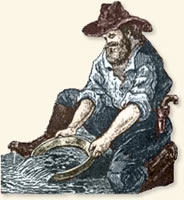
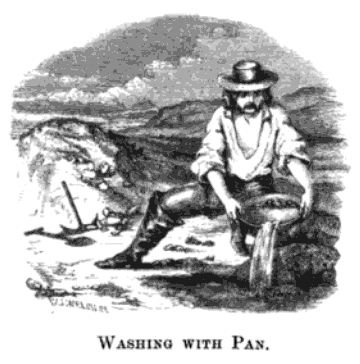
March 29-April 1: Bidwell camps on the Feather River near Hamilton, washes gold out of river. “While my horse was off feeding, I took a tin cup and went down to the river; washed the sands as well as I could, and every cupful took out small particles of gold.” (JB-91)
early April: Bidwell and friends look for gold on Butte Creek and the Feather River. “A week or two later myself and a few men found gold on Butte Creek, on the West Branch of the Feather River, and in several ravines and on main Feather River at White Rock.” (JB to A. Ekman 17 Jan 1898)
April 22: Bidwell and William Dickey go to Sutter’s Fort and Coloma, where they stake mining claims.
I went up, as others did, to see the place [Coloma], and made arrangements to hold mining claims there. Marshall built a little cabin on my claim so that I could hold it. (NHD, JB-91)
Apr 30: Bidwell and Dickey return from Coloma. (NHD)
May 2: Bidwell and George McKinstry check out the Consumnes River. (NHD)
May 8-13: Bidwell busy surveying Sutterville, a job he had contracted to do for Sutter. (NHD)
May 21: Bidwell writes to McKinstry from Sutter’s Fort about the influx of gold diggers and the need to invest in cattle and provisions because “everything in the provision line is about to command an exorbitant price.” (JB to GMcK 21 May 1848)
May 22: Bidwell leaves for Upper Sacramento Valley. (NHD)
late May: Bidwell assembles friends and supplies and they go prospecting on the Feather River. “I think it was late in May before we made our first mining camp on Feather River at the mouth of Morris Ravine.” (JB to A. Ekman 17 Jan 1898)
On reaching Chico an expedition was organized but it took some time to get everything ready. We had to send twice up to Peter Lassen’s mill to obtain flour, meat had to be dried, and we had to send to Sacramento for tools. In our party were Mr. [William] Dickey, [John] Potter, John Williams, William Northgraves, and myself. We passed near Cherokee and up on the North Fork.
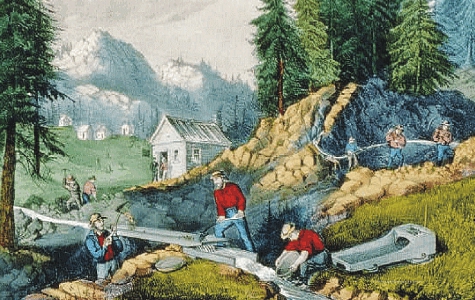
In nearly all the places we prospected we found the color. One evening while camped at White Rock, Dickey and I in a short time panned out about an ounce of fine gold. The others refused to prospect and said the gold we had obtained was so light that it would not weigh anything. At this time we were all unfamiliar with the weight of gold dust but I am satisfied that what we had would have weighed an ounce. (JB-77)
June 19: Bidwell writes to George McKinstry from Sutter’s Hock Farm.
I have been up to my Ranch, moved camp down to the bend of Feather river with a quantity of meat and coarse flour, and have come down to take up the things that were sent up in the canoe. Tomorrow I shall land in the “diggings.”
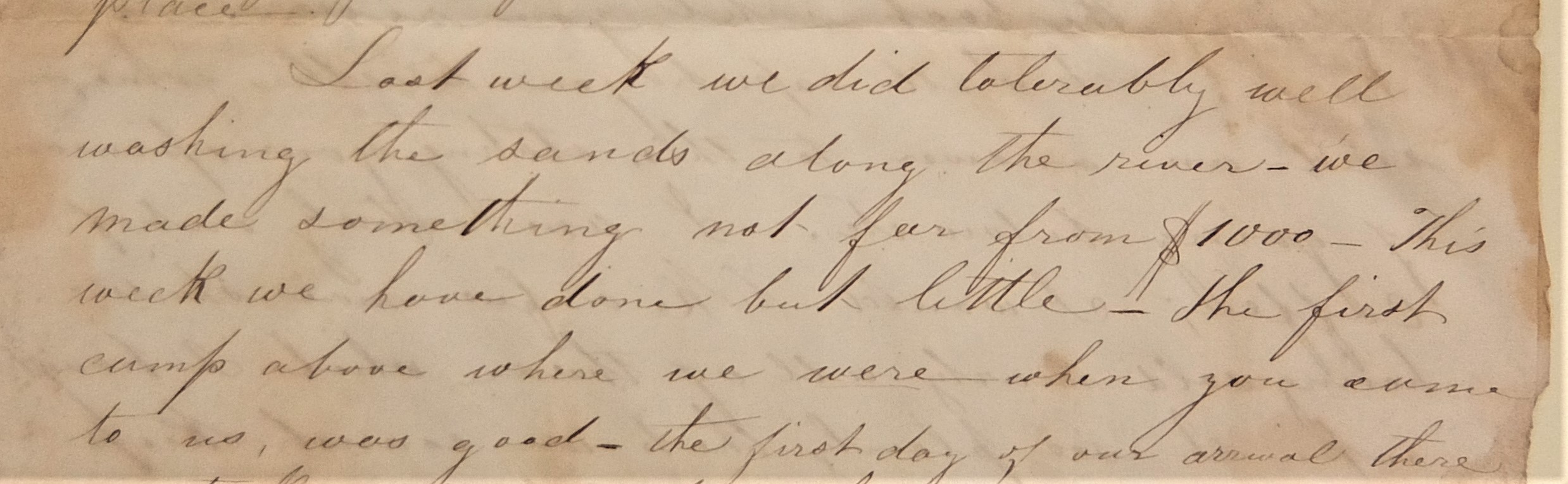
June 24: Bidwell writes to McKinstry from “Feather River below first camp.”
Last week we did tolerably well washing the sands along the river – we made something not far from $1000 – This week we have done but little – The first camp above where we were when you came to us, was good – the first day of our arrival there we took out not less than 300 dollars. – but the place soon became exhausted it being small, and we have not been able to find as good a one since – In fact if Mr. McCall had not arrived I should have sent an express to you yesterday. We are not making over $50 per day with all our Indians – and if we do not find a good place in one or two days at most, I want to go down either to Yuba or the American Fork.
California State Library
On the same date (June 24) Bidwell makes a note of “Articles taken to camp belonging to Pierson B. Reading for use Bidwell Mining Co.” He is getting organized and making plans, but hasn’t yet found rich diggings. He keeps exploring the Feather River and sometime in the next ten days he finds what he is looking for.
July 4: Bidwell discovers gold at what becomes Bidwell’s Bar. “On July 4 I discovered Bidwell’s Bar, and the next day moved up and took possession.” (JB to A. Ekman 17 Jan 1898)
This letter, written fifty years later to Dr. Adolph Ekman, a pharmacist in Oroville, is the only place I have seen Bidwell give a date to his gold discovery at Bidwell’s Bar. The letter is in the archive at Lake Oroville State Recreation Area. A copy was sent to me by Chuck Smay, author of The Town of Bidwell at Bidwell’s Bar: Boom and Bust, 1848-1860. (Thanks, Chuck!)







 goldfields