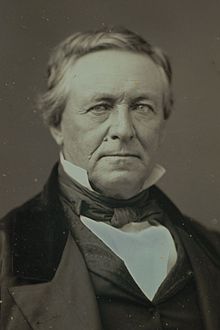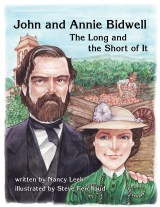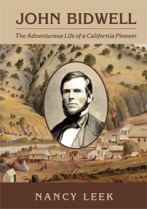
John Bidwell in 1850

One reason I like to write about John Bidwell is that he makes such a good lens for looking at the history of California. He was involved with many aspects of early California (politics, mining, agriculture, education), he knew everyone, he saved his letters and kept a journal. Information about Bidwell’s life is abounding, while such information can be hard to find about many other men and women.

An article by myself has just been published in The Diggin’s, the quarterly journal of the Butte County Historical Society. The genesis of the article was a short piece I wrote commemorating Bidwell’s participation in California statehood. When Congress passed and President Fillmore signed the act making California the 31st state of the Union, Bidwell was the man who brought the news and the documents to California.
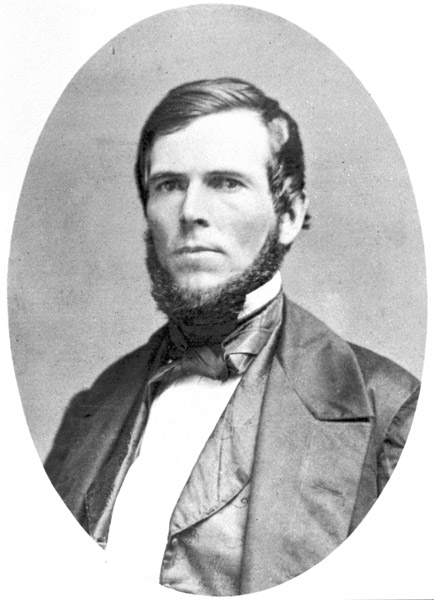
sc 17336 John Bidwell photograph ca 1850

The more I looked into Bidwell’s activities in 1850, the more there was to see. He had just bought Rancho Chico and was working to establish a ranch. At the same time he was winding up his survey of Sutterville, seeking to get his land title confirmed, serving in the state senate, escorting a block of gold-bearing quartz for the Washington Monument to D.C., promoting statehood in the halls of Congress, and visiting family and friends that he hadn’t seen for nearly a decade. He seems to have done a little unsuccessful courting along the way too.

Daily Alta California September 9, 1850

In New York he had his portrait taken at Mathew Brady’s photography studio. He also had a daguerreotype done of Raphael, the Maidu boy he had brought with him as his valet.

Raphael

I have written before about the ladies he escorted back to California, Mrs. Maria Crosby and her daughter Mary Helen Crosby. For years afterward Helen Crosby Hensley loved to tell the tale of her blue silk umbrella and how it helped to safely bring the statehood papers to California. For my Diggin’s article, I was able to get a photo of the famous umbrella, which is in the Sutter’s Fort archives. It looks to be in fine condition for its age.
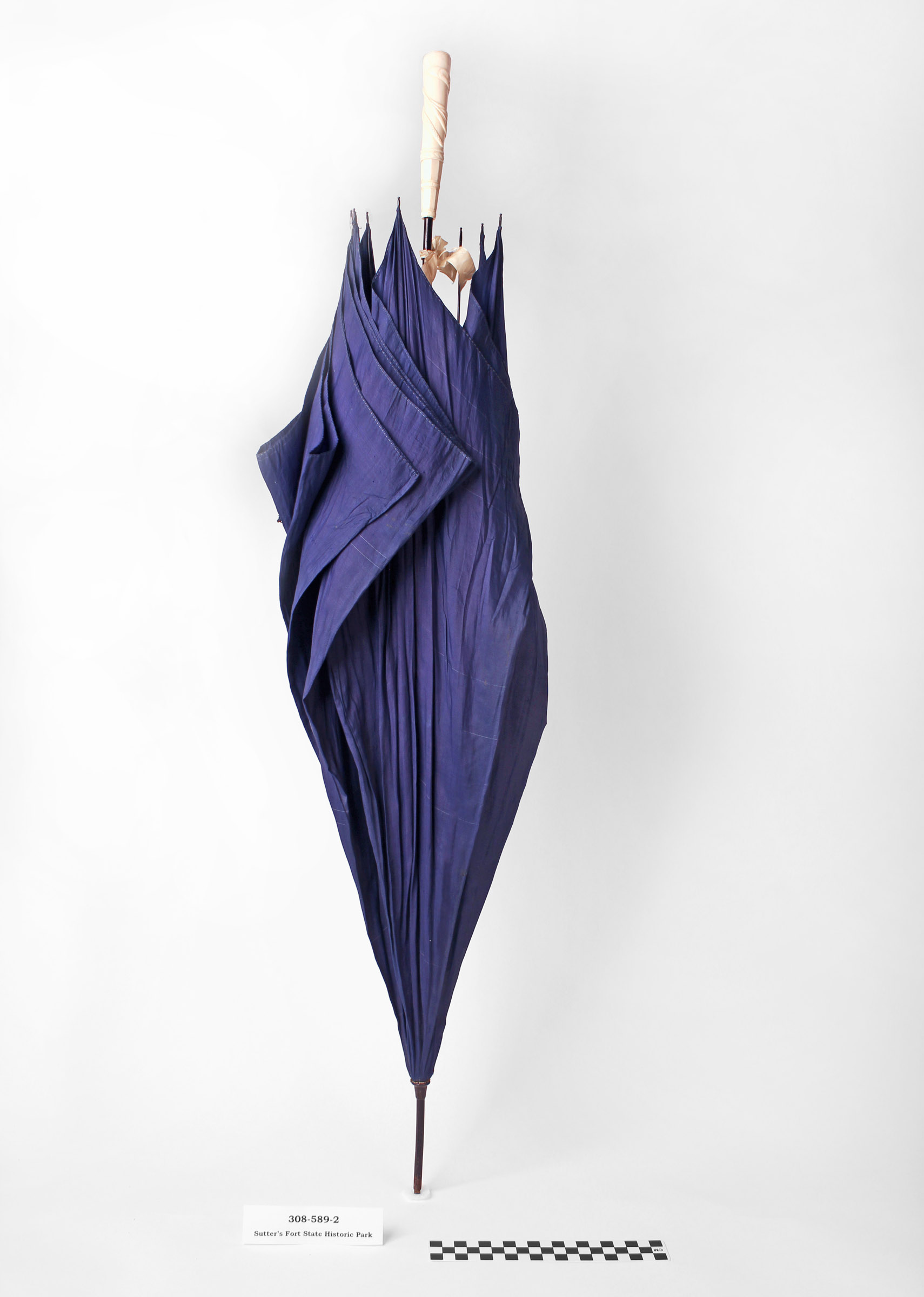
Posted in Mary Helen Crosby | Leave a comment

November 6, 1841 — The End of the Journey

Saturday, 6th. Fifteen of the Company started for a Spanish town, called the Pueblo of St. Joseph (which is situated about 40 miles from Marsh’s) to seek employment.

Members of the Bidwell-Bartleson Party didn’t waste any time sitting around at Marsh’s rancho, relaxing and recovering from their long and strenuous journey. They were made of tougher stuff than we are.

They arrived on November 4th, and on the 6th half the men set out for San Jose to look for work. The other half of the men went back to the San Joaquin Valley to hunt for game. John Bidwell decided to stay at Marsh’s for the time being, keeping an eye on the Company’s effects, and doing some local exploring.

The men who left for San Jose soon ran into trouble. They were arrested two miles from the pueblo and spent six days in the “calaboose” before they were released. Because of the “Graham Affair” of 1840, in which a few Americans fomented a rebellion against the Mexican governor, the authorities were understandably suspicious of any uninvited Americans coming into the territory.

The adobe jail at Monterey. The one at San Jose would have been similar.

The November 6th entry concludes John Bidwell’s overland day-by-day diary. It is not, however, the end of the journal. Bidwell added several pages of “Observations about the Country” detailing the vegetation, climate, and resources of California, including wages and prices. He gives his opinion about the Mexican government and outline the route to California. In conclusion he writes:

To all my acquaintances and friends who may be in bad health I would recommend a trip to California. All whom I have heard speak of the climate as regarded their health say its effects have been salutary.

And now it’s time for me to take a little salutary break from blogging, but I will be back soon with some book reviews and more explorations of life in Northern California.

Posted in Bidwell-Bartleson Party, Uncategorized | 4 Comments

November 5, 1841 — At Marsh’s

Friday, 5th. Company remained at March’s getting information respecting the country.

And resting, one hopes. After their arduous trek, they deserve a day of recovery.

Feeling that Marsh had treated them generously by killing an ox and a hog to feed them, and even grinding some of his seed wheat to make tortillas, the members of the company repaid him by offering him what few items they had to give. Bidwell says in his 1877 Dictation:

In return for the kindness extended to us, we opened our treasures consisting of cans of [gun]powder, butcher knives, lead, and various other useful articles and made the doctor what we considered liberal presents in return. I remember one of the party presented him with a case of surgical instruments. As for money, we had little or none.

The Marsh Rancho, showing the stone house Marsh built in 1853. Painting courtesy of the John Marsh Historic Trust

Posted in Bidwell-Bartleson Party, John Marsh | Leave a comment

November 4, 1841 — Hurrah for California!

Thursday, 4th. Left the river in good season and departing gradually from its timber came into large marshes of bulrushes. We saw large herds of elk and wild horses grazing upon the plain. The earth was in many places strongly impregnated with salt — came into hills. Here were a few scattering oaks — land appeared various, in some places black, some light clay color, and in other mulatto (between black and white) sometimes inclining to a red soil, but all parched with heat.

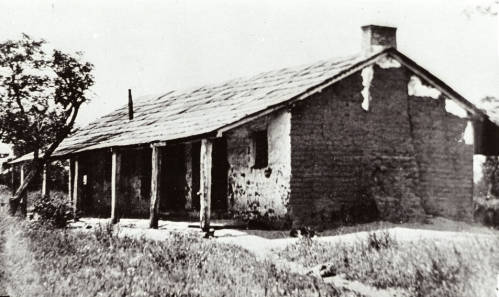
Finally we arrived at Marsh’s house, which is built of unburnt bricks, small and has no fireplace — wanting a floor and covered with bulrushes. In fact it was not what I expected to find; a hog was killed for the company. We had nothing else but beef; the latter was used as bread, the former as meat. Therefore I will say we had bread and meat for dinner. Several of our company were old acquaintances of Marsh in Missouri, and therefore much time was passed in talking about old times, the incidents of our late Journey, and our future prospects.

All encamped about the house — tolerably well pleased with the appearance of Dr. Marsh, but much disappointed with regard to his situation, for among all his shrubby white oaks, there was not one tall enough to make a rail-cut. No other timber in sight, excepting a few cottonwoods and willows.

After the skimpy rations of the past few months, the men hungered for fat meat, and the pork was welcome, even if it came in a beef and pork “sandwich.” Bidwell might have been hoping for bread too. But he had no complaints about the food Marsh gave them that first night.

You can tell from this entry that Bidwell is very interested in the potential of the land for farming — the quality of the soil, the lack of rain, the availability of timber.

Considering the glowing reports of California that Marsh had sent back east, Bidwell was surprised at the primitive conditions he was living in. A small adobe house with a dirt floor and no fireplace -– hardly what Bidwell had envisioned. He was accustomed to cooking over a fireplace indoors, but in California the cooking was generally done outside in the courtyard.

Marsh’s adobe might have looked like this, without the chimney. Reading Adobe, courtesy of Special Collections, CSU Chico.

“Cheyenne” Dawson contributed a vivid account:

So we had reached California — the first truly distinctive American emigrant train to do so. . . . We had expected to find civilization — with big fields, fine houses, churches, schools, etc. Instead, we found houses resembling unburnt brick kilns, with no floors, no chimneys, and with the openings for doors and windows closed by shutters, instead of glass. There were no fields or fencing in sight — only a strong lot made of logs, called a corral. Cattle and horses were grazing everywhere, but we soon found that there was nothing to eat but poor beef.

Marsh was very kind and asked us what we craved most. We told him something fat. He had a fat hog. This he killed for us, and divided it among the messes. He also had a small quantity of seed wheat that he was saving to plant. A part of this he had made into tortillas for us.

He told us that if we wished we could sleep in the house. This novel experience some of us tried, but we were much disturbed by fleas, and sick-stomached men crawling over us to get out. They had eaten too much pork.

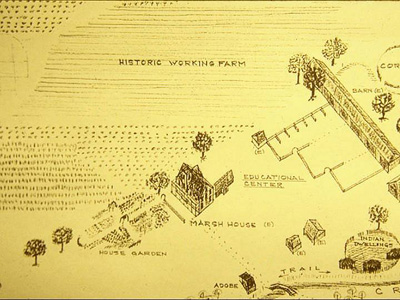
Below is a map of John Marsh’s Rancho. The adobe is at the bottom, by the creek. Take out the big house in the center, the barns, and the garden to get an idea of what Marsh’s home looked like in 1841.

Map courtesy of the John Marsh Historic Trust

The journey was over, but the adventure would continue. John Bidwell was now embarking on a new life, the life of a Californian. He would spend the next 59 years in his new home state.

Two more brief entries will conclude the journal.

Posted in Bidwell-Bartleson Party, John Marsh, Uncategorized | Leave a comment

November 3, 1841 — Almost There

Wednesday, 3d. We waited till Capt. B. came up, and all started for Marsh’s about noon; arrived at the St. Joaquin and crossed it — distance 13 miles — found an abundance of grass here. The timber was white oak, several kinds of evergreen oaks, and willow — the river about 100 yds. in width.

Now it is just a matter of continuing across the valley and the Coast Range for a few more miles. “Cheyenne” Dawson recalled:

The next morning, under the guidance of Jones and the Indian, we left the river we had been following [the Stanislaus], struck northwest, crossed the San Joaquin river, and camped on the further side.

They probably crossed the river about five miles west of Tracy. Then the next day they can continue northwest towards Mt. Diablo until they reach March’s rancho.

Mt. Diablo from the east. Photo by Jim Leek
Posted in Bidwell-Bartleson Party, Uncategorized | Leave a comment

November 2, 1841 — “Great Joy and Gladness”

Tuesday, 2nd.  Capt. B. with his 7 remained to take care of the meat he had killed — while the rest of the Company went on. We passed some beautiful grapes, sweet and pleasant.  The land decreased in fertility as we descended the stream.

Behold! This morning Jones, who left the camp to hunt on the 23rd ult. came to the camp. They (he and Kelsey) had arrived in the plains several days before us, and found an Indian, who conducted them to Marsh’s house, but he brought bad news; he said there had been no rain in California for 18 months, and the the consequence was, there was little breadstuff in the country. Beef, however, was abundant and of the best quality.

Thomas Jones and Andrew Kelsey (younger brother of Benjamin Kelsey) had gone on ahead to hunt for meat on October 23rd. Now they have reappeared with the exciting news that they had been lead by an Indian to the ranch of Dr. John Marsh.

“Cheyenne” Dawson recalled the same encounter:

We were traveling along, pretty comfortable on the whole, but casting glances of anxiety towards the mountains ahead, when we saw two men approaching transversely to our route. So rare a sight greatly excited our curiosity, and we stopped and waited. As they drew near, someone said, “Why, one of them looks like Jones! “No, it can’t be.” But it was Jones, and an Indian, come to find us and pilot us in, if found alive, to Marsh’s ranch.

Jones’ story was short. After getting lost from us he had struck westward, had killed with a rock a rabbit, and had subsisted on this until found by some Indians who took him to Marsh’s ranch. He had straightway put back, with an Indian guide, to find his comrades. Jones had some provisions, too. We all felt like hugging Jones. We didn’t, but those provisions! We must see them. So we camped right there and ate them.

Finding out about Marsh was good news indeed, for Marsh was the man who had set the movement in motion. His letters to Missouri, read by Bidwell and many others, had painted a glowing picture of California life and enticed them across half a continent.

As Bidwell said in the 1877 Dictation: “This settled the question that we had actually arrived in California, and were not far from San Francisco Bay. It was an occasion of great joy and gladness.”

John Marsh in 1852

Posted in Bidwell-Bartleson Party | Leave a comment

November 1, 1841 — “A Striking Contrast”

November, Monday 1st. The Company tarried to kill game; an abundance of wild fowl and 13 deer and antelopes were bro’t in. My breakfast, this morning, formed a striking contrast with that of yesterday which was the lights of a wolf.

“The lights of a wolf” being the lungs of a coyote.

Nancy Kelsey was not only walking barefoot and carrying her toddler, Baby Ann, but was also about six months pregnant. She collapsed in exhaustion when they reached the valley. She stated:

At one place I was so weak I could hardly stand, and I lay on the ground while Mr. Kelsey went out and killed a deer. We were then near Marsh’s ranch.

Bidwell tells it this way in his 1877 Dictation:

The eve of the next day found us surrounded by abundance; thirteen deer and antelope had been brought in. It was about the first of November, and there was no time to delay if we were going to reach California that fall. Most of the party were ready and anxious to press forward. Captain Bartleson and his men thought otherwise. They said we hadn’t yet reached California, we probably still had a long distance to travel, that such a place as we were in could not be found everywhere and they were going to stop and lay in meat for the balance of the journey.

Leaving them in camp and crossing the Stanislaus River, we proceeded down the north side of the same and camped. Early the next day the news came that the Indians in the night had attacked them and stolen all their horse. We remained till they came up, carrying on their backs such things as they were able.

John Bidwell never did get on with John Bartleson, and there is a note of satisfaction here that once again, Bartleson was wrong and got what he deserved.

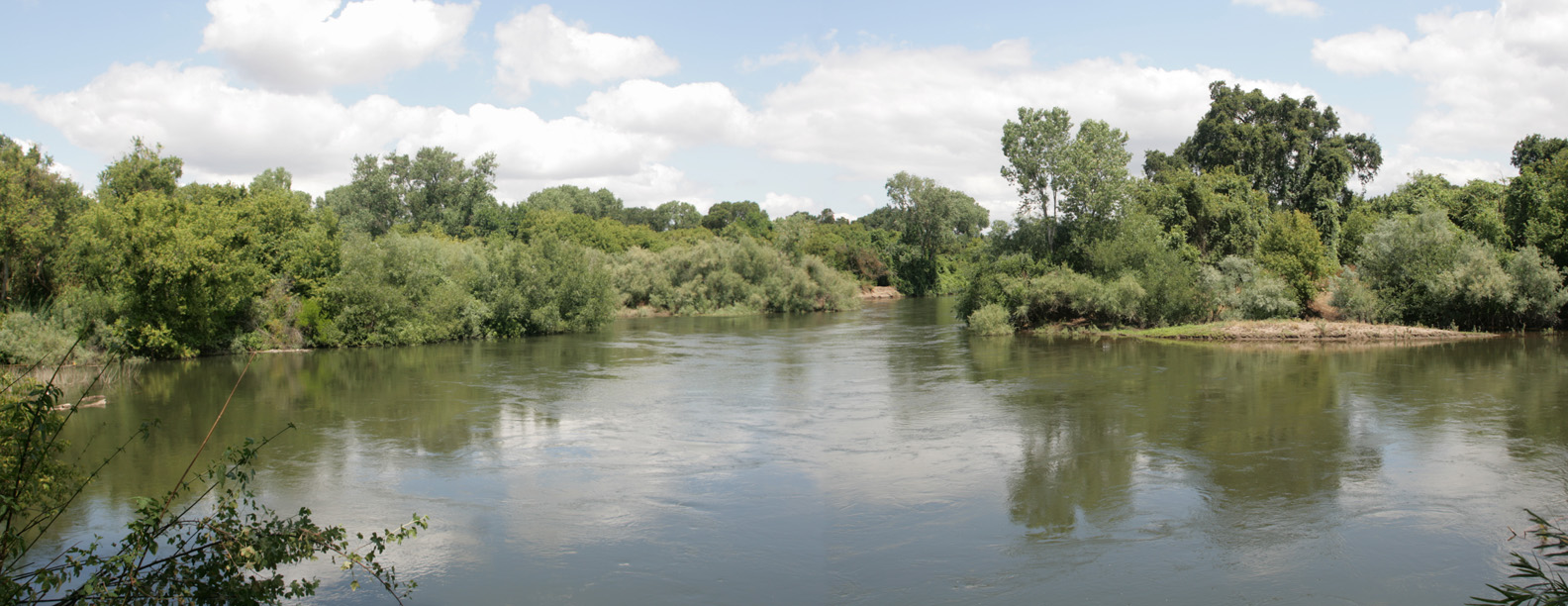
The Stanislaus River

It seems strange that they still don’t know that they are in California, but all will be resolved tomorrow.

California mule deer
Posted in Bidwell-Bartleson Party | Leave a comment

October 31, 1841 — “Joyful Sight!”

Sunday, 31st. Bore off in a N.W. direction to the nearest timber; day was warm, plain dry and dusty, reached timber, which was white oak (very low & shrubby) and finally the river which we had left in the mts., joyful sight to us poor famished wretches!!! Hundreds of antelope in view! Elk tracks thousands! Killed two antelopes and some wild fowls; the valley of the river was very fertile and the young tender grass covered it like a field of wheat in May. Not a weed was to be seen, and the land was as mellow and free from weeds as land could be made by plowing it 20 times in the U.S. Distance today 20 miles.

Bidwell is looking at the valley land with the eye of a farmer. He wrote this on the evening of the 31st, but that morning and the night before was quite a different story.

Night found us scattered on a line four miles in length. Every one traveled as long as he could see and then lay down to sleep. There was absolutely nothing for the horses to eat. Fire had left the valley black and desolate. We had killed a second mule and the meat still held out. At night we would unsaddle our animals and turn them loose. There was nothing for them to eat and not even a bush to tie them to.

When morning came the foremost of the party waited for the others to come up. They had found water in a stagnant pond, but what was better, they had killed a fat coyote, and with us it was anything but mule meat. As for myself, I was unfortunate being among those in the rear and not aware of the fest in advance. I did not reach it in time to get any of the coyote except the lights [lungs] and the windpipe. Longing for fat meat and willing to eat anything but poor mule meat and seeing a little fat on the windpipe, I threw it on the coals to warm it and greedily devoured it. (1877 Dictation)

Coyote

That was his breakfast, but dinner in the valley was another thing altogether. Somewhere near the present day town of Oakdale they came out of the foothills and down into the valley along the Stanislaus River, which they had followed off and on all down the western slope. They feasted on antelope and sandhill crane, and “ripe and luscious wild grapes.” Their horses feasted on the new grass just springing up from the fire-burnt ground. What a difference from morning to evening!

Posted in Bidwell-Bartleson Party | Leave a comment

October 30, 1841 — “Lo! to Our Great Delight”

Saturday, 30th. We had gone about 3 miles this morning, when lo! to our great delight, we beheld a wide valley! This we had entirely overlooked between us and the high mountains which terminated our view yesterday. Rivers evidently meandered through it, for timber was seen in long extended lines as far as the eye could reach. But we were unable to reach it today, and encamped in the plains. Here grew a few white oaks. Traveled today about 20 miles. Saw many tracks of elks. The valley was wonderfully parched with heat, and had been stripped of its vegetation by fire. Wild geese, fowls, etc. , were flying in multitudes.

With what jubilation they must have beheld the sight! Although they could not reach it that day, the Company could see a wide and extensive valley. The sight gave them great hope: hope of good food and easy traveling.

When did Bidwell and his companions enter the promised land of California? By present day borders they had already been in California since mid-October. They had been in Mexican territory even longer than that, but the land they traversed was more like the Great Empty Quarter of North America than part of a foreign nation. Although claimed by Mexico, the territory that later became the states of Utah and Nevada was inhabited solely by Native Americans.

For the Mexicans, Alta California was a narrow strip of land along the Pacific coast. There had been little exploration and no settlement in the Central Valley. All the missions and ranchos lay between the Pacific Ocean and the Coastal Range.

Most of the Company thought that they would not reach California until they crossed another mountain range. How far they still had to travel to get to California was hotly debated in the group, with some insisting that they could not get there before winter set in.

But whether or not they knew it, they were in California. California was spread out before them, and it would prove to be everything they had been promised: a fertile land teeming with wild game, with a healthy climate and plenty of room for all. California at last!

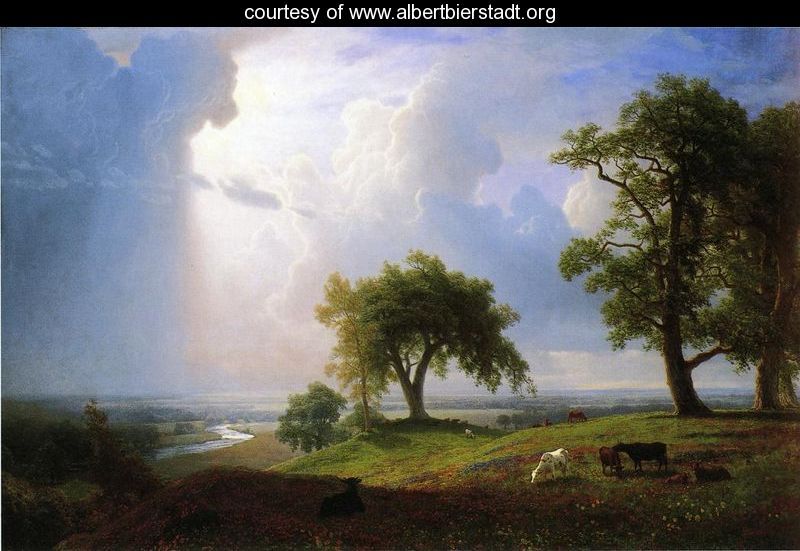
California Spring, by Albert Bierstadt
Posted in Bidwell-Bartleson Party, Uncategorized | 2 Comments

October 29, 1841 — “A Time of Great Discouragement”

Friday, 29th. Last night, the Indians stole a couple of our horses. About noon we passed along by several huts, but they were deserted as soon as we came in sight, the Indians running in great consternation into the woods. At one place the bones of a horse were roasting in a fire; they were undoubtedly the bones of the horses we had lost. Travelled no less than 9 miles today; the night was very cool and had a heavy frost. Although our road was tolerably level today, yet we could see no termination to the mountains–and one much higher than the others terminated our view. Mr. Hopper, our best and most experienced hunter, observed that, “If California lies beyond those mountains we shall never be able to reach it.”

Most of the Company were on foot, in consequence of the horses giving out, and being stolen by Indians, but many were much fatigued and weak for the want of sufficient provision; others, however stood it very well. Some had appetites so craving that they eat the meat of most of the mule raw, as soon as it was killed; some eat it half roasted, dripping with blood.

Weary and worn to the bone, barely living on the meat of their own pack animals, struggling down rocky canyons, the Company was in a desperate situation. With no map and no guide, they had not a clue where they were, and they could see no end to their journey.

Nancy Kelsey, who had started up into the Sierras riding a horse, with Baby Ann on her lap, was now walking. In her own recollection, taken down by a friend in 1893, she says, “I walked barefoot until my feet were blistered.”

Bidwell recalled in his 1877 Dictation:

As we approached the San Joaquin Valley, the Coast Range Mountains or that portion of which Mt. Diablo is the northern terminus, rose to view in the blue distance, but we had no knowledge of any intervening valley. Our traveling had been so circuitous, so irregular and indirect, that it was impossible for any one to say where we were or how far we had yet to travel.

It was the opinion of most if not all that we were not yet within five hundred miles of the Pacific Ocean. That the blue range bounding the western horizon was simply the beginning of other and perhaps great ranges beyond. Then came a time of great discouragement, some saying if California lay beyond other ranges of mountains, that we could never live to get there.

And yet they are almost there. Their location was not far from the present-day historic gold-rush town of Sonora, the “Queen of the Southern Mines.” They are in gold country, and soon they will be in the fruitful San Joaquin Valley.

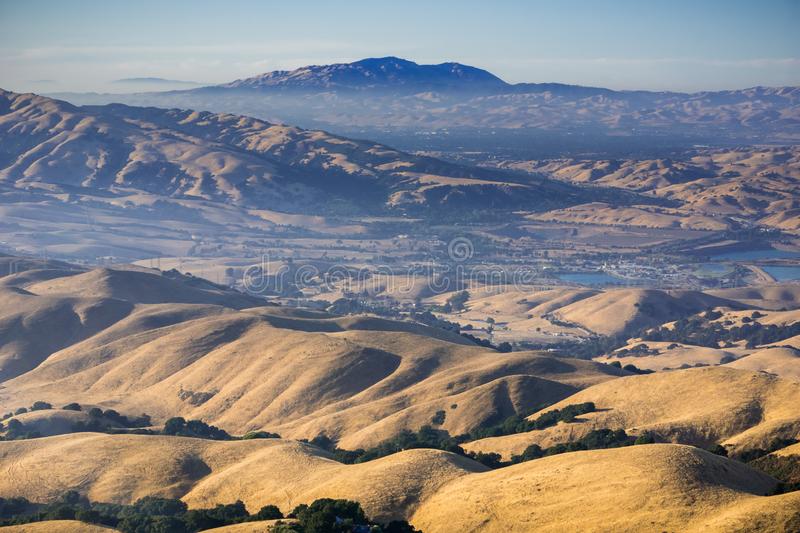
View toward Mt. Diablo from Mission Peak (this is actually the wrong side of Mt. Diablo)
Posted in Bidwell-Bartleson Party, Uncategorized | Leave a comment