October 10, 1841 — Honeydew, Anyone?

[Sunday, 10th] Large numbers of Indians lived about this place, but few (50 or 60) visited our camp. Crossed Mary’s river — it was here running E. leading from the lake which we saw to the W. of us yesterday, into the swamp by which we staid last night. Our course today was S.W. Distance 15 miles — encamped upon the lake.

Fifty or sixty hardly sounds like few to me, but maybe it’s all relative.

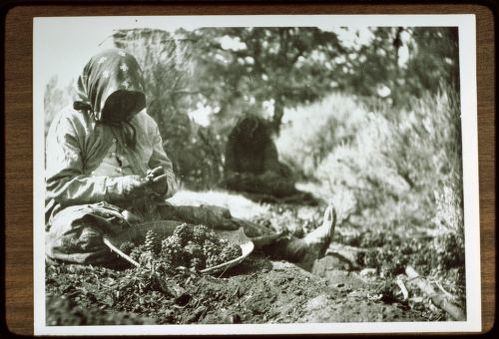
On the 7th Bidwell wrote about the “dry cane grass which the Indians had cut in large heaps to procure honey from the honey dew with which it was covered.” The Indians in this region are Paiutes, although Bidwell usually refers to them as Shoshones. Here is a little more about honeydew from his 1877 Dictation.

In the edges of the water the tule was covered with honeydew to an extent that enabled the Indians to gather it in large quantities. They made it into balls about the size of one’s fist and we bought and ate considerable of it. When we afterwards saw them gathering it, we saw that the Indians collected the insects that covered the honeydew as well as the dew itself and formed the whole into a ball.

According to a report titled Native American Plant Resources in the Yucca Mountain Area, Nevada, this reed was Phragmites australis. “The stems of this plant were used to make arrow shafts and wickiup walls. The candy-like,”honey dew’ exudate was scraped off the leaves and eaten as a sugary food.” The honeydew was created by aphids, which were included in the sugary balls. It was undoubtedly a very nutritious food.

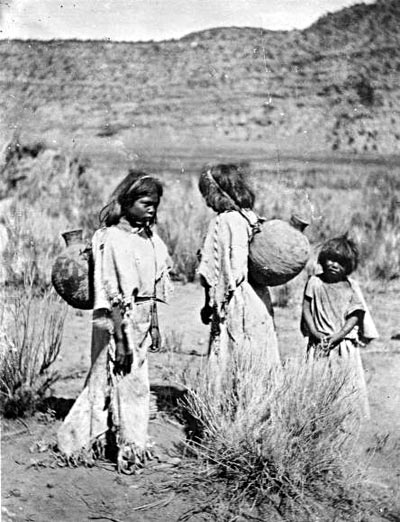
Paiute girls with water jugs
Posted in Uncategorized | Leave a comment

October 9, 1841 — Laborious Travel, Nauseous Water

Saturday, 9th. Crossed Mary’s river where it led from the swamp into a lake beyond; our pilot led us south on the trail of Capt. B. Crossed a plain which is covered with water the greater part of the year — then came into sand hills, among which traveling was very laborious. Saw to the W. of us a lake, presenting a sheet of water 20 or 30 miles in extent. Encamped by another swamp, in which the water was very nauseous. Distance 28 miles.

They are traveling through an utter wasteland — no trees, no grass, no good water — just sand hills punctuated by swampy pools of nasty water. They try to follow in the tracks of Bartleson’s men, but the trail was easily lost in the arid soil. In his 1877 Dictation Bidwell says:

Thrown entirely upon our own resources to find our way as best we could through this region and into California, Benjamin Kelsey proved to be our best leader.

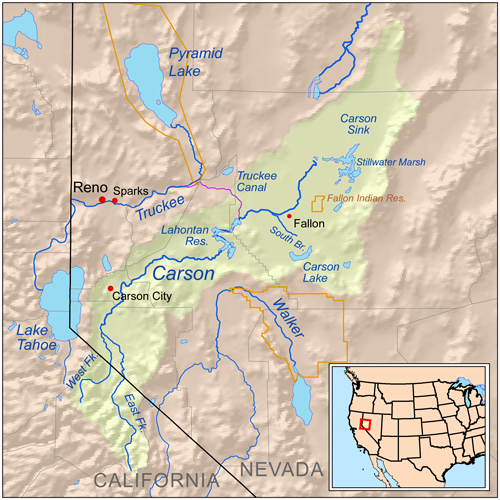
So we could call this the Kelsey-Bidwell Party. In the map below, the Humboldt River and Sink are at the upper right. From there the Kelsey-Bidwell Party were guided by the Indian guide southward to Carson Lake, and then westward to the Walker River. This was the river they would follow up into the Sierra Nevada.

Posted in Uncategorized | Leave a comment

October 8, 1841 — Duck Season

Friday, 8th. The swamp was clouded with wild geese, ducks &c, which rose from its surface at the report of our guns. We traveled about 6 miles and stopped to kill a couple of oxen that were unable to travel.

Jimmy John notes that they only traveled a few miles that day because their Indian guide told them that they could “get to no other watering place today.” So instead they tried to add to their store of meat by hunting geese and ducks.

They are still by the Humboldt Sink and following the remnant of Mary’s River. By going south instead of west, they are missing out on finding the Truckee River, which later wagon trains would seek out. But that would have meant crossing the “Forty Mile Desert,” a nightmarish trek for everyone who attempted it.

Dead oxen in the desert, J. Goldsborough Bruff’s depiction of the California Trail
Posted in Bidwell-Bartleson Party | Leave a comment

October 7, 1841 — The Departure of Capt. Bartleson

Thursday, 7th. Capt. Bartleson, having got enough meat yesterday to last him a day or two, and supposing he would be able to reach the mountains of California in 2 or 3 days, rushed forward with his own mess, consisting of 8 persons, at a rate entirely too fast for the oxen, leaving the rest to keep up if they could, and if they could not it was all the same to him. The day was very warm.

The Indian pilot remained with us — the river spread into a high, wide swamp, covered with high grass — Indians were numerous. Encamped by the swamp about dark, having come about 25 miles — water bad — no fuel, excepting weeds and dry cane grass which the Indians had cut in large heaps to procure honey from the honey dew with which it was covered.

They have reached the Humboldt Sink, where the river spreads out into a marshy swamp and soaks into the sand. The supposed leader of the company, John Bartleson, without consulting with any except his own mess, has decided to strike out on his own and beat the others to California.

John Bidwell never forgot this act of betrayal. Years later, in The First Emigrant Train to California (Echoes of the Past), he wrote about that morning:

When nearly ready to go, the Captain and one or two of his mess came to us and said, “Boys, our animals are better than yours, and we always get out of meat before any of the rest of you. Let us have the most of the meat this time, and we will pay you back the next ox we kill.” We gladly let them have all they wished. But as soon as they had taken it, and were mounted and ready to start, the captain in a loud voice proclaimed,

“Now we have been found fault with long enough, and we are going to California. If you can keep up with us, all right; if you cannot, you may go to – – -!”

(This was first published in The Century Magazine in 1890, a time when no respectable publication would print a swear word like “hell.” What Bartleson said is pretty clear, and John Bidwell never forgot it.)

Bartleson and his eight companions took off on their mules, with most of the meat from a freshly-slaughtered ox.  They had not said a word about abandoning their companions before this. Figuring that he and his men had enough meat to get them to the mountains, they left the others in the dust—some of the men and Nancy Kelsey on horses or mules, the rest on foot with the slow-traveling oxen. Jimmy John’s journal entry notes that:

They thought they could leave us behind and have the first sight of the beautiful plains of California. Our animals are giving out. Left one horse and mule today and threw away some heavy baggage.

Sink of the Humboldt, Nevada by Edward Deakin (1838-1923)
Posted in Bidwell-Bartleson Party, John Bartleson | Leave a comment

October 6, 1841 — “I Was Not in the Best Humor”

Wednesday, 6th. Company was out of meat and remained till the oxen came up; several Indians came to camp, one of whom we hired to pilot us on.

The company did not travel on the 6th. They had to wait until Bidwell showed up with the oxen he was driving. It took him until about noon on the 6th to catch up to the others. The day before, as Bartleson and his companions had driven forward on their mules, Bidwell lagged behind with the slow cattle.

The night of the 5th, far behind the others, he found a patch of grass, unpacked the oxen, and laid down to sleep without supper and without blankets.

I got up the next morning, hunted the oxen out of the willow-thicket, and repacked them. Not having had supper or breakfast, and having to travel nine miles before I overtook the party, perhaps I was not in the best humor. [Who would be?] They were waiting, and for the very good reason that they could have nothing to eat until I came up with the oxen and one could be killed. I felt badly treated, and let the captain know it plainly; but much to my surprise he made no reply, and none of his men said a word.

Imagine having to walk two or three hours through the rocky wilderness on no breakfast, looking for your flyaway companions. Imagine the others, sitting in camp, no breakfast, waiting for food to show up in the form of an emaciated ox that they would have to slaughter and roast before they could eat. It amazes me that this group did not have more arguments and divisions than it did, and furthermore, that they would all make it to California alive.

Just why Bartleson did not argue with Bidwell we shall see next time. He had a plan.

A healthy, well-fed ox in the desert. Overland Journal, Spring 2015
Posted in Bidwell-Bartleson Party | Leave a comment

October 5, 1841 — Tired Men and Slow Oxen

Tuesday, 5th. Today was very warm, and the oxen were not able to keep up with the horses. Traveled about 30 miles and stopped on the river about dark — grass plenty, willows — this going so fast was the fault of Capt. B., nothing kept him from going as fast as his mules could possibly travel. But his dependence was on the oxen for beef — for it was now all we had to live upon.

This area of good grass and willows is probably what later became known as Lassen Meadows, named for Peter Lassen. Today it is the Rye Patch State Recreation Area.

Captain John Bartleson and the men of his mess, with their horses and mules, are pressing forward, going as swiftly as they are able. The entire company is anxious to get to California before the year and their meat supply, run out. But the oxen cannot travel as fast as the mounts, and the men are dependent on those oxen for meat. This disparity is causing friction in the company and will lead to greater dissension in a few days.

In The First Emigrant Train to California (Echoes of the Past) Bidwell wrote:

We were getting tired, and some were in favor of leaving the oxen, of which we then had only about seven or eight, and rushing on into California. They said there was plenty of beef in California. But some of us said, “No, our oxen are now our only supply of food. We are doing well, making eighteen or twenty miles a day.”

One morning when it was my turn at driving the oxen, the captain traveled so fast that I could not keep up, and was left far behind. When night came I had to leave the trail and go over a rocky declivity for a mile and a half into a gloomy, damp bottom, and unpack the oxen and turn them out to eat, sleeping myself without blankets.

We’ll get the rest of this story tomorrow, when Bidwell gets to camp. Tramping after the oxen, doing all the work alone and without food, was not going to put him in a good mood.

LOOKING SW DOWN THE HUMBOLDT RIVER NEAR LASSEN MEADOWS, photo by Bob Black https://emigranttrailswest.org/virtual-tour/california-trail/
Posted in Bidwell-Bartleson Party, Uncategorized | Leave a comment

October 4, 1841 — Dry, Barren, Sandy

Monday, 4th. Distance 25 miles S.W. Country dry, barren, sandy except on the river.

If you have ever driven across Nevada, then you know you would not want to walk it.

Photo by Bob Black https://emigranttrailswest.org/virtual-tour/california-trail/

You can follow the California Trail in photos and driving instructions from The Parting of the Ways to the Humboldt Sink at Emigrant Trails West, the source of this photo.

Posted in Bidwell-Bartleson Party, Uncategorized | Leave a comment

October 3, 1841 — Hard Traveling

Sunday, 3rd. Traveled about 12 miles today, west.

And Jimmy John says:

3rd. We traveled about 12 miles today, a southwest course over sandhills and plains of loose sand which made hard traveling. We camped on the bank of the river this evening and killed a beef and a few ducks.

They are killing one ox for meat about every third day. What will they do when they run out of oxen?

They have run out of other things besides food. In the 1877 Dictation Bidwell remembered:

Some of our men had used up their tobacco and would do most anything to obtain more of it. I remember that some men cut out their pockets and chewed them. One man my the name of William Belty had a riding mule that kept in pretty good condition. He offered to let one of the men ride the mule each for a small piece of tobacco enough for him to chew during the day.

One morning Belty lost his daily allowance of the weed, and though he looked closely, he could not fund it. During the forenoon an Indian overtook us. He struck himself and said, “Shoshonie! Shoshonie!” We knew these Indians to be friendly. He at the same time held out in his hand the piece of tobacco. which he must have found after we left camp, for no Indians were around at that time. Belty was so unreasonable that he said the Indian was a thief and ought to be shot. I have no doubt he would have shot the Indian if I had not been with him.

Man Riding Stubborn Mule by S. Richards 1869
Posted in Bidwell-Bartleson Party | Leave a comment

October 2, 1841 — Turning Westward

Saturday, 2nd.  Having traveled about 5 miles, we all beheld with delight the course of the river change to S. W.  Here was excellent grass–it was 3 or 4 feet high, and stood thick like a meadow, it was a kind of bluegrass. The whole valley seemed to be swarming with Indians, but they were very timid.  Their sable heads were seen in groups of 15 or 20, just above the tops of the grass to catch a view of us passing by. Whenever we approached their huts, they beckoned us to go on — they are extremely filthy in their habits. Game was scarce, tho’ the Indians looked fat and fine. They were Shashonees.

The Indians may have actually been Northern Paiute. They lived in a harsh environment, but they had learned to make the most of the resources available to them.

The Humboldt River takes a westward turn about 25 miles east of Winnemucca, Nevada. Then it meanders westward until just north of Winnemucca, where it takes a definite turn to the southwest. Seeing the river turn in the expected direction was a great relief to Bidwell and friends. They were now pretty sure that they were on the right track.

Somewhere along the trail https://emigranttrailswest.org/virtual-tour/california-trail/

They were tired though. In Echoes of the Past Bidwell writes:

From the time we left our wagons many had to walk, and more and more as we advanced. Going down the Humboldt at least half were on foot [including Bidwell]. Provisions had given out, . . . we saw no game except antelope, and they were scarce and hard to kill; and walking was very fatiguing.

So they pressed on, wondering “How much farther to California?”

Posted in Bidwell-Bartleson Party | Leave a comment

October 1, 1841 — Still Worried

October 1st. The stream had already attained the size of which we supposed Mary’s river to be, and yet its course was due NW. Distance 20 miles.

Still headed northwest, still wondering if this is the right river.

How much knowledge did they have about this river? How much had it been explored previously?

Other than that erroneous fictionalized map, their only information came from fur trappers at Fort Hall. That’s where four of the men went to seek a pilot.

They were able to learn very little of the region lying west of Salt Lake. Their information was to the effect that there was a great and almost impassable desert which we were liable to become involved in if we went too far to the south. That there was a stream running west which had been visited by one of the trappers belonging to the Hudson Bay Company, among whom it was known by the name of Mary’s or Ogden’s River. That we must try to strike that stream, for to the south of it we would find no feed for animals. That we must be careful not to go too far to the north, for if we did, we would become involved in a maze of canyons and streams with precipitous cliffs which led off into the Columbia River and where we should be sure to wander and starve to death. The fact was no one knew but little about that country. No one had been through to California by that route so far as we could learn.

1877 Dictation, in The Bidwell-Bartleson Party, edited by Doyce C. Nunis

And with no more information than that, they went into the unknown.

The Great Basin and this river that formed the highway across it had been explored, or endured, by fur trappers looking for beaver twice before the Bidwell-Bartleson Party came along.

The first recorded sighting of the river (other than by the natives) was on November 9, 1828, by Peter Skene Ogden, a fur trapper for the Hudson Bay Company.  Ogden explored the river for several hundred miles. He initially named the river “Unknown River”, since he had no idea where it came from or where it went, but later he named it “Paul’s River”, after one of his trappers who died on the expedition and was buried on the river bank.

Ogden later changed it again to “Mary’s River,” after his Native American wife, and this is the name those fur trappers at Fort Hall used.  Ogden, who couldn’t seem to make up his mind, later suggested calling it “Swampy River,” because it ended in a marshy sink.

Peter Skene Ogden, around 1854. Bet he didn’t look like that in 1828.

Joseph Walker and Benjamin Bonneville led a band of trappers along the river all the way to California via the Humboldt River, the Humboldt Sink, the Carson Sink, and then up into the Sierra Nevada in 1833. They called the river “Barren River” for its lack of trees.  Washington Irving, who made Bonneville famous in 1837 with his book about the expedition, called it “Ogden’s River.” I wonder if John Bidwell read the book?

Finally in 1845 the river was explored by the “Pathfinder”, John C. Fremont. By his day the explorations of the German naturalist Alexander von Humboldt were well-known to all.  Humboldt had never been anywhere near the Humboldt River, but his other explorations were famous, so Fremont thought it fitting to give his name to this river. It’s certainly better than “Swampy River” or “Barren River.” Although I must admit “Unknown River” has a certain appeal.

Posted in Uncategorized | Leave a comment