October 16, 1841 — The Return of Captain Bartleson

Saturday, 16th. This morning 4 or 5 men started to ascend several of the high peaks to ascertain if it was possible to pass the mountains. Just as they were going to start Capt. B. came up. He was in rather a hungry condition, and had been traveling several days without provision, excepting a few nuts which they had purchased from the Indians and which they had eaten on a very small allowance.

We killed yesterday the best ox we had. This we shared freely with them. There were now but 3 oxen left and they were very poor. But there was no time to lose. The explorers returned & reported that they thought it almost an impracticality to scale the mountains, which continued to increase in height as far as they could see.

This evening the Company was convened for the purpose of deciding by vote whether we should go back to the lake and take a path which we saw leading to the N.W., or undertake to climb the mountains. We had no more provisions than would last us to the lake — nearly all were unanimous against turning back. I should have mentioned that our Indian pilots last night absconded. This stream I shall call Balm river, there being many balm Gilead trees upon it. (It is not laid down on any map.)

So John Bartleson and his companions return, dragging their sorry tails behind them. “They had the commissary with them,” as Dawson relates, meaning the oxen, dinner on the hoof, so they had to catch up and rejoin the company. The renegades told how they had subsisted on pine nuts and fish traded from the Indians. The fish gave them “something akin to cholera morbus”, as Bidwell later said. A bad case of the runs, in other words.

We were glad to see them although they had deserted us. We ran out to meet them and shook hands, and put our frying-pans on and gave them the best supper we could. Captain Bartleson, who when we started from Missouri was a portly man, was reduced to half his former girth. He said, “Boys! If I ever get back to Missouri, I will never leave that country. I would gladly eat out of the troughs with my dogs.” He seemed to be heartily sick of his late experience, but that did not prevent him from leaving us twice after that.

Up into the mountains, or back into the desert? What a dilemma! But they didn’t want to face the desert again, so they chose they mountains, where they hoped to find game. I am not sure which lake he is talking about — he might mean Carson Lake. But then what? They don’t have the knowledge or resources to survive in this harsh landscape like the Paiute. So they chose to press forward.

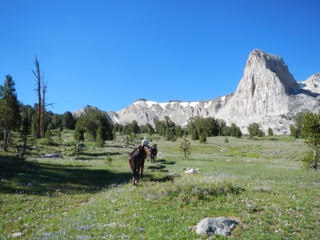
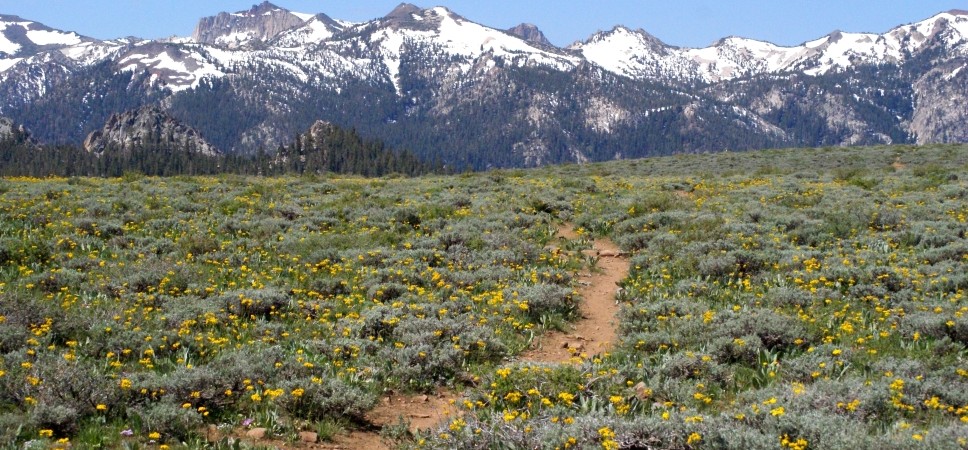
Time for a nice fall hike in the Eastern Sierra Nevada
Posted in Bidwell-Bartleson Party | Leave a comment

October 15, 1841 — Into the Mountains

Friday, 15th. Advanced upstream about 12 miles and arrived at the base of very high mountains. The creek had become a small spring branch, and took its rise at no great distance in the mountains. But we saw plainly that it was impossible to progress further without scaling the mts., and our Indian guides said they knew no further.

They have reached the base of the Sierra Nevada mountains, a formidable prospect. According to Michael J. Gillis, they are most likely in Little Antelope Valley. They have gone as far as they can go in the valley and now they are going to have to tackle the mountains or turn back.

Mike Gillis, co-author with Mike Magliari of John Bidwell and California, wrote an article for the Overland Journal (Winter 1998) on “The 1841 Trans-Sierra Route of the Bidwell-Bartleson Party.” I’ll be using it to follow John Bidwell across the mountains.

Little Antelope Meadow
Photos from https://jchighcountry.com/little-antelope/

Time for a hike!

Posted in Bidwell-Bartleson Party | Leave a comment

October 14, 1841 — “But We Made No Halt”

Thursday, 14th. This morning we saw at a distance Capt. B. with his 7 men, coming in a direction towards us, but we made no halt, ascended the stream about 20 miles. The mountains continued to increase in height.

That phrase, “but we made no halt” is a telling one. These men (and Nancy, don’t forget her) are not going to wait up for the double-crossing Captain Bartleson and his party. Note that the Kelsey-Bidwell Party is now ahead of Bartleson and his men, even though Bartleson was expecting to reach California before them. What went wrong?

Nicholas “Cheyenne” Dawson was with the Bartleson party, although in his telling some 50 years later, he says the men with Bartleson only meant to do some exploring, not desert the rest of the Company. They seemed to have followed the Walker River downstream until it terminated in a lake. This did not get them where they wanted to go so they headed west. They had eaten up the ration of beef that they had taken with them.

In the meantime Hopper had seen some deer signs; so we camped, and sure enough, Hopper soon killed and brought in a back-tailed deer. We made short work of eating him all up. We also found some baskets of grass seed hidden away by Indians. We confiscated them, poured the seed into the water we had boiled the deer in, and made a delicious soup. While we were devouring the deer, I had noticed Barnett cramming bones into his pocket. I understood this next day when I saw him, as we rode along, gnawing bones.

Traveling the next day we finally struck the river. On the opposite side was a bunch of Indians preparing to leave in haste. By shaking a white rag, we induced them to remain until we approached, for we had nothing left to eat, and thought they might have something we could barter them out of. Although they were frightened at first, we soon gained their good will, and having smoked the pipe of peace with them, let them know by signs our wishes. They produced their stock of trade — a gallon or two of pinion nuts. After tasting these we agreed to take them all, swapping butcher knives for them. We and the Indians then parted, very good friends, each thinking he had the best of the bargain. We now divided the nuts by measure; and I remember that I cogitated for some time — should I make one bait [bite] of mine, or dribble them out. I decided on the latter course, and dropped them into my pocket; but they were delicious.

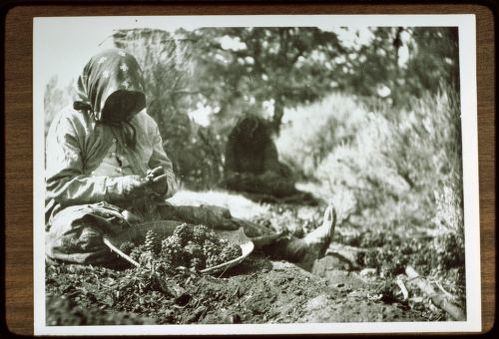
Pine nuts were a staple of the tribes in the Great Basin. They are high in protein and an excellent food source. For more on the history and culture of pine nuts by Native American tribes in Nevada, go to pinenut.com.

Paiute women harvesting pine nuts in 1912. Courtesy of the Library of Congress.
Posted in Bidwell-Bartleson Party, Uncategorized | Leave a comment

October 13, 1841 — Walker River

Wednesday, 13th. Traveled about 13 miles and only crossed a bend of the river; at this place it ran due north. Day was hot, the creek had dwindled to half its first size.

Jimmy John says it was 25 miles and his figure looks more likely. This was a cutoff to save traveling northward on the river and then back down again. They crossed the creek (the Walker River) and camped on the west side at the foot of a high mountain. This may have been Mount Wilson, in Lyon County, just south of present-day Yerington.

Wilson Canyon, Nevada By Davemeistermoab – https://commons.wikimedia.org/w/index.php?curid=5305377

The trouble with writing about the Walker River and Yerington, is that it starts a song running through my brain, “”Where the Walker runs down to the Carson Valley plain . . .” That’s the first line of Darcy Farrow, a song written by Steve Gillette and Tom Campbell. Probably the most famous version is by John Denver, but the one in my head is this one.

Posted in Bidwell-Bartleson Party | Leave a comment

October 12, 1841

Tuesday, 12th. Traveled about 4 miles upstream, and encamped, understanding our Indian (having hired another pilot) that it would be a long day’s travel to water, after leaving the creek.

Why leave the creek? The creek they are on is the Walker River, which makes a long arc northward and then south. The company plans to leave the river and cut across the hills to rejoin the river further to the west. How they were able to understand this plan from their Indian guide is anyone’s guess.

At any rate, this short 4-mile trek and camp by the river will give their animals time to rest and graze before heading out over waterless terrain.

Posted in Bidwell-Bartleson Party | Leave a comment

October 11, 1841 — Looking for a River

Monday, 11th. Left the lake this morning, going to the mountains on a S.W. course. Today we left the trail of Capt. B. and having traveled 19 miles, arrived on a stream which flowed rapidly, and afforded more water than Mary’s river. We though now, without doubt, that we were safe on the waters of the S. Joaquin (pronounced St. Waukeen) according to Marsh’s letter. Here grew willows, balm Gilead, and a few cottonwoods. The course of the stream as far as we could see was S. — but knew not how soon it might take a turn here in the mountains.

These pioneers had been motivated to set out for California by tales they heard from fur trappers, like Antoine Robidoux, and by letters written by Dr. John Marsh that were published in the Missouri papers. Marsh lived near Mt. Diablo and the nearest large river was the San Joaquin, so the company was on the lookout for it, but they had yet to cross the Sierra Nevada. It gives you an idea how little they knew of the geography around them.

The river they have found was the Walker River, which flows out of the Sierra. This was the river they would follow up into the mountains. In The First Emigrant Train, Bidwell wrote:

Leaving the Sink of the Humboldt, we crossed a considerable stream which must have been the Carson River, and came to another stream, which must have been Walker River, and followed it up to where it came out of the mountains, which proved to be the Sierra Nevada. We did not know the name of the mountains. Neither had these rivers then been named, nor had they been seen by Kit Carson or Joe Walker, for whom they were named, nor were they seen until 1845 by Fremont, who named them.

Bidwell is right about the Carson River, but wrong about the Walker. Joe Walker had explored it in 1833, but it was Fremont who named it.

Bidwell’s “balm Gilead” is either the balsam fir or the balsam poplar. Both trees exude a strong-smelling sweet resin.

Walker River in Nevada
Posted in Bidwell-Bartleson Party, Uncategorized | Leave a comment

October 10, 1841 — Honeydew, Anyone?

[Sunday, 10th] Large numbers of Indians lived about this place, but few (50 or 60) visited our camp. Crossed Mary’s river — it was here running E. leading from the lake which we saw to the W. of us yesterday, into the swamp by which we staid last night. Our course today was S.W. Distance 15 miles — encamped upon the lake.

Fifty or sixty hardly sounds like few to me, but maybe it’s all relative.

On the 7th Bidwell wrote about the “dry cane grass which the Indians had cut in large heaps to procure honey from the honey dew with which it was covered.” The Indians in this region are Paiutes, although Bidwell usually refers to them as Shoshones. Here is a little more about honeydew from his 1877 Dictation.

In the edges of the water the tule was covered with honeydew to an extent that enabled the Indians to gather it in large quantities. They made it into balls about the size of one’s fist and we bought and ate considerable of it. When we afterwards saw them gathering it, we saw that the Indians collected the insects that covered the honeydew as well as the dew itself and formed the whole into a ball.

According to a report titled Native American Plant Resources in the Yucca Mountain Area, Nevada, this reed was Phragmites australis. “The stems of this plant were used to make arrow shafts and wickiup walls. The candy-like,”honey dew’ exudate was scraped off the leaves and eaten as a sugary food.” The honeydew was created by aphids, which were included in the sugary balls. It was undoubtedly a very nutritious food.

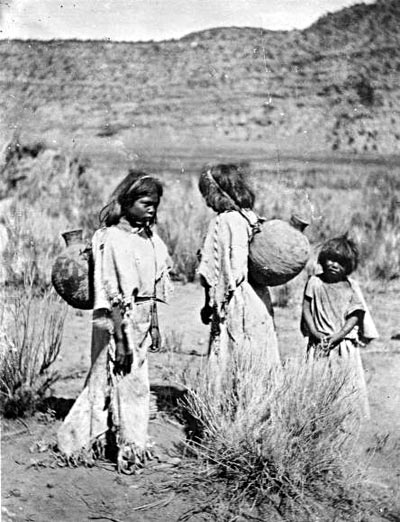
Paiute girls with water jugs
Posted in Uncategorized | Leave a comment

October 9, 1841 — Laborious Travel, Nauseous Water

Saturday, 9th. Crossed Mary’s river where it led from the swamp into a lake beyond; our pilot led us south on the trail of Capt. B. Crossed a plain which is covered with water the greater part of the year — then came into sand hills, among which traveling was very laborious. Saw to the W. of us a lake, presenting a sheet of water 20 or 30 miles in extent. Encamped by another swamp, in which the water was very nauseous. Distance 28 miles.

They are traveling through an utter wasteland — no trees, no grass, no good water — just sand hills punctuated by swampy pools of nasty water. They try to follow in the tracks of Bartleson’s men, but the trail was easily lost in the arid soil. In his 1877 Dictation Bidwell says:

Thrown entirely upon our own resources to find our way as best we could through this region and into California, Benjamin Kelsey proved to be our best leader.

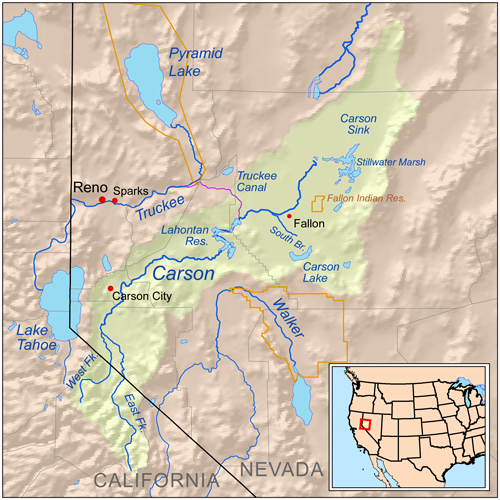
So we could call this the Kelsey-Bidwell Party. In the map below, the Humboldt River and Sink are at the upper right. From there the Kelsey-Bidwell Party were guided by the Indian guide southward to Carson Lake, and then westward to the Walker River. This was the river they would follow up into the Sierra Nevada.

Posted in Uncategorized | Leave a comment

October 8, 1841 — Duck Season

Friday, 8th. The swamp was clouded with wild geese, ducks &c, which rose from its surface at the report of our guns. We traveled about 6 miles and stopped to kill a couple of oxen that were unable to travel.

Jimmy John notes that they only traveled a few miles that day because their Indian guide told them that they could “get to no other watering place today.” So instead they tried to add to their store of meat by hunting geese and ducks.

They are still by the Humboldt Sink and following the remnant of Mary’s River. By going south instead of west, they are missing out on finding the Truckee River, which later wagon trains would seek out. But that would have meant crossing the “Forty Mile Desert,” a nightmarish trek for everyone who attempted it.

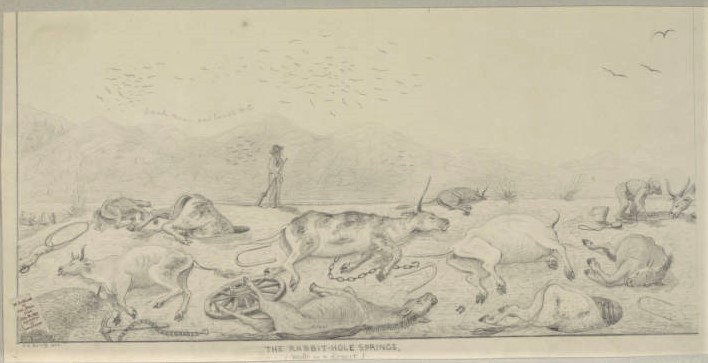
Dead oxen in the desert, J. Goldsborough Bruff’s depiction of the California Trail
Posted in Bidwell-Bartleson Party | Leave a comment

October 7, 1841 — The Departure of Capt. Bartleson

Thursday, 7th. Capt. Bartleson, having got enough meat yesterday to last him a day or two, and supposing he would be able to reach the mountains of California in 2 or 3 days, rushed forward with his own mess, consisting of 8 persons, at a rate entirely too fast for the oxen, leaving the rest to keep up if they could, and if they could not it was all the same to him. The day was very warm.

The Indian pilot remained with us — the river spread into a high, wide swamp, covered with high grass — Indians were numerous. Encamped by the swamp about dark, having come about 25 miles — water bad — no fuel, excepting weeds and dry cane grass which the Indians had cut in large heaps to procure honey from the honey dew with which it was covered.

They have reached the Humboldt Sink, where the river spreads out into a marshy swamp and soaks into the sand. The supposed leader of the company, John Bartleson, without consulting with any except his own mess, has decided to strike out on his own and beat the others to California.

John Bidwell never forgot this act of betrayal. Years later, in The First Emigrant Train to California (Echoes of the Past), he wrote about that morning:

When nearly ready to go, the Captain and one or two of his mess came to us and said, “Boys, our animals are better than yours, and we always get out of meat before any of the rest of you. Let us have the most of the meat this time, and we will pay you back the next ox we kill.” We gladly let them have all they wished. But as soon as they had taken it, and were mounted and ready to start, the captain in a loud voice proclaimed,

“Now we have been found fault with long enough, and we are going to California. If you can keep up with us, all right; if you cannot, you may go to – – -!”

(This was first published in The Century Magazine in 1890, a time when no respectable publication would print a swear word like “hell.” What Bartleson said is pretty clear, and John Bidwell never forgot it.)

Bartleson and his eight companions took off on their mules, with most of the meat from a freshly-slaughtered ox.  They had not said a word about abandoning their companions before this. Figuring that he and his men had enough meat to get them to the mountains, they left the others in the dust—some of the men and Nancy Kelsey on horses or mules, the rest on foot with the slow-traveling oxen. Jimmy John’s journal entry notes that:

They thought they could leave us behind and have the first sight of the beautiful plains of California. Our animals are giving out. Left one horse and mule today and threw away some heavy baggage.

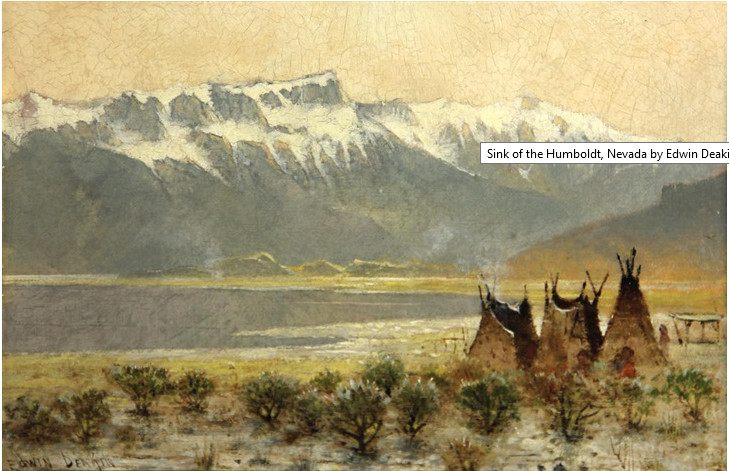
Sink of the Humboldt, Nevada by Edward Deakin (1838-1923)
Posted in Bidwell-Bartleson Party, John Bartleson | Leave a comment