Wednesday, 18th. Traveled but a short distance when we discovered that a deep salt creek prevented our continuing near the river. In ascending this stream in search of a place to cross it, we found on its margin a hot spring, very deep and clear. The day was very warm and we were unable to reach the river; encamped on this salt creek and suffered much for water, the water being so salt we could not drink it. Distance 15 miles.
From Soda Springs and the parting of the ways down the Bear River to the Great Salt Lake is only about 100 miles. On today’s highways this journey would take them a couple of hours. Even at their rate of about 15 miles a day, it might only take them a week to get to Salt Lake, but all this detouring around hills and streams means that they still have several days to go.
Camping on a salt creek is a foretaste, literally, of what they are soon to endure on a regular basis. They are on the banks of the Malad River, so named by earlier fur trappers because the water made them sick (“malade” in French). The banks are steep and the bottom is muddy, making it difficult to cross.
Jimmy John wrote:
18th. This morning we came to a deep muddy creek which we could not cross without going nearly a half a days journey up it and we have travelled about 5 miles. Crossed it and camped on the other bank. There are a number of hot salt springs on the banks of this creek, some are nicely boiling.
In the map below you can see the Malad River on the left, flowing south into the Bear River. The map shows how the party had to proceed up the river to cross, then back down again. The map is from an article tracing the route of the Bidwell-Bartleson Party in Utah, by Roy D. Tea. If you really want to trace this section of the journey, that’s the place to go.
Tuesday, 17th. Traveled about 16 miles; saw a large smoke rising out of the mountains before us. It had probably been raised by the Indians, as a telegraph, to warn the tribe that their land was visited by strangers. We were unable to procure any fuel this evening; we therefore slept without fire. The Indians found in this region are Shoshonees; they are friendly.
Indian smoke signals may be a tired trope of old Hollywood westerns, but smoke is a good way to send a simple message over a long distance and Indians did use this method of communication. Smoke signals were used not only by Native Americans of the Plains and Southwest, but also the Chinese, the Greeks, and other ancient cultures.
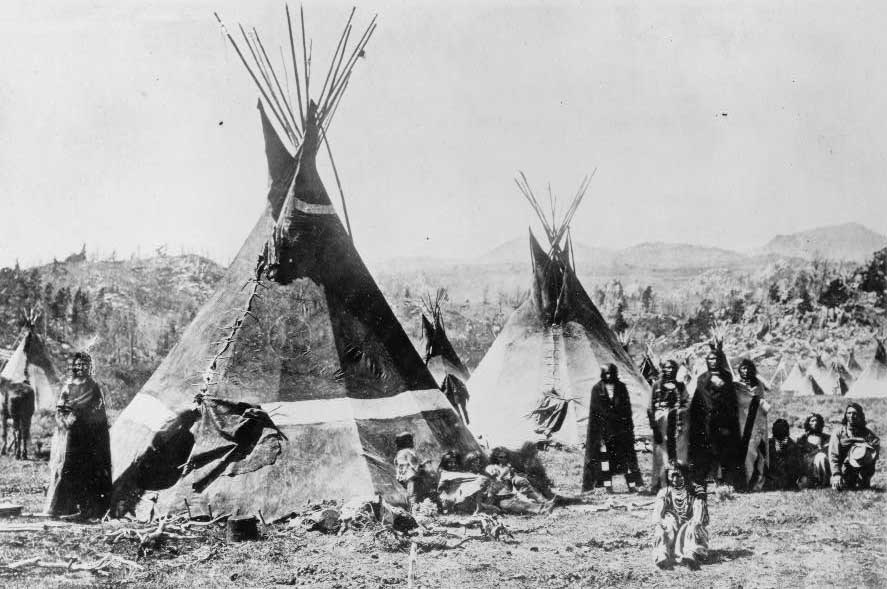
They are definitely in Shoshone country. The Shoshone tribe was spread across the Great Basin from southern Idaho to northern Utah and from Nevada to eastern Wyoming. At this time (1841) the Shoshone were friendly and peaceful, but increasing white encroachment would result in conflicts in the coming decades.
A Shoshone encampment in the Wind River Mountains of Wyoming, photographed by W. H. Jackson, 1870
Monday, 16th. This morning there was an abundance of water in the little stream and it was running briskly when we left it. If the water was not supplied by the melting of the snow in the mountains, it was really an interesting spring; found an abundance of choke cherries, very large and exquisitely delicious, better than any I ever eat before. Distance traveled, 12 miles.
They had noticed the water in the stream dry up the day before, and then start again during the night. It doesn’t look like Bidwell ever found the answer to this puzzle.
Notice that he says “better than I ever eat before,” rather than ate. He probably pronounced it et, and we now usually pronounce it and spell it ate, although et is still heard in some regions. Compare these present and past tense spellings to read/read. The old spelling of past tense eat can be found in Shakespeare, Boswell, and many other authors.
Chokecherries are best eaten when they are dark red, almost black. To me they look like the berries on pokeweed, a common weed around here, but those are poisonous.
Sunday, 15th. Continued our journey over hills and ravines, going to almost every point of the compass in order to pass them. The day was very warm — the grass had been very good, but it was now very much parched up. Having come about 15 miles, we encamped on a small stream proceeding out of the mountains at no great distance from us. But we were surprised to see it become perfectly dry in the course of an hour; some of the guard said there was plenty of water in it about midnight.
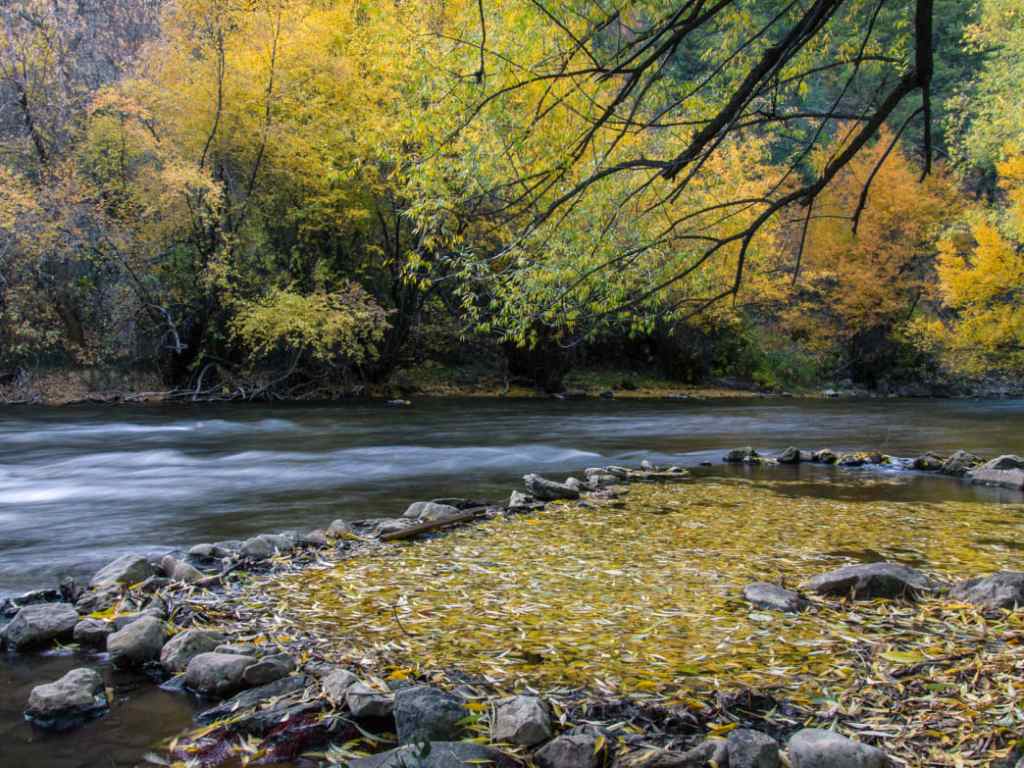
I don’t know exactly where they were along the Bear River, but here is a nice picture of Logan Canyon in Cache Valley, Utah.
Saturday, 14th. Left the river on account of the hills which obstructed our way on it; found an abundance of choke cherries, many of which were ripe. Road uncommonly broken, did not reach the river, distance about 14 miles.
Chokecherries (Prunus virginiana) are a small dark red fruit, native across most of North America and related to cherries and plums. They are chockful of antioxidants. They have a slightly astringent taste, but are sweet and delicious when fully ripe (so I am told — I’ve never eaten them).
For Native Americans, chokecherries were an important part of their diet and a key ingredient in pemmican. For the emigrants, chokecherries were a welcome addition to their otherwise monotonous fare. At this point in their journey, in mid-August, is when chokecherries ripen and are ready to pick.
Friday, 13th. Traveled about 10 miles in a southerly direction. It was the intention of the company to stop and hunt in Cash valley, which is on Bear river 3 or 4 days’ travel from its mouth.
He means Cache Valley, in northern Utah. Captain Fitzpatrick would have mentioned it as a good place to rest and hunt.
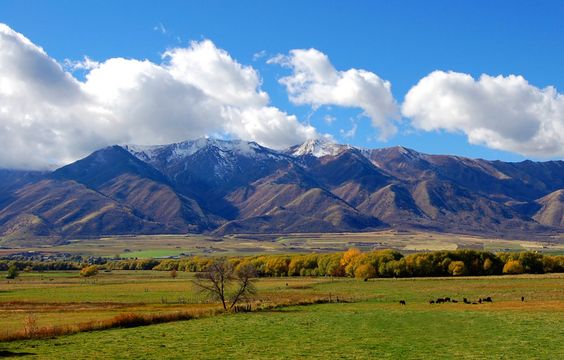
Cache Valley was well known to the fur trappers of the early 19th century. It was sometimes the site of rendezvous and was considered a good place to “cache” your furs until it was time to take the lot back to Missouri for sale. It is a beautiful well-watered fertile valley between the Rockies and the ranges of the Great Basin.
Today the Cache Valley is a well-populated area, with a major city (Logan) and lots of farms.
The Cache Valley and the Wellsville Mountains. Photo uploaded to Pinterest by Annie M.
But the Company is not there yet. They still have several days of travel down a river hemmed in by hills before they get to the valley. And on the 13th, Jimmy John said:
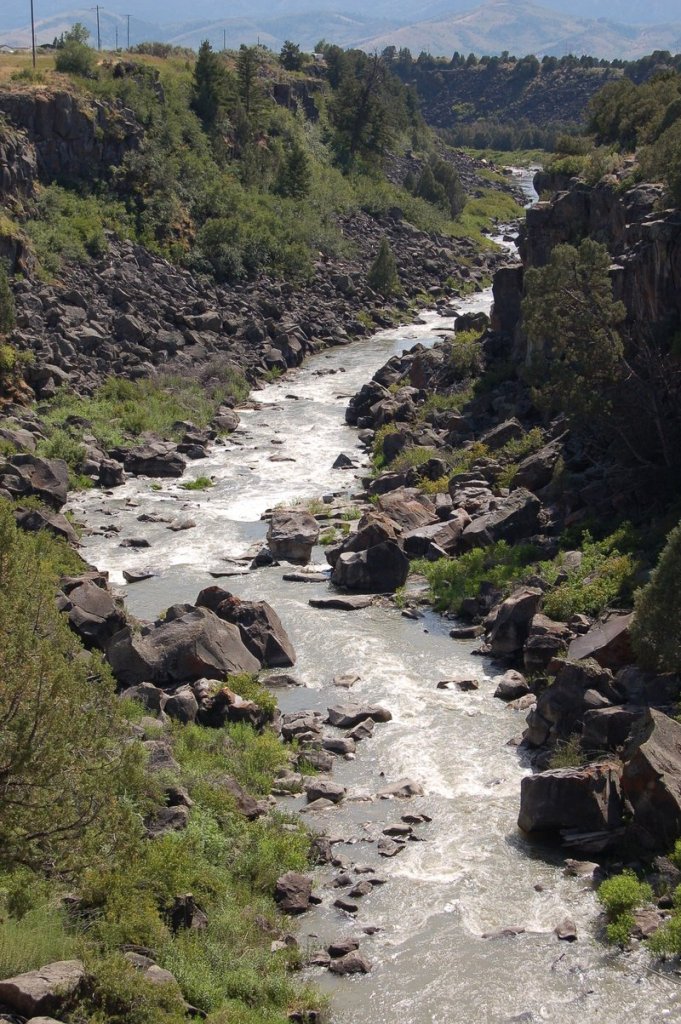
The river here runs thru a deep channel of black rock which has the appearance of being melted by volcanic eruptions and not by earthquakes.
They were probably trying to get through Black Canyon. It is now a popular place for kayaking.
I, in company with another man (J. John), went some distance below the camp to fish in the river; fished sometime without success-–concluded we could spend the afternoon more agreeably. The day was uncomfortably warm, could find no place to shelter us from the burning sun, except the thick copses of willows–these we did not like to enter on account of the danger of falling in with bears. We concluded to ascend the mountain, where were two spots of snow in full view, in order to enjoy the contrast between a scorching valley and a snowy mountain. Supposed the snow not more than 4 miles distant; set out without our guns knowing they would be a hindrance in ascending the mountain.
Our march was unremitted for at last 4 miles, had only gained the side of a hill which we at first supposed not more than a mile off; here we lingered to observe several kinds of trees which we had not before observed, among which were a kind of rock maple, choke cherry, &c. But conscious of being defeated in our object, if we lost much time, we ran up the eminence with renewed vigor, till at last gained the summit. But, being determined not to be outdone, we continued on under all the strength we could command. Crossed a valley 3/4 of a mile wide, ascended craggy steeps and passed through thickets of the densest kind; night obscured the valley below us, lost sight of the snow above us, afraid to return lest we fall in with bears as their signs were plenty and fresh; continued to ascend the mountain till midnight could not find the snow — we were cloud, not having our coats. Clouds drifted against the mountain and made us wet — slept under a pine tree which afforded us good shelter.
Morning came, it found us about half a mile below the snow, took as much as we could conveniently carry; took another route down the mountain, running and jumping as fast as our strength would permit, arrived at the camp about noon. They supposed, without a doubt, that the Blackfeet had got us, had been up all night on guard, every fire had been put out, they had been out twice in search of us and were about to start again when we arrived. We were received with a mixture of joy and reprehension. The company was soon under way and traveled about 4 miles.
James John, always known as Jimmy John, was from Ohio and ten years older than Bidwell. He would later settle in Oregon and found the town of St. Johns on the Willamette, now a neighborhood in Portland.
Bidwell told this story every time that he told about the trip; it was a major feature in all his accounts. In his 1877 dictation for H.H. Bancroft, he describes their route down the mountain:
At first the way was smooth and easy but soon we were sliding down in the snow and mud with our buckskin suits wet and bedraggled. This way soon led into a most rugged canyon and thickets so dense that it became impossible to pass through them except in the trails of the grizzly bears. . . . We carried our sheath knives in our hands at every step, for we knew not at what instant we would meet a bear face-to-face.
In The First Emigrant Train to California he describes their reception when they returned on the 12th:
Their first questions were “Where have you been?” “Where have you been?” I was able to answer triumphantly, “We have been up to the snow!” and to demonstrate the fact by showing all the snow I had left, which was now reduced to a ball about the size of my fist.
He was lucky that someone didn’t beat him over the head with that chunk of ice. One man suggested that they ought to be horsewhipped. “We laid hold of our rifles at once and told him neither he nor anyone else should apply such language to us.”
Wednesday, 11th. Having traveled about 6 miles this morning the Company came to a halt — The Oregon company was now going to leave Bear river for Ft. Hall, which is situated on Lewis river, a branch of the Columbia. Many who purposed in setting out to go immediately through to California, here concluded to go into Oregon so that the California company now consisted of only 32 men and one woman and child, there being but one family.
Fort Hall is on the Snake River, which is indeed a tributary of the Columbia, but I think Bidwell thought they were closer to Oregon and California than they really were.
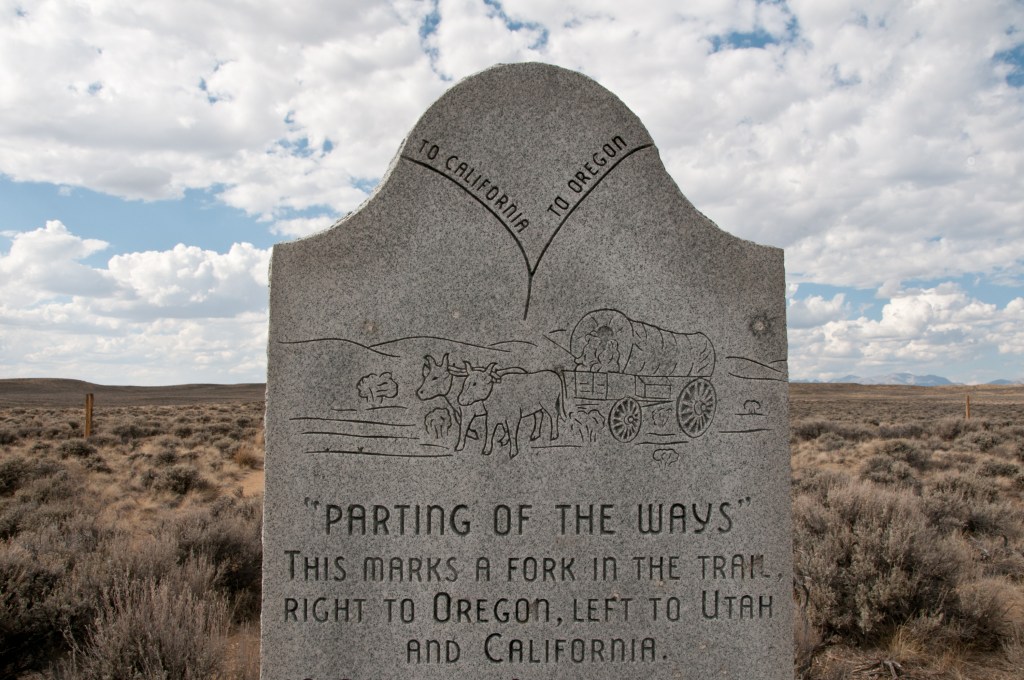
Monument along HW 28 designating the location of the “parting of the ways’ for those emigrants who chose to take the Seminole Cutoff. This monument, however is now believed to be a substantial distance from the true ‘Parting of the Ways. Along HW 28 Wyoming.
The two companies, after bidding each other a parting farewell, started and were soon out of sight. Several of our Company, however, went to Ft. Hall to procure provision, and to hire if possible a pilot to conduct us to the Gap in the California mountains, or at least to the head of Mary’s river. We were therefore to move slowly ’till their return. Encamped on Bear river, having come about 12 miles.
The Gap in the California mountains! If only there were, how much easier the journey would be for them and all the later pioneers. In a later writing, The First Emigrant Train to California, Bidwell writes:
Thirty-two of our party, becoming discouraged, decided not to venture without path or guide into the unknown and trackless region towards California, but concluded to go with the missionary party to Fort Hall and thence to find their way down Snake and Columbia rivers into Oregon. The rest of us — also thirty-two in number, including Benjamin Kelsey, his wife and little daughter — remained firm, refusing to be diverted from our original purpose of going direct to California. After getting all the information we could from Captain Fitzpatrick, we regretfully bade good-by to our fellow emigrants and to Father De Smet and his party.
And so they ventured into the unknown, and into the very worst part of the journey. But first, John Bidwell and his friend James John are going to have an adventure.
Tuesday, 10th. The day was fine and pleasant; a soft and cheerful breeze and the sky bedimmed by smoke brought to mind the tranquil season of autumn. A distance of 10 miles took us to the Soda Fountain, where we stopped the remainder of the day. This is a noted place place in the mountains and is considered a great curiosity–within the circumference of 3 or 4 miles there are included no less than 100 springs, some bursting out on top of the ground, others along the banks of the river which are very low at this place, and some even in the bottom of the river.
The water is strongly impregnated with soda, and wherever it gushes out of the ground, a sediment is deposited, of a reddish color, which petrifies and forms around the springs large mounds of porous rock; some of which are no less than fifty feet high. Some of these fountains have become entirely dry, in consequence of the column of water which they contained becoming so high as to create sufficient power by its pressure to force the water to the surface in another place.
In several of the springs the water is lukewarm — but none were very cold. The ground was very dry at this time, and made a noise as we passed over it with horses, as though it was hollow underneath. Cedar grows here in abundance, and the scenery of the country is romantic. Father De Smet, with 2 or 3 Flathead Indians, started about dark in the evening to go to Fort Hall, which was 50 miles distant.
It sounds like Yellowstone National Park, or Bumpass Hell in Lassen Volcanic National Park.
Bumpass Hell, July 2020
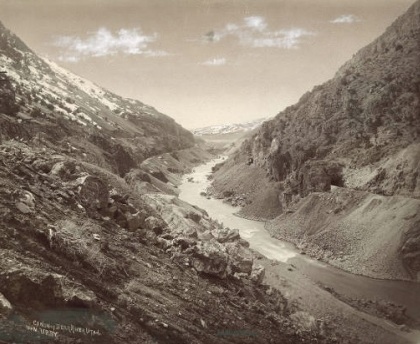
The Soda Fountain, or Soda Springs, was a well-known landmark on the Oregon Trail, and many travelers got out their diaries and recorded their impressions. It’s difficult to find any photos from the 19th century though. Here is one, taken by W.H. Jackson in 1872, of extinct basins at Soda Springs.
Library of Congress
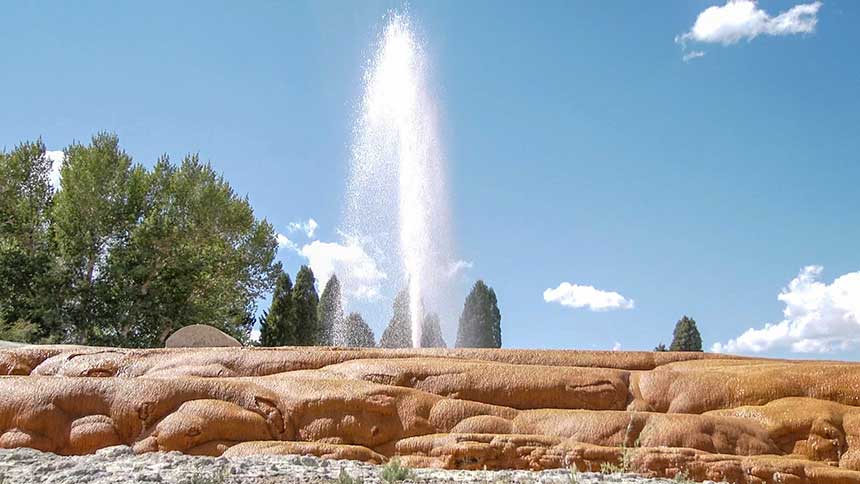
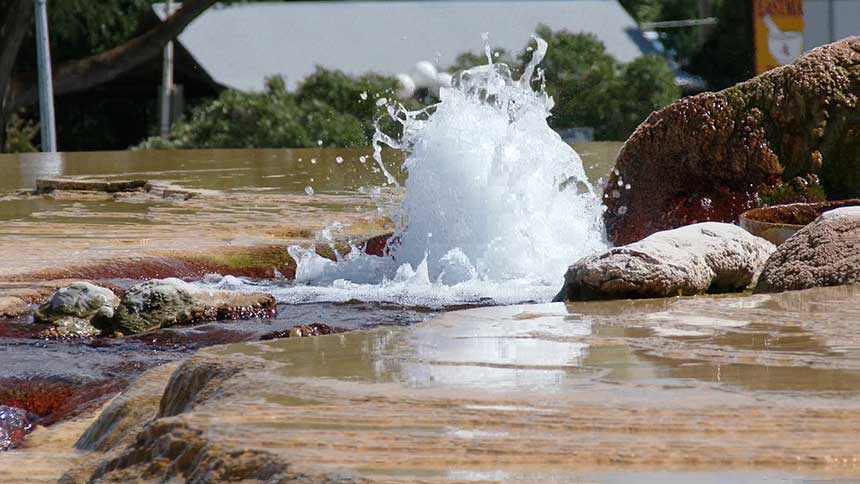
Today the landscape has changed greatly at Soda Springs, Idaho. Most of the naturally carbonated springs are gone, covered by a man-made reservoir. The main attraction is a geyser, the only “captive” geyser in the country, which was created in 1837 when a well drilling operation, which was attempting to build a natural hot springs swimming pool, inadvertently released a tepid geyser that shot 100 feet into the air. The geyser now has a timer on it and is released once an hour.
Mike Price, EastIdahoNews.com The geyser John Bidwell didn’t get to see
Let’s hope they all took baths here. I’ll bet they needed them.
9th. Traveled 16 miles on the bank of the river except in the afternoon we left the river and returned to it at night and camped. Killed two antelope and caught a number of fine fish.
Note the difference in mileage, which suggests that they were estimating it.







 goldfields