If you enjoy California history of all kinds (and who doesn’t?), sign up for the California Corner newsletter from the History Room at the California State Library. You’ll get a quarterly newsletter sent to your email box, packed full of photos, stories, and various tidbits of California lore.
To sign up, go to the California State Library mailing list page at https://www.library.ca.gov/mailing-lists/ There’s a slew of newsletters there, and maybe you are also interested in some of them. California Corner is the last one on the list.
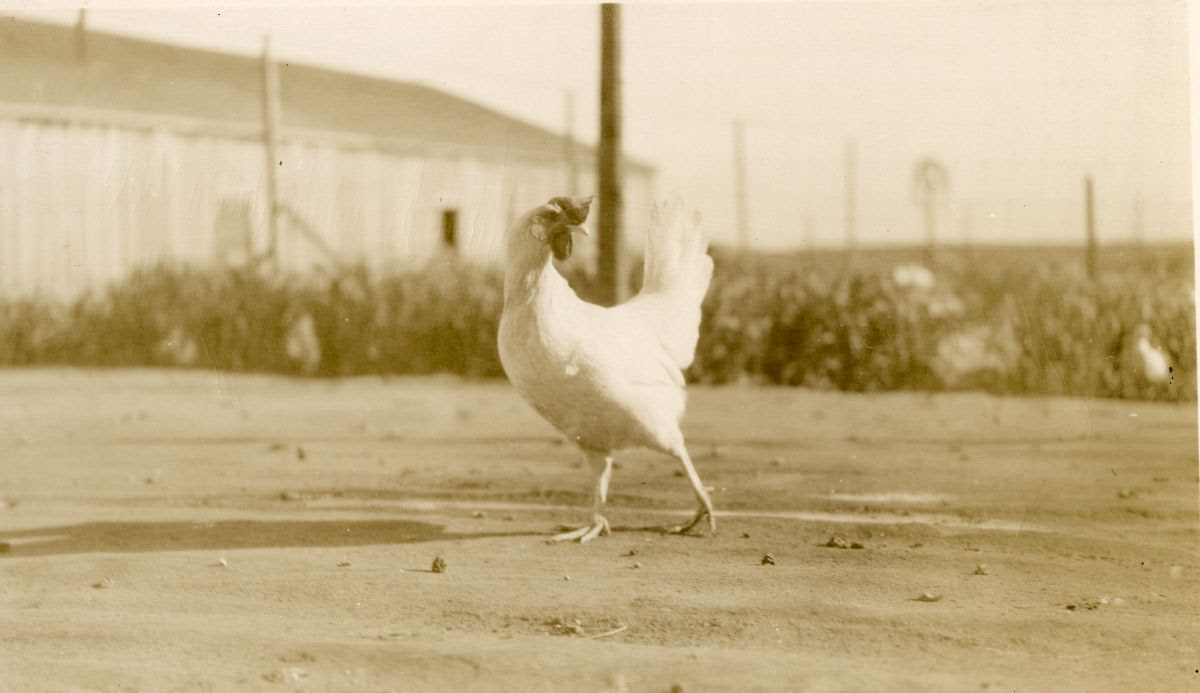
The first edition of the newsletter includes announcements of upcoming events, a welcome to new librarians (there’s a job I would have liked!), a feature on California authors, a fun item in “Discoveries in the Stacks” on the Gingerbread Man cookbook, and this featured photo of a sassy chicken. She looks like a fashion model on the catwalk. Or should that be henwalk?
The California State Library has a Facebook page and it is worth checking out too. There can never be too many ways to get your California history fix!
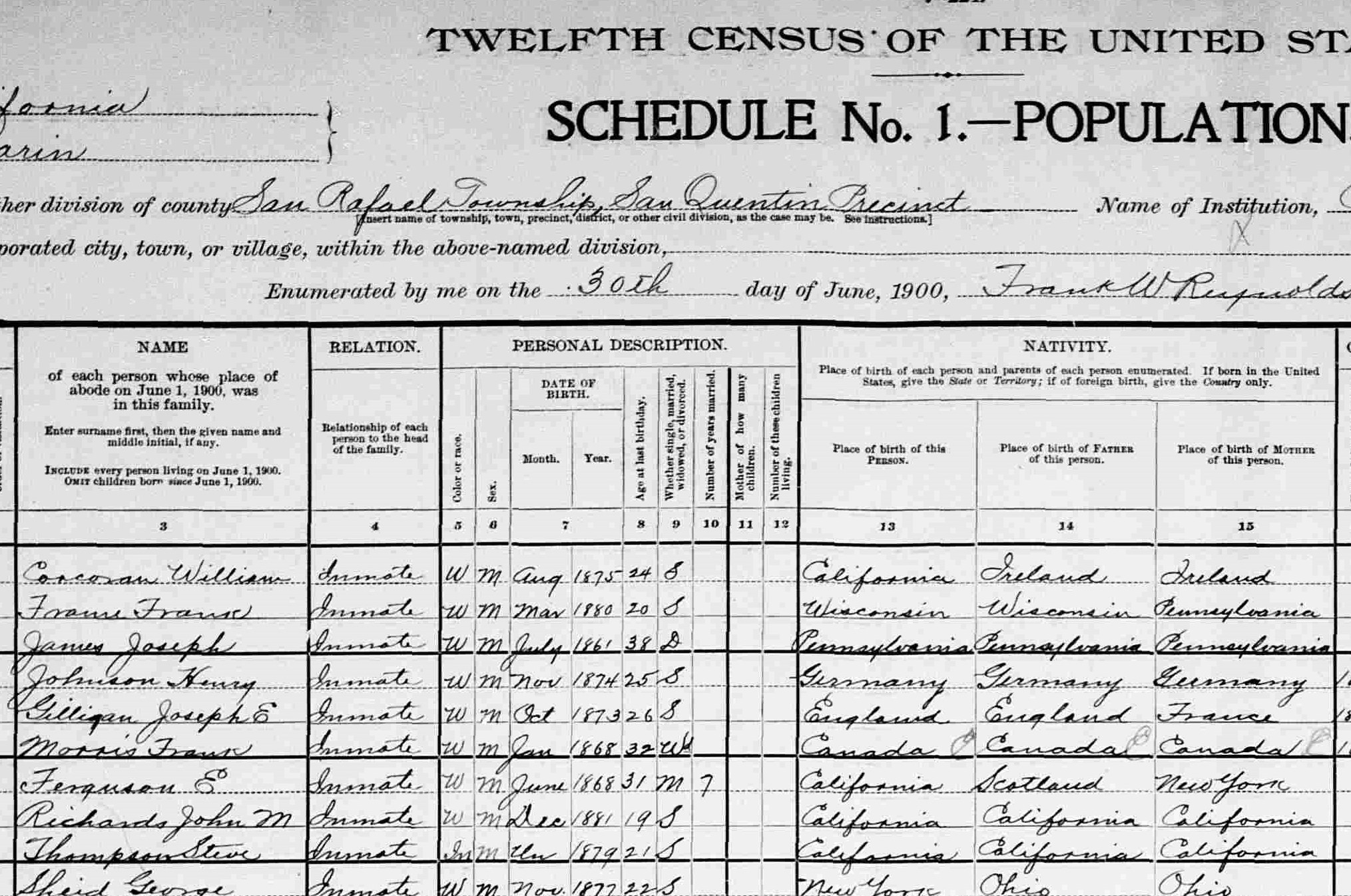
John Richards and Steve Thompson were incarcerated in the California State Prison at San Quentin when the census was taken in June 1900. John was 19 years old; Steve was 21. Their occupations (before they went to prison) are listed as teamster for John and laborer for Steve.
After 1900, I find no more record of Steve Thompson. He disappears. Given a life sentence, he probably spent the rest of his life, whether long or short, at San Quentin. But John Richards’ story continues.
Johnny Richards had garnered some sympathy from the public as a young man led astray by an older and more criminally-minded companion. Annie Bidwell wrote to him while he was in prison. She sent him packages; in 1901 she sent him Aesop’s Fables for Christmas and 25 handkerchiefs in 1905. She sought to get him paroled from prison, and in 1909 she was successful. Her diary tells the story:
1907 Mon Sept 2 [List of letters written] #3 John Richards – San Quentin
1909 Tues., February 2. Letters: 1 From Sister : 2 John Richards about his release on parole from San Quentin. His “papers” had been rec’d. at Prison. Very grateful to me.
Mon., February l5. Events: “John Richards Paroled from San Quentin, to take effect March l st l909” – thus the clerk of the prison wrote me in letter recd. today. Also sends list of clothing he must have and his fare to Chico. Ordered the clothing & fare sent to him, today.
Mon., February 22 Letter from San Quentin Clerk & Receipt for $35.00 which I sent for John Richards’ parole expenses
Tues., March 2. Events: John Richards returned on parole from San Quentin and called on me this A.M. and P.M. Wrote letter to officials notifying same of his arrival & that I would give him continuous work. We held a little service of prayer & thanksgiving.
The Diaries of Annie Kennedy Bidwell, 1888-1896, 1899-1911
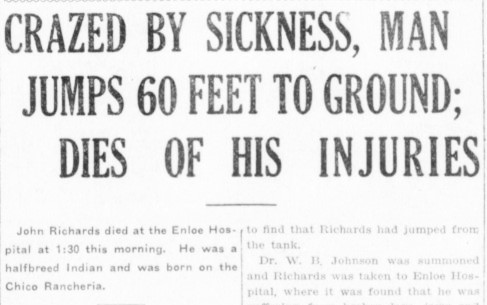
John Richards went back to working as a teamster, and might have faded quietly from sight, if it weren’t for his strange and unfortunate death in 1918.
Chico Record 17 January 1918
In a wild frenzy, John Richards rushed from his sickbed at the home of Mrs. Ed Martin on Humboldt avenue last night, dashed madly for the Northern Electric Mulberry shops, climbed to the top of a sixty-foot water tank and jumped from the tank to the ground, breaking both is legs in two places, the upper and lower jaw bone and the hip bone. He was unconscious at the Enloe Hospital early this morning. He may die.
Richards, who is thirty-seven years old, is employed by the Chico Ice & Cold Storage Company. About a week ago he was stricken with pneumonia, and the crisis approaching last night, he lost his reason temporarily.
He was discovered at the top of the water tank by Bert Holmes, nigh operator at the Northern Electrics shops.
“What are you doing up there?” queried Holmes as he looked up at Richards on top of the tank, his nightshirt flying in the breeze.
“I’m just taking in the scenery,” retorted Richards, who had climbed to the railing.
Bert Holmes telephoned the police for help, but by the time they got there, John Richards had jumped. He was taken to Enloe Hospital and died the next day. His body was buried at the Chico Rancheria cemetery.
No mention was made in newspaper articles about the crime from eighteen years ago. He had cleared his record. He had a job and a fiancee and the support of friends and family. His illness and death are a sad end to a promising life.
Justice was swift in the year 1900. The murder of Billy Simpson had taken place on the night of February 27th, and his body was found on the 28th. On March 2nd Steve Thompson and John Richards were arrested, and it was not long before they confessed to the crime. They were held in the Chico jail until their arraignment on March 9th in Oroville.
The two men were held in the same cell, and Thompson came up with a plot to escape. When Richards’ mother visited in the jail, he told her of the plan to “sandbag” the jailer, steal his keys, and let themselves out. Richards was nervous and did not want any part in a plot that would only get them in deeper trouble.
Chico Record 9 March 1900
Richards and Thompson were separated. Mrs. Harriet Young, the mother of Johnny Richards, visited him every day in jail. Steve Thompson seems not to have had any friends or family to care about him.
Chico Record 20 March 1900
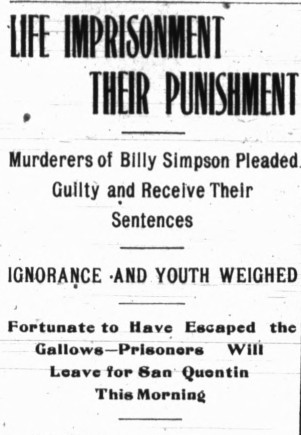
Less than three weeks after the murder, Thompson and Richards were in court before Judge Gray. Once again the newspapers contrasted the two: Richards tearful and remorseful, and Thompson with his “defying grin.” Both men pleaded guilty and the judge decided to take testimony before pronouncing sentence.
Sheriff Sylvester H. Wilson recounted the arrest and confessions of the two suspects. Mrs. Bidwell took the stand to attest to their characters.
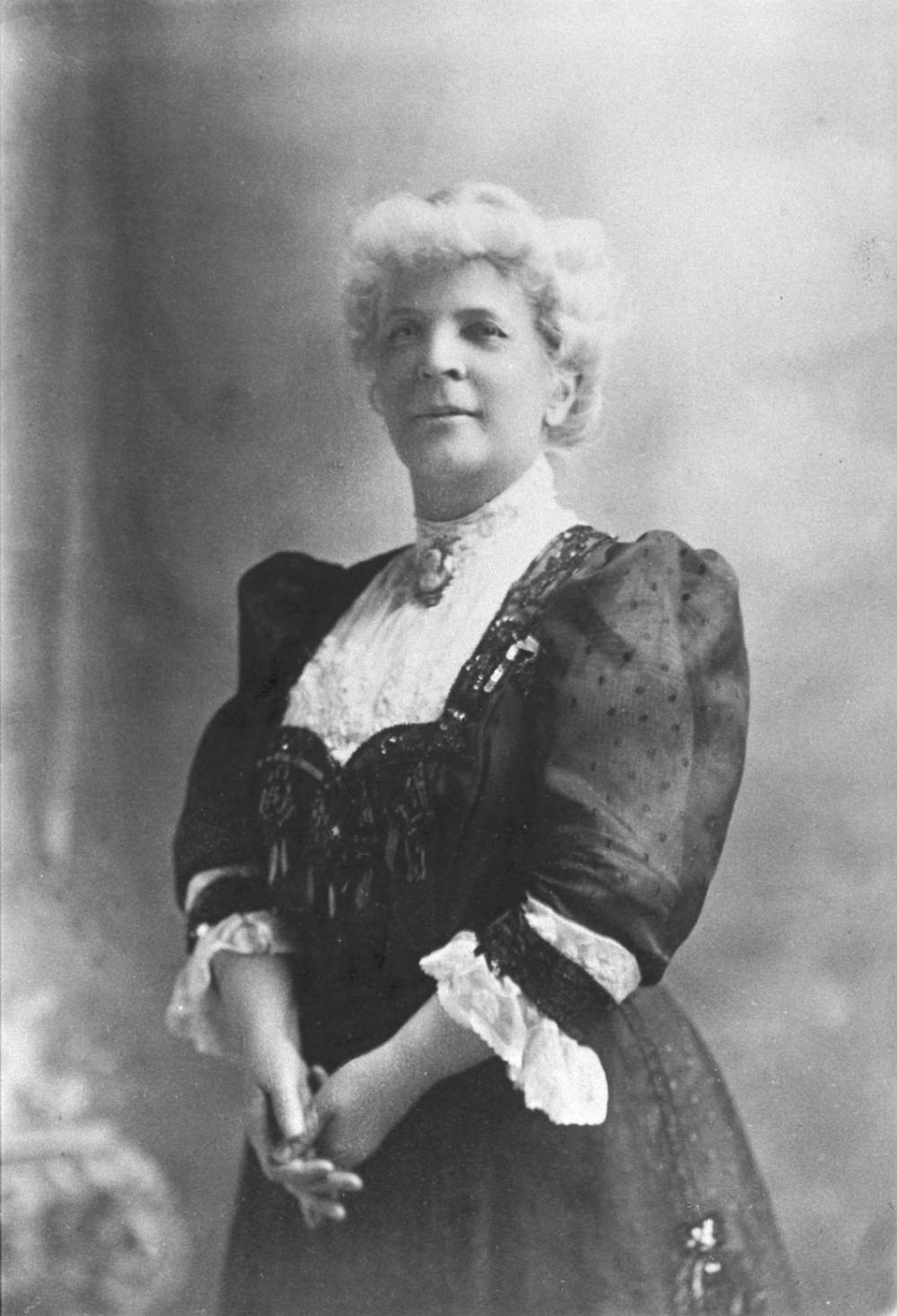
Mrs. Bidwell was called and testified regarding the character of John Richards. She said that she had known him since he was a child about five years of age; that he had been a hard-working boy, and she had petted him considerably. [i.e., she had favored him and given him attention when a child.] Thompson she had known only a short time. She considered him hopelessly ignorant.
Chico Record 20 March 1900
In her diary Annie wrote:
Mon., March 19
Up at 4.30 A.M. At 6.5 this A.M., Mr. & Mrs. Garrison, Mrs. Thornton & self over to Oroville to see Johnny Richards who, with Steve Thompson were to be arraigned for murder this A.M. Arrived a few moments before time. Mrs. G. saw the boys & prayed with them, while Mrs. Thornton & I went to see Dist. Atty. Sentence was pronounced on them about 10.20 O’C and Judge Gray, seeing our interest, took our testimony as to the boy’s character, which testimony he would give the privilege for a petition to the Gov. in 15 years, for Johnny’s pardon, in view of Johnny’s previous character as given by us.
Steve Thompson admitted that he was the one who killed Billy Simpson: “I kill him” was how Annie recorded it in her diary. He said John Richards did not beat Simpson with the iron pipe. Both admitted to taking several drinks of liquor before the crime. Statements were also taken from Richards’ sobbing mother and both attorneys.
Attorney McGee, representing the Indians, made a brief address in the course of which he asked that clemency be shown both defendants, because of the extreme ignorance of the one and the youth of the other. He also called attention to the fact that liquor had aroused the savage instincts and prompted the deed. He asked that justice be tempered with mercy.
Since a sentence of hanging would have been entirely possible, justice was indeed tempered with mercy, and Judge Gray sentenced both men to prison for life. The next day they were delivered by the sheriff to San Quentin.
After the Coroner’s Jury had viewed the remains, the body of Billy Simpson was released into the custody of Annie Bidwell so that she could return his body to the Indian rancheria for burial.
At just what time the funeral will take place is not known, as Mrs. Bidwell stated that she would not give out the time fixed. She does this for the reason that the Indians wish to conduct the services in their own way without the usual crowd of white people who would flock to the Rancheria, were the time of interment made public.
Mrs. Bidwell is very decided on this matter, and stated that if it were found necessary to have the ceremonies at midnight in order to avoid the curious crowd, this plan would be followed.
Chico Weekly Enterprise 9 March 1900
I can just imagine Annie being “very decided.” She was adamant about her decision and she was accustomed to getting her way. In the most ladylike manner, of course. In this case, she showed compassion and foresight in protecting the Indians from intrusion by white gawkers.
The funeral was held at the Indian chapel on Saturday, March 3rd, “the services being conducted according to the Indian desire.” (Chico Record 5 March 1900)
Mrs. Bidwell was careful to keep the time of the services a secret, that the Indians might not be disturbed by a throng of people bent on satisfying their curiosity. In this she was successful for there were but a few white people present to witness the ceremony.
On the morning of March 9, 1900, John Richards and Steve Thompson were arraigned before Judge Collins at the Chico City Hall on a charge of murder. By this time both men had confessed, the murder weapon had been found, and the stolen money retrieved. The courtroom was crowded with spectators as the two suspects were brought in.
The newspapers reported “a marked difference in the appearance of the two prisoners,” and took great interest in drawing the contrast.
Richards, who is almost white and shows but little Indian, was unusually pale and his red and swollen eyes showed that he had been crying. His lips trembled and it was evident from his nervous manner that he had slept but little, if any, during the night.
Chico Weekly Enterprise 9 March 1900
John Richards had a white father from Plumas County and his mother was half-white, hence the comment that he was “almost white.” He had been raised on the Rancho Chico rancheria and worked as a teamster. The newspaper reported the touching scene between mother and son. “It was truly pitiful to see this old woman clinging to the young murderer and to hear her wail of distress.”
Steve Thompson presented quite a different picture. It was said he had shown neither regret nor fear for the future, but smiled “at reference to the horrible deed.”
Thompson is a Pitt River Indian, a member of the tribe who, in the days of Fremont and Kit Carson, were noted for their daring, bravery and blood-thirsty nature. He entered the courtroom with that air of bravado characteristic of his race, smiling at all he chanced to know. His manner showed plainly that if he realized his position, he did not count the cost of his crime.
Chico Weekly Enterprise 9 March 1900
After the arraignment, the two men were taken to Oroville to be held in jail until the trial. Again the contrast was noted:
A large crowd of Indians from the Indian village assembled about the wagon. Thompson neither cared for them, not did the Indians care for him. He wore a defiant grin, but Richards was as solemn as a priest. He had been well liked by the Indians and they gathered about him to bid him farewell. They shook his hand, but not a hand was extended to Thompson.
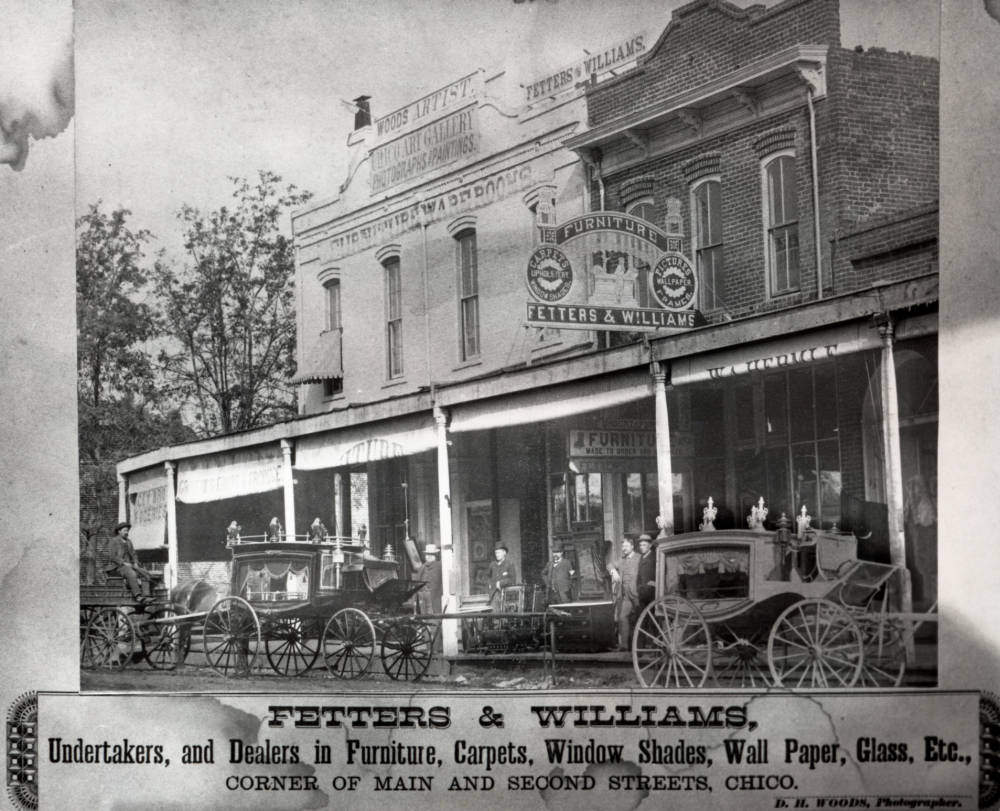
On March 2, 1900, the Butte County coroner assembled a jury to investigate the cause of the death of William Simpson, which had taken place on the night of February 27th. The eight jurors viewed the body at the Fetters and Williams mortuary, and took testimony from several witnesses.
General John Bidwell was called to give testimony as to the victim’s age. He said that he had come to the rancheria when about 20 years of age, and “as near as he could place his age was somewhere between 45 and 55,” which indicates that he started working on Rancho Chico a few years before he is first mentioned in Bidwell’s diary in 1880. He knew nothing about him before he came to Chico.
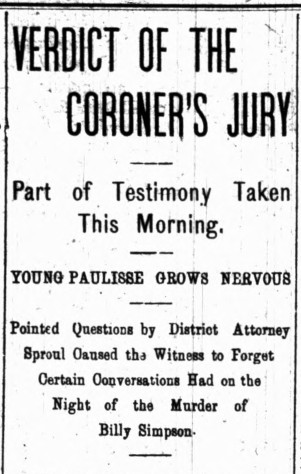
The next witness called was Rufus Paulisse, a resident of the rancheria. He had spoken with the two suspects on the night of the murder.
When I got to town I met Johnny and Steve at Graves’ corner where some men were singing. I went up to where they stood there a while, I think about ten minutes. We talked about the singing. Then I went away, leaving them there. I went around the block and went to the coffee house, and stayed there until about 9 o’clock. . .
When I came out I saw Steve and Johnny standing on McFeely’s corner. Johnny started to go up to town, and Steve called and asked me to go up town with them. I said I was going home and I did go home.
Rufus was nervous, probably because he didn’t want to get in trouble. He may have known more than he was saying, but he was not accused of being a partner to crime. He said that Steve Thompson and Johnny Richards wanted him to go with them, but he turned them down. He didn’t hear them say anything about Billy Simpson. “The last time I saw them was on the corner of McFeely’s shop, but I did not see either go back of the shop and did not see any club.” The quicker Rufus could get off the stand the happier he would be.
Rufus Pulisse (also spelled Pullisy and other variations) was about 25 years old and a member of the Mechoopda tribe. His father, simply known as Pulisse, had known John Bidwell since the early days. Like Billy Simpson, Rufus was a member of the brass band.
Dr. Jackson was called to testify about the wounds found on the body, and Fred Petersen told of finding the body. “At first he thought it was some drunken man who had wandered into the grounds and fallen asleep, but upon coming closer, he saw that the man was dead.” He saw two sets of footprints on either side of the body. Another man, J.L. Barnes, testified that he saw the pockets of the victim’s trousers turned inside out, and that the man’s keys were found ten or twelve feet from the body. Steve Thompson had thrown them there that night.
Marshal J.M. Chubbuck produced the murder weapon, a heavy piece of iron pipe, and testified as to how Richards had told him where to find it. Constable Moses H. Goe testified as to the statements made by the prisoners in which they admitted killing and robbing Simpson. There did not seem to be any other motive than robbery. Eighteen dollars and fifty cents doesn’t seem like much, but it was more than the two young men were used to seeing at one time. They were used to pennies and nickels and dimes. $18.50 would have been closer to $500 today.
Advertisement for Fetters & Williams, undertakers and furniture dealers, about 1885, with two hearses shown.
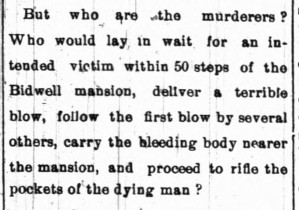
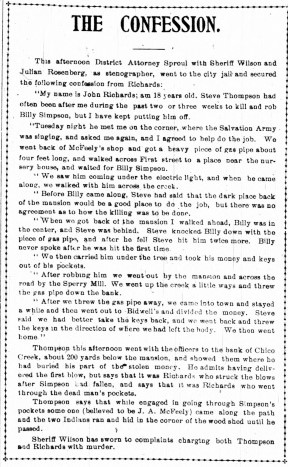
Who could commit such a terrible crime? That was the question on everyone’s lips. But only two days after the murder, the police had a confession. Johnny Richards told his version of the murder to Butte County District Attorney Joseph D. Sproul, Sheriff Wilson, and a stenographer.
My name is John Richards; I am eighteen years old. Steve Thompson had often been after me during the past two or three weeks to kill and rob Billy Simpson, but I have kept putting him off.
Tuesday night he met me on the corner, where the Salvation Army was singing, and asked me again, and I agreed to help do the job. We went back of McFeely’s shop and got a heavy piece of gas pipe about four feet long, and walked across First street to a place near the nursery house, and waited for Billy Simpson.
We saw him coming under the electric light, and when he came along, we walked with him across the creek.
Before Billy came along, Steve had said that the dark place back of the mansion would be a good place to do the job, but there was no agreement as to how the killing was to be done.
When we got back of the mansion I walked ahead, Billy was in the center, and Steve was behind. Steve knocked Billy down with the piece of gas pipe, and after he fell Steve hit him twice more. Billy never spoke after he was hit the first time.
We then carried him under the tree and took his money and keys out of his pockets.
After robbing him we went out by the mansion and cross the road by the Sperry Mill. We went up the creek a little ways and threw the gas pipe down the bank.
After we threw the gas pipe away, we came into town and stayed a while and then went out to Bidwell’s and divided the money. Steve said we had better take the keys back, and we went back and threw the keys in the direction where we had left the body. We then went home.
Chico Weekly Enterprise 2 March 1900
Steve Thompson had his own version of the event. Most of the details coincided with Richards statement, except that Thompson said that the robbery was Richards’ idea. He admitted striking the first blow, but said that Richards hit Simpson after he fell. Since Thompson was not as cooperative, and changed his story between confessions, the authorities were inclined to believe Richards.
It took both men to drag the body out of the driveway and under a tree. They hid by a corner of the woodshed until J.A. McFeely had passed, and then rifled the dead man’s pockets. They found eighteen dollars and fifty cents in a purse and missed a dime that was down in the bottom of a pocket. They split the money. Johnny Richards told the D.A.:
We divided the money over by Bidwell’s, out in the grove. Steve hid his money by the chestnut tree down by the creek. I stayed out in the road. I took my money with me. He told me he would give me ten dollars. I got nine dollars and a quarter.
Chico Record 2 March 1900
As far as I know (I haven’t looked recently) there is still an old chestnut tree on the north bank of Chico Creek, near the bridge that goes to the new Social Sciences building.
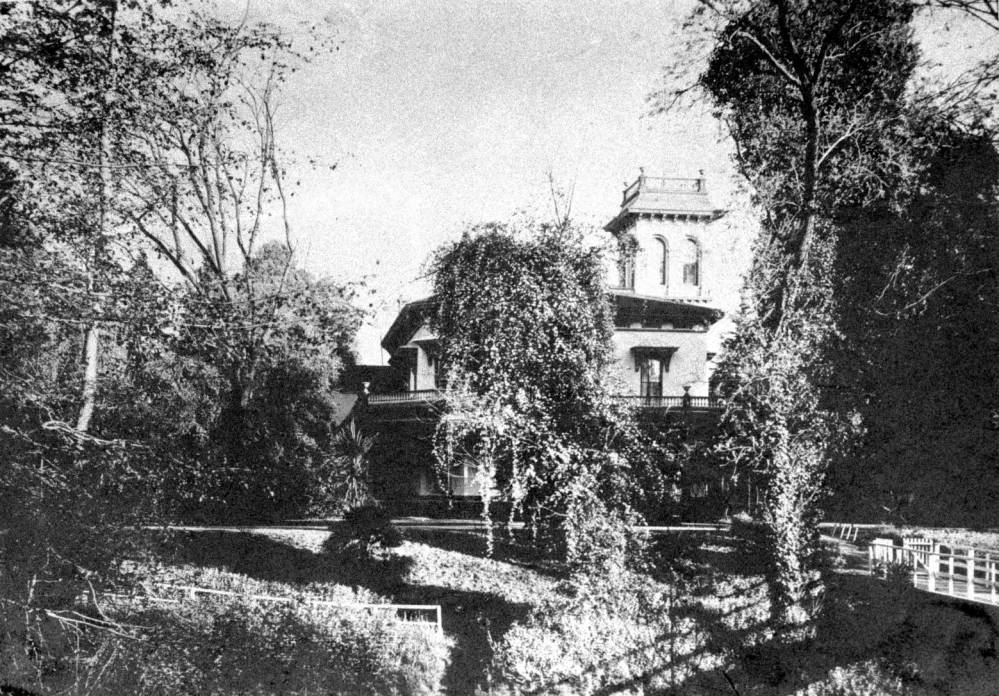
View of Bidwell Mansion about 1900, with footbridge on the right. CSUChico Special Collections sc14491
On the night of his murder, Billy Simpson had been seen going into The Chico Branch, a clothing store on Second Street, with two other Indians, The proprietor, C.N. Howard, said that one of the men, it might have been Simpson, he wasn’t sure, had bought a hat.
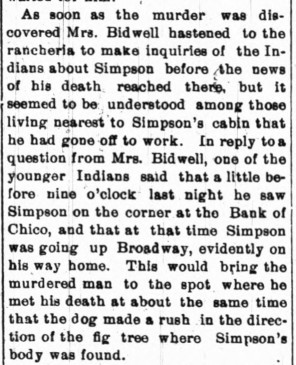
A few minutes after the visit to The Branch, Simpson was seen outside the Bank of Chico. He then stopped in briefly at a coffee-house on Broadway, near the Bidwell office, and then started for home. The time was about 8:45 p.m.
The walk would have taken him through Bidwell’s nursery and over the footbridge toward Bidwell Mansion. A few minutes later, J. A. McFeely left his store and started for home on the same route across the footbridge. As he was crossing the bridge he heard Charles Cunningham’s dogs making a ruckus behind the mansion.
Sheriff Sylvester H. Wilson and Marshal James Chubbuck fixed their suspicions on the Indians at the rancheria. They went through the names of the men, and the name Steve Thompson stood out to them, although exactly why is not clear. Possibly he was unemployed, perhaps he had been in trouble before. He had not been in Chico for long.
Sheriff Wilson and Marshal Chubbuck last evening arrested Steve Thompson, an Indian boy at the Rancheria, on suspicion. He was closely questioned regarding his whereabouts Tuesday evening and proved himself capable of lying in nearly every statement he made. He was locked up in the City Jail but no charge will be placed against him until further evidence is gained.
Chico Record 1 March 1900
They also found Johnny Richards, who had been seen with Thompson on the night of the murder. Both men were young; Richards was only eighteen. As Marshal Chubbuck questioned Richards at his place of work, “he rested his head on the wheel of the buggy and began to cry.” (Chico Record, 2 March 1900) The marshal was sure that, given a little time, Richards would confess.
Sheriff Wilson and Marshal Chubbock searched the cabin where Thompson and Richards lived. They found a pair of blood-stained overalls, further confirming their suspicions of the two men.
Later that same day they arrested Richards, who soon admitted that he was with Steve Thompson on the night of the murder, and that Thompson did the killing, bludgeoning Billy Simpson with an iron pipe. He told the officers where they had hidden the murder weapon.
He directed the officers to a spot between the Sperry Flour Mills and the cemetery bridge for the club, and upon going there the officers found a piece of gas pipe, which bears evidence of having been used in the murderous work.
The piece of gas pipe is covered with blood and is bent by the blows rained upon the head of Simpson. It is about four feet long and two inches in diameter.
Chico Weekly Enterprise 2 March 1900
If you know where Northern Star Mills is, and where the Camellia Street bridge crosses Big Chico Creek, then you have an idea of the location where the culprits threw the murder weapon. That bridge and street once led directly to the cemetery entrance behind Chico Junior High School.
Who was Billy Simpson, the man found murdered just outside Bidwell Mansion?
There is no known photograph of Billy. He was a California Indian, but probably not Mechoopda. The opportunity for employment on Rancho Chico had brought members of other local tribes to the rancheria, so that the Mechoopda called their village Bahapki (“unsifted”), indicating its mixed population. Billy reportedly came from Tehama County. He first shows up in John Bidwell’s diary in 1880, so that by 1900 he had worked for Bidwell for twenty years.
He was a trusted employee. By the 1890s he shows up in the diary frequently as driver on Bidwell’s road-building expeditions to the mountains on the Humboldt Wagon Road. Here he is in 1891:
Tues. July l4. Chico to McGann’s. Wife, self & Cora set out at 3.45 a.m. for Big Meadows – Billy Simpson goes as driver –
Thurs., July l6. Big Meadows – Hamlin Place. Events: Billy Simpson and Guy went to Prattville to get new brake block on carry all – also some other repairs on same –
Fri., August l4. Hamlin Place > Big Meadows. Events: Guy & Frankie went with Billy Simpson to Prattville and brought a good supply of fruits, vegetables & melons which came up by stage yesterday – All (except Joey) drove West toward and along the mountain in carryall to the main stream, where wife remained with Billy Simpson & the carryall –
Wed., September 23. Hamlin Place > Big Meadows. Events: Sent Billy Simpson early to intersect Stage on the Chico road.
Here he is again in 1898:
Sat., August 6. Butte Meadows. Places: New Beartrap hill grade with Mr. Berdan. From there Billy Simpson & I brought home a load of wood –
He was a musician and played a horn in the Indian Brass Band. An article in the Chico Weekly Enterprise (30 December 1888) listed the Christmas program at the rancheria chapel. The long list of recitations and musical numbers included “Music by the band” and “Music (horn) Billy Simpson.”
Billy was about 42 years old at the time of his death. He lived by himself in a cabin on the rancheria. He had once been married, but his wife and step-child had died some twenty years previously, and he remained alone.
Chico Weekly Enterprise 2 March 1900
Although to John Bidwell he was a valued employee, to the other Indians he may have seemed stand-offish and unfriendly. The Chico Record reported that “His holding himself aloof from the others, caused him to be disliked, and those who were inclined to be worldly and enjoyed liquor, believed that he was a spotter who would tell General and Mrs. Bidwell whenever they did anything wrong.” (1 March 1900)
Annie Bidwell replied to this insinuation by writing a letter to the editor. She had a good opinion of Billy, even though he was not a devout church attendee. She wrote:
I hope the Enterprise will not state that Billy Simpson’s death was due to antagonism engendered by his virtue, which is unjustice to the Indians. It is true that Billy did refuse to come to church on the ground that there were those present who “were hypocrites” — a very usual excuse with white people, also. But Billy did not refuse — as some have of other color — to become a Christian because of “hypocrites” in the church. He said he could not stand it to see those sitting there who pretended to me to be good while they were hypocrites.
Chico Enterprise, 2 March 1900
The body of Billy Simpson was buried in the Mechoopda Rancheria cemetery.
The murdered body of Billy Simpson was discovered early on the morning of February 28th. General and Mrs. Bidwell were already up and were notified immediately. Annie Bidwell quickly walked the few blocks to the Indian village.
Chico Weekly Enterprise 2 March 1900
Annie knew Billy Simpson well. He frequently drove her in the carriage around town or in the wagon up into the mountains in the summertime. He had worked for the Bidwells for twenty years and was considered a reliable and honest employee. She must have been horrified at his brutal murder.
To Annie, the residents of the Mechoopda rancheria were “her” Indians. She had channeled her maternal instincts into looking after them and saw their welfare as paramount. Besides this concern, she had a natural curiosity to get to the bottom of this dreadful occurrence.
Did they see her as a busybody? Perhaps. But she was generous with her time and her resources, and she could serve as a buffer against the white man’s world.
Billy had not been a regular church-goer at the Indian chapel. No doubt this disappointed Annie. But it did not diminish her good opinion of him or her determination to aid in solving the mystery.






 goldfields