On the Trail — August 4-6, 1841

From John Bidwell’s Journal:

Wednesday, 4th. Did not travel.

Well, that’s succinct. They had just struggled over a high divide to get from the Green River to the Bear River. They had come to a valley with water and grass for the livestock. It was a good place to stop and take a break. Jimmy John, in his journal, had more to say.

Today we did not move from the camp, but lay by and caught a good number of trout, some of which were 18 inches in length. There is a great number wild geese here and other fowls, and antelopes.

Thursday and Friday, the 5th and 6th, they continued downstream, continuing to enjoy trout, wild geese, and antelope. Bidwell noted on the 6th that they “found many kinds of wild currants, red, black, yellow &c., some of which were excellent quality.”

They were doing well, making 16 to 25 miles a day. But tougher times lay ahead.

savage-landscape-1

Bear River Valley–a photo taken by Charles R. Savage in 1869.

Posted in Uncategorized | Leave a comment

On the Trail — July 30, 1841

Wedding bells on the Oregon Trail!

Friday, 30th. Traveled about 5 miles and encamped. Guess what took place; another family was created! Widow Gray, who was sister to Mrs. Kelsey, was married to a man who joined our Company at Fort Larimie. His right name I forget; but his everywhere name, in the mountains, was Cocrum. He had but one eye–marriage ceremony performed by Father De Smet.

His “right name” was Richard Phelan, and he was a fur trapper who, with his one eye, spotted the widow Gray and took a fancy to her, which is probably the reason he joined the Bidwell-Bartleson Party at Fort Laramie. His courtship was successful. Since Phelan is an Irish name, he was no doubt a Catholic, and thus the couple was married by Father De Smet, and not by the Rev. Joseph Williams.

The man’s name was Phelan, but his nickname, or “everywhere name” as Bidwell says, was Cockrum.  Or maybe it was Cockrel—that’s the name Jimmy John records. I have no idea what the origin of that name would be.

I haven’t found a first name for Mrs. Gray, but she was the sister of Samuel Kelsey’s wife Lucy, who was traveling with her husband and three children. Mrs. Kelsey was undoubtedly happy to have her sister’s help with the kids. Both sisters with their families would go on to Oregon.

Lucy Kelsey was only 23 years old at the time, so the “Widow Gray” must have also been in her twenties. The Rev. Mr. Williams mentions the marriage, and says that Mrs. Gray “had left her husband in Missouri,” alive or dead he doesn’t say. What became of the couple is anyone’s guess.

Posted in Uncategorized | Leave a comment

On the Trail — July 26-29

Monday, 26th. Left Green river – moved off in a W. direction – distance 12 miles — encamped on a branch of Green river called Ham’s fork. Land high, dry, and barren, except upon the streams, which afford grass in abundance; also black currants, which though not delicious are acceptable.

The next day Bidwell recorded nothing more than “Advanced upstream about 12 miles,” and then he dittoed this entry for the next two days. Nothing very exciting going on. They were in the southwest corner of what is now Wyoming, approaching the Wyoming-Idaho/Utah border. The weather was hot, and the land dry, but the river provided water and grass for their livestock.

black_currant_1

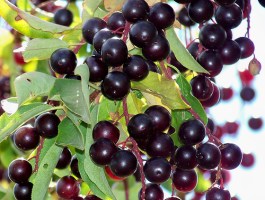
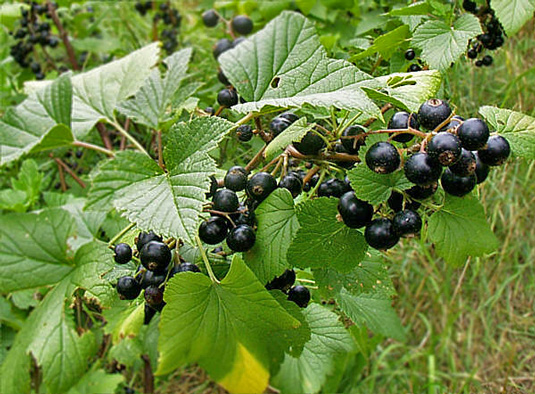
Wild Black currants

Black currants, even if they were not very sweet or delicious, would have provided vital nutrition for the travelers. Black currants have an extremely high level of vitamin C, as well as good levels of potassium, phosphorus, and iron. Excellent for keeping scurvy at bay, and scurvy is always a danger when people are living primarily on meat, as these pioneers were.

Posted in Uncategorized | Leave a comment

On the Trail — Prices

John Bidwell and friends did some trading when they met with Fraeb’s company of hunters and trappers at the Green River rendezvous. In his journal Bidwell records some of the prices for goods:

I will not omit to state the prices of several kinds of mountain goods. Powder which is sold by the cupful (pint) is worth $1 per cup. Lead 1.50 per lb., good Mackanaw blankets 8 to 15 dollars; sugar $1 per cupful; pepper $1 also; cotton and calico shirts from 3 to 5$; rifles from 30 to 60. In return, you will receive dressed deerskins at $3, pants made of deerskins $10, beaver skins $10, moccasins $1; flour sold in the Mts. at 50 cents per cupful, tobacco at $2 per lb., butcher knives from 1 to 3$. A good gun is worth as much as a horse; a cap lock is preferred, caps worth $1 per box.

I don’t imagine much cash traded hands. Instead the men would have been bartering. Perhaps Bidwell’s group still had items like sugar and pepper, gunpowder and lead to sell, and the mountain men had deerskins, moccasins, and flour and tobacco for those who had run out of supplies. Prices were high, but where else could they go to trade? If you needed it, you paid for it.

Posted in Uncategorized | Leave a comment

On the Trail — July 24-25, 1841

Saturday, 24th. Remained at this encampment and continued our traffic with the hunters. Chiles sold his oxen, 2 yoke, and wagon, another also was left.

The hunters, or fur trappers, bought all the alcohol brought by Bartleson and others, as well as other items, like Chiles’s wagon and ox team. Bidwell doesn’t say what they used to pay for it. It seems unlikely that they had money, but they probably had goods the travelers could use, such as weapons, ammunition, and clothing. Maybe this is where Bidwell picked up the buckskin suit he later says he was wearing.

The Rev. Joseph Williams described the party of hunters in his recollections:

We lay on the Green River bottom, where we fell in with Mr. Frap who was on a hunting expedition. This man, with nine or ten of his company, was afterwards killed in a skirmish with the Sioux Indians. His company was mostly composed of half-breeds, French, and Dutch, and all sorts of people collected together in the mountains, and were a wicked, swearing company of men.

In “The First Emigrant Train to California,” Bidwell relates what became of Fraeb’s party.

Years afterwards we heard of the fate of that party; they were attacked by Indians the very first night after they left us and several of them killed, including the captain of the trapping party, whose name was Frapp. The whisky was probably the cause.

Indeed, the alcohol and the resulting drunkenness would have drawn the attention of Indians. And since by the time Bidwell wrote this recollection he was a Prohibitionist, he does not fail to point the moral.

Posted in Uncategorized | Leave a comment

On the Trail — July 22-23, 1841

Thursday, 22nd. Descended Big Sandy about 12 miles and stopped where we found plenty of grass — this was very acceptable as our teams were already much jaded for the want of grass.

Gray returned this evening having found Trapp’s company, which consisted of about 20 men. They had returned to meet our company, though on their way to hunt buffalo, and were now encamped on Green river about 8 miles distant. Gray had suffered much in overtaking the trappers; his mule gave out, there being no water for a great distance, and he himself was reduced so much by hunger and thirst that he was unable to walk. He was therefore compelled to crawl upon his hands and feet, and at last came up with the company in the most forlorn situation imaginable–if they had been another half mile farther, he never could have reached them.

Poor John Gray! He nearly lost his life in pursuit of the fur trappers. If anyone could have found them, it was John Gray, the half-Mohawk, half-Scottish trapper and trail guide, but he was traversing some of the most  unforgiving territory in America. It was only his skill and knowledge of the wilderness that kept him alive.

The man that Bidwell here calls “Trapp,” was generally called “Frapp” by his men. A German-American from St. Louis, his name was actually Henry Fraeb. He was a veteran fur trapper and one of the founders, with Jim Bridger and William Sublette, of the Rocky Mountain Fur Company.  The Rev. Joseph Williams called his outfit “a wicked, swearing company of men,” which is probably a pretty accurate description of the kind of men who lived far from civilization.

remington

A drawing of two mountain men by Frederic Remington, captioned “I took ye for an Indian!”

Friday, 23rd. Went to Green river — distance 8 miles — spent the remainder of the day trading with the hunters.

Posted in Uncategorized | Leave a comment

On the Trail — July 16-18, 1841

Friday 16th. Traveled about 10 miles and encamped opposite the Wind River mountains where we were in full view of many lofty peaks glittering with eternal snow and frost under the blaze of a July sun.

Sunday, 18th. Left Sweet Water this morning, course SW. Crossed the divide which separates the water of the Atlantic and Pacific oceans, and after a travel of 20 miles reached Little Sandy, a branch of Green river – 1 buffalo was killed.

Leaving the Sweetwater River, the emigrants took the gradual climb up through South Pass, as a few wagons had done before them, and many, many more would do in the following years. As George R. Stewart wrote,”Here, at the summit of the Rocky Mountains, the very backbone of the continent, the grade was easy and the pass itself was more like a broad plain, so level that you were never sure when you passed from the Atlantic to the Pacific watershed.” (The California Trail)

South Pass–hardly the inspiring vista you expect for the Continental Divide.

Meanwhile the company awaited the return of John Gray, who had set off in search of the trappers who would surely be interested in the items (alcohol) that some members of the group had brought along to sell.

Stay tuned for more about the trappers and John Gray.

Posted in Uncategorized | Leave a comment

On the Trail — July 15, 1841

John Gray and W.G. Romaine had set out on July 6th to see if there were any fur-trappers camped at Green River, where the trappers usually had their rendezvous at this time of year. They didn’t find anyone, so the two men came back on the 13th. But other members of the party were anxious to find the trappers, since they had items that they wished to trade, so Gray set out once again on the 15th.

Thursday, 15th. As many of the company had articles of traffic which they wished to dispose of at Green river, a subscription was raised to recompense any who would go and find the trappers. John Gray started in pursuit of them, while the company marched on slowly, waiting for his return. Travelled about 6 miles today.

Gray was gone for a week and suffered a great deal in his search for the trappers. It would have killed a weaker man. I’ll write more about his ordeal when we get to the 22nd.

At this point in their journey they were traveling along the Sweetwater River and approaching South Pass and the Continental Divide.

Bidwell doesn’t mention it in his journal, but elsewhere he reveals that the “articles of traffic” were bottles or kegs of liquor. In The First Emigrant Train to California (Echoes of the Past, p. 119) Bidwell says:

Approaching Green River in the Rocky Mountains, it was found that some of the wagons, including Captain Bartleson’s, had alcohol on board, and that the owners wanted to find trappers in the Rocky Mountains to whom they might sell it. This was a surprise to many of us, as there had been no drinking on the way.

No drinking—because Bartleson was saving it up to sell to thirsty trappers. This was a bit of entrepreneurship that hadn’t occurred to young John Bidwell. Bidwell was not a teetotaler at this time in his life, but he never was a drinking man.

Posted in Uncategorized | Leave a comment

On the Trail: July 10, 1841

From John Bidwell’s journal for July 10, 1841:

“Saturday, 10th. Travelled about 14 miles and stopped to kill and dry meat. Buffalo began to grow scarce.”

By this time on their journey the company had almost exhausted its supplies of flour and other foodstuffs. Bidwell had laid in extra supplies, because he hated the idea of living on nothing but meat, but by now even he must have been running low. He doesn’t say how much he had left. The company knew they still had a long way to go, although they really didn’t have a good idea of how far. They began to kill buffalo and dry the meat, with the hope that the jerky would last them until California.

However they had left their plans to “make meat” until too late. Crossing the plains they had seen vast herds of buffalo, but now as they traveled up the Sweetwater River toward the Continental Divide, they saw fewer and fewer. They killed twenty buffalo on the 8th and ten on the 9th. On the 10th they decided to stay in place and spend a day or two hunting and drying meat.

greenriver

Green River, Wyoming

They killed 6 or 7 the 10th, and 4 or 5 on the 11th. John Gray and William Romaine came back from a scouting expedition to the Green River on the 13th and reported that they found no game ahead. Meat on the hoof was running out just at the time they realized how much they would need it.

Posted in Uncategorized | Leave a comment

John Grey and Ignace Hatchiorauquasha

John Grey (Bidwell spelled it Gray) was hired by the Englishman W. G. Romaine as a guide for his summer tour of the American West. Grey was half Iroquois and half Scottish, a St. Regis Mohawk, born around 1795 in upstate New York.  His father, William L. Grey, had served as a soldier during the American Revolution and then married into the Mohawks of Akwesasne. John Grey also went by the Iroquois name of Ignace Hatchiorauquasha, St. Ignatius being his patron saint.

John Gray, as depicted by Nicholas Point, S.J.

Father Nicholas Point, one of the priests with Father DeSmet, drew this portrait of John Gray while on the trail. The smaller picture is of Gray’s wife. Father Point also drew a sketch of John Grey battling five grizzly bears.

Grayandgrizzlies

The Catholic priests had a high opinion of Grey and his abilities. Father Gregory Mengarini records the following:

“So the sun rose and the sun set, and the end of our journey was still over a thousand miles away. Sometimes John Grey would say to me in the morning, “Father, so you see that speck in the distance? Today we must reach there.” “Then our day’s travel will be short,” I would answer. “We shall see,” he would say laughingly. And the hours of the morning would pass and we would be already journeying long under a scorching afternoon’s sun before that speck would achieve appreciable magnitude and distinctness of form.”

Grey entered the fur trade sometime around 1818, about the same time that he married his wife Marienne Netketichon, also a Mohawk. He was active in the fur trade for the next 25 years or so. He was considered a gifted leader who helped bridge the gap between Indians and white people.

Grey and Romaine, along with four other men, left the wagon train on July 25th to return to the United States. The trip with Romaine was probably the last of Grey’s excursions to the West, after which he retired to his home in Kansas City, Missouri. He was killed in 1848 in a dispute with a neighbor.

For more about John Grey, consult The Mountain Men and the Fur Trade of the Far West, by Leroy R. Hafen, or see the website of his great-great-great grandson Hunter Gray. (I removed the link because that website is no longer operative.)

Posted in Uncategorized | 1 Comment