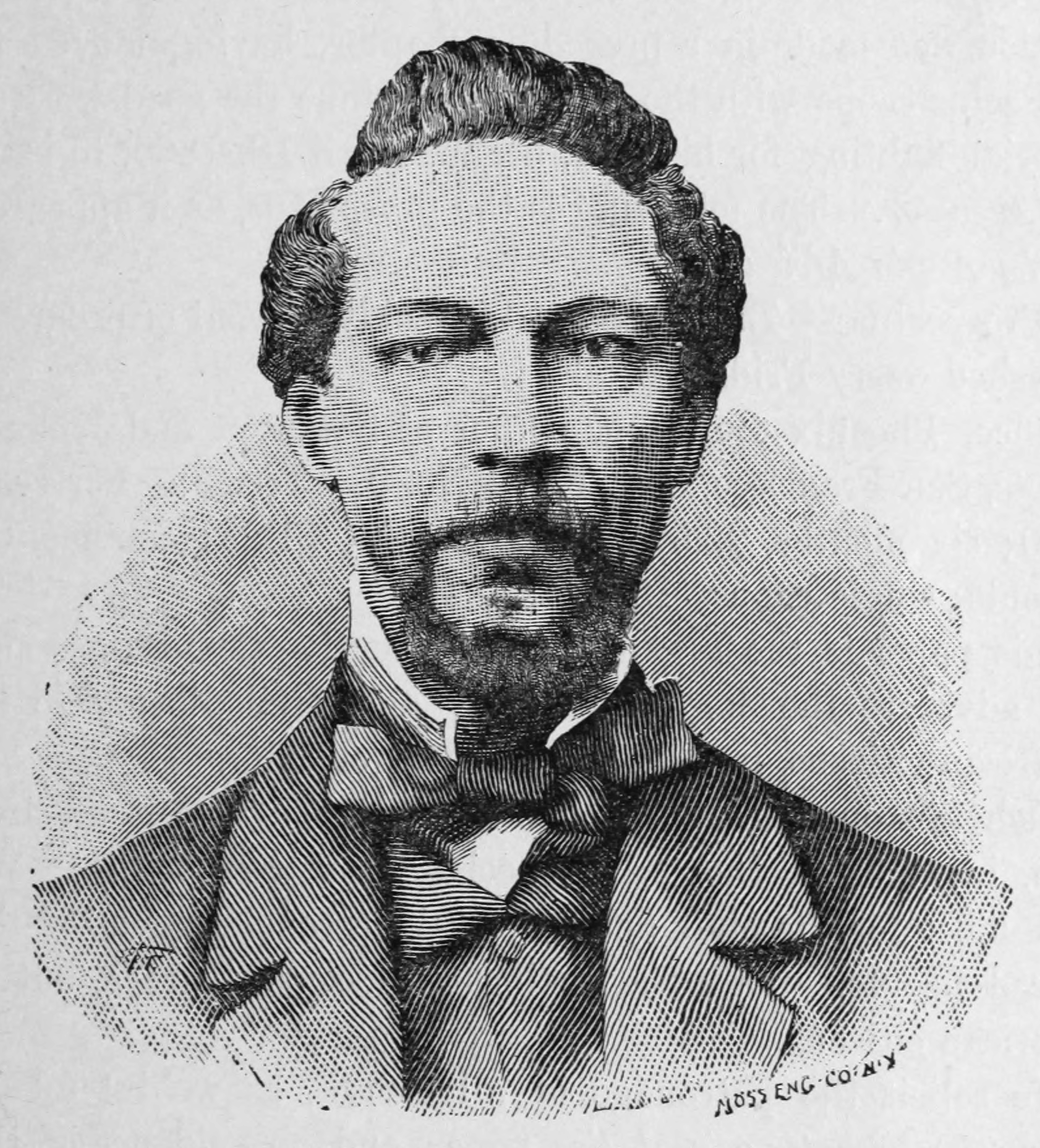
Philip A. Bell, born in New York City in 1808, came to California during the Civil War and in 1865 founded The Elevator, a San Francisco newspaper that covered events in the Black Community and advocated for Black suffrage and other causes important to African Americans.
In 1874 he visited Chico to take part in the 4th annual celebration of the passage of the 15th Amendment to the U.S. Constitution. In the April 18th edition of his newspaper he described Chico and saw much to admire.
Not having completed our business in Chico we concluded to remain a couple of days longer; and we made our visit both profitable and pleasant. By invitation of Gen. Bidwell we witnessed the working of a newly invented machine for leveling roads, which was highly satisfactory. The machine has a large steel blade, or share of steel, and was drawn by a team of ten mules.
It would have been fun to see that at work on the unpaved streets of Chico.
Bell’s impressions of Chico were favorable. “It is really a beautiful little place, now dignified with city privileges,” having been incorporated in 1872. “It is situated in a fertile valley of rich, alluvial soil, and has the advantages of grain and timber. The crops are always productive. We were informed by General Bidwell that a failure has never been known in Chico valley.”
“The city contains about 2500 inhabitants”, and he goes on to list various flourishing businesses: planing mills, carpenters, wheelwrights and blacksmiths. And hotels– “There are three hotels, the Central House, the Chico Hotel and Union House. At the Central, kept by Messrs. Clark and Trimble, the visitors to the celebration were well accommodated. The other houses refuse to admit a colored person within their doors.” Chico wasn’t perfect.
The Town Hall is a neat unpretentious building, erected on a lot donated by General Bidwell. The churches consist of Episcopalian, Presbyterian, Catholic and three Methodist Churches : the M. E. [Methodist Episcopal]Church North, M. E. Church South, and A. M. E Bethel Church; all built on laud donated by Mr. Bidwell. He also gave a large tract of land in the heart of the town to the Northern California Agricultural Association on which the Pavilion is erected.
He also lists the banks, newspapers, and fraternal lodges in town, and then goes on to focus on prominent African American men and their businesses. As Michele Shover has said, “The late 1860s and the early 1870s constituted the pinnacle of nineteenth century black experience”*and the black citizens of Chico for the most part were doing well.
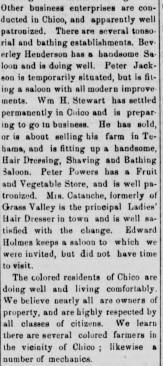
There are several tonsorial and bathing establishments. Beverley Henderson has a handsome Saloon and is doing well. Peter Jackson is temporarily situated, but is fitting a saloon with all modern improvements. Wm H. Stewart has settled permanently in Chico and is preparing to go to business. He has sold, or is about selling his farm in Tehama, and is fitting up a handsome Hair Dressing, Shaving and Bathing Saloon. Peter Powers has a Fruit and Vegetable Store, and is well patronized. Mrs. Catanche, formerly of Grass Valley, is the principal Ladies’ Hair Dresser in town and is well satisfied with the change. Edward Holmes keeps a saloon to which we were invited, but did not have time to visit. The colored residents of Chico are doing well and living comfortably. We believe nearly all are owners of property, and are highly respected by all classes of citizens. We learn there are several colored farmers in the vicinity of Chico; likewise a number of mechanics.
*Michele Shover, “The Black Experience in Chico, 1860-1899: Climbing the Slippery Slope,” in Exploring Chico’s Past and other Essays, (2005), p. 146. The essay contains more information about the people mentioned here and is highly recommended for anyone interested in African American life in Northern California.


 goldfields
As always, I relish reading the emails from you. Thanks!