Bancroft’s “Literary Industries”

When I was a student at the University of California, Berkeley, back in the late ’60s, I was lucky enough to get a job as a student assistant in the Bancroft Library. Other student assistants fetched books from the stacks, shelved books, checked books in and out, and filed cards. I got to work in the Manuscript Division of the Bancroft, where I sorted old letters and organized the less important collections. It was not only an interesting job, but I got to meet such luminaries in Western history as George P. Hammond and Dale Morgan.
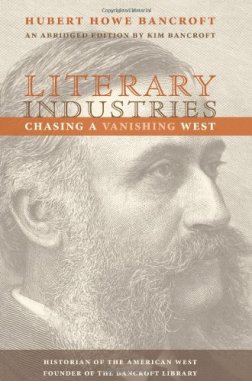
bancroftbookI never really understood who Bancroft was or where the Bancroft Library had come from, however, until I read this “new” book.  Literary Industries is Bancroft’s autobiography, an 800-page work written in 1890, here skillfully reduced to 225 pages by his great-granddaughter Kim Bancroft and published by Heyday Books.

Hubert Howe Bancroft was the son of New Englanders who had settled in Ohio, taking their Protestant work ethic and Puritanical solemnity with them. Bancroft loved his hometown of Granville, Ohio . . . and couldn’t wait to get out of it. Salvation from the farm and the schoolroom came in the guise of his brother-in-law, who hired him to work in his Buffalo, New York bookstore. In 1852 he migrated to California, shipping a stock of books to the Pacific coast and setting himself up as a San Francisco bookseller. He never looked back.

Selling books wasn’t enough for Bancroft. He became obsessed with collecting them. He wanted everything he could get his hands on that pertained to the history of the Pacific slope — not just books, but manuscripts, newspapers, letters, and records of all kinds, and not just California, but everything from Central America to Alaska. He wanted it all, and he scoured Mexico, Europe, and the eastern states for material, amassing a collection of over 60,000 books and documents.

He devised methods for organizing and extracting information from these sources, and pioneered the “history factory” method of writing historical works. He sent out representatives to acquire the recollections of early settlers before their knowledge passed beyond retrieval. One of the most entertaining parts of the book is the tale of how his agent, the sly and charming Enrique Cerruti, courted the wary General Vallejo and won his trunkful of historical documents, and then enlisted Vallejo in the quest to win still more precious documents from the native Californios.

H.H. Bancroft was a remarkable man, in a remarkable age, and this condensed version of his memoirs captures the wit and energy of a unique man. Not only that, but Heyday Books has produced a volume that physically is a pleasure to read and to hold. I bought my copy at the gift shop at Bidwell Mansion and I highly recommend the book to anyone who loves California history.


Posted in Bancroft Library, H.H. Bancroft | 2 Comments

More on the Chinese in Butte County

ahchung

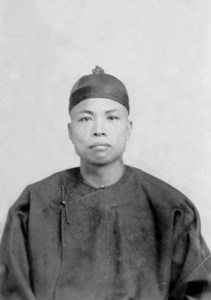
Ah Chung, Chico

Liz Stewart of Chico Heritage Association alerted me to the website Butte County California Chinese Immigrants. This project is the work of Bill Jones, former Special Collections librarian at CSUChico, and Paul Johnson. The focus is on a collection of photographs of Chinese men in Butte County during the 1890s. It also includes photos and essays that provide an excellent overview of the Chinese experience in California and in Butte County.

These photos were taken in order to comply with the Geary Act of 1892, a follow-up to the Chinese Exclusion Acts of 1882 and 1888, which required Chinese immigrants to carry residence certificates as proof of their right to be in the country. On the back of each photo is recorded the name of the subject, his age and place of employment, the date, and the names of several white witnesses.

Bill Jones, with the assistance of Jarith Kraft, did an outstandingly thorough job of checking census records, tax assessment rolls, newspapers, and other historical resources for every possible scrap of information on both the Chinese men and the witnesses, as well as the photographers and the places that employed the men. The result is a snapshot of Chinese life in Chico and Oroville in the 1890s.

Go and take a look!

Posted in Chinese, Uncategorized | 7 Comments

A Bachelor’s Hope for Leap Year

You may wrangle and rave of your Marysville girls,
   Of the girls of the Capital City,
Of the 'Frisco girls, with their fads and their curls,
   But the Butte Creek girls are most pretty.
Their smiles are far dearer to me than the gold
   That the millionaire hides in his coffers,
And I hope, 'ere the days of this leap year are told,
   Some dear one will make me an offer.
                                 Pres Longley, 1892
Posted in Pres Longley, Uncategorized | 1 Comment

Murder at Sutter’s Fort

In the last post I published a letter from the Themis of December 21, 1889, in which John Bidwell writes “You ask if I can throw any light on the killing of “The White Horse?””

So, who or what was “The White Horse”? What happened to him? In the November 23, 1889 issue of Themis the incident is described. The letters “k” and “q” refer to the map of the fort. The room designated “k” was formerly a granary and is now, I think, where the Sutter’s Fort Trade Post (gift shop) is located. “q” is the open spot on the north side by the slough, where “White Horse” was killed.

Fullscreen capture 12292015 94211 PM

The White Horse Story

“k” Room on west side of fort, next north of blacksmith. 40 x 17, was from 1842 to the fall of 1848 used by Sutter as a storehouse for wheat in bulk.

In the fall of 1848 it was rented to James Cary, and he fitted it up as a boarding-house. In this house was held a celebrated trial, the circumstances of which are worthy to be recorded. We get them from an eyewitness.

Late in October or early in November, 1848, a resident of the fort, an immigrant from Oregon, known to our informant only by the name of “The White Horse,” undertook to fence in an open space in the fort shown in diagram, and marked q.  C. E. Picket, also a resident at the fort, and since a well-known character in the State, claimed the open space, and, taking the law into his own hands, knocked down the fence put up by the other. “White Horse” started to rebuild his fence and Picket interfered, an altercation occurred, and Picket shot and killed his antagonist. There were then some 200 white men at the fort. There was a man at the fort named Tanner who was there acting as sheriff by appointment of Captain Sutter. He took Picket in charge, detaining him as a prisoner. Picket refused to submit, but Tanner was a stalwart, courageous officer, fitted for his place, and he disarmed his prisoner and compelled him to submit.

The white people at the fort had some knowledge of common law proceedings and determined that Picket should be tried for murder. Accordingly, they assembled in room marked k on plat and proceeded to elect by ballot a judge to sit at the trial. Sutter had some votes for that responsible position, but a large majority voted for Sam Brannan and he took his seat on the bench. A jury of eight was empanelled to try the case. Our informant can only remember the names of three of them: Thomas Shaddon, Martin Murphy and John Ames.

Picket plead his own case, and Brannan acted as Judge Advocate.  The trial came off the afternoon of the day of the killing. Picket insisted that he was an American citizen and, as such, entitled to bear arms, and Brannan decided that his two revolvers should be returned to him, and they were placed on the table during the trial. Picket was very nervous during the trial, as the Court, including the jury, were mainly strangers, and he was not wholly without fault.  Brannan charged the jury that this was a country governed by law and that breaches of the law should be punished. But he said if the jury found the prisoner guilty and determined to punish by imprisonment, there was no prison in which he could be confined.  The case was submitted to the jury about 10 P. M., and they deliberated till near morning, when they returned a verdict of not guilty, and Picket was discharged.


Posted in Sutter's Fort, Uncategorized | Leave a comment

Sutter’s Fort as John Bidwell Saw It

The following letter appeared in the December 21, 1889 issue of Themis, a weekly compendium of political and cultural news published in Sacramento. The paper ran a series about early days at Sutter’s Fort, which drew this comment from General Bidwell about the ground plan and bird’s eye view they had published in the November 23, 1889 issue.

Fullscreen capture 12292015 94211 PM

Themis, Nov. 23, 1889, p. 2.

SUTTER’S FORT.  Letter from General John Bidwell — His Estimate of the Descriptions of the Old Fort published in “Themis.”

General John Bidwell, of Chico, was one of the first of the American companions of Captain Sutter after the establishment of the fort. The General occupied for some time a position of importance at the fort, and was, before 1848, and ever since has been prominently identified with the history of the State. We deem the following letter from him of great importance, for, as there seems now a disposition to restore the fort as it was originally, and in any event to effect a partial restoration, any data that can be obtained should be preserved. There are few men living who are better able than General Bidwell to recall the scenes of those early years :

Chico, Dec. 19, 1889.  It is nearly a month since the receipt of your letter, with a copy of Themis. You ask if I can throw any light on the killing of “The White Horse?” or “any other reminiscence mentioned therein?” Being in the mines on Feather river at the time, I can say nothing of my own knowledge. Of course, everybody heard of the fact that C. E. Picket killed the man, and that he was tried and acquitted. I had, I think, known the man — think his name was Coryell. Of this, however, I cannot be positive, for in trying to recall the events alone from memory, I may confound the killing of a man by Coryell — McDowell, the gunsmith.  The birdseye view and ground plan of Sutter’s fort are remarkably correct. The bastions, to my mind, should appear just a little higher — and they had not gable roofs, but hip roofs — that is, sloped equally from an apex. At least this was the shape of the roofs when first made.  Sutter’s business office, where his accounts were kept and all his business transacted, was in the northeast corner of the second story of the building, marked “A.” [Referring to the building now standing. — Eds.] His private office, however, is correctly marked “g.” Said building “A” was made in 1841, and, when I saw it last of November of that year, had simply walls and roof — no doors, stairs, floors or windows. In comparison with the thatched huts which surrounded it, this was an imposing edifice at that date.  In one of the small buildings, I never knew which — Sutter had managed to distil brandy from the wild grapes that same year — 1841 — for he offered us brandy to drink, and told us he had made it from wild grapes. I did not taste it, but those of our party who did, pronounced it excellent. But I cannot recall the fact that any distillery was ever used at Sutter’s fort from that date till the fall of 1845, when Sutter established one, and made whisky from barley, which was a great curse and caused more trouble than anything he ever did. Sutter may have had some of the brandy made in 1841, as he kept it mostly for his private use, and only offered it on rare occasions to visitors, when Fremont first arrived in 1844.

Yours, very truly,  John Bidwell

Posted in Sutter's Fort, Uncategorized | Leave a comment

Pres Longley’s Christmas Poem

pres

Pres Longley, the Bard of Butte

Pres Longley, the “Bard of Butte,” wrote many, many poems for the newspapers. This one appeared in the Oroville Daily Register on December 24th, 1908.

A Poem for Christmas
About two thousand years ago
The Earth was filled with saddest woe
And men looked out from caverns dark
To catch a gleam, a single spark
Of some bright hope that might convey
The opening of a better day
But all was gloom -- no light divine
Amid the darkness seemed to shine.

No still, small Voice was heard to say,
"I am the Life, -- O come this way";
No great "Physician" cried aloud
Unto the maimed and sickened crowd,
"Believe in Me, I'll make you whole
In strength of body, mind and soul."
The rich ran riot in their lust,
The poor were groveling in the dust,
And few in God had put their trust.

Earth was a mansion of despair,
And every prospect bright and fair
Was merged in night; and none might turn
Aside the things that made them mourn.
But hear from off the wintry plain
A song of joy, a sweet refrain
Of angel voices singing nigh
That made sweet music in the sky.

And a Voice resounding o'er the hill,
To all mankind, "Peace and good will."
A star arose -- a glittering gem--
It was the "Star of Bethlehem."
Jesus lay in manger, and
Wise men came from Eastern land
To offer praise and homage due
To One whose love for man is true.

It was an era in our race
That brought to us the smile of grace.
He healed the sick, the lame, the blind,
And brought sweet comfort to the mind.
He drank the bitter cup of gall,
And dying broke our sinful thrall.
Without our Christ, we'd sink again
To hopeless sinfulness and pain.

But now we see o'er all the world
The banner of His Cross unfurled,
And written on its folds so dear
The words of of hope and cheer
And a Voice still crying, ere you sink,
"Ho! every one,come up and drink,
Drink of His love, 'tis free as rain,
And you shall never thirst again."
Posted in Uncategorized | Leave a comment

Who was the town of Nicolaus named for?

If you are driving on Highway 99, you will see a sign pointing to the small town of Nicolaus. It is situated just to the east of the highway on the south side of the Feather River. In the days of the Gold Rush it was an important and busy site. For a while it was considered the farthest spot on the river to which a sea-going vessel could be navigated, making it an important jumping-off point for the mines.

Nicolaus was the first name of its founder, Nicolaus Allgeier, a native of Germany born in 1807. He came to the United States around 1830 and became a fur trapper for the Hudson Bay Company in the Rocky Mountains. He met John Sutter at a mountain man rendezvous when Sutter was traveling to California in 1838 and signed up to travel with Sutter and seek their fortunes on the Pacific Coast.

In Oregon Sutter made for California by way of Hawaii, while Allgeier and his friend Sebastian Keyser traveled overland to central California. In 1840 they arrived at Sutter’s newly founded settlement of New Helvetia, or Sutter’s Fort, where they were employed as trappers and bodyguards. These men were rough and dangerous characters —  Sutter claimed that “One of them, Big Nicolas, wanted to kill me one day and caused a great deal of trouble.”

In 1841 Sutter sent Allgeier to his Hock Farm to help build an adobe farm house. Since the road between the Hock Farm and Sutter’s Fort had to cross the Feather River, a ferry was needed, and Sutter deeded one square mile of land to Allgeier in payment for past and future work on the understanding that he would maintain a ferry there for Sutter and other travelers.

Nicolaus Allgeier lived in an Indian-style willow pole and grass hut until 1847, until he built himself an adobe house. He turned it into a two-story hotel in 1849 to accommodate the rush of gold seekers. He lived with an Indian woman and employed numerous Indians to operate the ferry and tend cattle.

John Bidwell was well-acquainted with Nicolaus, who sometimes called upon his aid in business matters. Nicolaus was illiterate and signed with an X, as in this letter:DSCN4327 In the California State Library is a letter from Nicolaus to Bidwell which reads as follows:

Nicolaus July 7th 1851

 Mr. J. Bidwell

            My dear friend

             I wrote you a few lines some three weeks past to come down as soon as possible on account of some Business I would like you to attend to for me here. I will expect you as soon as you receive this to come and see me if possible, for I have some Business matter to settle and can not well trust eny body els, you know well I can not read or write and I am trobled very much.

            I would also beg of you not to make it know to eny one, that I have send for you for the above purpose, etc. I will expect you to spend a few days here. I will keap you at work, etc.

                        yours very Respectfully

                        Nicolaus Algeier

Information taken from John Sutter: A Life on the North American Frontier, by Albert L. Hurtado, and the Yuba-Sutter Wiki.


Posted in Nicolaus Allgeier, Uncategorized | 1 Comment

Holiday Happenings

I’ll get back to writing about northern California history soon, I promise. You might get tired of hearing about my new book, and we don’t want that. But here’s one more tidbit of book news:

Yesterday I was interviewed by Jerry Olenyn for a news feature on KRCR-TV. Jerry did a good job of turning my stumblings and babblings into cogent soundbites, and it was fun to see how he does the job. You can watch it at the KRCR website. It was also a beautiful day to enjoy the fall colors at Bidwell Mansion.DSCF0112-001

Here are some Holiday Happenings I’d like you to know about.

The Bidwell Mansion Association is having its holiday event for member on Friday, December 4th, 6-8 p.m. Not a member of the BMA? You should join! Tickets are $30 for members and $35 for non-members, including a one-year membership, so you can save on your first year as a member.holiday postcard 2015 image

Bidwell Mansion is all gussied up for the holidays, with lavish new decorations all through the house. John and Annie will be there to welcome their guests. The Glatz sisters will be presenting seasonal music in the parlor.

Catering is by A Fresh Approach, and wine-tasting (don’t tell Annie!) by Bertagna Vineyards. Steve Ferchaud and myself will be signing books. The BMA promises you a lovely evening to start off the holiday season.

For other holiday events at Bidwell Mansion — family photo sessions and holiday evening tours — take a look at the Bidwell Mansion SHP page.

If you aren’t coming Friday evening, but would like to get a signed copy of John and Annie Bidwell: The Long and the Short of It, please come to the Chico Library on Saturday, December 5 at 2 p.m. I’d love to see you there! Sales will benefit the Bidwell Mansion Association.

The first weekend in December is chockful of fun things to do. Here are two more:

Stansbury House presents A Merry Dickens Christmas Friday through Sunday, Dec. 4-6. Check their website for times and goings-on. Mark Twain will put in an appearance!

The annual Christmas Creche Festival takes place at the LDS Church at East and Mariposa, Thursday Dec. 3 through Sunday Dec. 6. Check their Facebook page for times. Thousands of nativity sets from around the world will be on display, and there will be refreshments and activities for the kids. Admission is free.

Thursday evening at the Creche Festival I will be reading The Gift of the Magi, by O. Henry, as part of a program of readings and music. I hope you can come enjoy the special spirit of Christmas at this event.


Posted in Uncategorized | Leave a comment

John Bidwell, Jailbird

John Bidwell spent November 16-18, 1841, in jail.

He had gone to San Jose to get a passport, since John Marsh had neglected to get one for him.

At the order of Mariano Guadalupe Vallejo, who wanted to know what the heck these Americans were doing in Mexico, John Marsh had gone to San Jose to explain the matter and soothe the general. He came back with passports for most of the men in the Bidwell-Bartleson Party—but not John Bidwell.  Bidwell suspected that Marsh hadn’t gotten him a passport because he wanted to keep him at his ranch as a useful employee, but Bidwell was having none of that.

On the 15th he set out for San Jose on his own to get a passport. Arriving at Mission San Jose on November 16th, he was promptly thrown in jail by Mexican soldiers until he could find someone to explain his presence to the authorities.

He spent three uncomfortable and flea-bitten days in jail until he was able to hail a passerby who understood English.

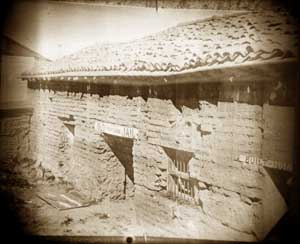
Monterey Jail

The adobe jail in Monterey, similar to the one that held Bidwell.

“He proved to be an American . . . and he kindly went to Vallejo, who was right across the way in the big Mission building, and procured for me the passport.” The passport was made out for Juan Bidwell, and can be seen at the California State Library.

Vallejo could have sent the whole party of Americans back where they had come from. But Alta California had need of skilled labor, and he decided to let them stay.

Bidwell returned to Marsh’s ranch on the 18th. But he had no intention of sticking around. Captain John Sutter was hiring, so to Sutter he would go. He set out for Sutter’s settlement  on November 21st.

Posted in John Marsh | Leave a comment

Dan Barnett’s Review

Dan Barnett’s review of John and Annie is in the Chico Enterprise-Record this morning. How nice to get an early morning e-mail from Carla Resnick telling me about it, and just as nice to read it in the print newspaper on this rainy Sunday morning.

“Colorful and captivating” is how Dan describes the book. Thanks, Dan!

Posted in Uncategorized | Leave a comment