Pres Longley’s Christmas Poem

pres

Pres Longley, the Bard of Butte

Pres Longley, the “Bard of Butte,” wrote many, many poems for the newspapers. This one appeared in the Oroville Daily Register on December 24th, 1908.

A Poem for Christmas
About two thousand years ago
The Earth was filled with saddest woe
And men looked out from caverns dark
To catch a gleam, a single spark
Of some bright hope that might convey
The opening of a better day
But all was gloom -- no light divine
Amid the darkness seemed to shine.

No still, small Voice was heard to say,
"I am the Life, -- O come this way";
No great "Physician" cried aloud
Unto the maimed and sickened crowd,
"Believe in Me, I'll make you whole
In strength of body, mind and soul."
The rich ran riot in their lust,
The poor were groveling in the dust,
And few in God had put their trust.

Earth was a mansion of despair,
And every prospect bright and fair
Was merged in night; and none might turn
Aside the things that made them mourn.
But hear from off the wintry plain
A song of joy, a sweet refrain
Of angel voices singing nigh
That made sweet music in the sky.

And a Voice resounding o'er the hill,
To all mankind, "Peace and good will."
A star arose -- a glittering gem--
It was the "Star of Bethlehem."
Jesus lay in manger, and
Wise men came from Eastern land
To offer praise and homage due
To One whose love for man is true.

It was an era in our race
That brought to us the smile of grace.
He healed the sick, the lame, the blind,
And brought sweet comfort to the mind.
He drank the bitter cup of gall,
And dying broke our sinful thrall.
Without our Christ, we'd sink again
To hopeless sinfulness and pain.

But now we see o'er all the world
The banner of His Cross unfurled,
And written on its folds so dear
The words of of hope and cheer
And a Voice still crying, ere you sink,
"Ho! every one,come up and drink,
Drink of His love, 'tis free as rain,
And you shall never thirst again."
Posted in Uncategorized | Leave a comment

Who was the town of Nicolaus named for?

If you are driving on Highway 99, you will see a sign pointing to the small town of Nicolaus. It is situated just to the east of the highway on the south side of the Feather River. In the days of the Gold Rush it was an important and busy site. For a while it was considered the farthest spot on the river to which a sea-going vessel could be navigated, making it an important jumping-off point for the mines.

Nicolaus was the first name of its founder, Nicolaus Allgeier, a native of Germany born in 1807. He came to the United States around 1830 and became a fur trapper for the Hudson Bay Company in the Rocky Mountains. He met John Sutter at a mountain man rendezvous when Sutter was traveling to California in 1838 and signed up to travel with Sutter and seek their fortunes on the Pacific Coast.

In Oregon Sutter made for California by way of Hawaii, while Allgeier and his friend Sebastian Keyser traveled overland to central California. In 1840 they arrived at Sutter’s newly founded settlement of New Helvetia, or Sutter’s Fort, where they were employed as trappers and bodyguards. These men were rough and dangerous characters —  Sutter claimed that “One of them, Big Nicolas, wanted to kill me one day and caused a great deal of trouble.”

In 1841 Sutter sent Allgeier to his Hock Farm to help build an adobe farm house. Since the road between the Hock Farm and Sutter’s Fort had to cross the Feather River, a ferry was needed, and Sutter deeded one square mile of land to Allgeier in payment for past and future work on the understanding that he would maintain a ferry there for Sutter and other travelers.

Nicolaus Allgeier lived in an Indian-style willow pole and grass hut until 1847, until he built himself an adobe house. He turned it into a two-story hotel in 1849 to accommodate the rush of gold seekers. He lived with an Indian woman and employed numerous Indians to operate the ferry and tend cattle.

John Bidwell was well-acquainted with Nicolaus, who sometimes called upon his aid in business matters. Nicolaus was illiterate and signed with an X, as in this letter:DSCN4327 In the California State Library is a letter from Nicolaus to Bidwell which reads as follows:

Nicolaus July 7th 1851

 Mr. J. Bidwell

            My dear friend

             I wrote you a few lines some three weeks past to come down as soon as possible on account of some Business I would like you to attend to for me here. I will expect you as soon as you receive this to come and see me if possible, for I have some Business matter to settle and can not well trust eny body els, you know well I can not read or write and I am trobled very much.

            I would also beg of you not to make it know to eny one, that I have send for you for the above purpose, etc. I will expect you to spend a few days here. I will keap you at work, etc.

                        yours very Respectfully

                        Nicolaus Algeier

Information taken from John Sutter: A Life on the North American Frontier, by Albert L. Hurtado, and the Yuba-Sutter Wiki.


Posted in Nicolaus Allgeier, Uncategorized | 1 Comment

Holiday Happenings

I’ll get back to writing about northern California history soon, I promise. You might get tired of hearing about my new book, and we don’t want that. But here’s one more tidbit of book news:

Yesterday I was interviewed by Jerry Olenyn for a news feature on KRCR-TV. Jerry did a good job of turning my stumblings and babblings into cogent soundbites, and it was fun to see how he does the job. You can watch it at the KRCR website. It was also a beautiful day to enjoy the fall colors at Bidwell Mansion.DSCF0112-001

Here are some Holiday Happenings I’d like you to know about.

The Bidwell Mansion Association is having its holiday event for member on Friday, December 4th, 6-8 p.m. Not a member of the BMA? You should join! Tickets are $30 for members and $35 for non-members, including a one-year membership, so you can save on your first year as a member.holiday postcard 2015 image

Bidwell Mansion is all gussied up for the holidays, with lavish new decorations all through the house. John and Annie will be there to welcome their guests. The Glatz sisters will be presenting seasonal music in the parlor.

Catering is by A Fresh Approach, and wine-tasting (don’t tell Annie!) by Bertagna Vineyards. Steve Ferchaud and myself will be signing books. The BMA promises you a lovely evening to start off the holiday season.

For other holiday events at Bidwell Mansion — family photo sessions and holiday evening tours — take a look at the Bidwell Mansion SHP page.

If you aren’t coming Friday evening, but would like to get a signed copy of John and Annie Bidwell: The Long and the Short of It, please come to the Chico Library on Saturday, December 5 at 2 p.m. I’d love to see you there! Sales will benefit the Bidwell Mansion Association.

The first weekend in December is chockful of fun things to do. Here are two more:

Stansbury House presents A Merry Dickens Christmas Friday through Sunday, Dec. 4-6. Check their website for times and goings-on. Mark Twain will put in an appearance!

The annual Christmas Creche Festival takes place at the LDS Church at East and Mariposa, Thursday Dec. 3 through Sunday Dec. 6. Check their Facebook page for times. Thousands of nativity sets from around the world will be on display, and there will be refreshments and activities for the kids. Admission is free.

Thursday evening at the Creche Festival I will be reading The Gift of the Magi, by O. Henry, as part of a program of readings and music. I hope you can come enjoy the special spirit of Christmas at this event.


Posted in Uncategorized | Leave a comment

John Bidwell, Jailbird

John Bidwell spent November 16-18, 1841, in jail.

He had gone to San Jose to get a passport, since John Marsh had neglected to get one for him.

At the order of Mariano Guadalupe Vallejo, who wanted to know what the heck these Americans were doing in Mexico, John Marsh had gone to San Jose to explain the matter and soothe the general. He came back with passports for most of the men in the Bidwell-Bartleson Party—but not John Bidwell.  Bidwell suspected that Marsh hadn’t gotten him a passport because he wanted to keep him at his ranch as a useful employee, but Bidwell was having none of that.

On the 15th he set out for San Jose on his own to get a passport. Arriving at Mission San Jose on November 16th, he was promptly thrown in jail by Mexican soldiers until he could find someone to explain his presence to the authorities.

He spent three uncomfortable and flea-bitten days in jail until he was able to hail a passerby who understood English.

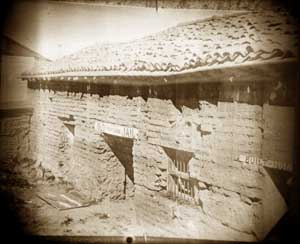
Monterey Jail

The adobe jail in Monterey, similar to the one that held Bidwell.

“He proved to be an American . . . and he kindly went to Vallejo, who was right across the way in the big Mission building, and procured for me the passport.” The passport was made out for Juan Bidwell, and can be seen at the California State Library.

Vallejo could have sent the whole party of Americans back where they had come from. But Alta California had need of skilled labor, and he decided to let them stay.

Bidwell returned to Marsh’s ranch on the 18th. But he had no intention of sticking around. Captain John Sutter was hiring, so to Sutter he would go. He set out for Sutter’s settlement  on November 21st.

Posted in John Marsh | Leave a comment

Dan Barnett’s Review

Dan Barnett’s review of John and Annie is in the Chico Enterprise-Record this morning. How nice to get an early morning e-mail from Carla Resnick telling me about it, and just as nice to read it in the print newspaper on this rainy Sunday morning.

“Colorful and captivating” is how Dan describes the book. Thanks, Dan!

Posted in Uncategorized | Leave a comment

The Book is Here!

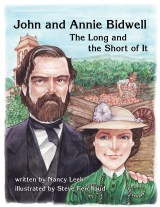
John and Annie Bidwell CoverJohn and Annie Bidwell: The Long and the Short of It is now available! It will be in the General’s Store (the gift shop) at Bidwell Mansion starting next weekend. Bidwell Mansion State Historic Park is open Saturday, Sunday, and Monday, 11 a.m. – 5 p.m. Other places that will be carrying it are Made in Chico and The Bookstore on Main Street.

If you want to get a copy into your eager little hands, and you live in Chico, you can contact me at goldfieldsbooksca@gmail.com. I will arrange for me to deliver, or you to pick up, your very own copy.

The cover price of the book is $16.95. Direct sales are $17 a copy, sales tax included.

DSCF0100This has been a fun project. It was a pleasure to work with Steve Ferchaud, who is not only a fine illustrator, but also a delightful human being. He had plenty of imaginative ideas for extending the text and enhancing the appeal of the book. Wait till you see his two-page spread on Bidwell Park!

Posted in Uncategorized | Leave a comment

November 1, 1841

From John Bidwell’s trail journal:

November. Monday, 1st. The Company tarried to kill game; an abundance of wild fowl and 13 deer and antelopes were brought in. My breakfast, this morning, formed a striking contrast with that of yesterday which was the lights of a wolf.

The “lights of a wolf” is described in other recollections as the windpipe of a coyote. Another member of the party had shot the coyote on the morning of October 31st. By the time Bidwell caught up with the rest of the men, the only thing left to eat was the lungs (lights) and the windpipe.

Got to be about the worst breakfast ever!

But their situation changed literally overnight. On the afternoon of the 31st they sighted the valley, “joyful sight to us poor famished wretches!!!” Antelope! Elk! Wild ducks and geese! On November 1st they spent the day hunting and feasting on wild game.

Bidwell tells it this way in his 1877 Dictation:

The eve of the next day found us surrounded by abundance. . . . It was about the first of November, and there was no time to delay if we were going to reach California that fall. Most of the party were ready and anxious to press forward. Captain Bartleson and his men though otherwise. They said we hadn’t yet reached California, we probably still had a long distance to travel, that such a place as we were in could not be found everywhere and they were going to stop and lay in meat for the balance of the journey.

Leaving them in camp and crossing the Stanislaus River, we proceeded down the north side of the same and camped. Early the next day the news came that the Indians in the night had attacked them and stolen all their horses. We remained till they came up, carrying on their backs such things as they were able.

John Bidwell never did get on with John Bartleson. There is a note of satisfaction here that once again, Bartleson was wrong and got what he deserved.

Posted in Uncategorized | Leave a comment

Goldfieldsbooks.com

This blog has a new name — it is now goldfieldsbooks.com. Don’t leave out the “s” in the middle or you won’t find it. It’s still the same northern California history blog, but I’ll also be promoting my new book here. You can also still get here with the old URL.

My new book is John and Annie Bidwell: The Long and the Short of It. It’s a paperback picture book selling for $16.95. It has full-color illustrations by the talented Steve Ferchaud, and is aimed at the young readers who visit Bidwell Mansion and want to know more. I hope it will be equally valuable to teachers and families.

I am self-publishing the book under the imprint Goldfields Books. I don’t know what future projects are in store, but there may be more books from Goldfields in days to come.

John and Annie Bidwell is at the printer right now. It will be out well in time for Christmas. It will be for sale at Bidwell Mansion, at Made in Chico, and at other outlets around the area. I’ll keep you posted on where and when you can buy the book.

Posted in Uncategorized | Leave a comment

Coming Soon!

The book is almost here! John and Annie Bidwell Cover

This is what the cover will look like. It’s at the printer now, and in a week or two a pallet of books will show up on my doorstep, and then the fun begins.

I will be having a book-signing at the Bidwell Mansion Association Holiday Event on December 4th. Other book-signing programs are in the works. If anyone wants me to do a presentation, I am always happy to talk about the Bidwells’ incredible lives and sign books.

The book is a 32-page 8.5 x 11 inch soft-cover picture book, with full-color illustrations throughout by Steve Ferchaud. The design and layout was done by Carla Resnick, who is not only an excellent graphic designer, but a good neighbor. The cover price is $16.95. I am self-publishing the book under the imprint Goldfields Books.

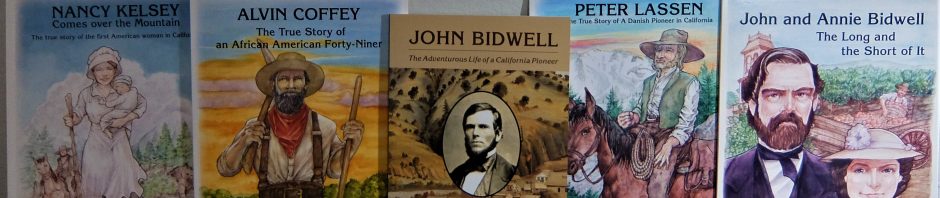
I have done my best to make it historically accurate, and it includes a timeline and a bibliography. I think it will make an excellent companion to my first book: John Bidwell: The Adventurous Life of a California Pioneer.

Bidwell3Here’s another one of my favorite illustrations from the book: John and Annie camping with John Muir. The Bidwells were good friends with Muir. They really did take him camping with them, and they really did have a tent that looked like that. There is a well-known photograph that shows John and Annie posing outside their striped tent.

I certainly hope everyone who sees the book likes it, and I hope it will be a valuable resource for teachers who bring their classes to Bidwell Mansion. And I’ll let you know as soon as the book is available for purchase.

Posted in Uncategorized | Tagged | Leave a comment

Manjiro’s Return Home

Manjiro arrived in Honolulu in October of 1850 with his earnings from the goldfields in his pocket. He went immediately to find his friends, Denzo, Toraemon, and Goemon. Denzo and Goemon were willing to risk the return, but Toraemon, knowing that there was a very real danger of being imprisoned or executed, decided to stay in Hawaii.

A newspaper appeal on behalf of the men brought in $160 and clothing for the men. Putting together all their money, Manjiro bought an old whaleboat, maps, a compass and other needed equipment, as well as gifts for his family. He found a merchant ship bound for Shanghai whose captain was willing to drop them off near Japanese waters.

Two months later the ship came within four miles of Okinawa. In spite of heavy seas and rough weather, the whaleboat was lowered and Manjiro and his companions rowed for shore. The fishermen and villagers they encountered fled from them and refused to speak with the strangers, even though Manjiro entreated them in Japanese. Laws were strict and any contact with outsiders meant punishment. They were immediately arrested by the local officials.

Okinawa was under the rule of Japan, so the men were sent to a powerful lord on Kyushu, the southernmost major island of Japan. From there they were sent to the shogun. The gifts that Manjiro had bought for his family and the gold he had sewn in his clothing for his mother were confiscated. The men feared for their lives, but Manjiro was able to convince the authorities that he was much more valuable alive than dead. He possessed knowledge of the West that no one else in Japan had.

The men underwent endless questioning. Altogether they were imprisoned and interrogated for a year and a half.  It was not until June 1852 that they were released and allowed to visit their families. It had been nearly twelve years since Manjiro left home. His mother and siblings greeted him as one returned from the dead and took his to see his memorial tablet in the village graveyard.

Manjiro did not get much time to spend with his family. Within three days the local lord sent for him. His knowledge and experiences were of the utmost value. In a move nearly unprecedented in Japanese society, Manjiro was elevated from the station of a lowly fisherman to the rank of samurai. As a samurai he was allowed to wear two swords and to take a surname. He chose the name of Nakahama, his home village. He began teaching world history, geography, and English to other samurai.

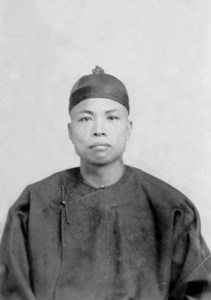
Nakahama Manjiro

Nakahama Manjiro

His career as a teacher was interrupted by the advent of Commodore Perry and his fleet. As the only man in Japan fluent in English and familiar with the United States, he was summoned to the capital to advise the shogun. Although never allowed to meet with the Americans, he counseled behind the scenes for an end to Japan’s isolationist policy. As Japan’s outlook on the world changed, Manjiro took on the task of teaching ship-building and navigation at the Naval Academy, and served as interpreter with the first Japanese embassy to the United States. While there he went to visit his old friends in New Bedford. By then it had been twenty-one years since he had seen Captain Whitfield.

To the end of his life at the age of 71, Manjiro taught English and advised the government. His incredible life story made him a famous man in Japan. It’s good to know that his sojourn in the California Gold Rush helped him on his way.

Posted in Manjiro | Leave a comment