Manjiro in California

Captain William Whitfield and his wife took Manjiro in, treated him like a son, and sent him to school, where he excelled. Then when he was nineteen years old, Manjiro went to sea once again aboard an American whaling ship. For three years, from 1846 to 1849, he sailed the Atlantic, Indian, and Pacific Oceans as the Franklin, commanded by Captain Ira Davis, searched for whales.

At one point in their voyage, as the ship sailed close to Japan, Manjiro spotted a group of Japanese fishing boats. Captain Davis gave his permission for a boat to be lowered, and  eagerly Manjiro approached the fishermen, hoping to be taken home. But fearing the authorities, the fishermen would not even speak to him, let alone take him on board. He returned to his ship.

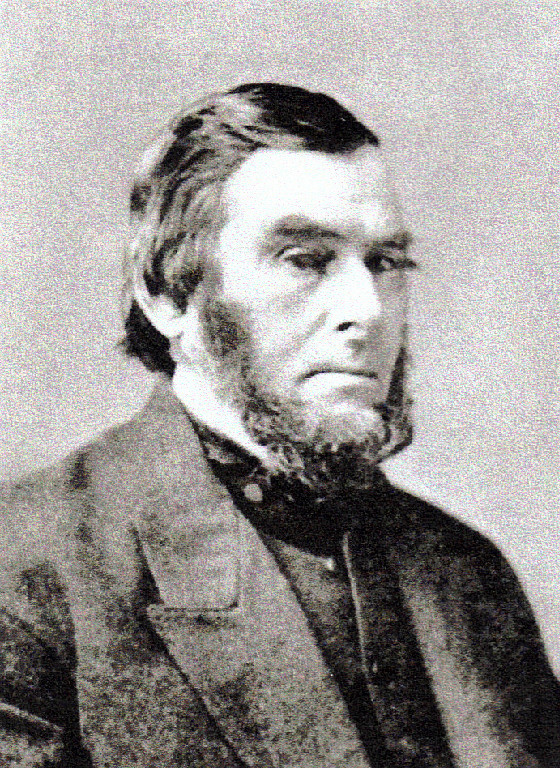
Captain William Whitfield of New Bedford, Massachusetts, looking every inch the whaling ship captain.

Captain William Whitfield of New Bedford, Massachusetts, looking every inch the whaling ship captain.

Later the whaler docked in Honolulu, where Manjiro’s companions had been left when he went on to New Bedford with Captain Whitfield. One of the men had died, but three were left, working as servants and hoping for the day that they could return to Japan. Manjiro consulted with them about how they might someday make the return voyage.

By the time the Franklin reached New Bedford in September 1849, the entire nation was talking about the discovery of gold in California. Manjiro saw his chance. If he could get to California and strike it rich, he would have the money he needed to return to Japan and his mother.

He signed on board a lumber ship bound for California. Such was the competition for passage to California that Manjiro worked for no wages as part of the crew, and paid $25 besides for the privilege.

Arriving in San Francisco, Manjiro wasted no time in making his way by steamship to Sacramento, and then by foot to the goldfields. He found a job working for $6 a day digging for gold. After a month he bought his own tools and went off to try his luck.

Two months of panning gold in a mountain stream, and Manjiro had what he figured would be enough. Living frugally, he avoided the gambling dens and dance halls and kept a close watch on his pile. He took his gold to San Francisco and traded it for $600 in coin. Then he bought passage on a steamship bound for Honolulu. He was homeward bound.

Next time: What Kind of Welcome Awaits?

P.S. I first discovered the story of Manjiro when I read Rhoda Blumberg’s book for young readers: Shipwrecked: The True Adventures of a Japanese Boy (2001). Two adult books on his experiences are The Life and Times of John Manjiro, by Donald R. Bernard (1992) and The Man Who Discovered America, by Hiskazu Kaneko (1956).

Manjiro’s adventures have also been fictionalized in Heart of a Samurai, a novel for young readers by Margi Preus (2011), and Manjiro: The Boy Who Risked His Life for Two Countries, a picture book biography by Emily Arnold McCully (2013).

Posted in Uncategorized | Leave a comment

A Japanese Man in the Gold Rush

In May 1850 a young man stepped off a ship in San Francisco. Nothing remarkable there. Thousands of young men were arriving in San Francisco on their way to the goldfields. Like the others, this young man had come to California to seek for gold. But he hadn’t joined the Gold Rush to get rich. He just wanted to get home.

The young man was an Asian, but with a difference. He was not Chinese, like the other Asian immigrants beginning to come to Gold Mountain — he was Japanese, and he must have been the only native of Japan in California.

His name was Manjiro. He was born in a fishing village in 1827, and by the time he was nine years old his father had died and he was left to support his mother and siblings. So from that young age he worked the fishing boats. Then at the age of 14, he and his five companions were shipwrecked. For five months they nearly starved on a small rocky island until they were picked up by a New England whaling ship.

It was impossible for them to be taken back to Japan. Foreign ships were not allowed to land on the coast of Japan, even to return rescued fishermen, and if they left, even accidentally, Japanese citizens could not return to their homeland on pain of death.

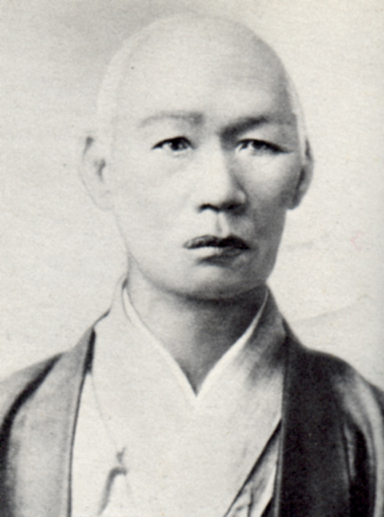
A photo, possibly showing Manjiro as a young man, recently found in the New Bedford Public Library.

A photo, possibly showing Manjiro as a young man, recently found in the New Bedford Public Library.

So Manjiro went with Captain William Whitfield to New Bedford, Massachusetts. On board ship, he began learning English, and the captain, impressed by the boy’s intelligence and attentiveness, taught him piloting and seamanship. In New Bedford he was enrolled in school and continued his education in language, mathematics, and navigation. Captain Whitfield and his wife treated Manjiro, whom they called John Mung, as their adopted son.

Throughout his sojourn in the United States, Manjiro suffered from homesickness. He longed to see his native land once more. He yearned for his mother and worried that she was living in poverty and distress without her eldest son to care for her. But how could he return to Japan? How would he find the means to make the voyage? What ship could take him there? And if he did find a way to get to Japan, how would he be treated? What good would it do his mother if he were arrested and executed on his return?

More about Manjiro and his return to his homeland next time. For information about the photo, see this article in the Japan Times.

Posted in Uncategorized | Tagged | 4 Comments

A Picture Book for John and Annie

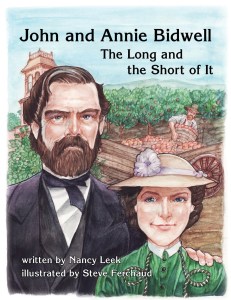
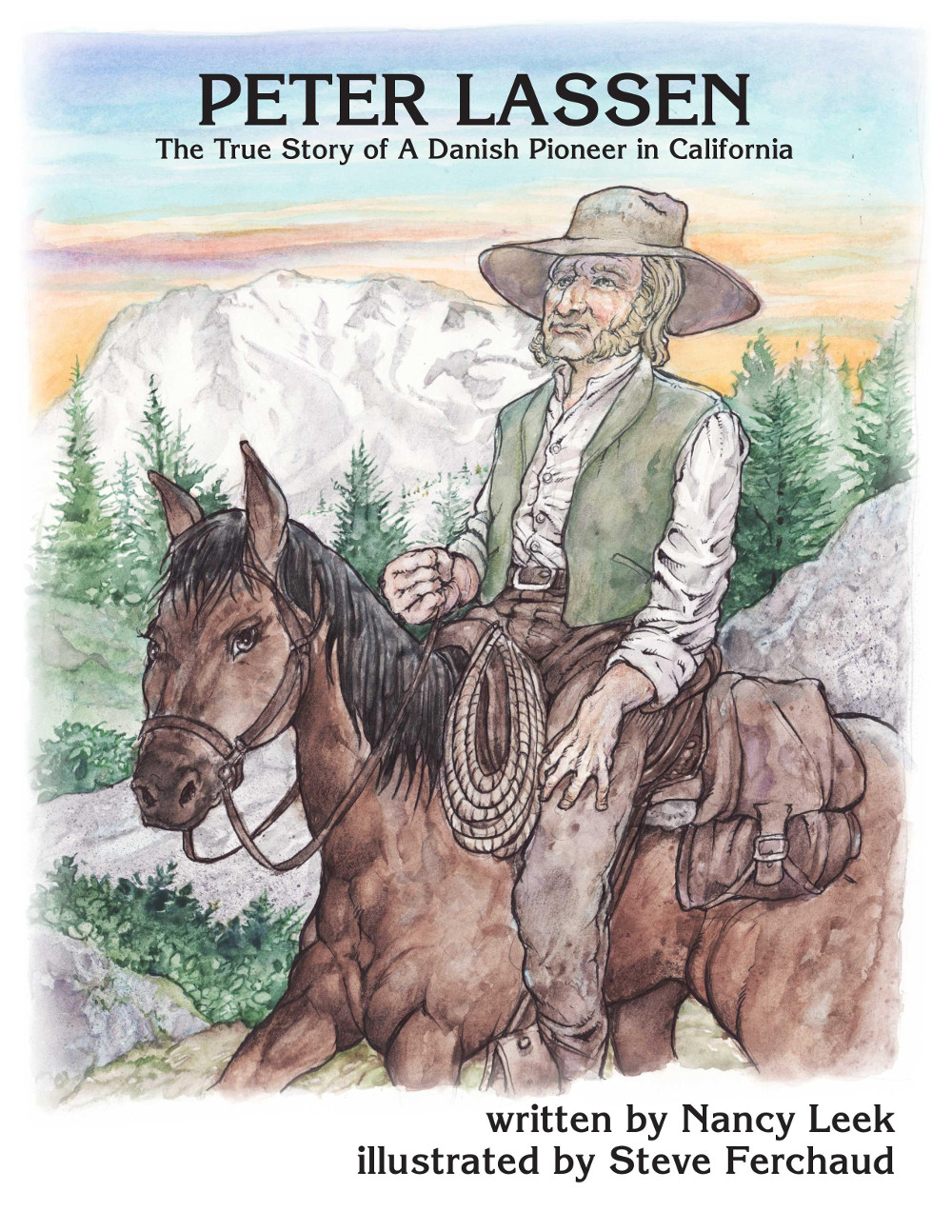
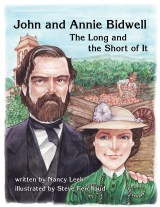
Coming soon! A picture book biography of John and Annie Bidwell for young readers. I want to show you some samples pages.

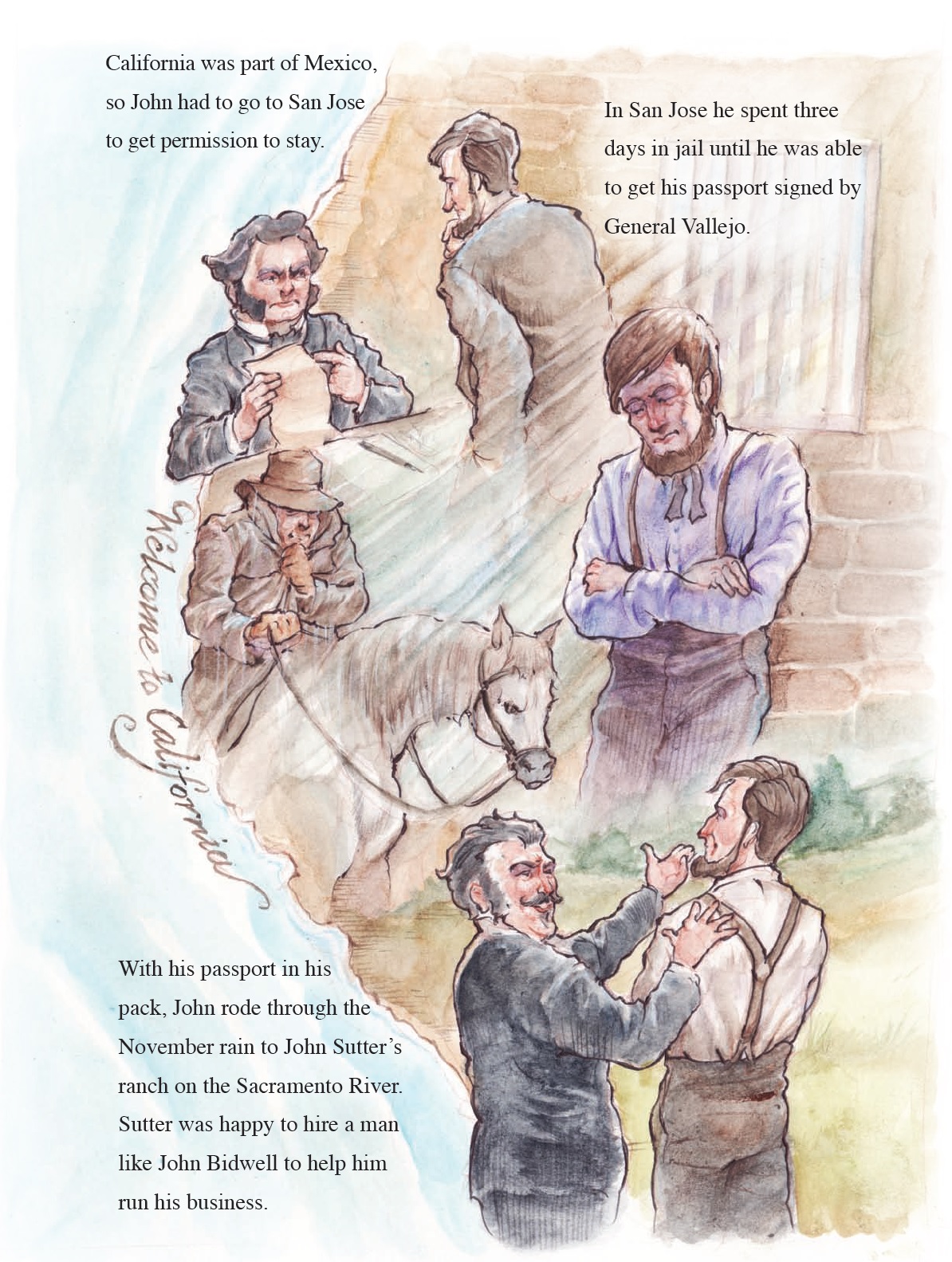
John Bidwell's first days in California.

John Bidwell’s first days in California.

Ever since I did my book on John Bidwell in 2010, teachers have asked me for an easier book that they can use with 3rd grade classes. It’s in the works and should be available shortly. It covers the Bidwells’ lives from the time John left Missouri to journey to California, to the day Annie gave Bidwell Park to the city of Chico.

The illustrations are by Steve Ferchaud, a talented local illustrator who has illustrated many books, as well as doing pictures for magazines and newspapers. It’s been a delight to see how he can translate my text into lively, informative pictures.

Bidwell2

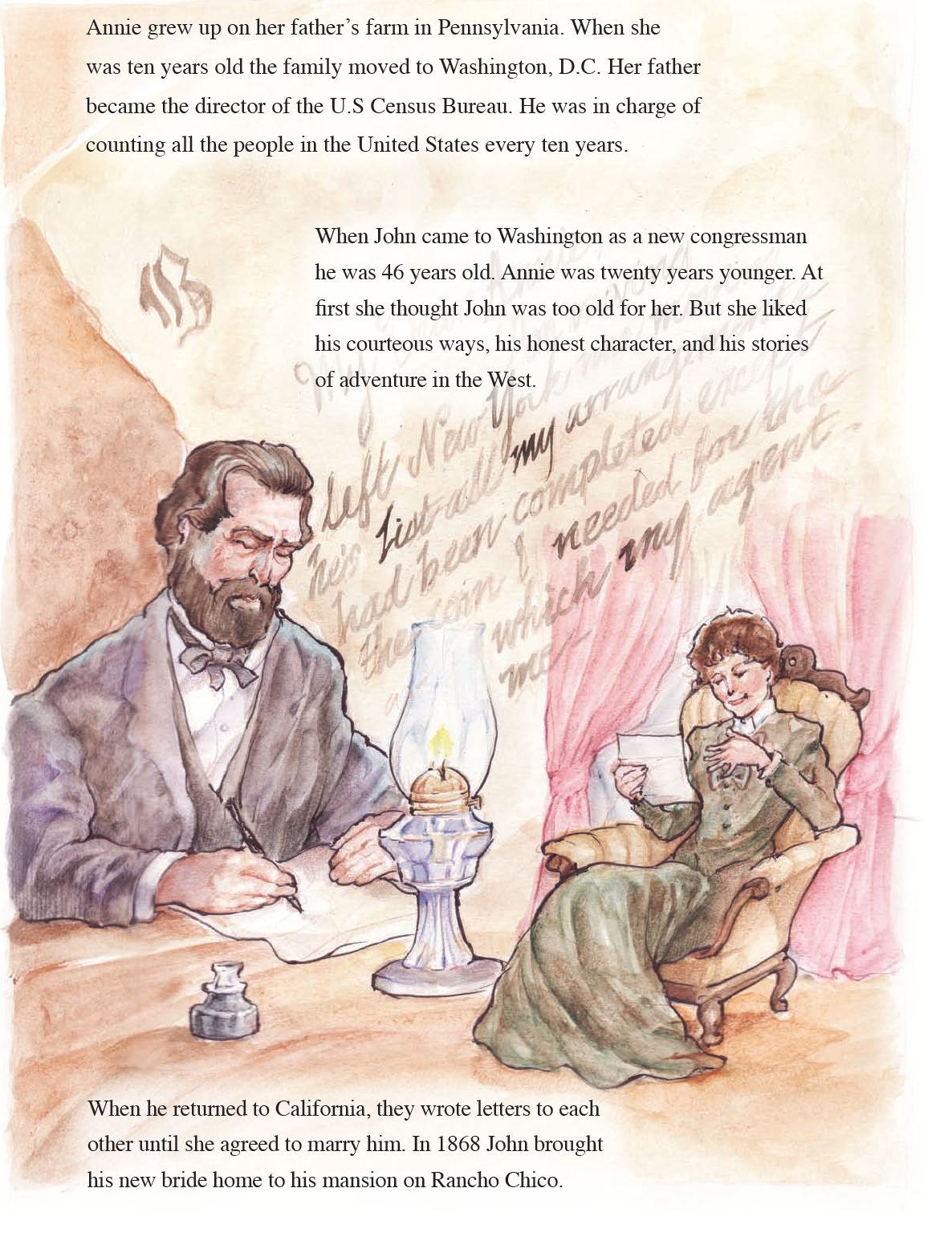
John and Annie’s romance.

The book will be 8.5 by 11 inches and 32 pages, with color illustrations throughout. It includes an afterword and timeline that add more information about John and Annie’s lives. Steve and I have worked hard to make sure that the text and illustrations are as historically accurate as we can make them.

Bidwell3

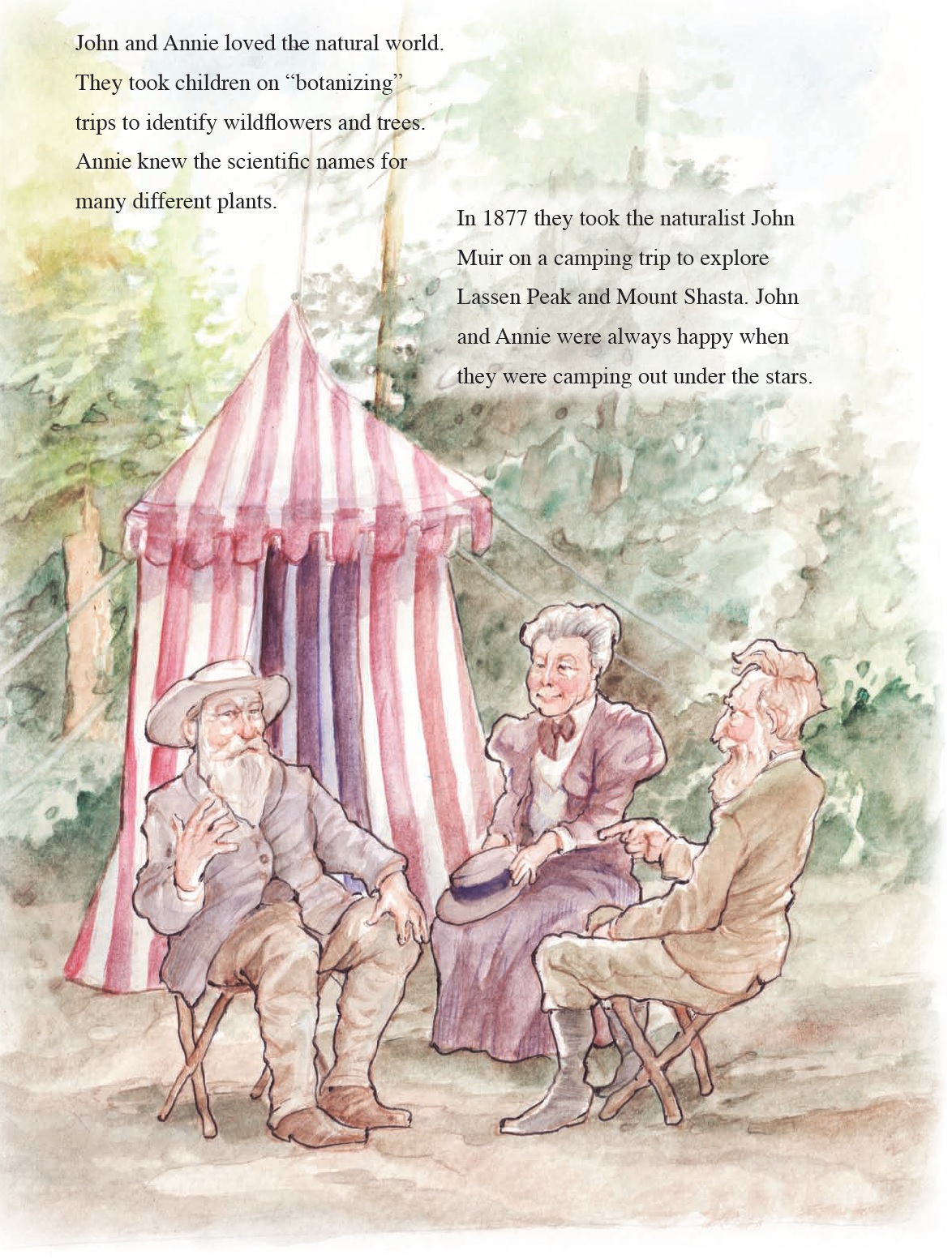
Camping with the Bidwells and John Muir.

The book will be for sale at Bidwell Mansion State Historic Park and in other local outlets. I hope you enjoy it!

Posted in Uncategorized | Leave a comment

Chico in the 1850s

Continuing the recollections of D. F. Crowder. The following appeared in the Chico Enterprise for December 27, 1917. Crowder came to Chico in 1856, at the age of twelve, so he saw it before it was even a town.

Bidwell had a flour mill which was run by water power. It was located on the creek about a hundred yards from where the present Sperry flour mill stands.

Rancho  Chico in the 1850s, with Bidwell's Store, adobe house and hotel, and flour mill.

Rancho Chico in the 1850s, with Bidwell’s Store, adobe house and hotel, and flour mill.

Both flour mills are gone today, but they stood next to the creek next door to where Northern Star Mills is today.

Flour was $1.75 a sack of fifty pounds, but no one kicked in those days. I used to see a good deal of John Bidwell. He was always busy with the ranch affairs and was seen very little about the hotel. He never was behind the bar himself, that I know of. Drinks we’re told were 25 cents each.

The hotel was Bidwell’s two-story adobe that he built after his log cabin burned down in 1852.

There was no bridge across Chico creek but there was a ford near where the present bridge now stands. The Shasta trail, now the Shasta road, lead off almost due north as it does now and it was black with immigrants — just like ants, coming and going. Some had ox teams, some were afoot and others drove mules. I don’t remember ever seeing a burro at that time.

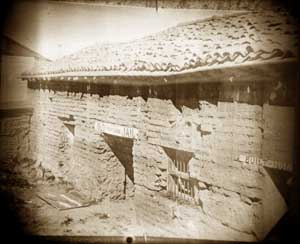
John Bidwell's adobe with Chico Creek in foreground.

John Bidwell’s adobe with Chico Creek in foreground.

It must have been a busy place in those days with plenty of traffic and people stopping all the time at Bidwell’s house for a meal or a drink or a rest.

Posted in Uncategorized | Leave a comment

Stagecoach Robberies in Butte County

D.F. Crowder’s memories of early days in Chico continued:

Soon after I came here [in 1856] I remember hearing the men folks tell about a robbery just across Butte creek, about six miles south of here — at the first little creek that you cross beyond the present Butte creek bridge.

The name of that creek is Robbers’ creek today because of this robbery. The highwaymen got away with a big quantity of gold, $5000 I think.

Another robbery took place right in front of where now stands Canfield’s wagon shop in Main street. Here the robbers made a good haul and for many years it was supposed that they buried their loot beneath a huge oak tree which stood there. Diligent search, however, failed to disclose it. Everybody was a peace officer in those days when it came to anyone breaking the law of man. They very seldom caught these stage robbers and the only way to catch them at all was to shoot them on the spot. They killed two north of Keefer’s ranch.

According to Cheryl Anne Stapp, in her book The Stagecoach in Northern California, the first holdup of a moving stagecoach in California happened in 1856 near Marysville. Robberies increased steadily through the 1860s, reaching a peak in the ’70s and ’80s.

stagecoachrobberyI searched the California Digital Newspaper Collection for information about the stagecoach robberies that D. F. Crowder describes. It’s hard to know, but here is one that might be a match. It appeared in the Sacramento Daily Union on June 11, 1860.

ROBBERY OF WELLS. FARGO, AND CO. — On Saturday night, June 9th, about nine o’clock, as the Shasta stage from Marysville arrived at a gulch about seven miles below Chico, five men rose up from the gulch, where they had beep secreted, and leveling their guns at the driver, and Bowen, the Express Messenger, ordered them to stop. Bowen instantly grasped his pistol, but finding it was useless to resist, surrendered. One of the gang unhitched the horses, while another took the treasure box, and demanding the key of Bowen, opened it and extracted $15,000, with the remark that the company was rich, and his party had particular use for the money. This done, they hitched on the horses, and permitted the stage to proceed. As the stage started, some passenger gave the robbers four charges from a revolver, but does not know if they took effect. Bowen has returned with his party to Chico, without finding any clue to his treasure or the robbers. Bowen, James Y. McDuffie, and a lady, were the only passengers. A reward of $7,000 has been offered by Wells, Fargo & Co. for the recovery of the treasure, and $5,000 for the conviction of the robbers.

Posted in Stagecoaches | 1 Comment

Joe Finnicum, the Chico Stage Driver

stagecoachharpers

Pres Longley wrote a poetical tribute to Joe Finnicum, a local stage driver. The poem appeared in the Chico Enterprise, on December 23, 1892.

JOE FINNICUM IN POETRY

Joe Finnicum, the Jehu,
Who drives upon the grade,
From Chico up to Powelton,
Moves onward undismayed.

Joe goes off when he’s loaded,
Goes off just like a gun,
And his team is never goaded,
But dash off just for fun.

He likes to hall the widows,
For they’re talking all the time,
And Joe still holds that kissing
Should not be called a crime;

And when the pretty maidens come,
So handsome, tall and slim,
They climb upon the forward seat,
And ride along with him.

They say they like to ride with Joe,
For his rig is nice and “nifty,”
They say he loves the feminines,
From fifteen up to fifty;

He holds the pretty schoolma’ms on,
While dashing ‘round the curves,
And whatever else he may not have,
You bet he’s got the nerves.

The term “Jehu” for a fast driver comes from the Bible; Jehu was a king noted for his chariot-driving. So we read in Kings 9:20 “the driving is like the driving of Jehu the son of Nimshi; for he driveth furiously.” In fact, Jehu even drove right over the body of the notorious queen Jezebel. Joe is a different sort of jehu; he is beloved of the ladies.

Joe Finnicum was a real person.  “Finnicum the stage-driver” is mentioned in a news story in the Sacramento Daily Union from August 14, 1886.

A Joke with a Back Action.—The Chico Register has the following : Samuel West, the forger, and another man were sent down from Chico some days ago, by Finnicum, the stage-driver. The Deputy sheriff at Chico did not think to say which was West and which was not to Finnicum, and the shrewd rascals noticing this, put up a job on the county officials. They changed names and offenses for the time being, and the ” vag.” answered to the name of West when he was spoken to. At the end of fifteen days the ” vag.” was turned loose, as he had served out his time, and yesterday, when West was called up to plead he stated that he was not West, but that he had skipped the country under his —the ” vag’s” names of Hines. Deputy Sheriff Guidery at once telephoned to Chico asking for a description of the two men, and when the reply came sure enough West was gone, and the ” vag.” was there in his place. He thought it a rich joke on the officers, but District Attorney Gray turned the joke on him by having him indicted for assisting a prisoner to escape, and for the offense he is liable to be sent to State Prison for the next five years.

Posted in Stagecoaches | 2 Comments

Bidwell’s Admission Day

In September 1889 John Bidwell wrote to his friend E. Nelson Blake:

Your memory is good — true, 39 years ago we brought the news of California’s admission into the Union. Where are those who were our fellow passengers? Except for yourself, I cannot recall the name of one living! We ought to be thankful that our lives have been spared to behold the wonderful march of events of this prolific age!

Unfortunately, Blake’s letter to Bidwell recalling the great day does not survive. Blake had a very good memory for his California days, and it would be nice to have his recollections.

Headline of the Daily Alta California, Extra Edition, Oct. 18, 1850.

Headline of the Daily Alta California, Extra Edition, Oct. 18, 1850.

Both were passengers on the steamship Oregon, arriving on October 18, 1850 with the news that California had become the 31st state on September 9th. Bidwell was traveling in a first class cabin, while Blake, a farm boy on his way to the goldfields, was in steerage.

Bidwell carried with him the statehood documents. Traveling with him were his Maidu valet Rafael, Samuel J. Hensley, H.A. Schoolcraft, who had traveled to Washington with Bidwell, Mrs. Elijah Crosby and her daughter Helen, and Bidwell’s brother Thomas. By 1889 all these but Helen Crosby, who had married Hensley, had passed away.  And John Bidwell, who had been Hensley rival for her hand, had forgotten all about her.

The Oregon steamed into San Francisco Bay, firing cannons and decorated “from stem to stern and from the taffrail to the maintop” (as the Daily Alta California reported) with fluttering flags to announce the long-awaited news. Jubilation erupted throughout San Francisco as the citizens celebrated with bonfires, marching bands, booming cannons, and all-night balls.

We don’t make much of Admission Day presently, which is too bad. If you want to celebrate, there is an event on Wednesday, Sept. 9th at 11:00 a.m. in Oroville at the Liberty Pole at Montgomery and Huntoon Streets.

Posted in Uncategorized | Leave a comment

Stage Drivers: The Beaus of the Road

awf_stagecoach-illustration_500x140More of the recollections of D. F. Crowder, from “The Eventful Yesterdays: The Story of Early Chico,” Chico Enterprise, January 1, 1918.

The big event of the day in ’56 at the Bidwell Rancho was the arrival of the stage coaches which ran regular up the valley from Sacramento. They were great, lumbering Concord coaches with sometimes four, but more often six horses to them. The animals were changed about every ten or twelve miles and the time made by these coaches was good. One came from the north and one from the south each day. When it came time for them to arrive little knots of men would gather in the road and peer north and south for a glimpse of the rising dust. Then someone would shout “Here she comes!” and soon the galloping horse covered with foam would dash up in front of the hotel.

A Concord coach in Idaho.

A Concord coach in Idaho.

There would be a groan of the brakes, the stage would stop and tired dust-covered travelers would alight to stretch their legs and ask the news. But it was not for long for the horse would be changed rapidly, the mail was thrown into the boot and away with the crack of a whip the horses would dart down the long trail which soon was lost in the mass of oaks which lined its path.

Famous stage driver George Monroe.

Famous stage driver George Monroe.

I learned in the years that followed that stage drivers were top crust. They were the beaus of the road and women passengers vied with each other to ride with them. They were generally dressy, good-looking young fellows, and wore long leather gauntlets on their wrists and little white Stetson hats. In later years whenever there was a dance in Chico or any social affair the stage drivers always lead the grand march or were the lions of the evening. And this not without reason, for in those days stage driving required a deal of skill and knack and besides some personal bravery for stages were constantly being held up and robbed, often with an attendant lass of life.

And finally, who could resist a still from the classic movie Stagecoach, with Claire Trevor and John Wayne, directed by John Ford.

stagecoach

Posted in Stagecoaches | Leave a comment

The Sight of a Pretty Woman

A story told by D. F. Crowder in the Chico Enterprise, December 29, 1917—

Of women in those days there were very few. In fact, women were somewhat of a curiosity. Men would go many miles just to look at a woman and when a woman, a pretty one, came in to camp, the news flew for miles . . .

I remember one woman, a Mrs. A. M. Sadorus, who afterwards settled on Rock Creek and died later in Nevada, who told about the curiosity her presence caused when she came West. . . . It was mooted about that a very comely woman was in camp and one miner, more venturesome than the rest, said his eyes were just watering for the look of a pretty woman  . . .  it would do his heart good to see one of God’s fair creatures again. So he went to the Sadorus camp where Mrs. Sadorus and her husband were resting for a few days. Mrs. Sadorus was in the tent and the miner who wanted just to see her approached the husband who stood outside.

“See here, pard,” said the miner, “If you don’t object I’d like just to look at your woman. I ain’t seen one since I left home, back in the States five years ago. No offense meant and you can tell her for me that if she will come out of that thar tent and let me look at her for just one minute I’ll give her ten dollars in dust.”

Sadorus, being a man of humor and appreciating the situation, and likewise acknowledging the reason for the miner’s whimsicality, laughingly told his wife about it. Mrs. Sadorus entered into the spirit of the occasion and putting on a pretty dress came from the tent and stood before the enraptured miner who had removed his hat in awe.

“God Almighty,” he said, “you air a purtty woman. It does my old heart good to see one of your kind again.”

For a full minute the old miner gazed upon the lovely vision and, pulling out his wallet, he handed her a $10 pinch of dust and took his departure.

I have heard Mrs. Sadorus tell this story many times and there are those here yet who will vouch for its truth.

D.F. Crowder 1909. Photo courtesy Special Collection, Meriam Library, CSUChico.

D.F. Crowder 1909. Photo courtesy Special Collection, Meriam Library, CSUChico.

D.F. Crowder came to Butte County in 1856 at the age of 12. He became a farmer in the area of Mud Creek. I suppose the event related here happened before he arrived. Women were exceedingly scarce in the mining camps and diggins.

From December 28, 1917 to January 28, 1918 the Chico Enterprise printed his recollections in a series entitled The Eventful Yesterdays: The Story of Early Chico. Some very interesting reading there — I’ll share some more soon.

Posted in Uncategorized | 2 Comments

Casaba Melons

I found in the California State Library the original letters that accompanied the shipment of melon seeds to John Bidwell. There are two letters, one form letter addressed to John Kennedy (Annie’s brother) and a hand-written one to General Bidwell.

Letter from Department of Agriculture, John Bidwell Papers, California State Library.

Letter from Department of Agriculture, John Bidwell Papers, California State Library.

The text reads as follows:

Sir:   I have the honor to inform you that I have this day sent to your address three varieties of Melon seeds from Asia Minor, received from the Governor General of Smyrna. They are sent for experiment. Please report results.

(Also please find two prs from the Ionian Islands.)

When received please acknowledge.

Respectfully yours, etc.

Horace Capron,  Commissioner

Letter to John Bidwell from S. Dean. John Bidwell Papers, California State Library.

Letter to John Bidwell from S. Dean. John Bidwell Papers, California State Library.

The text:

Genl Bidwell

Dear Sir

Herewith I send you 8 prs. melon seed all rare – The Ionian Melon cost the Department $120 a lb. gold. So it should be very choice.

I take the liberty of sending these seeds as I think it due to California that our farmers have some choice seeds, and I thus avail myself of my position to supply them.

Though so late in the season that irrigation may be necessary yet “better late than never.”

Respectfully yours,

  1. Dean

Please report results to Commissioner.

The seeds came in May 1869 and Bidwell immediately planted them, with great success.I don’t know what the abbreviation “prs.” means, and maybe I have it wrong.

I have grown Casaba melons in the past, but I didn’t plant any this year, because of the drought. They take a lot of water. Bidwell had his melon field situated at the end of a flume. Here is a picture of a melon I grew. They are delicious — the best!

DSCN0538

Posted in Casaba melon | 1 Comment