Jennie Megquier — Sewing in San Francisco

Jennie Megquier’s letters from Gold Rush San Francisco record a few interesting notes about clothing. In November 1849 she wrote:

I have starched twenty shirts this evening. I tell you this to give you an idea of the amount of work I have to do. Uncle has given me a whole piece of calico, one of de laine, one balererine. I shall make it all into broad aprons as I cannot get time to make a dress and when they get dirty throw them away that is the order of the day in this rich country.

Calico is a plain weave cotton fabric, and delaine was a lightweight wool fabric with a print. What balererine is I have no idea. It isn’t in any online fabric dictionary, like this one or this. Delaine is the sort of fabric that Jennie would have ordinarily used to make a nice dress, not aprons.

Uncle had some washing done for which they charged six dollars a dozen, they looked so bad, he gave them two dollars to keep them.

Which sounds like a joke, but that’s what Jennie wrote.

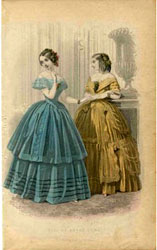
A fashion plate from Godey's Lady's Book 1853.

A fashion plate from Godey’s Lady’s Book 1853.

Later she had more time to sew, and in 1853 wrote:

I was in at Mrs. Calkins today, all well, she and Mrs. Davis are making dresses all the while, I presume they have twenty five in a year, a silk dress lasts but two months at the best. I know not why but everything goes to destruction in a very short time here. . . . I have been making me a brown silk, and next week I am going to make a black one, today I have been making a pink thibet sack trimmed with velvet ribbon but I am sure I do not know when I will wear it.

Thibet was another fine woolen cloth used for making dresses. By a “sack” she probably meant a free-hanging dress with a loose waist.

Posted in Uncategorized | Leave a comment

Chickens at Rancho Chico

In going through the John Bidwell Papers at the California State Library I came across this note from Edward Shackelford Darlington, a young man who briefly worked for John Bidwell in 1851. He is writing from Sam Neal’s Ranch, just south of Rancho Chico, to remind Bidwell to give the chickens water — just the sort of instruction that nowadays would be communicated by cell phone or email.

Letter courtesy California State Library, John Bidwell Papers.

Letter courtesy California State Library, John Bidwell Papers.

Darlington, who was only 19 or 20, can’t resist spoofing the etiquette of 19th century letters. It looks like something Mark Twain would write.

Here is the text, but the bare text cannot do justice to Darlington’s courtesy and flourishes.

Neal’s Oct. 24th [1851]

Major,

I neglected to tell you to have water placed in the chicken coop – also in the small pans around the house. This is absolutely necessary for the preservation of the health of the feathered tribe. – By complying with the requests herein named you will much oblige

Yours very respectfully

with great regard

Your obt servant

in great haste etc.

E. Shackelford Darlington

Posted in Edward Darlington | 2 Comments

How Ya Gonna Keep ‘Em Down on the Farm

. . . after they’ve seen San Francisco?

It didn’t take long for San Francisco to work her magic on Jennie Megquier. She wrote about the folks at home in Maine, “I have seen so much of things a little more exciting that I fear I shall never feel perfectly satisfied with their quiet ways again.” Then she drew this word-picture for her daughter:

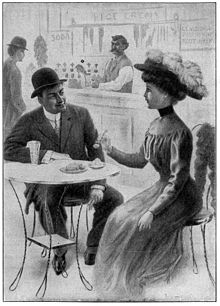
Here you can step out of your house and see the whole world spread out before you in every shape and form. Your ears are filled with the most delightful music, your eyes are dazzled with everything that is beautiful, the streets are crowded the whole city are in the street. We have near us a splendid ice cream saloon which surpasses anything I have seen in the states, very large windows with magnificent buff silk damask curtains with lace like those that Newhall Sturtevant boasts so much of, two large rooms are connected by an arch hung with the same material, marble tables, floors and counters and as light as day at all hours of the night. The homeliest man in the city treated me to an ice cream there a few nights since at one dollar a glass.

icecreamparlorWinthrop Maine had nothing to compare with the ice cream parlors of San Francisco!

Posted in Uncategorized | Leave a comment

A Woman’s Work Is Never Done

SIL7-89-01, 4/22/03, 4:14 PM,  8C, 3724x5398 (1956+864), 100%, A.I. Basic,  1/60 s, R46.5, G33.3, B47.8

SIL7-89-01, 4/22/03, 4:14 PM, 8C, 3724×5398 (1956+864), 100%, A.I. Basic, 1/60 s, R46.5, G33.3, B47.8

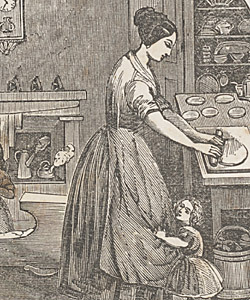
Jennie Megquier ran a boarding house in San Francisco, and the work was never-ending. She writes:

I should like to give you an account of my work if I could do it justice. . . In the morning the boy gets up and makes a fire by seven o’clock when I get up and make the coffee, then I make the biscuit, then I fry the potatoes then broil three pounds of steak, and as much liver, while the woman is sweeping, and setting the table, at eight the bell rings and they are eating until nine.

I do not sit until they are nearly all done. I try to keep the food warm and in shape as we put it on in small quantities. After breakfast I bake six loaves of bread (not very big) then four pies, or a pudding, then we have lamb, for which we have paid nine dollars a quarter, beef, and pork, baked, turnips, beets, potatoes, radishes, salad, and that everlasting soup, every day dine at two.

For tea we have hash, cold meat, bread and butter, sauce and some kind of cake and I have cooked every mouthful that has been eaten excepting one day and a half that we were on a steamboat excursion.

I make six beds every day and do the washing and ironing you must think that I am very busy and when I dance all night [she loved to go to dances] I am obliged to trot all day and if I have not the constitution of six horses I should have been dead long ago, but I am going to give up in the fall whether or no, as I am sick and tired of work.

She also sewed all her own clothes, but more of that later.

Posted in Uncategorized | Leave a comment

More from Jennie Megquier

The Megquiers shipped a “portable iron house” to San Francisco, figuring it would be a good investment in a city where people were living in shacks and tents, and indeed it was. They used the ground floor for a store, and rented out the upper floor for offices.

We have a fine store which is now nearly completed, the upper part will rent for one thousand per month a pretty little fortune of itself if rents continue as they are now, but it is doubtful. Our motto is to make hay while the sun shines, we intend to sell the first good offer and return forthwith, although there are many things here that are better than the states yet I cannot think of staying from my chickens [her children] a long time, and it is not just the place for them at present, no schools, churches in abundance but you can do as you please about attending, it is all the same whether you go to church or play monte, that is why I like, you very well know that I am a worshipper at the shrine of liberty.

Jennie had chafed under the day-long church services back home in Maine, where her father was a deacon in the Baptist church. She didn’t miss that at all.

The land is very rich would yield an abundance if it was cultivated, but no one can wait for vegetables to grow to realize a fortune, potatoes are twenty cents a pound, beets one dollar and seventy-five cents a piece, tomatoes, dollar a pound but we have them for dinner notwithstanding, we have made more money since we have been here than we should make in Winthrop in twenty years, the Dr often makes his fifty dollars, a day in his practice, then we have boarders to pay our house rent, they make great profits on their drugs [Dr. Megquier and his partner].

To show you some of the profits on retail, the Dr bought a half barrel of pickle in salt, after soaking them I put up fourteen quart bottles, sold them for six dollars more than we gave for the whole, which still left me the same bulk I had at first.

Prices were fascinatingly high — everyone talked about the prices. The money came in fast, but it went out fast as well. Jennie was sure that she would go home with “an apron full of gold,” but that would take longer than she expected.

Posted in Uncategorized | Leave a comment

Mary Jane Megquier in San Francisco

Mary Jane, known as Jennie, arrived in San Francisco on June 13, 1849. Her husband, Thomas Megquier, was a medical doctor and planned to practice medicine and open a drug store. Jennie knew she could make money running a boarding house, if she could just get a house. (Their name, by the way, was pronounced “Me-gweer.”)

. . . you may bless your stars [she wrote to her daughter] that you are not here at present, report says there are six thousand people here that have no shelter, but some are going and coming from the mines, so we got a small room the size of my bedroom in Winthrop for five of us with our luggage, your Father and me lie on a single mattress on the floor with one small pillow. Col. Hagen, wife, and little girl lie on a hard mattress on the bedstead  . . .

. . . some kind of provision are cheap as in the states such as beef pork flour, but vegetables are enormously high . . .We have been here three days and have had nothing to eat but beef, pickled fish, and poor flour bread.

. . . money is plenty as dirt if you have any means of getting hold of it, but we have not been here long enough to tell whether we can make anything or not, but if your Father can get practice there will be no doubt but we can get money enough in a year or two to come home, there is seven million dollars in gold dust in this little place besides thousands of coined money . . .

Jennie would soon find how to make her own way in San Francisco, where, as she wrote:

everyone must do something, it matters but very little what it is, if they stick to it, they are bound to make money.

Posted in Uncategorized | Leave a comment

Chico’s 4th of July

cropped-imgp8959.jpgHow did 19th century Chicoans celebrate Independence Day? Here’s an entry from John Bidwell’s diary for 1876 that will give you a glimpse:

Tues. July 4
Warm, very – no wind. = Bells rang & cannon & anvils roared all last night – Celebration went off well – good oration by Rev. Mr Dickerman – Fireworks & ball in evening.

An oration by a public figure or clergyman was a must. That would be followed by the reading of the Declaration of Independence and at least one patriotic poem. There would have been a parade too, and the town was decked out in red, white, and blue bunting. It was a day long event, and as Bidwell notes, it started the night before, and went on well into the evening of the 4th with fireworks and dancing.

Bells ringing and cannon firing makes sense, but what’s this about “anvils roared?” How do they do that?

“Firing the anvil” was a popular way to generate noise and excitement in the 19th century. All you need are two anvils and some black powder, which you could get from your friendly neighborhood blacksmith. Here’s what you do:anvil

(I don’t recommend trying this at home, even if you do happen to have an anvil. Could be dangerous.)

Take one anvil and turn it upside down. On the underside is a hollow about the size of a brick. Pour in some gunpowder and place a fuse or a trail of gunpowder. Then place the other anvil right side up on top. When you light off the gunpowder, you will get a terrific explosion and the top anvil will fly at least a hundred feet in the air. It will come down too, so clear the deck.

You can find some examples of anvil firing on YouTube, like this one.

Posted in 4th of July | Leave a comment

Indian War on the Klamath River

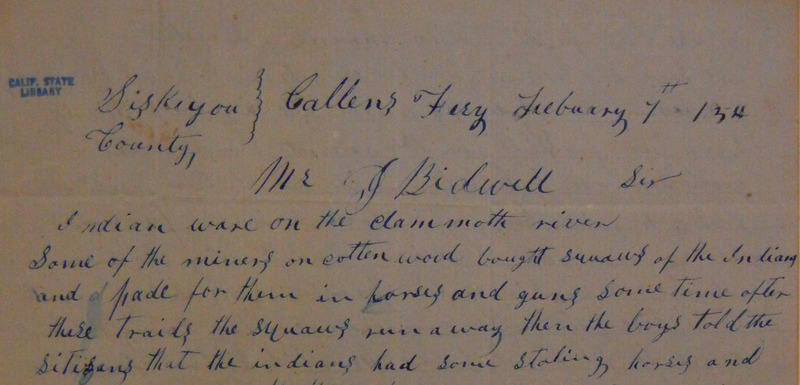
Letter from Jas. C. Callen to John Bidwell, courtesy of the California State Library.

Letter from Jas. C. Callen to John Bidwell, courtesy of the California State Library.

On February 7, 1854 James C. Callen wrote John Bidwell about an “Indian ware on the clammoth river.” A ’49er, Callen had been residing in Butte County in 1850, but by 1854 he was living on the Klamath River “ten miles from Yreiky.” Here is the first half of his letter, reporting on a skirmish with Indians. Spelling is just the way he wrote it. Note that he always spells ‘they’ phonetically as ‘tha’, the rest you can probably figure out.

Siskiyou County, Callens Fery Febuary 7th / 54

Mr. J Bidwell   Sir

Indian ware on the clammoth river

Some of the miners on cottonwood bought squaws of the Indians and pade for them in horses and guns some time after these traids the squaws run away then the boys told the Sitisans that the Indians had some stoling horses and if tha would help them to provision and aminison tha would bring them a way, so tha ware all furnished and when tha came to the place whare the indians ware tha found them all in a large cave and well prepared for wore. So tha wint back and told a worse taile than ever Sitisens and traiders made up a second out fit for the boys and about forty of them turned out now to take the cave and horses when tha came in Sight the indians hailed them and inquired there bisness the cottonwood boys thinking it would ondly be sport for them fired on the indians tha soon saw the indians had the advantage and give ground the indians fought them about four miles and killed four whites and wounded five more one Indian was kild and several wounded this caused the excitement the indians sent them word to come on that tha had a good fourt and could cleare out all that could come you can se the last fight in the mountin herreld.

The Mountain Herald was a weekly newspaper published in Yreka beginning in 1853. This letter is in the John Bidwell Papers at the California State Library, where you can also read the Mountain Herald. The transcription is my own.

Posted in Uncategorized | Leave a comment

Across the Isthmus of Panama with Mary Jane Megquier

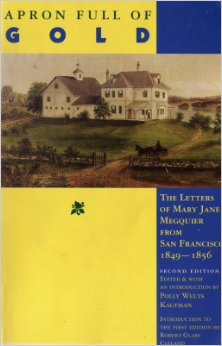
Apron Full of Gold: The Letters of Mary Jane Megquier from San Francisco 1849-1856

Apron Full of Gold: The Letters of Mary Jane Megquier from San Francisco 1849-1856. 2nd edition. Edited and with an introduction by Polly Welts Kaufman.

Mary Jane Megquier, known to family and friends as Jennie, came with her husband to California in 1849, leaving her three children behind in Maine with relatives. At first the plan was only for her husband to go — many a man left wife and children behind when he headed for the goldfields. But at the last minute Jennie decided to go along. As she wrote to her daughter from New York, “they think some of taking me along with them, it is so expensive getting womens work they think it will pay well . . .”

Although she missed her children terribly, she thoroughly enjoyed the adventure of traveling to California and living in mining camps and San Francisco. “Women’s work” was hard, but the lively variety she found all around her more than made up for it.

Her letters home, written between 1849 and 1856, are one of the best portraits of life during the Gold Rush. I have read a number of covered wagon accounts of the overland journey, but this was the first time I read a first-hand account of traveling the Panama route. Crossing the isthmus was an uncomfortable and often dangerous undertaking, yet Jennie reveled in it, in spite of the heat, damp, insects, disease, bad food, and lack of comfort. She was no complainer.

Here is an excerpt in which she describes the journey up river from Chagres:

After waiting three or four hours we were stowed into a canoe (Mr. Calkin, Dr. [her husband] and myself) twenty feet long two feet wide with all our luggage which brought the top of the canoe very near the waters edge. We seated ourselves on our carpet bags on the bottom of the boat, if we attempted to alter our position we were sure to get wet feet, notwithstanding our close quarters the scenery was so delightful the banks covered with the most beautiful shrubbery and flowers, trees as large as our maple covered with flowers of every colour and hue, birds of all descriptions filled the air with music while the monkeys alligators and other animals varied the scene, that we were not conscious of fatigue.

Two natives pushed the boat with poles unless the water was too swift for them they would step out very deliberately and pull us along, Was it not a scene for a painter to see us tugged along by two miserable natives. There are ranchos every few miles where you can get a cup of miserable muddy coffee with hard bread of which we made dinner, then we doubled ourselves in as small compass as possible and started, under a broiling sun the thermometer at one hundred.

Arrived at our destination for the night about five o clock where we seated ourselves on the bank to watch the arrival of the canoes, before dark there were one hundred Americans on that small spot of ground all busy as bees making preparation for the night. Our part thought it best to have the natives cook their supper, it was rich to see us eating soup with our fingers, as knives, forks, spoons tables, chairs are among the things unknown, they have no floors, the pigs, dogs, cats ducks, hens, are all around your feet ready to catch the smallest crumb that may chance to fall.

As I was the only lady in the party they gave me a chance in their hut but a white lady was such a rare sight they were coming in to see me until we found we could get no sleep, we got up and spent the remainder of the night in open air, At four we took up our bed and walked, Would to God I could describe the scene. The birds singing monkeys screeching the Americans laughing and joking the natives grunting as they pushed us along through the rapids was enough to drive one mad with delight when we got tired sitting, we would jump out and walk to cut out the crooks which were many, we could never see more than ten rods, sometimes we would find that we were going northeast when our proper course was directly opposite.

At four in the evening we reached Gorgona, another miserable town, where you will find the French, New York and California Hotels, but you cannot get decent food, nor a bed to lie upon at either house. There is a church in town which is not as respectable as the meanest house you have in town . . .

More from Mary Jane next time.
Posted in Mary Jane Megquier | Leave a comment

A Visit to Vina

What do a 12th century Spanish monastery, Peter Lassen’s ranch, Stanford University, and New Clairvaux Vineyard have in common? They all come together at Vina.

I have been planning to take the short (19 miles from Chico) drive north to Vina for ages now. I finally did it today, together with my husband Jim and our daughter and her family. If you live in Northern California, it is well worth the trip, in history alone, and if you like wine, that’s another reason to go.

New Clairvaux Chapter House.

New Clairvaux Chapter House.

The Abbey of New Clairvaux is a Cistercian Trappist monastery following the Rule of St. Benedict. It was founded in 1955, and is home to over 20 monks, who spend their days in prayer and manual labor. They care for walnut and prune orchards and grape vineyards.

The abbey site in Tehama County is rich in history. It was once part of the 22,000 acre Rancho Bosquejo, the Mexican land grant belonging to Peter Lassen. In 1852 the property passed to Henry Gerke, who was successful in growing grapes and making wine. It was during Gerke’s time that the site acquired the name Vina.

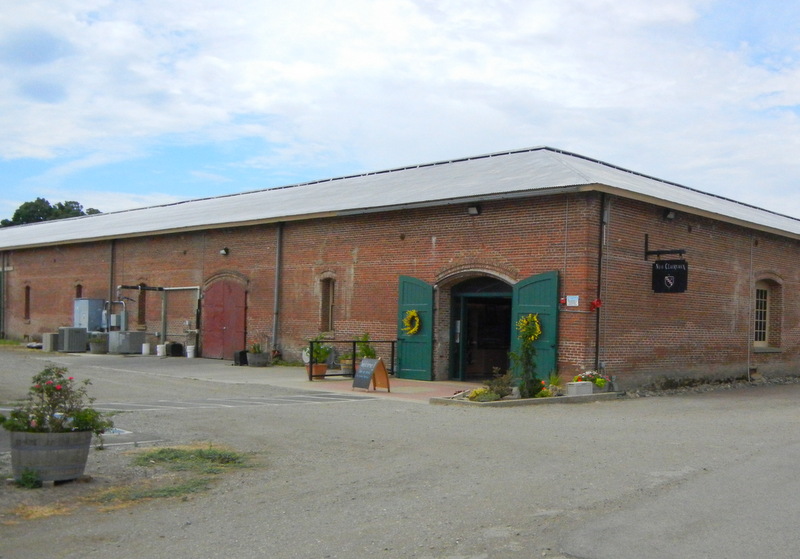
Later the ranch was bought by Leland Stanford, governor and railroad baron, who built up a land empire of 55,000 acres. His “Great Vina Ranch” became the world’s largest wine operation. The huge brick fermenting plant built by Stanford still stands. Difficulties in growing and processing the grapes in the hot Sacramento Valley meant that the wine business was never as successful as Stanford hoped, but he did pretty well with brandy.

Stanford's fermenting building.

Stanford’s fermenting building.

After Stanford’s death in 1893 his wife carried on the business, which helped to finance Stanford University, but increasing pressure from the temperance movement led the University to get out of the wine-making business. They uprooted the grapevines and sold off the land in 1919. Sixty years ago the Cistercians bought it from a dairy farmer named Flynn. In addition to the orchards, they re-planted grapes and established New Clairvaux Vineyard.

Lassen and Stanford are not the only famous California names associated with Vina. William Randolph Hearst comes into the picture as well. For the last 20 years the monks have been reconstructing a medieval Spanish chapter house using stones from a monastery that Hearst acquired in Spain. Hearst never used the stones to build his second castle. Instead they have come home to the abbey. You can read more about this project at Sacred Stones.

For fascinating history in a scenic package, Vina is hard to beat. Go visit it soon. The linked websites have all the visiting information.

Posted in Uncategorized | 1 Comment