John Bidwell Waxes Poetical in the Spring

In 1851 John Bidwell wrote to a young lady of his acquaintance, “My Friend Miss E. Boyd,” describing his life in the goldfields of California. Here is his description of springtime in the Central Valley:

For miles and hundreds of miles up the Sacramento and San Joaquin rivers the soil is as rich I suppose as any I ever saw, for miles you might travel following the course of either river in the early Spring and beautiful flowers fairly paint the landscape in their rich and varied profusion, broad prairies covered with wild oats & peas would often be along your road. Occasionally you would be obliged to cross some small creek; these are (many of them) well shaded with oak trees, & many an oaken bough sustains loads of grapes, green yet, but in a few weeks their rich purple would tempt your appetite after a better meal than you would be likely to get here . . .

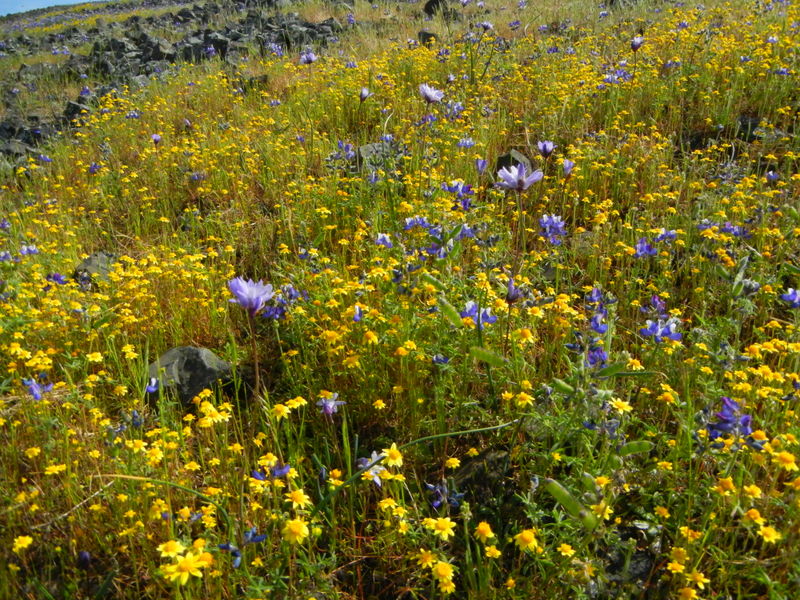
DSCN3462

The wildflowers may be mostly gone from the valley floor, replaced by roads and orchards and houses, but you can still enjoy a California spring as Bidwell saw it. Just go as soon as you can to North Table Mountain Ecological Reserve, here in Butte County, and enjoy the vista of lupines, goldfields, yellow carpet, bluedicks, red maids, owl clover, meadowfoam, and monkey flower. The small creek is there, the oak trees, and the cattle. Enjoy it while you can, for it will soon be gone until another spring.

Posted in Uncategorized | Leave a comment

Bidwell Campaign Song

Campaign button for the 1892 Prohibition Party national election.

Campaign button for the 1892 Prohibition Party national election.

As long as we are on the topic of political campaign songs, here’s another one. This is from Bidwell’s run for president on the Prohibition Party ticket in 1892. Bidwell’s vice-presidential running mate was James B. Cranfill of Texas. This song, which was written for the campaign in California, promotes A. M. Hough, who was the Prohibition Party gubernatorial candidate. He was Bidwell’s running mate in 1890, when Bidwell was the Prohibition candidate for governor.

Be prepared; they liked their songs lengthy back then:

With General Bidwell at the Front, by D.C. R.

With General Bidwell at the front, and A.M. Hough beside,

We’ll make the fight–see if we don’t– Whatever ill betide.

But ill will  not betide us long, we’re growing grandly great;

Our men are marching, thousands strong, to vote and save the state.

Hurrah for Bidwell and for Hough!

And Prohibition too;

Our nominees are good enough,

They’re stalwart, strong, and true.

We aim to save our golden state, fronting the calm west sea.

From shame, from ruin doubly great, for truth and purity.

We aim to save, alas! the need, the rum-invaded home;

Save from the spoiler”s cruel greed, Secure from base to dome.                            Hurrah for Bidwell, etc.

The churches are at last awake,–alive to high emprise;

It is a fight they too must make; or basely compromise;

They’ve prayed too long, God’s will be done, whilst voting the reverse;

Their votes and prayers should both be one against the dreadful curse.                   Hurrah for Bidwell, etc.

The workingmen, the farmers, and  those who for daily wage

Toil hard;’ are banding in  one band their sorrows to assuage:–

They see with us the corporate greed deserves a killing blow,

And so, to satisfy their need, their ballots they’ll bestow.                                      Hurrah for Bidwell, etc.

The Rep’s they fence the liquor in and make it pay a tax;

They think high license is no sin their morals are so lax.

They’re “hand in glove” with the base trade for pelf and party gain,–

Fair promises they’ve often made, which we’ve believed in vain.                  Hurrah for Bidwell, etc.

The Dem’s also! are just as bad;–or worse, perhaps than they;

Free whisky is with them a fad– free whisky night and day;

They have and hold their lofty “Jinks” and shout for liberty;

But soon will come a change, me thinks! we’ll all be glad to see.          Hurrah for Bidwell, etc.

Hurrah! Hurrah! once more hurrah! and then hurrah again;

Hurrah for order and for law, clean politics and men;–

Hurrah for peace, at home, abroad; through all our vast domain–

The home redeemed, the rum outlawed never to rule again.          Hurrah for Bidwell, etc.

I’ve got to say, this is not the most inspiring campaign song that I can  imagine. “Our  nominees are good enough”? “Soon will come a change methinks”? I wonder just how singable this song was, and whether it did the job of rousing the troops.

The printed copy I have of this doesn’t indicate the tune. These kind of songs were usually written to fit some well-known tune like “Yankee Doodle” or “Rosin the Bow.” These lyrics would fit the sailing song “A Wet Sheet and a Flowing Sea,” which was better known then than now.

Campaign songs in our modern age have fallen on hard times. You don’t hear very many, and they don’t often have original lyrics, like this one does. For a comparison, check out The Republican Campaign Songster for 1860. It has over forty songs extolling Lincoln, freedom, and abolition.
 

Posted in Prohibition Party | Leave a comment

“The Farmer of Chico” in Politics

Back in the day when political campaign songs were numerous and popular, the following song appeared in the Sacramento Bee on August 4, 1875. It is not complimentary to John Bidwell. In 1875 Bidwell was the candidate for governor of the People’s Independent Party, also known as the Anti-Monopoly Party, which stood against the Big Four railroad barons and their control of politics in California. Both the Democrats and Republicans hit back against Bidwell. They portrayed him as a greedy land baron ruling over an agrarian empire, exploiting his workers and keeping the small farmer at bay.

You can find the tune for “Joe Bowers” at https://maxhunter.missouristate.edu/songinformation.aspx?ID=54  Here is the entire newspaper article:

The Farmer of Chi-co

Tune : “Joe Bowers”

The following was sung at the meeting of the Republicans of the Tenth Ward of the Twelfth Senatorial District, San Francisco, last week:

It’s of an ancient farmer, who had a ranch in Butte

He raised a heap of wheat and corn and garden-sass* and fruit,

His cattle ranged a thousand hills and filled the plain below,

And he lived in regal splendor, this farmer of Chico.


This antiquated farmer was a gallant pioneer,

He boldly came the plains across and early landed here;

He roughed it with the Indians and Mexicans also,

And then they called him General John, the farmer of Chico.


In forty-five, or thereabouts, the land was very low,

And farmer John obtained a grant of forty miles or so,

But how he got the title, I don’t pretend to know,

But the finest farm in Butte is the Ranch of El Chico.


Some twenty thousand acres he still retains today,

And joins the Independent cry of “No Monopoly!”

A little farm may do for men with little means to show,

But leagues alone will satisfy the farmer of Chico.


And now this ancient farmer is making quite a stir,

He wants to get the people to make him Governor—

But when the votes are counted, the answer will be “No

Sir!” we do not want for Governor the farmer of Chico.

* garden-sass: vegetables

Posted in People's Independent Party | Leave a comment

Amethyst and Adobe

Sutter's Fort

Sutter’s Fort

What do amethysts and adobe bricks have in common? A tale told by John Bidwell about Sutter’s Fort and a treasure thrown in the dust.

In January 1892 John and Annie Bidwell visited old Sutter’s Fort, which by then was falling down and melting away. A move was on to restore the fort, and contributions had been solicited from the public by the Native Sons to buy the land and begin restoring the fort to its former glory.

According to the Sacramento Bee, in an article reprinted in the Chico Enterprise, General Bidwell and his wife toured the site of the old fort and inspected the progress of the restoration. The General pointed out his office in the central adobe building.

The sight of the restored fort brought back vivid recollections of the days when the fort was in its prime.

“Over in the corner of the garret,” said the General . . . “I had stored away a box of valuable stones which General Sutter had received as gifts in the Sandwich Islands and given to me. A magnificent amethyst was among them. When the first gold came down to be assayed, everything was turned upside down, and somebody threw the box of stones out of the window that you see there into the corral below. Most of them became lost, but when I discovered they were gone I made a search and recovered the amethyst and brought it to New York, where it was mounted and pronounced to be one of the finest stones of the kind ever seen.”

My thanks to John Rudderow, who found this article in the Chico Enterprise for January 22, 1892.


Posted in John Sutter | Leave a comment

A Valentine for Annie

To: Miss Annie Kennedy               February 14, 1866

A  Annie is a charming girl, an editress, a writer

N  Nor could you find in all the world a better nor a brighter

N  Now if fair Annie would be mine, take me for her intended

I   I would not wish for greater bliss

E  Ere life’s bright dream were ended.    sc17333 Annie Ellicott Kennedy Bidwell

This little valentine acrostic is printed in What Makes a Man: The Annie Kennedy-John Bidwell Letters 1866-1868, edited by Chad L. Hoopes. But it almost certainly is not by John Bidwell. He arrived in Washington, D.C. in December 1865 to take his place in the U.S. Congress. He met Annie sometime in the winter or spring of 1866, but they did not begin corresponding until December 1866. The poem does not appear in Dear General, edited by Linda Rawlings, which is a more complete version of their letters.

John Rudderow has seen this poem in the State Library and thinks it was from someone at the Presbyterian Church that Annie attended. I’d like to go looking for it and see if I can pin down the author. In the meantime, enjoy the valentine and maybe try your hand at an acrostic on your own sweetheart’s name.

Posted in Annie Kennedy Bidwell | Leave a comment

Annie’s Diamond Ring–The End

What happened to Annie’s ring, with its California diamond? Was it buried with her? Did she leave it to a relative in her will? Where did it go?

I’ve been wondering about that, and thought I would check the Bidwell diaries to see if there was any clue. Nothing in Annie’s diary–she didn’t keep a regular diary, like her husband. But in John’s diary on June 20, 1876 there is this:

Windy, cool, pleasant day a light sprinkle. = R. F. Parks was here to inspect the wool – dined with us. = Made agreement with Yee Kee to dig all trees on Eighth street = Wife gave Mr Parks a drive = Wife lost her California diamond.

Mr. Parks was from Marysville and was in Chico for a few days. Evidently Annie entertained him by taking his for a carriage ride, perhaps through Vallombrosa, and on the way the diamond fell out of the ring. Was it ever found?

The next year, on May 21, 1877, Bidwell records: Callers: Mr. Shand – about Diamond. Was this the diamond? I don’t know. He doesn’t say anything else about it.

So there we are. Annie had her California diamond set in a ring, she lost it in 1876, and possibly it was recovered in 1877. Or maybe it is still lying out there somewhere, under the dirt in Bidwell Park. Keep an eye out for it if you are in Bidwell Park!

Posted in Uncategorized | Leave a comment

Annie’s Diamond Ring, Part Four

During his Washington years John Bidwell felt like he was navigating a minefield of social missteps and blunders. In his letters he often refers to his fear of giving offense. He had spent the last 25 years on the Western frontier, where ladies of Annie’s social standing were rarely met. Now he was head-over-heels in love with her, and very fearful of saying the words or making the gesture that would lose her good opinion of him forever.

Still, there was that diamond. And if he could get her to accept it, that would be proof of her regard. More than regard, surely. It would be proof of her love, even if she was not ready to admit it.

The trick was to get her to accept a gift that looked exactly like an engagement ring, before there was any engagement to be married. How did he manage it?

Annie Bidwell in 1875. There is a ring on her left hand, but it is impossible to see what it looks like.

Annie Bidwell in 1875. There is a ring on her left hand, but it is impossible to see what it looks like.

The clue comes in a letter from Annie to John in October 1867. At this point she had decided to accept his proposal of marriage, but had not actually told him so yet. She writes:

Sallie [her sister] concluded I ought not to wear the ring, that however we might regard it, you must, could not avoid, associating it at least, with an engagement ring. The assertion to the contrary was unavailing.

Sallie was more perceptive than Annie, it seems.

I told her you would never offer a ring, in part a gift to you [the diamond had been given to him], as an engagement ring, and gave her your words–written from New York. Papa and Mamma agreed with me, assuring me I never would have accepted, even on my terms, any other than this ring; that had you purchased one for me, or had not the diamond been a “rough one” shown me in its rough state, and an American diamond,–etc.–with other attending circumstances–which you know, that I would not have worn it.

So if he had simply gone to Tiffany’s and bought a ring, she would have turned it down. But the fact that it was an American diamond, which she had seen it before it was cut and polished, combined with the understanding that it could be returned at any time, and so on and so forth, gave her the excuses she needed to keep it and wear it. And once it was on her finger, even if he was far away in California, how could she forget him? Clever John Bidwell!

Posted in Annie Kennedy Bidwell, diamonds, Uncategorized | 2 Comments

Annie’s Diamond Ring, Part Three

John writes from Chico on June 18, 1867:

And now another thing, the ring. I send it by this steamer. It may be a little too large for you. If so, have it made smaller. It will cost but little. I will pay the expense. I fear you will not like the style of the ring. It is so plain, but fix it to suit you. Herewith I will enclose $10 for any changes you may see proper to make, and if they cost more please let me know.

One thing I would like to have you do. Have your name engraved on the ring somewhere. Then if you ever return it–I hope you never will–it will be to me a more precious memento. You remember the conditions.

The conditions were that the ring was a pledge of friendship, and if circumstances were to ever alter (that is, if she were to marry someone else) then she would return the ring.

Annie received the ring about a month later, and on August 7th she wrote:

Now I must thank you for the beautiful ring which I saw for the first time yesterday. It is a little too large, so I will comply with your request and have it made a little smaller.

Which she did, at a cost of 50 cents.

The setting is perfect I think, and not too plain as you suggest. We sit a great deal on balconies, and by moonlight the diamond is beautiful and reflects credit on American diamonds! Pardon the pun, both for its poverty and boldness.

John must have been highly gratified to know that she was wearing the diamond ring and watching it sparkle in the moonlight. Now if he could just get her to come to California . . . .

Posted in Annie Kennedy Bidwell, diamonds | Leave a comment

That Diamond, or How Much Was $125 Worth in 1867?

John Bidwell was told by a New York jeweler that his diamond from Butte County, California was worth $125. What would that be in today’s money?

According to the website Measuring Worth,

A simple Purchasing Power Calculator would say the relative value is $2,030.00. This answer is obtained by multiplying $125 by the percentage increase in the CPI from 1867 to 2013.

So it would take around $2000 to buy today what $125 would buy in 1867. That probably is about right if we are talking about groceries, clothing, or rent. But we are talking about a diamond, and that is an entirely different matter. We don’t know the size of John Cherokee diamond, but a good quality 1 karat diamond on today’s market costs more than $2000.

Measuring Worth goes on to explain:

If you want to compare the value of a $125.00 Commodity in 1867 there are three choices. In 2013 the relative:
real price of that commodity is $2,030.00
labor value of that commodity is $15,400.00(using the unskilled wage) or $31,200.00(using production worker compensation)
income value of that commodity is $29,100.00

Maybe the diamond was worth a lot more than a $2000 diamond today. It’s really impossible to tell what Bidwell’s diamond would be worth today, since he doesn’t say how big it was, or how it measured in karats. But I’ll bet it was a very pretty little sparkler.

I only wish I knew what happened to it.

More about the diamond ring next time.

Posted in Annie Kennedy Bidwell, diamonds | Leave a comment

Annie’s Diamond Ring, Part Two

I am thinking seriously of going to Washington Saturday night and coming back Sunday night . . . It is doubtful. I wrote your father that perhaps I might do so. I hardly think I shall be able. A letter put in the post office as late as Sunday evening will reach me.

So wrote John Bidwell to Annie from New York City. He should have made the trip and given her the ring. But he waffled around, didn’t go, and didn’t get her letter in reply before he got on board the ship for California.

Annie promptly replied on Sunday, but the letter didn’t get to John in New York in time.  In it she says:

A young portrait of Annie Ellicott Kennedy.

A young portrait of Annie Ellicott Kennedy.

Mamma thinks if you had brought “the ring” there would have been no impropriety in my acceding to your terms–namely–to be mine until circumstances, on your part or mine, should render the return of it advisable. I hesitated, but if it would be a gratification to you, it would be agreeable to me. It would have given me pleasure to see it, having seen it in its rough state. You need not fear that you have offended me.

A little more boldness on his part, and the ring would have been on her finger before he departed. Of course, she had to consult with Mamma first. She always did. But since Mamma gave her approval, it would not be a breach of etiquette to accept the ring.

Obviously she was charmed by the man from California, and attracted to him. But she hadn’t said so yet. Most of her letters were taken up with urging him to accept Christ as his Savior. Nevertheless, she was intrigued by that diamond, and by the man who offered it to her. He would win her yet. A few more months would pass, however, before she got to wear the diamond ring.


Posted in Annie Kennedy Bidwell, diamonds | Leave a comment