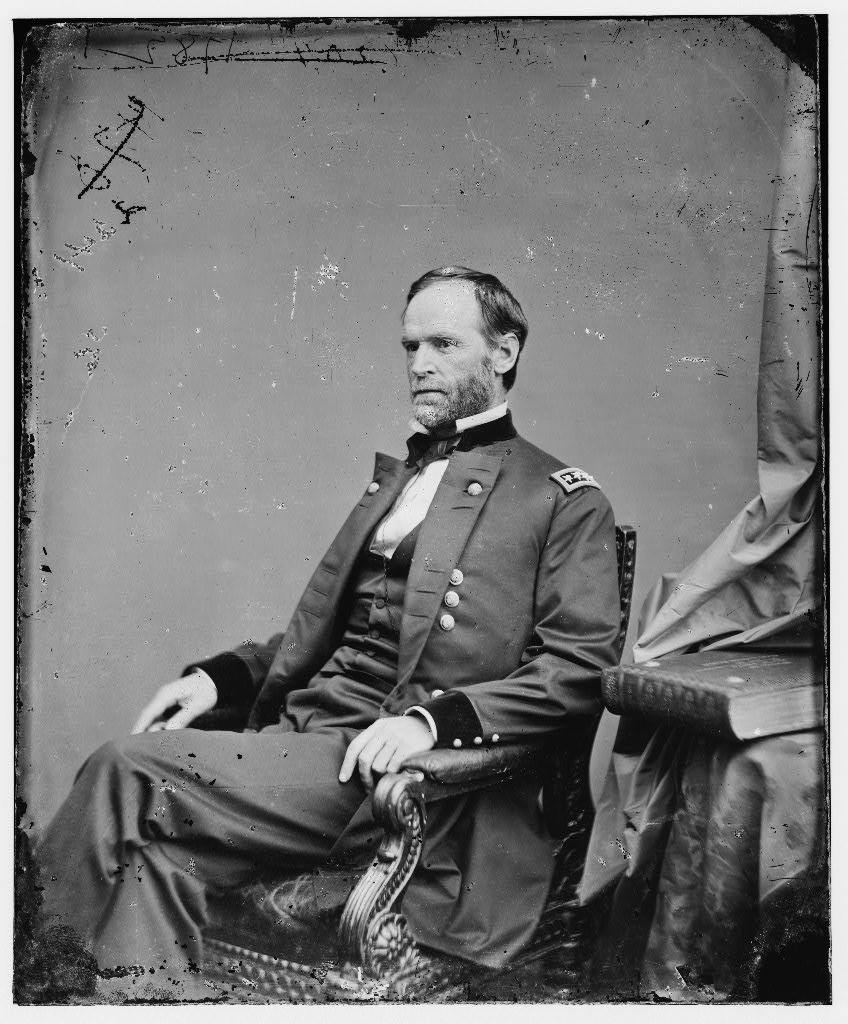
John Bidwell first met William Tecumseh Sherman in California in 1847 when Sherman was a first lieutenant in the U.S. Army and Bidwell was a surveyor and a major in the California Battalion. I’ve written about that encounter, as told in Sherman’s memoirs, elsewhere.
They saw each other off and on in the following years. Sherman was a banker in San Francisco from 1853 to 1857, and Bidwell, who often had business in the City, probably saw him there. Sherman’s army career took off with the Civil War and by the end of the war his fame was only second to General Grant’s. Both Grant and Sherman attended the wedding of John Bidwell and Annie Kennedy on April 16, 1868.
In 1877 Sherman made a trip to the West Coast to inspect Army posts. Everyone hoped to see him and speak to the hero. But he could be elusive. On his journey by stagecoach and train from Oregon to San Francisco he passed through Chico. An item in the Chico Enterprise announced his imminent arrival.
Chico Weekly Enterprise 5 October 1877
John Bidwell wrote in his diary:
Sat. October 6. Wife, sister and self went to Depot to see Gen Sherman. He did not get out of car so no one but myself saw him, for he called me into his room.
It seems that General Sherman, having had some sleepless nights, was still in bed. He was not properly dressed to meet the ladies, let alone the crowd that had gathered at the depot. When he reached San Francisco he wrote Bidwell a letter of apology.
Courtesy of the California State Library
As you can see, his handwriting is not the easiest to decipher. But I have been working on it and next time I will give you a complete transcription.
Puncturevine in a nearby field, before it went to seed
Puncturevine, AKA goatheads, caltrops, devil’s thorn, and tribulus terretris. You’ve seen and and you hate it. I hate it. Everybody hates it.
It is the bane of cyclists, gardeners, and barefoot children everywhere. With its sharp penetrating thorns and prostrate habit, it is the worst weed ever. How did it get here?
I have been told by some people that puncturevine was imported and planted around Chico on the orders of Annie Bidwell so that the local Indians, the Mechoopda Maidu, would have to wear shoes.
That would be a nasty thing to do, but it’s not true. To promote that idea is a scurrilous slander of Mrs. Bidwell. To be sure, she wanted the Indians on Rancho Chico to adopt and adapt to European-American ways, and with that goal she promoted education, Christianity, and Western customs. But she had nothing to do with puncturevine.
How do we know?
The University of California put out a bulletin in May 1932: The Puncture Vine in California, by Ethelbert Johnson. Puncturevine is not a native plant; it originally came from Europe to the U.S. It spread throughout the Southwest during the latter 19th century. It first appeared in southern California around 1903, spreading up from Arizona. At that time it doesn’t seemed to have reached northern California, but the weeds ability to hitchhike on car tires and railroad cars accelerated its spread throughout California. In 1920 the State Department of Agriculture reported that:
It has now spread over a large area in the Upper San Joaquin Valley, and is found in a nearly unbroken line along- the railroads northward to San Joaquin County. In the Sacramento Valley it has been found at Woodland, Durham, and Marysville, and is reported as widespread along the railroads in Tehama County.
So you can blame the railroads for its spread, but not Annie Bidwell. If it had invaded the ranch, she would have hated it as much as you or I do.
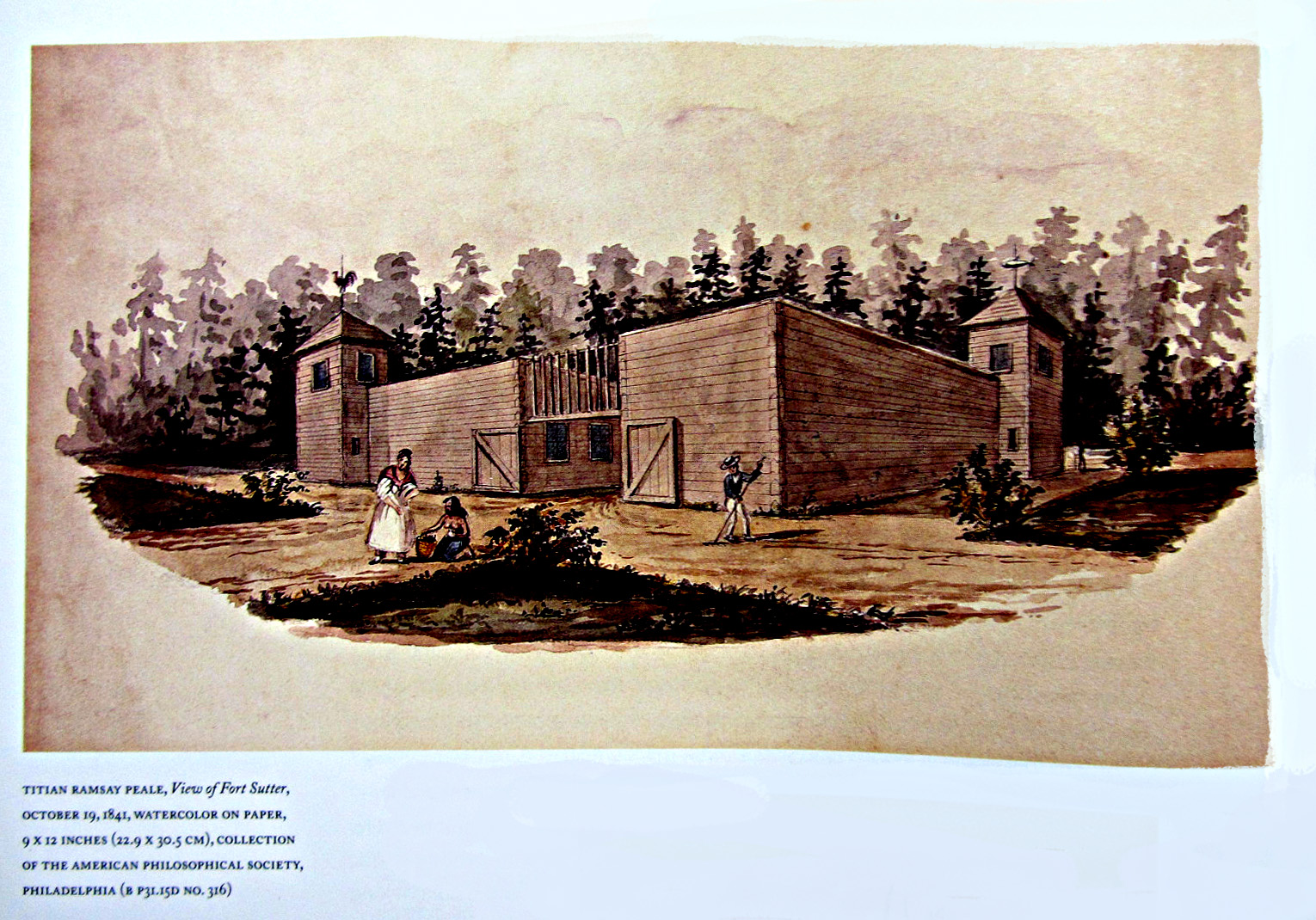
Here’s a puzzle for you. Is this an early sketch of Sutter’s Fort?
It looks kind of like Sutter’s Fort, but not big enough. It’s captioned “View of Fort Sutter.” But is that really what it is?
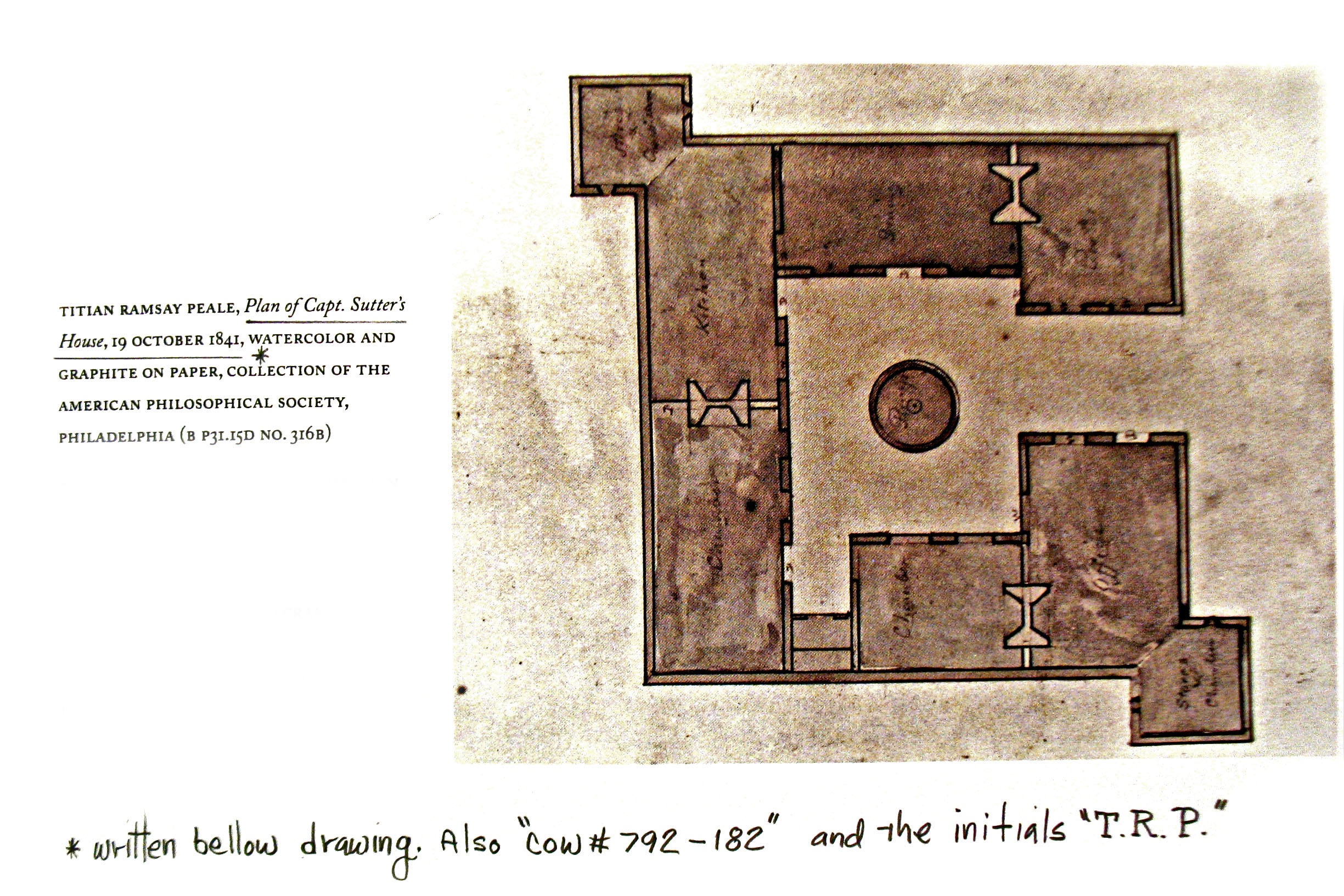
I had never seen this picture before. A couple of weeks ago I had a pleasant conversation with a gentleman at the Tehama County Museum History Rendezvous, who asked if I knew anything about it. I didn’t. He kindly shared these pictures with me.
The two drawings are by Titian Ramsey Peale, an artist who accompanied the U.S. Exploratory Expedition (also know as the Wilkes Expedition) on its round-the-world tour from 1838-1842. Titian Peale was the son of American polymath painter Charles Wilson Peale. (I love it that Peale named his sons Raphaelle, Rembrandt, Rubens and Titian, after his favorite artists, although I do not recommend that anyone name their son Titian today.)
In the fall of 1841, as the Wilkes Expedition explored San Francisco Bay, Captain Ringgold took some men into the Sacramento Valley. They explored the Sacramento River as far north as the Feather River and visited with John Sutter at his settlement of New Helvetia. The date on these two sketches is October 19, 1841. Is this what Sutter’s Fort looked like at that date?
Probably not. Captain Sutter was in negotiations to acquire Fort Ross. He had need of anything and everything he could get from the Russians: lumber, nails, fittings, tools, agricultural equipment, weapons, livestock, boats — everything. With all that, he told Peale and Ringgold, he planned to build himself a fort.
Why did he need a fort? John Bidwell, who arrived just a month later in mid-November 1841, later stated that Sutter felt threatened by the Mexican-Californians, who had begun to sense that they didn’t need a foreigner in their midst who was gathering other foreigners around him. As Bidwell said, “These threats were made before he had begun the fort, much less built it, and Sutter felt insecure.”
Titian Peale wrote in his journal that Sutter met the expedition and “conducted us to his house.” He says that Sutter “is now building extensive corrals and houses of adobes.” But nothing about a fort.
You can imagine Sutter, hospitable and expansive, telling his visitors about his grand plans to acquire Fort Ross and all its accoutrements, and then build a fort that would secure his position in the heart of California. Peale in response creates a picture of what that fort might look like, with its bastions that resemble those at Fort Ross. “Yes,” says Sutter, “that’s just what I need, except I will make it even bigger and better.” And so he did.
It’s only my conjecture, but it fits what we know of Sutter’s early situation and of the explorers who visited him in 1841. If you are interested in learning more about the Wilkes Expedition, you can read Sea of Glory, America’s Voyage of Discovery: The U.S. Exploring Expedition, 1838–1842 by Nathaniel Philbrick (New York: Viking, 2003). It’s a fascinating tale of exploration from the Americas to Antarctica to the islands of the South Pacific, although the account is skimpy when it comes to the expedition in California. If you really want to get into it, the Smithsonian has made Wilkes’s own account (all five volumes) available online. California is in volume 5.
I am just back from a trip to Chicago and Wisconsin to visit with some of my family. Here’s a picture of my two college girls on an architectural boat tour of Chicago. Nothing beats spending time with grandkids.
On Saturday I will be at the History Keepers and Seekers Rendezvous at the Tehama County Museum, in the town of Tehama, just west of Los Molinos. It’s a fun event with something for every history buff, from spinning and weaving, to flint-knapping, to antique cars and trucks. Live music! Great raffle prizes! Don’t miss it.
I’ll be at the Dairyville Orchard Festival too, on Saturday October 21st. More music, plenty of yummy food, and artisans from around the North State.
On Tuesday, September 26th I’ll be speaking about local history to the Durham Rotary Club. If you need a speaker for your group, let me know. I love sharing history.
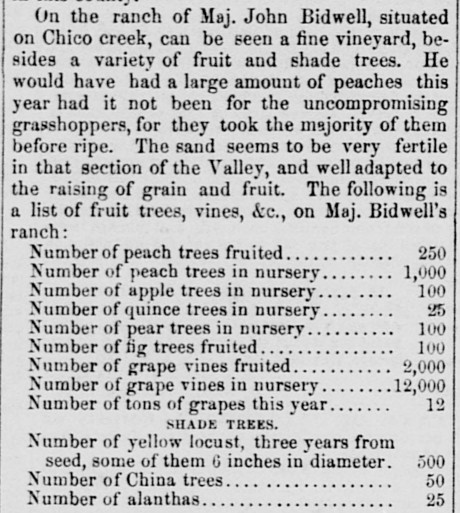
John Bidwell wanted Rancho Chico to be more than a wheat and cattle ranch. He foresaw that California could be “one grand fruit orchard”, and he would start on his ranch.
This newspaper report from 1855, only six years after he bought Rancho Chico, shows just how quickly he set to work to realize his vision.
Sacramento Daily Union 22 October 1855
Luckily we don’t have grasshoppers to destroy our fruit crops nowadays.
Bidwell set out his first peach trees in 1852, with a variety of peach pits obtained from Boston that produced good peaches from seed, without grafting. Three years later he had 250 peach trees with fruit, and a thousand more saplings in his nursery. His friend Nelson Blake, who had helped to plant the first trees, wrote in 1853:
How do the Peach trees look that Mr. Barber and myself set out? and the Onions we sowed? Have any of the Apple seeds that I sowed come up this last spring or the Pear or Quinces?
It looks like the apples, pears, and quinces were doing fine by 1855. The figs had been obtained from Mission San Jose in 1851, and were also thriving.
He also got his grapevines from missions and they were doing well. Later he would rip out the wine grapes and switch to raisins and table grapes.
By 1857 many farmers had followed Bidwell’s lead and were growing fine crops of tree fruit.
Of peaches, this season, the variety is extensive, and the quantity produced enormous. Some of the specimens from Smith’s, Hooker’s, &c, &c, near the city, are splendid, but the handsomest specimens of peaches we have seen this year were 1 dozen from the orchard of Major John Bidwell, of Chico, Butte county. They were sent to a friend in this city. His crop this year is reported to be very large. His trees are large and fine, and, strange to say, are all seedlings. [That is, the trees were raised from peach seeds.]
Sacramento Daily Union 5 August 1857
As for the shade trees, locust trees were what Bidwell first planted along the Esplanade. Later they were torn out and replaced with less messy street trees. “China trees” are probably chinaberry trees, a popular ornamental, and “alanthas” must be ailanthus, also known as “tree of heaven.” That tree was first brought to the United States from China in 1874. It was a popular fast-growing garden exotic in the nineteenth century. Now it pops up everywhere and is considered a noxious weed and an invasive species. I guess we have John Bidwell to thank for the ailanthus trees in Chico.
It’s not too late to make your plans for summer travel by stagecoach. Go from Sacramento to Shasta City in Thirty Hours! Leaves Sacramento promptly at 6 a.m. and gets you to Shasta at noon the next day. Nothing said about an overnight stay anywhere, but if you need to break up your trip, you can probably stop at any of these stations. Major Bidwell can accommodate you at Bidwell’s Ranch. Mrs. Evoy has a nice hotel at Briggsville, a town listed on the route.
Sacramento Daily Union 1 July 1853
Here is Hall & Crandall’s ad from the other end of the route, in Shasta City. Travel in the best and swiftest style with American horses and “the most superb Concord Coaches.” The drivers “are all experienced in their business, and are temperate and responsible men.” They will get you to Sacramento in time to take a steamer to San Francisco. Rest assured you will be in good hands.
In April 1868 the editor of the Marysville Daily Appeal reported on a visit to “The Town of Chico,” situated on the ranch of General Bidwell and “on the living waters of Chico Creek.” He found it to be a busy place, with “twelve to fifteen stores, several hotels, livery stables, blacksmith shops, carpenter shops” and everything that could be found in any thriving town in the state. (It also had “innumerable whiskey shops” but he doesn’t mention that in this glowing report. That turns up in another article later that year.)
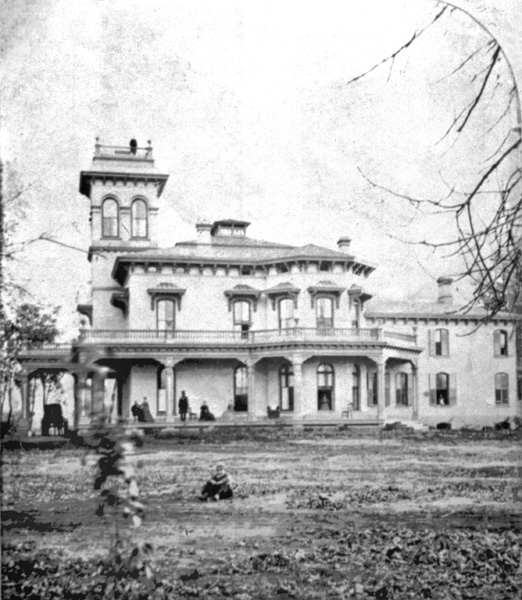
Bidwell Mansion ca 1870
He was given a tour of Bidwell Mansion by Mr. P. M. Craig, the carpenter foreman. (General Bidwell was not at home — he was in Washington, busy getting married.) He saw every feature of the mansion, “from base to dome.” He enjoyed the scene from the tower, viewing the ranch spread out before him, with the Sierras to the east, the Coast Range to the west and “to the south the famous Sutter Buttes — the Sphinx of California.”
The superficial measurement [the perimeter] is nearly 8000 ft. upon which the building stands, including the verandah, surrounding the entire building and observatory, which fronts the main wall, and is 65 ft. high. The basement is abundantly capacious. The first story is 14 feet, the second, 12 and attic 11 in height, containing in the aggregate 54 rooms, including closets and bathrooms.
It is furnished with a well in the basement which supplies a large cistern in the upper part of the building, from which every room is abundantly furnished with pure, soft water. The walls are 2 feet thick with a 6-inch opening in the center [for insulation]; neatly stuccoed on the outside with the best hard white finish on the inside.
Marysville Daily Appeal 25 April 1868
The house boasted “every modern improvement of the modern age.” It was truly a state-of-the-art building, and the finest house north of Sacramento.
“The cost of this magnificent residence is estimated to between fifty and seventy-five thousand dollars.” Readers would have gasped at those figures. According to the website Measuring Worth, $50,000 spent on a purchase in 1868 is equivalent to $1,107.071 in today’s dollars, and the same amount spent on a construction project is a whopping $18,449,419! Eighteen million dollars to build the equal of Bidwell Mansion today.
Chico had over 400 registered voters (men only, of course), and a population “equal in number to an average of one half the smaller counties in the State.” All in all, he concluded
It is one of the most inviting places in the interior for settlement.
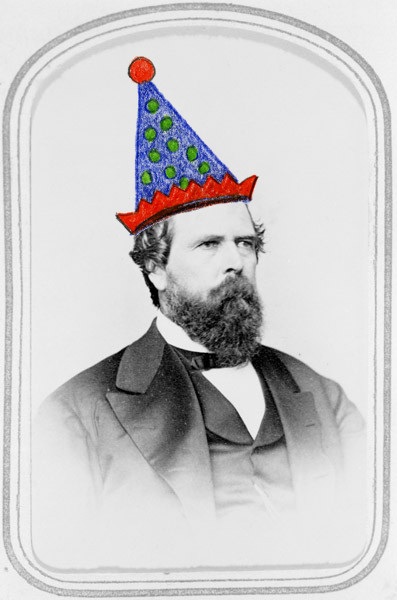
Happy Birthday to California pioneer and Chico founder John Bidwell!
John Bidwell was born on August 5, 1819 in Chautauqua County, New York, near the shores of Lake Erie, 204 years ago.
Bidwell rarely noted his birthday in his daily diary, but in 1898 he wrote: BIRTHDAY (79th) – Florence had an extra good dinner. He was at Butte Meadows, having spent the week camping out and working with a crew on the Humboldt Wagon Road. That day, August 5th, he wrote:
New grade round Beartrap hill – Started to work there at 6.l0 a.m. – returned at 6 l/2 p.m. finished clearing the gradeway + wife with me all day.
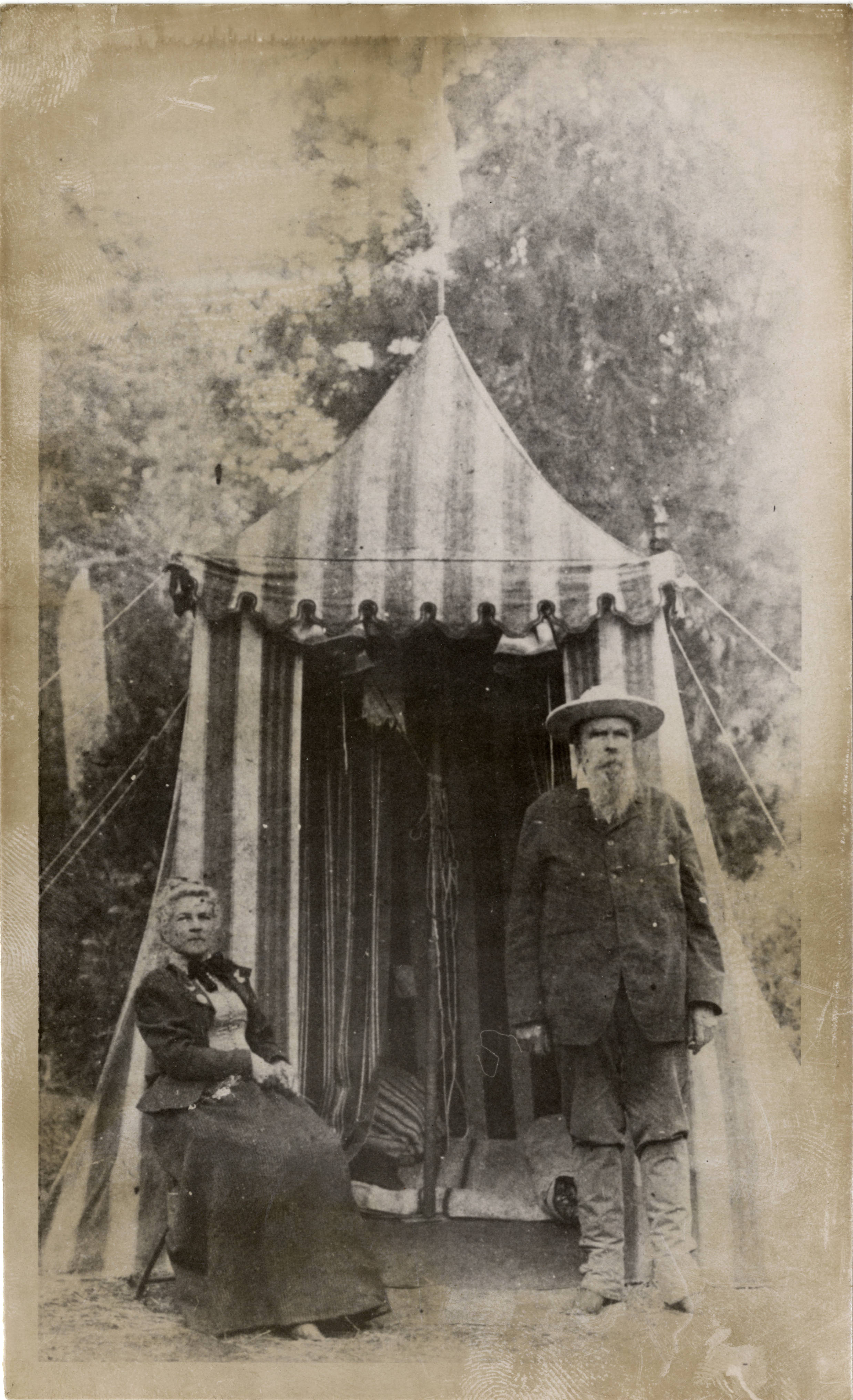
Bidwell was no slacker and he loved road-building. To him a twelve-hour day spent “clearing the gradeway” was a fine way to spend his birthday. He surely deserved that “extra good dinner” that Florence the cook produced. After dinner, John and Annie retired to their little old camping tent.
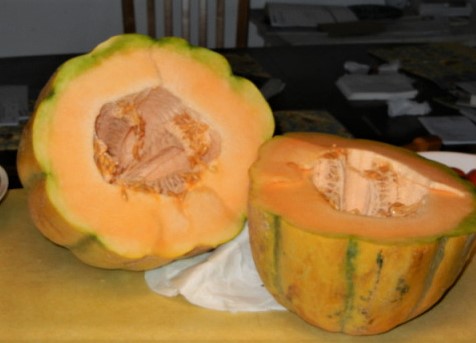
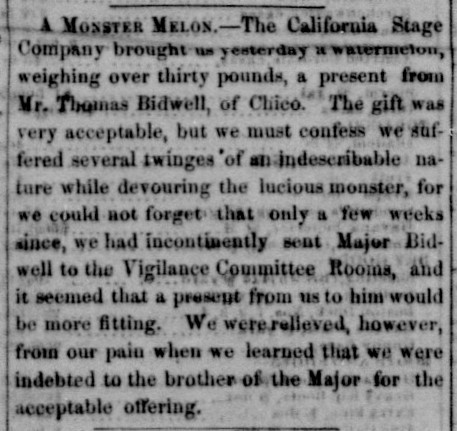
On August 1st, 1856, The Marysville Daily Herald published their thanks for the gift of a 30-pound watermelon, sent by Thomas Bidwell, younger brother of Major John Bidwell.
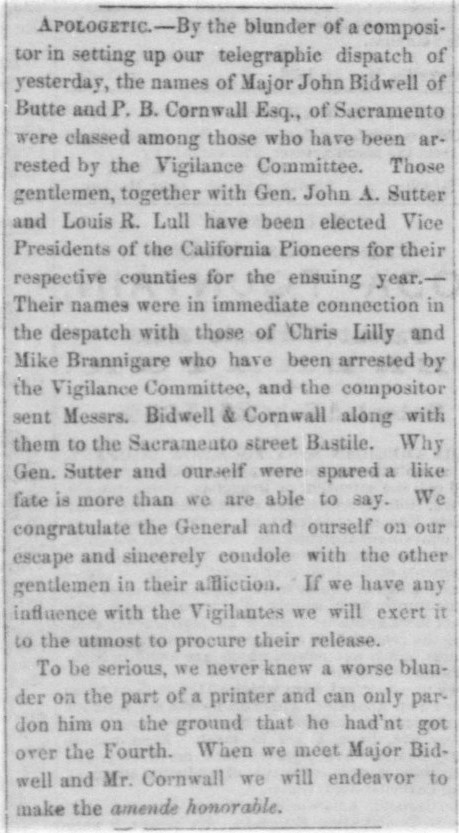
Why were they honored with such a hefty and delicious gift? It seems to have been a case of “no hard feelings.” When the Herald published the news from San Francisco, the compositor had mixed up two stories and put the names of John Bidwell and P.B. Cornwall down as men arrested by the Vigilance Committee, when instead they had been elected to the governing board of the Society of California Pioneers.
Marysville Daily Herald 9 July 1856
It looks like Major Bidwell has been consorting with bad company.
The editor of the Herald, Louis R. Lull (also an SCP board member) promptly apologized. Why he and General Sutter hadn’t likewise been “arrested” he couldn’t say, but he condoled “the other gentlemen in their affliction” and promised that “If we have any influence with the Vigilantes we will exert it to the utmost to secure their release.”
Marysville Daily Herald 10 July 1856
I imagine John Bidwell got a laugh out of the mix-up and told his brother to ship one of their best melons to editor Lull.










 goldfields