Wandering around the Sierras

It was getting late in October, the Bidwell-Bartleson Party had run out of food, and they were still making their way down the canyons of the western side of the Sierra Nevada. On October 23, 1841, John Bidwell set off on his own to hunt for game, which was “exceedingly scarce.”

You would think that Bidwell would take someone else with him, but he doesn’t seem to have heard of the buddy system. His idea was to range ahead of the party looking for game to shoot, then rejoin them further down the trail. He didn’t find any game, he got himself lost in the steep and rocky canyons, and wound up spending the night in a strange and fantastic landscape.

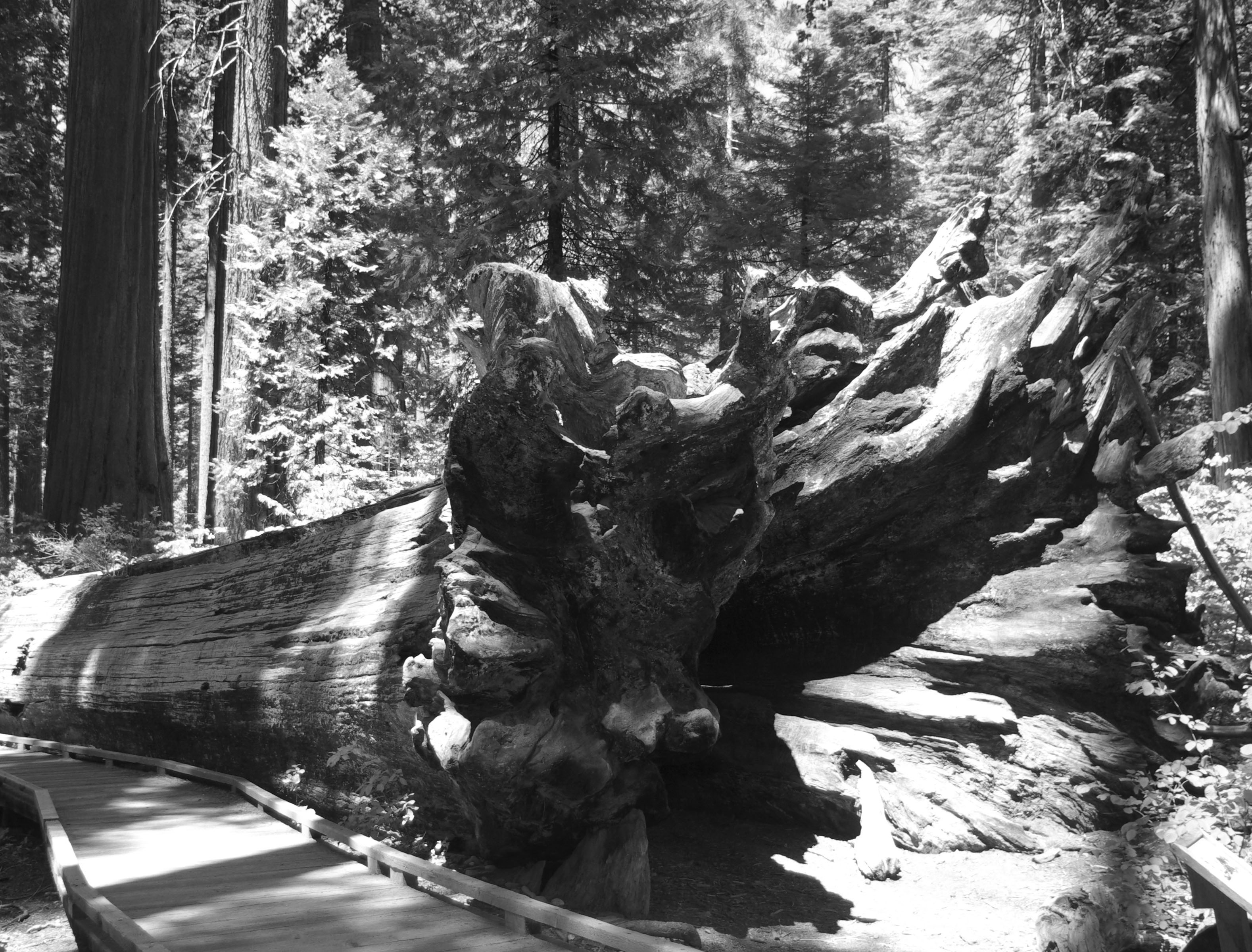
“Just at dark I came to an enormous fallen tree and tried to go around the top, but the place was too brushy, so I went around the butt, which seemed to me to be about twenty or twenty-five feet above my head. This I suppose to have been one of the fallen trees in the Calaveras Grove of Sequoia gigantea or mammoth trees, as I have since been there, and to my own satisfaction identified the lay of the land and the tree. Hence I concluded that I must have been the first white man who ever saw the Sequoia gigantea, of which I told Fremont when he came to California in 1844.” (Echoes of the Past)

Image

“The Father of the Forest,” the tree where John Bidwell sheltered in 1841. Picture taken in 2010. The roots are now much worn down compared to when Bidwell saw them.

Bidwell always considered himself the first white man to lay eyes on the giant sequoias, and many years later he proudly showed Annie the grove where he had spent a cold and sleepless night. The discovery of the grove is usually credited to Augustus Dowd in 1852, and he certainly publicized it, but Bidwell and others had stumbled across these giants of the forest before he did:  J.K. Leonard recorded seeing the trees in 1833 and Joseph Walker in 1834. Neither of their writings were available to Bidwell, so he was justified in thinking that he was the first American (other than the natives) to see these wonders.

Posted in Uncategorized | Leave a comment

Bidwell’s Address to the Society of California Pioneers

One of my favorite sources for information on John Bidwell is his 1897 address to the Society of California Pioneers. The Society was limited to those who had come to California before the end of 1849. Plenty of 49er’s joined, but there were not very many who could claim to have come earlier than John Bidwell.
 
In his speech to the Society members he describes California as he saw it under Mexican rule, in the era of ranchos and missions. Then he goes on to talk about the “foreigners” in California.
 
When I came to California there were very few foreigners here. By foreigners I mean Americans, English, Scotch, Irish, etc. in other words, all not Californian or Mexican born, the people here called foreigners.
 
And then he lists all the foreigners he knew, beginning at San Diego, and working his way up the state to Sonoma and Napa. He remembers all their names! He lists about 100 men (no women), and then allows that there might have been a few more, runaway seamen and the like, that he didn’t know, for a total of about 150 residents who were not Californios. In stating this number he is disputing other estimates that he considers exaggerated.
 
One hundred and fifty “autobiographies and reminiscences” recorded by the Society of California Pioneers are available at the Online Archive of California, including Bidwell’s address. Fascinating reading!


Posted in Uncategorized | Leave a comment

Cresting the Sierras

Sonora Pass, in the area where the Bidwell-Barleson Party crossed the Sierra Nevada.

The view from up there. Sonora Pass, in the area where the Bidwell-Bartleson Party crossed the Sierra Nevada.

The Bidwell-Bartleson Party climbed up narrow canyons on the eastern slopes of the Sierra Nevada, following streams and seeking grass for their mounts. Some were on horses or mules, others were on foot. On October 18th they crested the mountains, and John Bidwell wrote:

“Monday, 18th. Having ascended a about half a mile, a frightful prospect opened before us–naked mountains whose summits still retained the snows perhaps of a thousand years, for it had withstood the heat of a long dry summer, and ceased to melt for the season. The winds roared–but in the deep dark gulfs which yawned on every side, profound solitude seemed to reign. We wound along among the peaks in such a manner as to avoid most of the mountains which we had expected to climb–struck a small stream descending toward the West, on which we encamped, having come 15 miles.”

According to Michael Gillis, the “small stream” that they camped by was Clark’s Fork, which flows into the Middle Fork of the Stanislaus River. They didn’t know how far they had to go yet, but at least they were headed downstream. Considering that they were crossing the mountains without a guide, a map, or even a compass, they were doing pretty well.

Michael J. Gillis traced this journey in his article for the Overland Journal entitled “The 1841 Trans-Sierra Route of the Bidwell-Bartleson Party.” On the 18th he says that the group was climbing up Golden Canyon, and crested the Sierra Nevada at an elevation of 9,425 feet. The article isn’t available online, but I have a photocopy.

“In only four days, thanks to good weather, good luck and some savvy scouting, the Bidwell-Bartleson Party had made its way to the west side of the Sierra Nevada.” The worst of their journey was behind them, but before them they only saw an unending vista of snow-capped mountains, and they had no idea how far they still had to go. They didn’t even know that they had arrived in California. Another two weeks of struggle lay ahead of them before they reached the valley.

Posted in Uncategorized | Leave a comment

October 14, 1841

I’ll be signing books at the Chico Library Fall Festival this Saturday from 11 a.m. to 12:30 p.m. If anyone would like a copy of either John Bidwell or my new book The Miner Poet, or if you just want to chat about California history, please stop by and say “Hi!”

And where was John Bidwell on this date in 1841?

The Bidwell-Bartleson Party, minus Bartleson and his friends, was heading up the Walker River. A week earlier the erstwhile leader of the company, John Bartleson, with seven  of his friends had taken off on their mules, abandoning the rest of the group. There had been friction in the company, as you can imagine given their perilous situation, and Bartleson decided to push on ahead. They took all the meat from a freshly-slaughtered ox with them.

His words as they left were, “Now we have been found fault with long enough, and we are going to California. If you can keep up with us, all right; if you cannot, you may go to hell!”

Captain Bartleson’s words still rang in John Bidwell’s mind when he wrote about the incident 48 years later.  (Although Bidwell, mindful of the readership of The Century Magazine, put in a dash— for the word “hell.” I imagine that’s what the man said.)

Then on the 14th they came back, dragging their tails behind them. As Bidwell recorded:

“Thursday, 14th. This morning we saw at a distance Capt. B. with his 7 men, coming in a direction towards us, but we made no halt, ascended the stream about 20 miles. The mountains continued to increase in height.”

Captain Bartleson was back, and out of food.  “We were glad to see them,” Bidwell later reported, “although they had deserted us. We ran out to meet them and shook hands, and put our frying pans on and gave them the best supper we could. . . He seemed heartily sick of his late experience, but that did not prevent him from leaving us twice after that.”

Posted in John Bartleson, Uncategorized | Leave a comment

On the trail in October 1841

Notice how the weather is getting cooler in October? We are currently enjoying lovely fall days, but the days are shorter and the nights are cooler. What if you were trying to get to California and hadn’t yet crossed the Sierras?  That could be dangerous, as the Donner Party would find out 5 years after the Bidwell-Bartleson Party.

On October 11th, 1841 the Bidwell-Bartleson Party was still crossing Nevada. They followed the Humboldt River (they called it Mary’s River) to the Carson Sink, where the river disappeared into swamp and sand. Then they struck westward and reached the Walker River (which they mistook for the San Joaquin.) Here is John Bidwell’s journal entry for October 11, 1841:

Monday, 11th. Left the lake this morning going into the mountains on a S.W. course. Today we left the trail of Capt. B. and having traveled 19 miles, arrived on a stream which flowed rapidly, and afforded more water than Mary’s river. We thought now, without doubt, that we were safe on the waters of the St. Joaquin (pronounced St. Wawkeen) according to Marsh’s letter. Here grew willows, balm Gilead, and a few cottonwoods.”

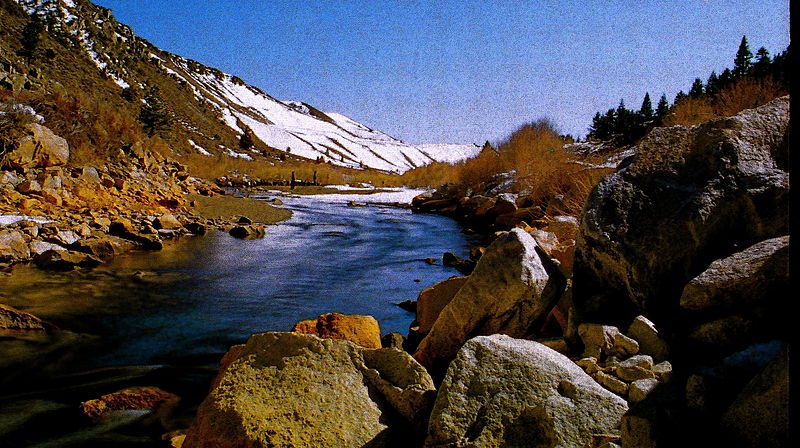
walkerriverThe Walker River made a good route up into the mountains, although future travelers on the California Trail would not travel this far south. In following the Humboldt Bidwell & Co. had missed the few miles of dry country that would have taken them to the Truckee River.

They still had three weeks of hard traveling ahead of them.

Posted in Uncategorized | Leave a comment

On the California Trail, 1850—Traveling in Comfort

I have been reading Covered Wagon Women: Diaries and Letters from the Western Trails, 1850. This is the second volume in an eleven volume series devoted to women’s journals of the westward movement.

I am quite intrigued with the journal of Margaret Frink, who with her husband Ledyard decided to journey to California in 1850. They were a childless couple living a pleasant and prosperous life in Martinsville, Indiana. News of “the delightful climate and abundance of gold” in California gave them the notion to set out, although no one else they knew from their region was going.

The first order of business was to have a suitable wagon built for the journey. Margaret Frink goes into detail on the fitting out of the wagon:

The wagon was built expressly for the trip, it being built light, with everything planned for convenience. It was so arranged that, when closed up, it could be used as out bedroom. The bottom was divided off into little compartments or cupboards. After putting in our provisions and other baggage, a floor was constructed over all, on which out mattress was laid. We had an India-rubber mattress that could be filled with either air or water, making a very comfortable bed. During the day we could empty the air out, so that it took up but little room.

Who knew that folks had air mattresses and water beds in 1850? I didn’t. Margaret Frink was using an air mattress that had to be blown up by hand with air from human lungs, just like a camping trip from my youth, before they had electrical pumps built into air mattresses.

But it turns out that India rubber was all the rage in the early 19th century, when rubber started being used to make galoshes and other water-proof items. And when Charles Goodyear in the U.S. and Thomas Hancock in England simultaneously discovered vulcanization in 1843, the industry took off like a rocket, and all kinds of wonderful, flexible, water-proof items began appearing, including Margaret Frink’s India rubber air mattress.

Posted in Uncategorized | Leave a comment

Questions for Teachers’ Examination 1889

2. A druggist buys quinine at $5 a pound avoirdupois and retails it at 10 cents a dram apothecaries’ weight. What per cent profit does he make?

Stumped? Then you probably wouldn’t qualify as a teacher in 1889. This is the second question (the first was hard to make out in the photocopy) of Questions for Teachers’ Examination published in the Oroville Register in June 1889. There is no indication of how or when or where the exam was to be given; the article is simply a list of questions with no answers. I assume that the questions were published as a study guide for prospective teachers.

If you think that question from the Arithmetic section is too difficult, maybe one of the Mental Arithmetic questions will be easier. After all, you are supposed to be able to do this one in your head.

1. 10 1/2 is what percent of 12? (I was never good at percentages. Let’s try another one.) 4.  Sold a horse for $90 and lost 25 per cent, what should he have been sold for to gain 25 per cent? (Hmmm . . .  more percentages. Let’s try something else.)

Grammar. 1. Construct sentences using “for” as a conjunction, “but” as a preposition, “that” as a relative pronoun, “what” as an adjective, and “only” as an adverb. (Hey, I think I can do this one!)  2. Give sentences containing clauses used; 1st, as the antecedent of a pronoun; 2nd, as the object of a preposition; 3rd, as an attribute; 4th, in opposition; 5th, as the subject of a sentence.  (Yikes! let’s try the next section.)

Geography. 1. Define physical, political, and mathematical geography. Name the lines on the earth that are the limit of the sun’s vertical rays. (Not sure about mathematical geography, but I’m pretty sure that the lines are the Tropics of Cancer and Capricorn.)  6. What articles do we export to South America? What imports do we get from there?

U.S. History. 1. Relate the causes which led to the settlement of Virginia, Georgia, Massachusetts, Pennsylvania, and Rhode Island. 4. Locate and state of what historical interest is each of the following: West Point, Coloma, Fanueil Hall, Mt. Vernon, St. Augustine?  (I think I could do a pretty fair job at this. In fact, so far U.S. History is my best subject in this exam.)

Physiology. 1. Describe the greater and lesser circulation of the blood. (Okay, as long as you don’t want all the correct terminology.)

Theory and Practice (of Education). 1. Write a program for use in a country school of twenty pupils of mixed grades. (You are preparing to be a teacher of everything to everyone.)  5. What steps would you take to awaken a desire for knowledge outside of the textbooks? (Good question!)

Composition and Penmanship. Six topics for a one-page essay are given, including “A Fishing Trip,” “The Story of a Five-Dollar Piece,”, and “Our Country.”

Book-keeping. 1. Give the use of the following terms: sundries, inventory, account, assets, stock. (I wouldn’t do well in this section, but I might be able to muddle through.)

Orthography. That means spelling. A list of 50 tricky words is given that the candidate should be able to spell, such as accessory, vermilion, trafficking, thralldom, complaisance, and Tuolumne.

Vocal Music. (Yes, the teacher is expected to teach the children to sing.) 1. What is singing. What is a tone? How is the length of tones indicated in music?

Word Analysis. 2. Define each of the following and name and define a derivative formed from each: logos, demos, cratos, philos, bios. (It’s all Greek to me, but I think I could do this one.) 5. Give the derivation of the following: tantalize, good-bye, husband, calculate, boycott, daisy, guillotine, dahlia, capricious, agriculture. (I like word origins; I could get most of these.)

Entomology. 1. Describe the metamorphosis of the silkworm moth. 2. Describe some common representatives of Orthoptera, Coleoptera. (Hmmm . . . it’s getting harder. Got to get out the bug book.)

Industrial Drawing.  1. Using nothing but straight lines, draw a tea pot, a table, a chair. (That’s going to be one angular teapot.)

Natural Philosophy. (That’s Physics to you.) 1. Define “atmospheric pressure”; the different kinds of levers. State upon what principle an artesian well acts. 8. How was the velocity of light determined? What is its velocity? (Oops. I’d have to read up on that.)

Algebra. 1. State the difference between a co-efficient and an exponent. Between a factor and a term. (This is followed by a bunch of algebra problems and I am in trouble again.)

Rhetoric. 1. What is rhetoric? State its relation to grammar.

Constitution and School Law.  1. How may a bill in Congress become a law without the President’s signature? In whom is the judicial authority of the United States vested? For what term of office? (And other questions about civics and government.) 2. Define suffrage. Who are entitled to vote in California? (Not female school teachers who could pass an exam like this and handle 30 students of all ages in a one-room schoolhouse, but were not considered competent to vote in 1889.)

Natural History.  1. Define perianth, ovary, cotyledon, endogen, tuber. 4. To what sub-kingdom and class does each of the following belong: whale, frog, spider, horse, alligator. (Brush up your biology!)

So there you have it: a few sample questions for graduates of the Chico Normal School who plan to teach in Oroville, Gridley, Bald Rock, Concow, Nimshew, or any of the other little schools scattered around Butte County. How do you measure up to a schoolteacher of 1889?

Posted in Education | Leave a comment

John Bidwell and Pres Longley

The book on Pres Longley, edited by John Rudderow and myself, is out! If you are interested in The Miner Poet: Poems of Pres Longley, it is available at Lyon Books, Paradise Coin and Gift, Bidwell Mansion, and from the editors. Just contact us at theminerpoet@gmail.com.

Pres Longley, the poet of Helltown and the bard of Butte, was well-known in Butte County for his verse, which appeared in the local papers. He knew John Bidwell pretty well. I went looking through John Bidwell’s diary to find out when he first mentions Pres.

In 1877 Bidwell was involved in building a fair pavilion in Chico for the County Fair. He was always a great supporter of agricultural fairs. Pres wasn’t much involved with agriculture, but he did like fairs, and he was in town for this one.

Bidwell’s journal entries are brief, but he always listed whoever had called on him that day. On Saturday September 28 Bidwell lists Longley as one of his callers. The fair was due to open on Monday, but because of rainy weather, it was delayed until the following day, October 1, when Bidwell notes: Fair: opened in the Pavilion – Pres. Longley [Butte Creek miner noted for his poetry on local subjects] delivered the poem.

If you needed a poem for the opening of a Fair, or a Fourth of July celebration, or any other notable occasion, Pres Longley was the man to provide the verse. Among the remarks and orations there was always a place for a poem to commemorate the event. Whether his lines were recorded and preserved I do not know, but I suspect they were not, or else John Rudderow would have found them.

Posted in Uncategorized | Leave a comment

Anvil Firing

I have learned a lot about old times in California as I have worked on editing this book on Pres Longley, the miner poet. Yesterday John Rudderow, the instigator of this project, told me about the old custom of “firing the anvil” on the 4th of July.anvil

Want to make a lot of noise and don’t have a cannon? Not to worry, you can have the same level of excitement and racket with a couple of anvils and some black powder. Every town had at least one blacksmith who had the necessary equipment, so it wasn’t hard to arrange.

(I don’t recommend trying this at home, even if you do happen to have an anvil. Could be dangerous.)

Take one anvil and turn it upside down. On the underside is a hollow about the size of a brick. Pour in some gunpowder and place a fuse or a trail of gunpowder. Then place the other anvil right side up on top. When you light off the gunpowder, you will get a terrific explosion and the top anvil will fly at least a hundred feet in the air. It will come down too, so clear the deck.

To see some anvil firing, go to YouTube or take a look at this one. Or go up to Weaverville on the 4th of July. It looks like they are still firing anvils at their celebration.

Posted in Uncategorized | 1 Comment

Pres Longley, the Bard of Butte

I have a new project that I’ve been working on for the past month or so, and I am hoping it will be a book soon. I am helping to edit a book of poems by Pres Longley, the poet of Helltown, the Bard of Butte, friend of John Bidwell, resident of Butte Creek Canyon, a miner poet.

Alexander Preston Longley came to California with his brother in 1852 after spending two years fighting Comanches with the Texas Rangers. He prospected here and there in Northern California, finally settling in 1866 at Boneyard Flat near Butte Creek. For sixty years he wrote poems about life in California: verse about his miner friends, tributes to pretty girls, eulogies of dearly departed pets, patriotic poems, humorous pieces, comments on the passing scene.

I think you will like getting to know Pres Longley and reading his verse. Here is a small sample:

You may wrangle and rave of your Marysville girls,

     Of the girls of the Capital City,

Of the ‘Frisco girls, with their fads and their curls,

     But the Butte Creek girls are most pretty;

Their smiles are far dearer to me than the gold

     That the millionaire hides in his coffers,

And I hope, ‘ere the days of this leap year are told,

     Some dear one will make me an offer.

Posted in Uncategorized | Leave a comment