The Days of ’49

“The days of old, the days of gold, the days of ’49” live on in California. There’s a reason it is called the Golden State, and the San Francisco football team is called the Forty-Niners. Those Gold Rush years left their mark. That was the year that brought men pouring into the state, all of them intent on making a fortune, and making it fast.

Who were these men? (and most of them were men). The majority were immigrants from the United States, coming by ship from the Eastern seaboard, or overland from the interior. But men from nearly every part of the globe hustled to California.

In a letter to a young lady friend, John Bidwell described the people he met in the diggings. “There’s nothing here to please the eye or gladden the heart but Gold. The Yankee, the Mexican, the Spaniard, Portuguese, Chinese, Malays, New Zealanders, Sandwich Islands [Hawaiians], Chillanians [Chileans], Peruvians, besides various tribes of Indians, tame and wild.”
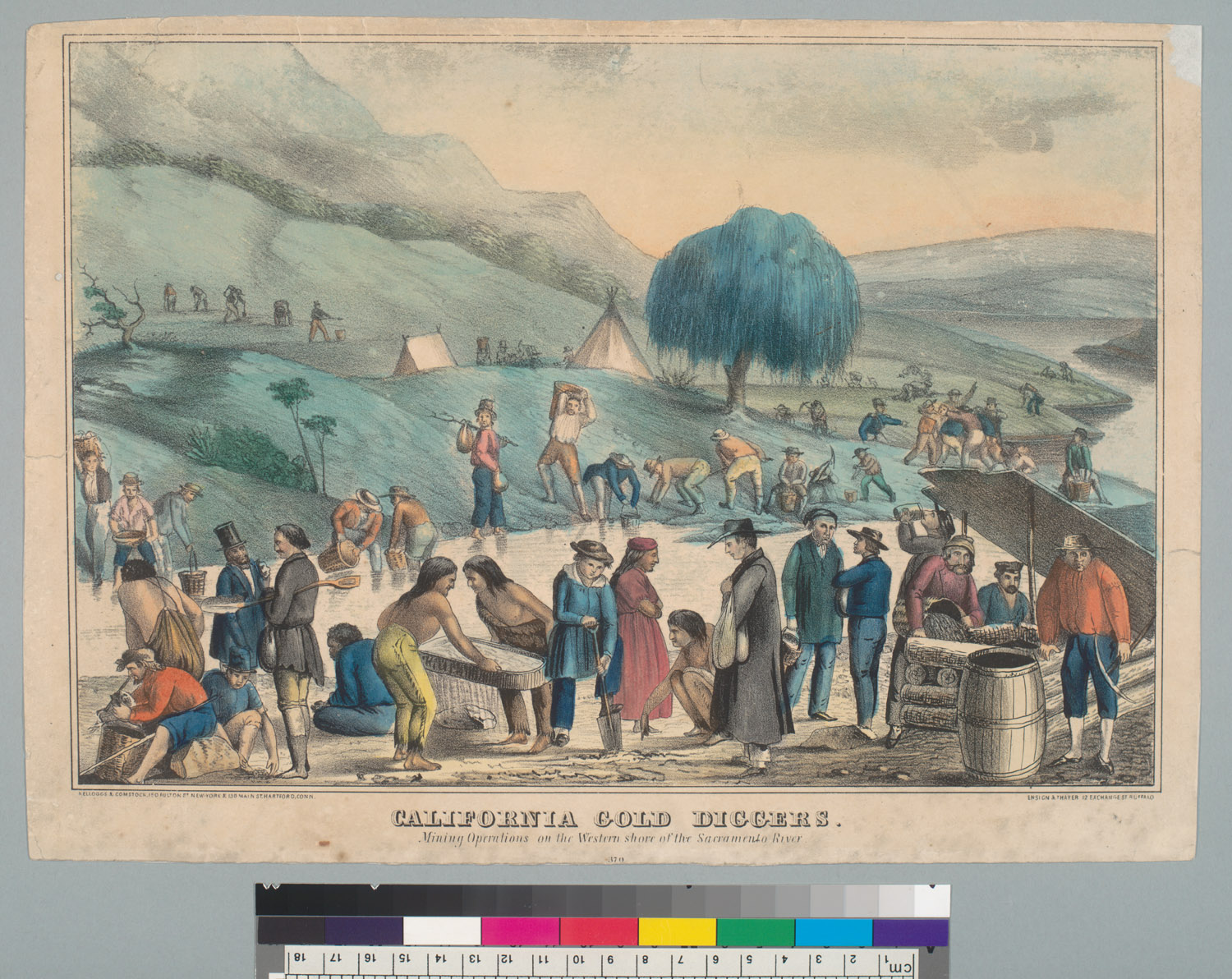
An image from the Bancroft Library depicting miners in all their human variety.

Before the Gold Rush there were maybe 26,000 residents of California, exclusive of the Indian population. Roughly half of these were Mexican-Californians, and the other half Americans and other foreigners (such as Johann Sutter the Swiss-German and Robert Livermore the Englishman.)  By the summer of ’49 the number had doubled, and that was before most Americans could get themselves to the gold fields.  Mexicans, other Central and South Americans, and Hawaiians were closer to hand. By the end of the year over 100,000 people had arrived, each one of them with the gleam of untold wealth in their eyes.

They came to a land devoid of any adequate system of government. A military governor was in charge, but there were no judges, no courts, no trial by jury. California was badly in need of a code of law and a civil government. It wasn’t long before the Argonauts were complaining and petitioning the governor to have the problem dealt with. Congress had done nothing to set up a Territorial government, so Gen. Riley figured he might as well get started on forming a state government. Given its unparalleled growth, California was going to be a state soon enough, so it might as well have a government ready.
Posted in Uncategorized | Leave a comment

The Wisdom of Minerva

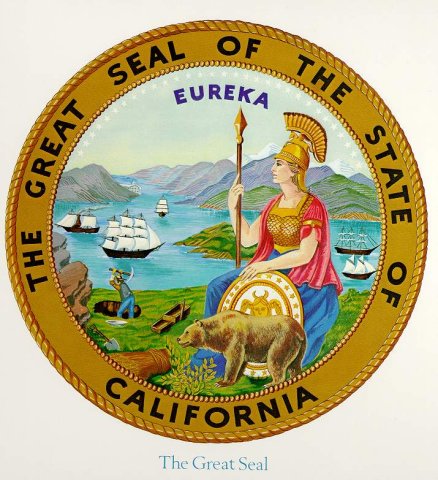
The Great Seal of California depicts Minerva, goddess of wisdom, seated, with a grizzly bear by her side.  Why Minerva?  Because Minerva (or Athena) sprung fully formed from the forehead of her father Jupiter (or Zeus). As explained by Caleb Lyons, the secretary of the state constitutional convention, “This is introduced as a type of the political birth of the State of California without having gone through the probation of a Territory.”

California did not follow the usual path to statehood: designation as a Territory by Congress, then admission as a state. Only Congress could confer upon the region a Territorial government, and Congress failed to act. Events just moved too fast in California for Congress to keep up, and the state made the leap from conquered territory to statehood in record time.

When the war with Mexico concluded, California remained under military rule. Government was under a succession of military governors, Commodore Stockton, John C. Fremont, and General Stephen Kearney among them, although they squabbled among themselves as to who was in charge. Fremont refused to recognize Kearney’s authority and was court-martialed, convicted, and later pardoned.

The Treaty of Guadalupe Hidalgo, ratified in May 20, 1848, concluded the Mexican War and made California officially part of the United States. By this time gold had been discovered at Sutter’s Mill and soon the rush would be on. As men poured into California, the legal situation stood in confusion. Until a new government was formed, Mexican law was supposed to remain in force, but the Americans were not sure what the Mexican laws were, and it’s not clear if the old Californios knew much more.

Throughout 1848 Col. Richard B. Mason, the successor to Kearney as military authority, awaited word from Congress about a territorial government, but he waited in vain. Congress failed to act. By the time General Bennett Riley assumed command in April 1849, the region was rapidly filling up with gold-seekers, and still there was no civil government. It was time for Californians to take matters into their own hands.

Posted in Uncategorized | Leave a comment

Bidwell in the 1850’s

I haven’t been posting much lately; instead I’ve been trying to get a handle on California politics in the 1850’s. I realized, after I started writing about Bidwell in politics, that I didn’t really know much about politics and government in early California, other than what I knew from him. So I’ve been trying to fix that.

Bidwell himself didn’t write much about the 1850’s. He covered the 1840’s very thoroughly more than once, recounting his adventures on the California trail and his experiences during the Mexican War and the Gold Rush. Exciting stuff. But when it comes to his activities during the 1850’s there isn’t much to go on. He may have kept a journal, but if he did it is lost. His letters may be the best source for this period. Some day I’ll have to dig deeper in the California State Library and see what I can find.

During the 1850’s John Bidwell served as a senator in the first state legislature. He traveled to Washington, D.C., was present when President Fillmore put his signature to the act making California the 31st state of the Union, and brought the documents back to San Francisco. Even when not serving in the legislature, he was active in state politics as a delegate to party conventions.

He worked tirelessly at developing his ranch and promoted agriculture throughout the state. He welcomed travelers at his adobe home on the Shasta Road. As the man who had surveyed numerous land grants up and down the state, he testified in many court cases dealing with land titles. He wrestled with the difficult questions of how to treat and protect the native Californians, a people that most white settlers would be glad to help disappear. All in all, he was a very busy man during this period, but he didn’t leave much of a record.

Posted in Uncategorized | Leave a comment

Bidwell the Democrat

Somewhere in his writings, and I can’t find the reference, Bidwell says in his early career in California he was an “incorrigible Democrat.” When he left Missouri and came into California in 1841, a young man of 22, he naturally allied himself with the Democratic Party, the party of Andrew Jackson.  The Democrats were the party for the small farmer and the urban working man. Their opposition in the first half of the 19th century were the Whigs.

Later in his life he would become disaffected by the Democrats and change his allegiance, but during the 40’s and 50’s he would have voted Democrat, if he got a chance to vote in the back of beyond that was California.

I think this is the only photo that shows the first state capitol in San Jose. John Bidwell may be in the picture somewhere, but it is impossible to say which one he is.

The Democrats dominated California politics during the 1850’s. In the first state election on November 13, 1849 (although in reality California was not yet a state) John Bidwell was elected to the state senate, representing the Sacramento district. In December he went to San Jose and together with the rest of the new legislature began the process of building a state government.

We had to frame a code of laws, and our constitution was almost a literal copy of the constitution of New York. A few members who had been able to get copies of the statues of N.Y. introduced nearly all the bills, and they were almost literal transcriptions of the N.Y. laws.  . . . I was head of the committee on corporations, also on the committee of county boundaries. I was chosen for this because I had more knowledge of the counties than perhaps any one else there.

I wrote the first charter of the City of San Francisco, for which the newspapers gave me great credit, but I didn’t deserve the credit, because I had copied it almost entirely from the charter of St. Louis. There was nothing very remarkable in getting up the code of laws.

And so began Bidwell’s political career in California. There was one earlier event–in August 1849 he was elected to the state constitutional convention.  But he never got the word of his election until it was too late. He hadn’t campaigned for the position, and in the summertime he was up in the hills, mining for gold. By the time he found out that he had been selected by voters to help write the constitution, it was too late to take part.

Posted in Uncategorized | Leave a comment

John Bidwell in Politics

Here’s an interesting question: What political party did John Bidwell belong to?

The first answer that probably comes to mind is the Prohibition Party. Most people in Chico know that John Bidwell was the Prohibitionist candidate for U.S. president in 1892. (In case you didn’t know, he lost to Grover Cleveland.)  But the Prohibition Party wasn’t founded until 1869. What was John Bidwell before he was a Prohibitionist?

Democrat?  Republican?  Some obscure special interest third party?  How about all three?

Yes, indeed.  Good old steady John Bidwell was all of those, and might have become governor of California on any one of those political tickets. Who knew he was so fickle?

Not really fickle, but as politics in California and in the United States changed over the course of the 19th century, he changed too.  From “incorrigible” Democrat (as he described himself), to Republican, to Anti-Monopolist, to Prohibitionist (with a nudge from Annie), Bidwell served his state and pursued his ambitions. In subsequent entries during this election year I’ll explore Bidwell’s political career and we’ll see what kind of politician he was.

Posted in Uncategorized | Leave a comment

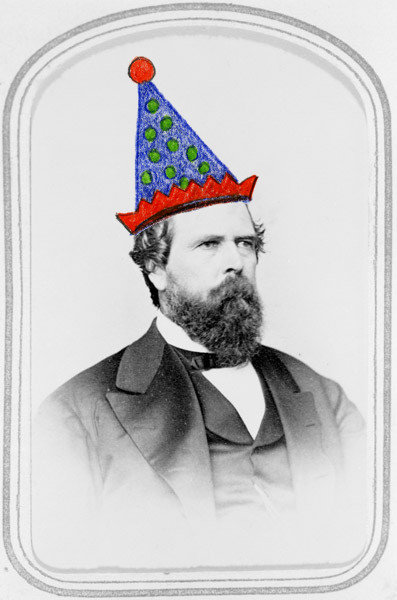
Happy Birthday, John Bidwell!

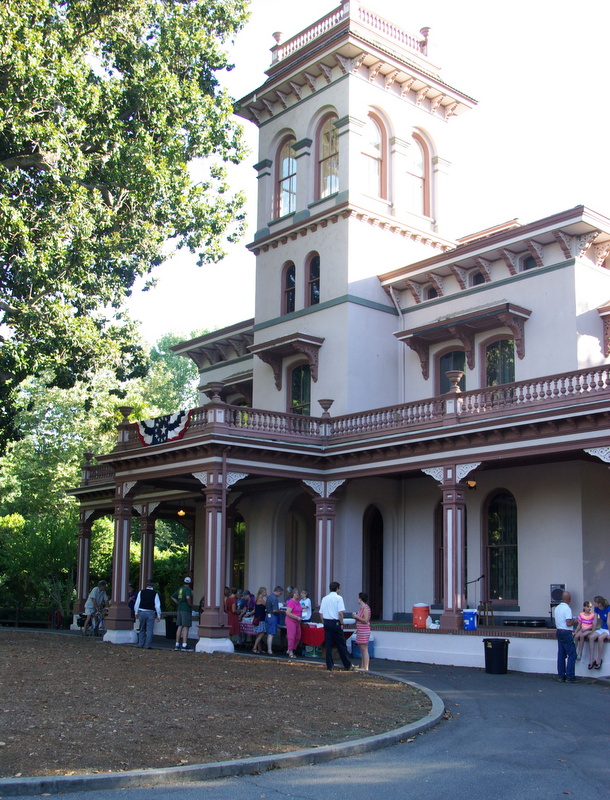
Today is the 193rd birthday of General John Bidwell.  He was born August 5, 1819, in Chautauqua County, New York.  The Bidwell Mansion Association celebrated his birthday at Bidwell Mansion with a community party this evening, and judging by the amount of cake eaten, we had over 150 attendees. 

Music was provided by the Chico Community Band and folksinger Don Sacks, who led us in a rendition of the Happy Birthday song.

Community participants included the Chico Cat Coalition, North State Symphony, Sounds of the Valley, Youth for Change, City of Chico Parks and Recreation, and the Chico Visual Arts Alliance.

Here’s hoping that John Bidwell sees many more happy birthday events!

Posted in Uncategorized | Leave a comment

Party Time!

An Invitation from the General:

Join my friends in celebrating my birthday on August 5, 2012 at my home, Bidwell Mansion. There will be cake, Shubert’s ice cream, music and fun. It’s been 193 years since I was born in Chautauqua County, New York, on August 5, 1819.

I am happy to see how well you have preserved the beautiful home that Annie and I shared.  I wish the citizens of Chico many more prosperous years, and hope you will enjoy the party given by my friends.

Posted in Uncategorized | Leave a comment

Major Bidwell in 1849

In 1849 Edward Washington McIlhaney of Virgina joined a company heading for the gold fields of California.  Arriving in the Sacramento Valley on the 1st of October, some members of the company set out northward to the Shasta Mines. McIlhany later gave this description of John Bidwell and his ranch.

A painting of Edward W. McIlhany, now in the Oakland Museum.

“We started up the river and finally reached Major Bidwell’s Ranch, one of the finest ranches in California. We found him a very intelligent, hospitable, and a fine-looking man. We remained several days at his ranch also, gaining a great deal of information. Bidwell gave us an account of his mining first in ’48 at a mining camp called Bidwell’s Bar, named after him, as he discovered the camp. . . . He told us that he thought we would be disappointed in the mines, but as we had started we would not be satisfied until we got there, not being very far from his place.  He advised us that if we were not satisfied there to go to Bidwell’s Bar, as it was very rich and was not worked out.

Mr. Bidwell owned thousands of acres of land gotten from a Mexican land grant. He had an Indian village not far from his residence built of adobe houses, trees set out in the village and ditches through the village to carry pure water from the mountains. Forty Indian men in this village worked for him in his mine by which he made a great deal of money.”

Edward Washington McIlhaney, Recollections of a ‘49er (2006), edited by Scott J. Lawson.

Posted in Uncategorized | Leave a comment

Bidwell’s Fourth of July

Here’s an entry from the General’s diary for July 4, 1877:

Fine cool pleasant day. = Callers: J.W. Gilkyson to excuse committee about calling on Bonte – Haley (Ed. Enterprise) to see Bonte – Mr. Ellis to dine – Rich to call on Bonte – Grand 4th July celebration – Rev. J.H.C. Bonte, orator, Nourse poet, Dr. Dawson reader of poem, St.T. Black reader of Declaration of Independence – Procession began at 9 1/2 A.M. – and lasted one hour – exercises at Pavilion lasted until 12 1/2 P.M. The whole a grand success = in P.M. the Horribles – In evening salute, music, fireworks, dancing.

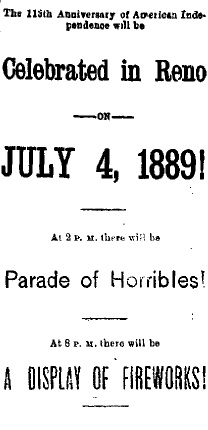
Most of the General’s entries for the 4th record an oration, a poem, and the reading of the Declaration of Independence. But what were “the Horribles?”  That one stumped me until I did a bit of googling.

According to Language Log, a “parade of horribles” was a popular feature of 4th of July celebrations in the late 19th century. A procession of grotesques–people in masks and costumes–formed part of the festivities of the day. This is probably what Bidwell was referring to in his July 4, 1874 entry when he notes “a hideous crowd, masked, came over from town.”  The Daily Nevada State Journal ran this announcement in 1889.

Glocester, Rhode Island, still holds an “Ancients and Horribles Parade” on the 4th of July. I wonder when it died out in Chico?

Posted in Uncategorized | 5 Comments

“Rich, Pleasant, and Spicy”—Grasshoppers, Anyone?

In the reminiscences collected by C.C. Royce, John Bidwell recalled the time when the Indians provided a tasty meal made of ground roasted grasshoppers to Fremont’s troops.  John C. Fremont, “the Great Pathfinder,” returned to California on his third exploratory trip in the fall of 1845. By the time they reached the valley, his men were out of provisions, and grateful for anything they could get from the natives. Bidwell recalled:

Fremont’s party got out of provisions, but staid as near where Fremont had told them as possible, and got provisions from the Indians. They staid as long as they could, but when the provisions gave out they went to the San Joaquin Valley and there found the others, and his exploring party was again united.  The Indians’ provision was a kind of meal. The men were fond of it. It was rich, pleasant, and spicy to the taste. The calls upon the Indians being urgent, caused them to become rather careless in grinding the aforesaid meal, and Fremont’s men discovered legs, wings, and heads of grasshoppers in it. The meal was simply grasshoppers pounded and pulverized in the usual way. Their fondness for the meal from that time rapidly waned, but not before some had become quite sleek and fat.

“Rich, pleasant, and spicy!” Sounds nourishing too. Anyone want to try some?

Addresses, reminiscences, etc. of General John Bidwell. Compiled by C.C. Royce, can be accessed at the Library of Congress’s American Memory project.

Posted in grasshoppers | Leave a comment