Everybody Goes to Sutter’s

It seems that in 1841 California, Sutter’s establishment was like Rick’s Cafe Americaine in Casablanca. Everyone went there.

Bidwell later wrote: “Nearly everybody who came to California made it a point to reach Sutter’s Fort. Sutter was one of the most liberal and hospitable of men. Everybody was welcome—one man or a hundred, it was all the same.” (Echoes of the Past, p. 169)

John Bidwell spent the month of December at Sutter’s settlement. The first order of business was to learn the Spanish language. Alta California, as it was then known, was a province of Mexico, and to accomplish anything in California Bidwell was going to have to know the language. Even the Indians, if they spoke any language other than their native tongues, spoke Spanish, “that being the language of the country,” as Bidwell wrote, “and everybody had to learn something of it.”

So he got right to work learning Spanish, and in five weeks had a good basic grasp of it, which would improve as he spent more time in California. In later years his wife Annie would be quite proud of his ability to speak Spanish. He spoke it so well, and with such a good accent, she maintained, that the Spanish ambassador complimented him on it.

Posted in Uncategorized | Leave a comment

Comparing the Journals

When John Bidwell finished rewriting his journal sometime in 1842, he sent it back to a friend in Missouri, probably in 1843, although who carried it there no one knows. He would later claim he did not intend it for publication, but it certainly reads like a work intended for publication, and published it was, though again we don’t know by whom.

The only extant copy of “A Journey to California, 1841” is the one that belonged to George McKinstrey, and is now in the Bancroft Library. Bidwell’s original journal has disappeared.  I doubt he would have thrown it away, but somewhere in his travels he lost it. The only clue to what the original looked like are the two-week’s worth of extracts copied out by James John.

In writing up his journal for publication, Bidwell expanded on the entries and dressed up the language. We can see how by looking at a couple of entries. First the original, then the revision—

23. Meat grew scarce in camp. Having only 3 days scanty provision, it became necessary to use all means in our power to kill game which was scarce. 5 of our horses gave out today. We camped near the creek.

Friday, 23rd. Having no more meat than would last us 3 days, it was necessary to use all possible exertions to kill game, which was exceedingly scarce. For this purpose I started alone, very early in the morning, to keep some distance before the Company, who had concluded to continue as near as possible to the creek on the N side. . . .

Bidwell goes on here to tell the story of getting lost among the giant sequoias, a story that is not mentioned in the original journal at all. It was an important story to him, but he didn’t have the paper or the time on the trail to tell the story at length.

Here’s another pair:

28. Today the travling was rough. Some horses were killed by falling down the ridge of the mountain. They killed some of their horses to eat for the provision has run out. Travled about 9 miles today and camped.

“Thursday, 28th. Surely no horses nor mules with less experience than ours could have descended the difficult steeps and defiles which we encountered in this day’s journey. Even as it was, several horses and mules fell from the mountain’s side and rolling like huge stones, landed at the foot of the precipices. The mountains began to grow obtuse, but we could see no prospect of their termination. We eat the last of our beef this evening and killed a mule to finish our supper. Distance 6 miles.”

“Steeps and defiles,” “precipices,” “obtuse,” “termination” — this is Bidwell the schoolmaster writing. He is putting his best foot forward, and it is hard to believe that he didn’t intend his prose to be seen by an audience.
Posted in Uncategorized | Leave a comment

A Tale of Two (or Three or Four) Journals

John Bidwell arrived at Sutter’s “Fort” (no fort yet) on November 28th, and found Jimmy John there before him. Jimmy, who was ten years older than John, had been his companion on several adventures on the trail, notably their trip to the snow, and their attempt to get down a canyon, when they became separated.

Jimmy was the only other man in the Bidwell-Bartleson Party who kept a journal on the trail. His journal exists in two versions, and sheds some light on the composition of Bidwell’s journal.

One journal now belongs to the Oregon Historical Society, and appears to be John’s original journal written on the trail. The handwriting was described by Doyce B. Nunis as “open and scrawly.” On the whole it is more detailed than the second journal, but it ends with the entry for August 20th. I haven’t seen the actual journal, so I don’t know if the booklet looks complete, or is missing leaves at the end.

The other journal, which resides in the Rosenbach Library in Philadelphia, may be a rewrite of the first journal. The handwriting at the beginning is small and neat, as if someone else were copying out the text, but halfway through it changes to the “scrawly” hand of Jimmy John. The entries take John all the way to his arrival at Sutter’s house on November 4th.

At the end of this second journal there is an “Extract from John Bidwell’s journal from the 20th of Oct. to the 4th of Nov.”  Jimmy John, wanting to have a complete account of the travels of the rest of the party, copied out these last entries from Bidwell’s journal. This is the only known surviving text of the original journal kept by Bidwell on the trail.

At the same time that Jimmy was rewriting his trail diary, Bidwell was doing the same to his. They both worked on rewriting their journals during the month of December, 1841, while they were residing with Sutter. This gave Jimmy the opportunity to complete his account with the extracts from Bidwell’s journal.

Next time: Comparing the two versions of Bidwell’s journal.

Posted in Uncategorized | Leave a comment

December, 1841

John Bidwell and his two friends arrived at Sutter’s establishment on November 28th, 1841. There they were given a hearty welcome by John Augustus Sutter, a German-born adventurer who had been granted a vast tract of land by the Mexican government.

Even better, they found at Sutter’s their old companion James John, who had become separated from their group in the Sierras back in October. Not knowing what had become of him, and fearing that he had been killed by hostile Indians or fallen to his death in a steep canyon,  they were delighted to meet Jimmy John again.

Bidwell later wrote, “On the eighth day we came to Sutter’s settlement; the fort had not then been begun. Sutter received us with open arms and in a princely fashion, for he was a man of most polite address and the most courteous manners, a man who could shine in any society.”

Sutter was a man with wide-ranging ideas on how to make money in California. He envisioned a valley filled with farms, mills, shops, and men, all working to develop the riches of California. And he, John Sutter, would be in charge of it all. To realize his dreams he needed manpower, and lots of it. He was hiring fur trappers, vaqueros, farm laborers, and skilled craftsmen, if he could find them.

Sutter was delighted to meet John Bidwell. This was just the kind of man he needed. A man who knew how to write clearly, keep accounts, survey property lines, and draw maps was a rare find indeed. He promptly hired him as his clerk.

For his part, John Bidwell took to Sutter right away. Sutter was everything Marsh was not: cheerful, generous, hospitable. Bidwell would work for Sutter off and on for the next eight years.

Posted in James John, John Sutter | Leave a comment

November 27, 1841

John Bidwell had set out on November 21 for Sutter’s rancho on the Sacramento in the company of two other men.  I’ve been trying to find out who his companions were, but Bidwell doesn’t give their names in any of his accounts. Rockwell Hunt, in his biography of Bidwell, tells a story that indicates that one of them was Michael Nye.

At any rate, Bidwell and his companions spent a week slogging through rain and mud on their way to Sutter’s. By the 27th they were out of provisions, hungry and tired. On the day before they arrived at Sutter’s the weather finally cleared.

“The storm abated. The sun came out through masses of clouds, vast herds of antelopes seen and I went in advance to kill some game, there being no gulch or depression in the surface which was not filled with water, whereby I could possibly approach. I failed to do more than frighten the antelope, and cause them to gather in a larger band by roaming around as all who saw antelope can readily understand. Having crawled upon the ground until my gun was wet and unfit to rely upon . . . I resolved to discharge it, wipe it out and reload. Holding it at an angle of 45 degrees slowly went off. Going on in the direction we were traveling, at a distance of more than half a mile I think, I saw an antelope, and supposed he had ended his days there—on examination I found my ball had struck in his eye.” (1877 Dictation)

Many, many years later Bidwell recounted this story to Rockwell Hunt. He considered that shot to be the best of his life, and it certainly was a life-saver. Hunt continues:

“When his companion, Mike Nye, heard about it, he was overjoyed. “Bidwell,” he said with enthusiasm, “I’d vote for you for President!” Then, with a twinkle in his eye, the dignified general recalled that in the campaign of 1892 the Prohibition nominee received one vote from Crook County, Oregon, where his old friend Nye lived at that time!” (Hunt, John Bidwell: Prince of California Pioneers, pp. 77-78.)

Michael Nye lived for many years in Marysville, and later moved to Crook County, Oregon, where he died in 1906. He was the last surviving member of the Bidwell-Bartleson Party.

Posted in Michael Nye | Leave a comment

November 21, 1841

“Started for Capt. Sutter’s on the 21st and arrived there on the 28th. This place is situated nearly due N. of Marsh’s, on the Sacramento river, and about 75 miles. We were received by Capt. Sutter with great kindness, and found here J. John, who had left us in the mountains on the 10th of last month. Oct. He arrived one day sooner at this place than we did at Marsh’s.”

So wrote Bidwell in the revision of his journal. Both Marsh and the Mexicans told the men that if they were looking for work, to go see Sutter, who had only recently acquired his vast land grant where the Sacramento and American Rivers converge.

The Mexicans had colonized the land along the coast, and along the Mission Trail, but they had not ventured inland very far. Sutter persuaded them to give him a huge peice of the inland valley, where he planned to build his own independent empire.

“Dr. Marsh said we could make the journey in two days, but it took us eight. Winter had come in earnest, and winter in California then, as now, meant rain. I had three companions. It was wet when we started, and much of the time we traveled through a pouring rain. Streams were out of their banks; gulches were swimming; plains were inundated; indeed, most of the country was overflowed. There were no roads, merely paths, trodden only by Indians and wild game. We were compelled to follow the paths, even when they were under water, for the moment our animals stepped to one side down they went into the mire.”

How they could see the path in the pouring rain is hard to imagine. They must have gone into the mire time and again. The trip is certainly easier nowadays, in a car, whether it’s raining or the sun is shining.

Posted in Uncategorized | 3 Comments

November 17, 1841

John Bidwell spent November 17, 1841 in jail.

At the order of Mariano Guadalupe Vallejo, who wanted to know what the heck these Americans were doing in Mexico, John Marsh had gone to San Jose to explain the matter and soothe the general. He came back with passports for most of the men in the Bidwell-Bartleson Party—but not John Bidwell.  Bidwell suspected that Dr. Marsh hadn’t gotten him a passport because he wanted to keep him at his ranch as a useful employee, but Bidwell was having none of that.

On the 15th he set out for San Jose on his own to get a passport. Arriving at Mission San Jose on November 16th, he was promptly thrown in jail by Mexican soldiers until he could find someone to explain his presence to the authorities.

He spent three uncomfortable and flea-bitten days in jail until he was able to hail a passerby who understood English.

“He proved to be an American . . . and he kindly went to Vallejo, who was right across the way in the big Mission building, and procured for me the passport.” The passport was made out for Juan Bidwell, and can be seen at the California State Library.

Vallejo could have sent the whole party of Americans back where they had come from. But Alta California had need of skilled labor, and he decided to let them stay.

Bidwell returned to Marsh’s ranch on the 18th. But he had no intention of sticking around. Captain John Sutter was hiring, so to Sutter he would go. He set out for Sutter’s settlement  on November 21st.

Posted in Uncategorized | Leave a comment

What became of James John?

The same day that John Bidwell and the rest of the company arrived at Marsh’s ranch, Jimmy John arrived at Sutter’s Fort. He had become separated from the rest of the party in the Sierras two weeks earlier. He and Bidwell had gone down a canyon looking for a passable route. Bidwell, being the cautious one, insisted that the men and horses could not get through, and went back. Jimmy, who was always more impetuous and daring, pressed on.

He expected the others to catch up with him, but they never did. He continued over extremely rough terrain, with very little to eat. Sometimes he found some wild grapes, and another time he ate the same rushes that his horse grazed on. Once he shot at a hawk carrying a squirrel. “Did not kill the hawk, but made it drop the squirrel. This gave me some relief being nearly all I had to eat since I left the Company.”  (The First James John Diary, in The Bidwell-Bartleson Party, edited by Doyce B. Nunis, p. 178.)

He met friendly Indians, who gave him acorn soup to eat, but then angered them when he   mistook one of their dogs for a wolf and killed it. He barely escaped with his life. Coming down into the valley he met another group of Indians who led him to Captain John Sutter’s settlement on the Sacramento River.

In his diary, Jimmy’s entry for November 4th reads:

“About sunset two Indians came on horses and took me and my baggage to Captain Suiter’s [Sutter’s] house, a distance of 6 miles. Capt. Suiter has a fort here made of dobies [adobes] and burned brick, mounted with a few old cannons and guarded by about 29 men, mostly runaway sailors and Canackers or Owihees [Hawaiians] besides a number of pet Indians which he employs for war parties and who built his fort and farm. He keeps also a harem of Canacker [Hawaiian] women. This place is called New Helvetia.”

Makes you wonder what life was like at Sutter’s Fort in the early days.

Posted in Uncategorized | 1 Comment

November 10, 1841

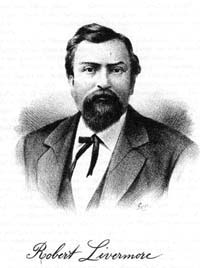
“I went to R. Livermore’s, which is about 20 miles from Marsh’s, nearly W[est]; he has a Spanish wife and is surrounded by 5 or 6 Spanish families.”

John Bidwell was eager to explore the California landscape and find out what the opportunities were for a farmer. Dr. Marsh must have told him that Robert Livermore had a ranch about 25 miles to the southwest of Marsh’s ranch, so Bidwell set out to learn more.

Robert Livermore was an Englishman, one of those sailors who jumped ship and stayed in California. Born in 1790, he landed in California in 1822 in San Pedro and worked as a ranch foreman until he could acquire his own land grant. In 1834 he and his partner Jose Noriega started running cattle on a ranch in what became Alameda County, and in 1839 they acquired title to Rancho Las Positas. In 1838 he married Maria Josefa de Jesus Higuera Molina. They had eight children.

He had a reputation as a hospitable and honest man. He stayed out of politics. He didn’t even go prospecting for gold during the Gold Rush, knowing that his land, livestock, and crops would be more valuable in the long run than gold could ever be. John Bidwell would have agreed with him on that.

Robert Livermore died in 1858, and the town of Livermore is named after him.

Posted in Livermore | Leave a comment

November 8, 1841

John Bidwell stayed at Marsh’s rancho, while fifteen of the company went to “the pueblo of St. Joseph” (San Jose) to look for work. Bidwell wanted to pump Marsh for more information about California and its resources, as well as travel around and see some of the country on his own.

“The next morning I rose early, among the first, in order to learn from our host something about California, –what we could do, and where we could go,–and strange as it may seem, he would scarcely answer a question.”

Marsh had at first welcomed the newcomers, but he was evidently having second thoughts.  Bidwell soon came to see him as “one of the most selfish of mortals.” Although he had fed them on pork and beef the first night, and even used some of his seed wheat to make tortillas for the thirty-two men, Marsh was obviously worried about being saddled with a host of hungry mouths that he couldn’t afford to feed.

The men, who had no money, paid him with various items—a can of gunpowder or a butcher-knife–but Marsh only grumbled that they had already cost him $100, and “God knows whether I will ever get a real or it or not.” (A real being a Mexican coin.) All the men left as soon as they could, and Bidwell never had a good word to say about John Marsh.

Posted in Uncategorized | Leave a comment