July 2-4, 1841

“Friday, 2nd. Continued to coast up the N. fork [of the Platte River]; the bottoms of the river were in many places completely covered with Glauber Salts, so much so that even handfuls could be taken up perfectly white.”

Glauber’s salt is a hydrous sodium sulfate mineral, also known as sal mirabilis (wonderful or miraculous salt.) It was formerly used as a laxative, much as Epsom salt (magnesium sulfate) was, until gentler methods came along. Now the mineral is mainly used in the manufacture of detergents, and in paper pulping.

“Saturday, 3rd. Left the N. fork; a distance of 12 miles took us to a spring of cool, though unpleasantly tasted water. The day was intensely warm, and road mountainous; killed four buffalo and two deer.”

“Sunday, 4th. Pursued our way over hills and dales, scorched with heat; came to a small copse of red willows, from which issued excellent springs of water. Three buffalo killed, distance travelled 22 miles.”

Neither Bidwell, Jimmy John, or Father De Smet make mention of any celebration of Independence Day on the 4th of July, although it could hardly have gone unremarked. Their focus was on the day-to-day difficulties of the journey: the rough terrain, the need to find food and water, and the imperative to press on.

Posted in Uncategorized | Leave a comment

June 13-28, 1841

I’m playing catch-up here. I’ve been out of town for a few days, plus I should go back and pick up an incident I skipped over earlier in the month. So here is what John Bidwell was doing on the trail during the latter half of June, 1841.

“Sunday, 13th. A mournful accident occurred in the camp this morning–a young man by the name of Shotwell while in the act of taking a gun out of the wagon, drew it with the muzzle towards him in such a manner that it went off and shot him near the heart. He lived about an hour and died in the full possession of his senses.”

This was the only death during the entire dangerous trip. George Shotwell was “buried in the most decent manner our circumstances would admit of, after which a funeral sermon was preached by Mr. Williams.”

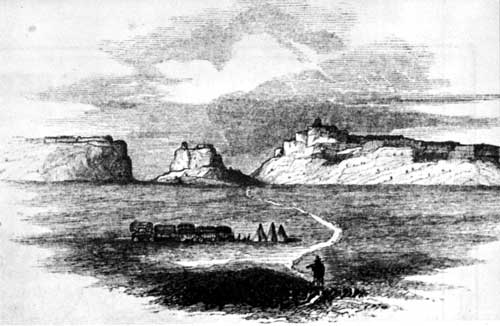
The company continued up the Platte River, passing Chimney Rock and Scotts Bluff. On Tuesday, June 22nd they arrived at Fort Laramie, an outpost owned at that time by the American Fur Company. Bidwell spelled it Larimie, Jimmy John spelled it Laramy, and Father De Smet, giving it a French air, spelled it La Ramee. There was another fort nearby, Fort Lupton, and they camped in between the two forts. They stayed to rest on Wednesday, and “the things of Mr. Shotwell were sold at auction.”

“Monday, 28th. Passed an immense quarry of beautiful white alabaster; 3 buffalo killed, distance traveled 18 miles, encamped on a little rivulet affording as good water as ever run.” According the Father De Smet, the men spent the evening carving the alabaster; some of them made pipes that they might give as gifts to the Indians, but the alabaster could not withstand heat, and broke.

Posted in Uncategorized | Leave a comment

June 19, 1841

“We gradually receded from the river in order to pass through a gap in a range of high hills called Scott’s Bluffs. As we advanced towards these hills, the scenery of the surrounding country became beautifully grand and picturesque–they were worn in such a manner by the storms of unnumbered seasons that they really counterfeited the lofty spires, towering edifices, spacious domes, and in fine all the beautiful mansions of cities. We encamped among these envious objects having come about 20 miles.”

After the flat monotony of the prairies, Scotts Bluff provided a welcome change of scenery for travelers on the Oregon Trail. Many travelers remarked on the fantastic forms taken by the steep-sided hills in this area of western Nebraska. More information about the history and geology of Scotts Bluff can be found at the website for Scotts Bluff National Monument and the Oregon-California Trails Association.

Posted in Uncategorized | Leave a comment

An Excursion to Bidwell Point


My husband Jim and I went on a little excursion today to see Bidwell Point in western Glenn County. Bidwell Point is a large hill overlooking the town of Elk Creek, just on the other side of Stony Creek. We were thinking about climbing to the top, but the access road was posted “No Trespassing”, and besides, it was a hot afternoon, so instead we just took a picture.

John Bidwell explored this area in the summer of 1844, at the request of Thomas O. Larkin, the American consul at Monterey, who wanted to find a land grant for his children. Together with one Indian guide, Bidwell traveled by horseback up the Sacramento Valley on the west side of the river. At the present site of Colusa he turned west and traveled across the hot, dry plain until he reached Stony Creek, in the foothills of the Coast Range. Here they met Indians who had never seen a white man before. They followed the creek downstream (northward).

“To our surprise, the number of Indians increased to many hundreds. In half a day we passed seventeen large villages. They had evidently come from their permanent villages and made their temporary homes by this fresh flowing stream. These Indians certainly proved anything but hostile; they were evidently in great awe of us, but showed no signs of displeasure. There were hundreds before and behind us, and villages were made aware of our coming before we reached them.”

Ever careful of his safety, Bidwell took precautions for the night. Although the Indians seemed friendly, he didn’t want to leave himself exposed and possibly lose his horses or equipment. So he retreated to the top of what is now called Bidwell Point.

“Seeing a conical hill, I determined to make it my camp for the night. I now told the old Indian (through his guide) that I was going there to sleep, and that his people must all go to their villages and not come near me during the night.”

They barricaded the top of the hill with rocks and took turns keeping watch during the night. But not one Indian approached them, and the next day, which was the 4th of July, they proceeded northward. They came to a large Indian village with a dance house.

“It seemed a gala day with the Indians, or else they made it so for my especial benefit. Male and female were attired in their gayest costumes . . . and to round up the day’s festivities they got up the gayest and largest dance, accompanied by not unmusical chants, I ever saw or heard.”

Bidwell’s recollections form the third chapter in a history of Colusa County published in 1891.

Posted in Uncategorized | Leave a comment

June 11, 1841

“Friday, 11th. The oxen had wandered about a 1/2 mile from camp this morning, when a man was sent to bring them in; he soon came running back in great haste, crying “the Indians are driving the oxen off”!! In less than half an hour the oxen were at camp and not an Indian to be seen–all this is easily accounted for when we consider how timidity and fear will make every bush, or stone, or stump and Indian, and 40 Indians, thousands.”

Indian trouble was the foremost worry of the men in the Bidwell-Bartleson Company. They were wary of contact with the Indians and always on the defensive. Bidwell, a man who prided himself on his “self-possession” and calm rational mind, liked to poke fun at his companions’ skittishness. If he had fears of his own (and he surely did) he isn’t about to let his readers see them.

His comment about “timidity and fear” may well have been added when he wrote out a fair copy of his journal and sent it back to Missouri. Since we don’t have the original, we don’t know how much was added after the fact, but this is the kind of comment that sounds like it might be a later reflection.

He continues this entry: “Vast herds of buffalo continued to be seen on the opposite bank of the river.”

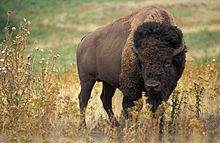
The buffalo of the Great Plains were an awesome sight. Just two days previous he had written “8 or 10 buffalo killed today, but not one-tenth of the meat was used; the rest was left to waste upon the prairie.” He deplored this destruction and predicted that “if they continue to decrease in the same ratio that they have for the past 15 or 20 years, they will ere long become totally extinct.” As we know, they nearly did. Bidwell, writing in 1841, can be considered an early conservationist. He agreed with the Indians, who, he said, “behold with indignation the shameful and outrageous prodigality of the whites.”

Posted in buffalo, Indians | Leave a comment

June 5, 1841—Tornado!

“Saturday, 5th. Started early to get clear of our red visitors. Descried a large herd of buffalo on the opposite side of the river–saw several boats descending the river, laden with fur, robes, etc. They belonged to the American Fur Company–one of our Company, E. Stone, returned with them.

The latter part of the day was very inclement, high winds, dark clouds rushed in wild confusion around and above us. Soon with amazement we saw a lofty waterspout, towering like a huge column to support the arch of the sky; and while we were moving with all haste, lest it should pass over us and dash our wagons to pieces, it moved off with the swiftness of the wind and was soon lost among the clouds. Rain & hail succeeded, the largest hailstones I ever saw. Several were found, an hour after the sun came out bright & warm, larger than a turkey egg.”

Tornadoes, hailstorms, and wild weather are nothing new to the Great Plains, but this was the first time Bidwell had seen weather quite so spectacular.

Posted in Uncategorized | Leave a comment

June 4, 1841

“Friday, 4th. Half past six this morning saw us on the march. The valley of the river was here about 4 miles wide. Antelope were seen in abundance. A young man (Dawson) was out hunting, when suddenly a band of Cheyenne Indians about 40 in number came upon him; they were pleased to strip him of his mule, gun, and pistol, and let him go. He had no sooner reached the camp and related the news than the whole band came in sight. We hastened to form a corral with our wagons, but it was done in haste. To show you how it affected the green ones, I will give the answer I received from a stout, young man (and he perhaps was but one of 30 in the same situation), when I asked him how many Indians there were. He answered with a trembling voice, half scared out of his wits, there are lots, gaubs, fields and swarms of them!!! I do really believe he thought there were some thousands. Lo! there were but 40, perfectly friendly, delivered up every article taken, but the pistol.”

Nicholas Dawson was ever after this incident known in the company as “Cheyenne,” to distinguish him from the other Dawson in the company, V. W. Dawson, called “Bear.” He left his own account of the incident. The guide, Thomas Fitzpatrick, had warned them not to stray beyond sight of the wagon train, but in following an antelope herd Dawson had wandered out of sight. Suddenly he was accosted by the band of Cheyenne, who forced him to dismount and, in his words, “seized my gun and knife, stripped me of my outer clothing, and taking my mule, left me.”

Dawson ran back to the wagon train, told his story, and Fitzpatrick and a few men on horseback set out to find the Indians.

“I was very angry now, and intent on vengeance, so hastily borrowing a horse and gun, I hurried after the party. I came on at full speed and was aiming at the first Indian within range, when I was stopped by some forcible language from Fitzpatrick, and perceived that Fitzpatrick and the Indians were engaged in a friendly powwow. It had proved to be a band of Cheyennes, friendly but thievish. They camped near us that night, and Fitzpatrick attempted to get back my property. He and I and the Indians sat around in a circle, and for every article to be returned, gifts of blankets, clothes, etc. had to be thrown down, a peace pipe smoked by all, and much haranguing done. Fitzpatrick’s patience gave out before all was got back, and declaring that I ought to be satisfied to have got off with my life, he refused to intercede further.”

Seems to me that it was a good thing all around that the Bidwell-Bartleson Party had joined up with the missionaries and their guide, Fitzpatrick. Otherwise they would have all been dead on the prairie within a month from their misadventures.
Posted in Uncategorized | Leave a comment

June 1, 1841

“June. Tuesday, 1st. This morning we hastened to leave our miserable encampment and proceeded directly north, we reached Big Platte river about 12 o’clock. The heat was uncommonly oppressive. . . . This afternoon we had a soaking shower, which was succeeded by a heavy hailstorm.”

The Rev. Williams wrote of this weather “At 2 o’clock commenced a most tremendous bad storm, with wind, which blew down most of the tents, accompanied with rain and lightning and thunder almost all night. I slept but little, the ground being all covered with water. That night dreadful oaths were heard all over the camp ground. O the wickedness of the wicked!” Poor Rev. Williams found it very trying to travel “in the midst of an ignorant and hard-hearted people.”

Bidwell continues his journal entry: “Wonderful! This evening a new family was created! Isaac Kelsey was married to Miss Williams, daughter of R. Williams. The marriage ceremony was performed by the Rev. Pr. Williams, so we now have five families, if we include a widow and child.”

Miss Winifred Williams was the daughter of Richard Williams and his wife, whose name is not recorded. Isaac Kelsey, who was also known as Zedidiah, was one of the four Kelsey brothers on the trip. He and Samuel went to Oregon, and Benjamin and Andrew went to California. Isaac was born in 1818, making him one year older than John Bidwell, and 22 or 23 years old when he married on the trail. Very little else is known about the young couple and their further adventures.

Posted in Uncategorized | Leave a comment

May 31, 1841

Monday, 31st. This morning about 10 o’clock we met six wagons with 18 men, with fur and robes on their way from Ft. Larimie [sic] to St. Louis. Ft. Larimie is situated on Larimie’s fork near its junction with the N. fork of Platte, and is about 800 miles from Independence. [So their guide, Thomas Fitzpatrick, must have told Bidwell.] The wagons were drawn by oxen and mules–the former looked as though they received a thousand lashes every day of their existence! The rusty mountaineers looked as though they never had seen razor, water, soap, or brush. It was very warm, and we travelled till dark before we were able to reach water, and then it was not fit to drink, and then we could not procure any wood, grass scarce.”

This illustration by Frederic Remington shows two mountaineers as Bidwell saw them, without “razor, water, soap, or brush.”

The company had left the Kansas River and traveled up the Little Blue, and at this date were situated just beyond the source of the Little Blue and not yet at the Platte River, which they would follow until they reached Ft. Laramie. The “rusty mountaineers” that Bidwell’s group met were working for one of the fur-trading companies that flourished in the western territories during the first half of the 19th century. St. Louis was the marketplace and supply point for the fur traders and mountain men, and from that point the buffalo robes and beaver pelts were shipped to the East Coast and Europe.

Posted in Bidwell-Bartleson Party, Uncategorized | Leave a comment

May 26, 1841

“Wednesday, 26th. Two wagons were broke today; about a dozen Pawnees came to our camp, stopped to repair the wagons, having come about 15 miles. . . . A man by the name of Williams, a Methodist preacher, overtook the company this evening on his way to Oregon Territory. He had not arrived in time to start with the company from the settlements, and had traveled entirely alone, without any gun or other weapon of defense, depending wholly on Providence for protection and support.”

The Rev. Joseph Williams was 64 years old in 1841 when he set out to visit the missionaries in Oregon. That made him the oldest member of the Bidwell-Bartleson Party. He left a short record of his experiences on the trail entitled “Narrative of a Tour from the State of Indiana to the Oregon Territory in the Years 1841-2.”

Williams was greatly disappointed when he reached Westport, the starting point, and found that the company had already left. When he was told that he had only missed them by three days, he set off to catch up. On the 26th he rode across the prairie, “happy in my soul,” until about 4 o’clock, when he spotted the company a few miles ahead. He stopped to feed his horse, then traveled on and by evening he joined the company. They told him how narrowly he had missed being captured by Indians. Williams didn’t seem particularly surprised, for he was confident that God was watching over him.

Posted in Uncategorized | Leave a comment