August 12, 1841

“I, in company with another man (J. John), went some distance below the camp to fish in the river; fished sometime without success–concluded we could spend the afternoon more agreeably.”

So begins the journal version of a story John Bidwell told seemingly every time he told about his overland journey to California. He and James “Jimmy” John had time to go fishing because the company was waiting for the return of the four men they had sent to Ft. Hall for supplies and information. The day was hot, and looking across the valley they could see a mountain with inviting patches of snow.

“Supposed the snow not more than 4 miles distant; set out without our guns knowing they would be a hindrance in ascending the mountain.”

They walked and walked, but the mountain never seemed to get any closer. Bidwell suggested they return to camp, but Jimmy gave him a scornful look and kept walking. “I called to him to stop, but he would not even look back. A firm resolve seized me to overtake him, but not again to ask him to return.”

“The rocks were sharp, and soon cut through our moccasins and made our feet bleed. But up and up we went until long after midnight, and until a cloud covered the mountain.” In the dark they crawled under a stunted tree and lay there shivering. They had no coats or blankets to keep them warm.  “When daylight came we discovered we had lain in the nest of a grizzly bear. The hair was rubbed off the brush and there were all the signs of the grizzly’s lair.”

As soon as day dawned they continued up the mountain and found the snow. It had hardened into ice, but John cut a large piece out with his knife and wrapped it in his handkerchief. They decided to take a shorter but steeper route back to the camp.

“At first the way was smooth and easy but soon we were sliding down in the snow and mud with our buckskin suits wet and bedraggled. This way soon led into a most rugged canyon and thickets so dense that it became impossible to pass through them except in the trails of the grizzly bears. . . . We carried our sheath knives in our hands at every step, for we knew not at what instant we would meet a bear face-to-face.”

The two footsore adventurers limped across the hot valley until at last they came into camp about noon. “They supposed without a doubt, that the Blackfeet had got us, had been up all night in guard, every fire had been put out, they had been out twice in search of us and were about to start again when we arrived. We were received with a mixture of joy and reprehension.”

“Their first questions were “Where have you been?” “Where have you been?” I was able to answer triumphantly, “We have been up to the snow!”  and to demonstrate the fact by showing all the snow I had left, which was now reduced to a ball about the size of my fist.” (The First Emigrant Train to California)

He was lucky that someone didn’t beat him over the head with that chunk of ice.

Posted in Uncategorized | Leave a comment

August 11, 1841

“Wednesday, 11th. Having traveled about 6 miles this morning the Company came to a halt–the Oregon Company were now going to leave the Bear river for Ft. Hall . . .  Many who purposed in setting out to go immediately through to the California, here concluded to go into Oregon so that the California company now consisted of only 32 men and one woman and child . . . The two companies, after bidding each other a parting farewell, started and were soon out of sight. Several of our Company, however, went to Ft. Hall to procure provision, and to hire if possible a pilot to conduct us to the Gap in the California mountains, or at least to the head of Mary’s river.”

Their guide, Captain Fitzpatrick, had already told the Bidwell-Bartleson Party to give up their plans to travel to California. He advised them to travel with the missionaries and then continue on to Oregon.  If they still wanted to get to California, they could winter in Oregon and continue their journey next spring.

The direct route to California lay across dangerous unmapped territory, with no roads and no guideposts. Fitzpatrick was not familiar with the region, but he said he had heard of trappers that had explored the country to the west and the south of Salt Lake, looking for beaver. The company hoped to find a guide at Fort Hall, and sent four men to inquire, but they would not find anyone there to guide them.

They would also not find any “Gap” in the California mountains, but that realization lay six arduous weeks in the future.  Bidwell had seen a map back in Missouri that showed two rivers flowing from the Great Basin through California to the Pacific Ocean. They were still hoping to follow one of those rivers to the sea.

“After getting all the information we could from Captain Fitzpatrick, we regretfully bade good-bye to our fellow emigrants and to Father De Set and his party.  We were now thrown entirely upon our own resources. All  the country beyond was to us a veritable terra incognita, and we only knew that California lay to the west.” (The First Emigrant Train to California)

Posted in Uncategorized | Leave a comment

August 10, 1841

“Tuesday, 10th. The day was fine and pleasant; a soft and cheerful breeze and the sky bedimmed by smoke brought to mind the tranquil season of autumn.”  John Bidwell waxing poetic on the trail.

“A distance of 10 miles took us to the Soda Fountain, where we stopped the remainder of the day. This is a noted place place in the mountains and is considered a great curiosity–within the circumference of 3 or 4 miles there are included no less than 100 springs . . . The water is strongly impregnated with soda, and wherever it gushes out of the ground, a sediment is deposited, of a reddish color, which petrifies and forms around the springs large mounds of porous rock . . .”

The Soda Fountain, or Soda Springs, was a well-known landmark on the Oregon Trail, and many travelers got out their diaries and recorded their impression like Bidwell did. I couldn’t find any good photographs of Soda Springs from the 19th century. Today the landscape has changed, and most of the naturally carbonated springs are gone, covered by a man-made reservoir.

The company of pioneers was about to split up, with half going to Oregon and half to California, and before they do I want to mention Mrs. Samuel Kelsey. There were four Kelsey brothers in the group–two would go to Oregon and two to California. Samuel Kelsey had married Lucretia “Lucy” Applegate in Missouri in 1830–they had five children.  Bidwell tells this story from their time on the trail before they parted ways:

“I remember Mrs. Samuel Kelsey; I pitied her. We had traveled all day and everybody was tired. It was hard work to get a fire built, but she managed to and was frying some bacon and tried to make some coffee. She had, I think, 5 children, the smallest of which could barely stand alone. They were all standing about, crying at the top of their voices for something to eat. Just at that time the coffee upset and it went into the bacon and put out the fire. She threw up her hands and hollered out loud enough for the whole camp to hear: “I wish to the Lord I had never got married!”

Posted in Kelsey | Leave a comment

August 8, 1841

“Sunday, 8th. Started about noon and went ten miles; scenery of the country was grand.”

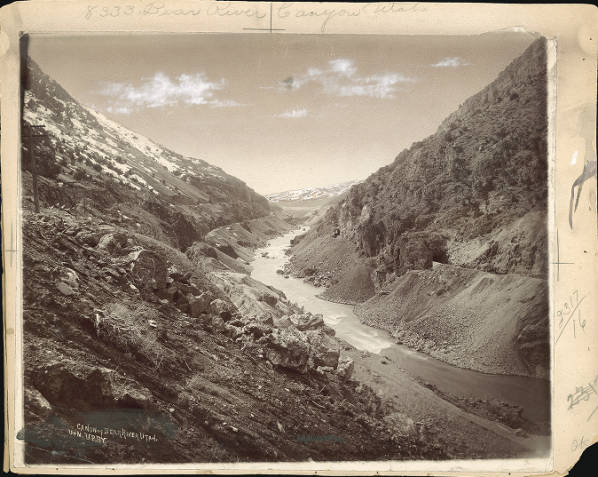
Bear River Valley--a photo taken by Charles R. Savage in 1869.

For the last few days Bidwell’s entries had been of this type. The two companies (Bidwell’s and De Smet’s) were still traveling together, but not for much longer. They were following the Bear River as it wound northward along what is now the Wyoming-Utah-Idaho border. Bidwell uses the word “beautiful” over and over to describe the picture of the river as it meandered through high bluffs. And there were wild currants too, “some of which were of an excellent quality.”

Posted in Uncategorized | Leave a comment

Before They Close

This last week Jim and I visited several State Historic Parks, all but one of which is on the closure list, and every one of them with some connection to John Bidwell. That’s because John Bidwell knew everybody (and I mean everybody) in California in his day.

Here’s where we went:

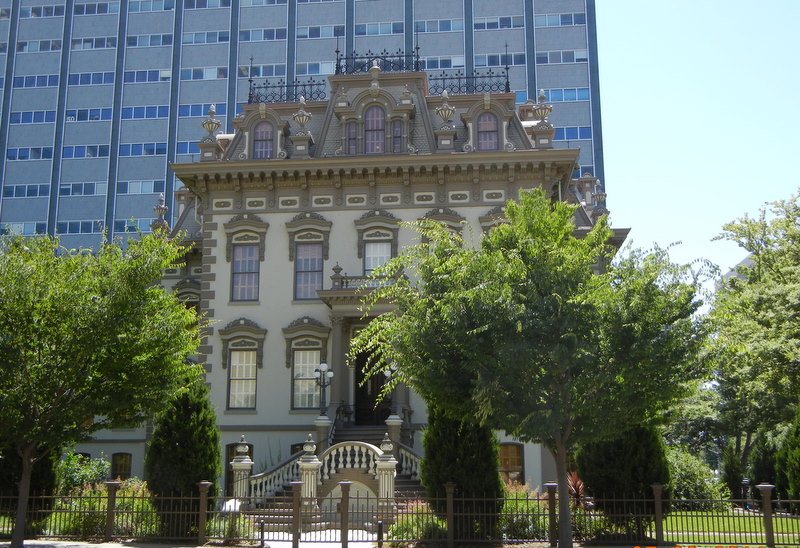
Leland Stanford Mansion in Sacramento: Stanford’s home when he served as governor 1861-1863. This is the house where Leland Stanford Jr, who died at the age of 15, was born and raised. The mansion is dressed to the nines in the most opulent and ostentatious Victorian fashion, but the rooms are small for the amount of decoration they have to carry. The house started as a small townhouse, then was expanded and then expanded again and again–more rooms were added, but the original rooms stayed small. Stanford even raised the entire house and inserted a new ground floor under the old one, adding a sweeping double stairway up to the front door. It is a gorgeous home, used by the state of California for receptions and other protocol functions.
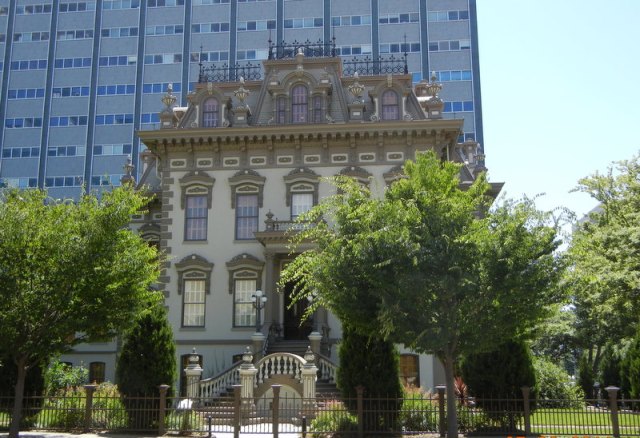
Of course I didn’t think it was near as pleasant a home as Bidwell Mansion, but then Stanford was not near as pleasant a person. Both Bidwell and Stanford were deeply involved in state politics and the Republican Party. Stanford made Bidwell a brigadier general in the State Militia in 1863. That’s how he became General Bidwell.

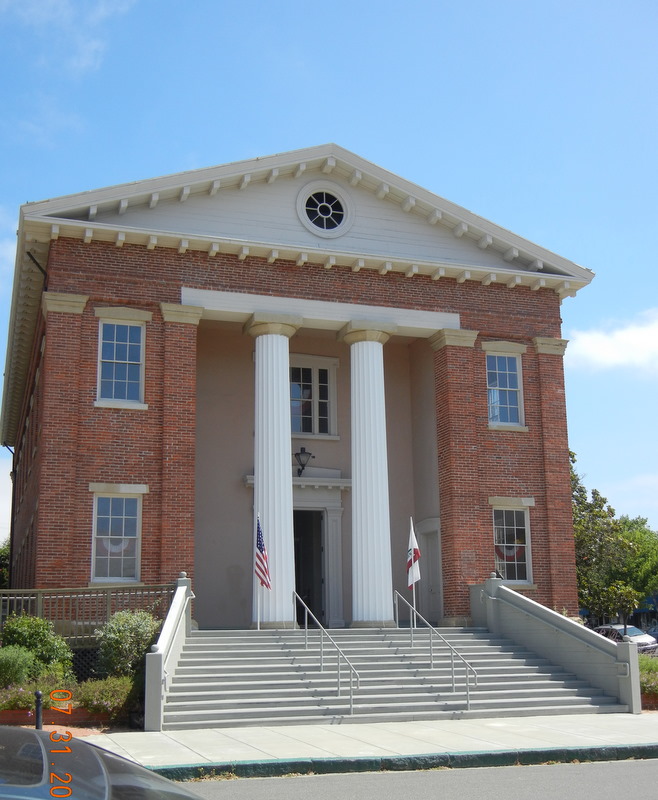
State Capitol in Benicia: For one year, 1853-54, Benicia (next door to Vallejo) was the state capital of California. It has a fine old two-story brick building, with two Grecian columns at the entrance, where the legislature met. The columns are made from the masts of ships abandoned at San Francisco during the Gold Rush. Bidwell would have known many of the members of the legislature, having served as a state senator himself in San Jose in 1849-1850. He had known Robert B. Semple, the founder of Benicia, ever since the Bear Flag Revolt.

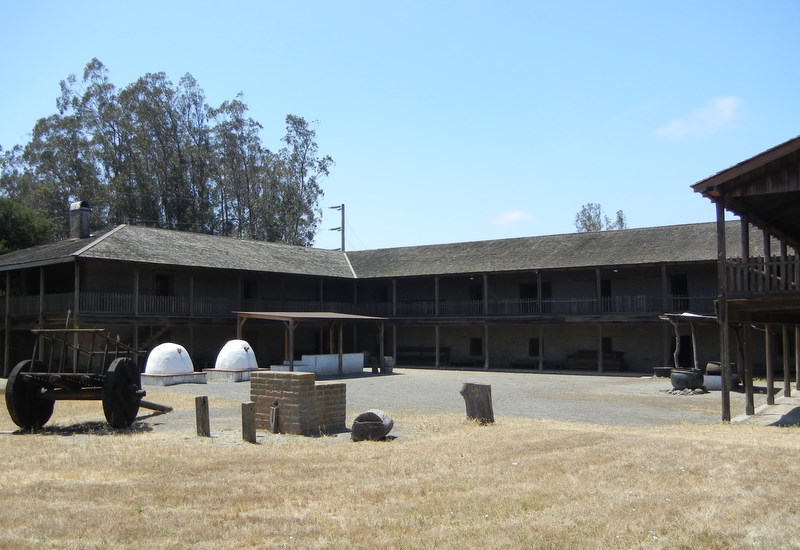
Vallejo’s Petaluma Adobe:  General Mariano Guadalupe Vallejo had a vast 66,000 acre rancho stretching across Sonoma County and beyond, with headquarters at Petaluma. The adobe was bigger than I expected—a long two-story building with two wings, surrounding a courtyard where all the cooking was done. The sleeping quarters are upstairs, and the various workshops—the weaving room, the granary, the metalwork and tanning shops–are all downstairs. The wide verandas and simple furnishings really give the visitor a feel for life in old Alta California.

Bidwell knew General Vallejo very well, from the day that Vallejo signed his passport in 1841, until the last years of their lives. In 1846, when Vallejo was seized in Sonoma by the “Bears” during the Bear Flag Rebellion, he was sent to Sutter’s Fort and placed in the charge of John Bidwell. Later the military officer in charge of the fort told Bidwell that he was being too friendly with the prisoners, so Bidwell set off for Sonoma to join the excitement. He and Vallejo agreed that California would probably be better off under the government of the United States.

Fort Ross: This is the one that is not slated for closure.
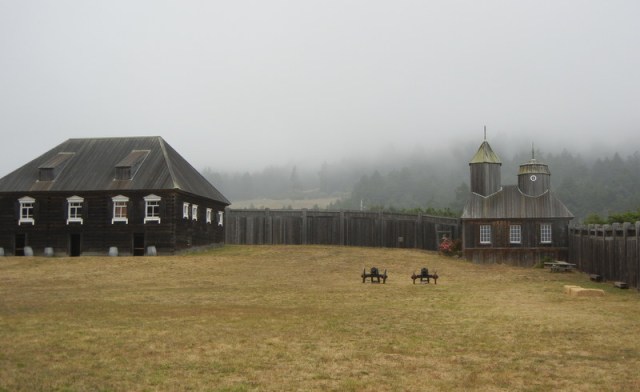
Bidwell lived here for 14 months in 1842-43. John Sutter had just arranged to purchase Fort Ross and all its contents from the Russians when Bidwell showed up in California. Sutter hired Bidwell as his clerk, and gave him the assignment of dismantling Fort Ross. I assume that all the cannons, muskets, tools, plows, etc. etc. that you can see here are not the originals, since all of those were sent to Sutter’s establishment on the Sacramento River back in 1842.

Now I’ve just got to get myself up to Ide Adobe before it closes.
Posted in Fort Ross, Uncategorized | 1 Comment

July 30, 1841

“Friday, 30th. Traveled about 5 miles and encamped. Guess what took place; another family was created! Widow Gray, who was sister to Mrs. Kelsey, was married to a man who joined our Company at Fort Larimie. His right name I forget; but his everywhere name, in the mountains, was Cocrum. He had but one eye–marriage ceremony performed by Father De Smet.”

His right name was Richard Phelan, and he was a fur trapper who, with his one eye, spotted the widow Gray and took a fancy to her, which is probably the reason he joined the Bidwell-Bartleson Party at Fort Laramie. His courtship was successful. Since Phelan is an Irish name, he was no doubt a Catholic, and thus the couple was married by Father De Smet, and not by the Rev. Joseph Williams.

The man’s name was Phelan, but his nickname, or “everywhere name” as Bidwell says, was Cockrum.  Or maybe it was Cockrel—that’s the name Jimmy John records.  I haven’t found a first name for Mrs. Gray, but she was the sister of Samuel Kelsey’s wife, who was traveling with her husband and five children. Mrs. Kelsey was undoubtedly happy to have her sister’s help with the kids. Both sisters with their families would go on to Oregon.


Posted in Uncategorized | Leave a comment

July 26-29, 1841

“Monday, 26th. Left Green river – moved off in a W. direction – distance 12 miles . . . . Land high, dry, and barren, except upon the streams, which afford grass in abundance; also black currants, which though not delicious are acceptable.”

The next day Bidwell recorded nothing more than “Advanced upstream about 12 miles,” and then he dittoed this entry for the next two days. Nothing very exciting going on. They were in the southwest corner of what is now Wyoming, approaching the Wyoming-Idaho/Utah border. They traveled along Black’s Fork of the Green River. The weather was hot, and the land dry, but the river provided water and grass for their livestock.

Black currants, even if they were not very sweet or delicious, would have provided vital nutrition for the travelers. Black currants have an extremely high level of vitamin C, as well as good levels of potassium, phosphorus, and iron. Excellent for keeping scurvy at bay, and scurvy is always a danger when people are living primarily on meat, as these pioneers were.

Posted in Uncategorized | Leave a comment

John Gray and Ignace Hatchiorauquasha

John Gray (sometimes spelled Grey) was hired by the Englishman W. G. Romaine as a guide for his summer tour of the American West. Gray was  half Scottish and half Iroquois, a St. Regis Mohawk, born around 1795 in upstate New York.  His father, William L. Gray, had served as a soldier during the American Revolution and then married into the Mohawks of Akwesasne. John Gray also went by the Iroquois name of Ignace Hatchiorauquasha, St. Ignatius being his patron saint.

John Gray, as depicted by Nicholas Point, S.J. Picture from http://www.hunterbear.org/family_stuff.htm

Father Nicholas Point, one of the priests with Father DeSmet, drew this portrait of John Gray while on the trail. The smaller picture is of Gray’s wife.

The Catholic priests had a good opinion of Gray and his abilities. Father Gregory Mengarini records the following:

“So the sun rose and the sun set, and the end of our journey was still over a thousand miles away. Sometimes John Grey would say to me in the morning, “Father, so you see that speck in the distance? Today we must reach there.” “Then our day’s travel will be short,” I would answer. “We shall see,” he would say laughingly. And the hours of the morning would pass and we would be already journeying long under a scorching afternoon’s sun before that speck would achieve appreciable magnitude and distinctness of form.”

Gray entered the fur trade sometime around 1818, about the same time that he married his wife Marienne, also a Mohawk. He was active in the fur trade for the next 25 years or so.

Gray and Romaine, along with four other men, left the wagon train on July 25th to return to the United States. The trip with Romaine was probably the last of Gray’s excursions to the West, after which he retired to his home in Kansas City, Missouri. He was killed in 1848 in a dispute with a neighbor.

For more about John Gray, consult The Mountain Men and the Fur Trade of the Far West, by Leroy R. Hafen, or see the website of his great-great-great grandson Hunter Gray.  (I removed the link because that website is no longer operative.)

Posted in Uncategorized | Leave a comment

July 23-24, 1841

“Friday, 23rd. Went to Green river–distance 8 miles–spent the remainder of the day trading with the hunters.

“Saturday, 24th. Remained at this encampment and continued our traffic with the hunters. Chiles sold his oxen, 2 yoke, and wagon, another also was left.”

The hunters, or fur trappers, bought all, or nearly all, the alcohol brought by Bartleson and others, as well as other items, like Chiles’s wagon and ox team. Bidwell doesn’t say what they used to pay for it—whether they had money, or whether they traded goods.

In “The First Emigrant Train to California,” Bidwell relates what became of Fraeb’s party. “Years afterwards we heard of the fate of that party; they were attacked by Indians the very first night after they left us and several of them killed, including the captain of the trapping party, whose name was Frapp. The whisky was probably the cause.” Indeed, the alcohol and the resulting drunkenness would have drawn the attention of Indians. And since by the time Bidwell wrote this recollection he was a Prohibitionist, he does not fail to point the moral.

Posted in Uncategorized | Leave a comment

July 22, 1841

“Gray returned this evening having found Trapp’s company, which consisted of about 20 men. They had returned to meet our company, though on their way to hunt buffalo, and were now encamped on Green river about 8 miles distant. Gray had suffered much in overtaking the trappers; his mule gave out, there being no water for a great distance, and he himself was reduced so much by hunger and thirst that he was unable to walk. He was therefore compelled to crawl upon his hands and feet, and at last came up with the company in the most forlorn situation imaginable–if they had been another half mile farther, he never could have reached them.”

The man that Bidwell here calls “Trapp,” was generally called “Frapp” by his men. A German-American from St. Louis, his name was actually Henry Fraeb, and he was a veteran fur trapper and one of the founders, with Jim Bridger and William Sublette, of the Rocky Mountain Fur Company.  The Rev. Joseph Williams called his outfit “a wicked, swearing company of men,” which is probably a pretty accurate description of the kind of men who lived far from civilization.

John Gray, who nearly lost his life in pursuit of Frapp’s company, was a half-Mohawk, half-Scottish trapper and trail guide from French Canada. He had been hired by W. G. Romaine as a companion and guide for Romaine’s summer excursion on the plains. If anyone could have found Frapp, it was John Gray, but he was traversing some of the most  unforgiving territory in America, and he was very lucky to survive the ordeal.

Posted in Uncategorized | Leave a comment