February 1842

February 5th. Bright, clear and warm.
February 6th. Same.
February 7th. Rainy.
February 8th. This morning snowed 5 minutes.

That was the weather report from the California coast in February 1842. John Bidwell spent all of 1842 at Bodega Bay and Fort Ross supervising the dismantling of the Fort and the shipment of all the useful items the Russians had left behind to John Sutter at New Helvetia on the Sacramento. He probably also made occasional trips down to San Francisco, and perhaps also back to New Helvetia, along with the equipment he was shipping to Sutter.

During that time he copied out the journal that he had kept on his overland trek to California. To this he added “Observations about the Country,” “Resources of the Country,” and other notes on the flora, fauna, climate, and political situation. Here are a couple examples:

“All concur in pronouncing the country good for fruit, apples, etc. I presume it is so; I went to Ross on the 25th on January–I saw here a small but thrifty orchard, consisting of apple, peach, pear, cherry, and quince trees–the peach trees had not shed their leaves and several were in blossom, the quince and more than half the apple tress were as green as in summer. There were roses, marygolds and several kinds of garden flowers in full bloom.” (The Bidwell-Bartleson Party, p. 60)

It’s no wonder he would later predict that California could become “one grand fruit orchard.”

“Fish–there is a great abundance of salmon in every stream, particularly in the spring of the year, when they are very fat. The Sacramento and its branches contain an abundance. Whales I likewise see almost daily spouting along the coast.” (The Bidwell-Bartleson Party, p. 64)
Posted in Uncategorized | Leave a comment

Miner’s Lettuce

John Bidwell probably discovered miner’s lettuce the first winter that he lived in California. After a steady diet of beef, beans, and game, anything green would be welcomed for the sake of variety, if nothing else.

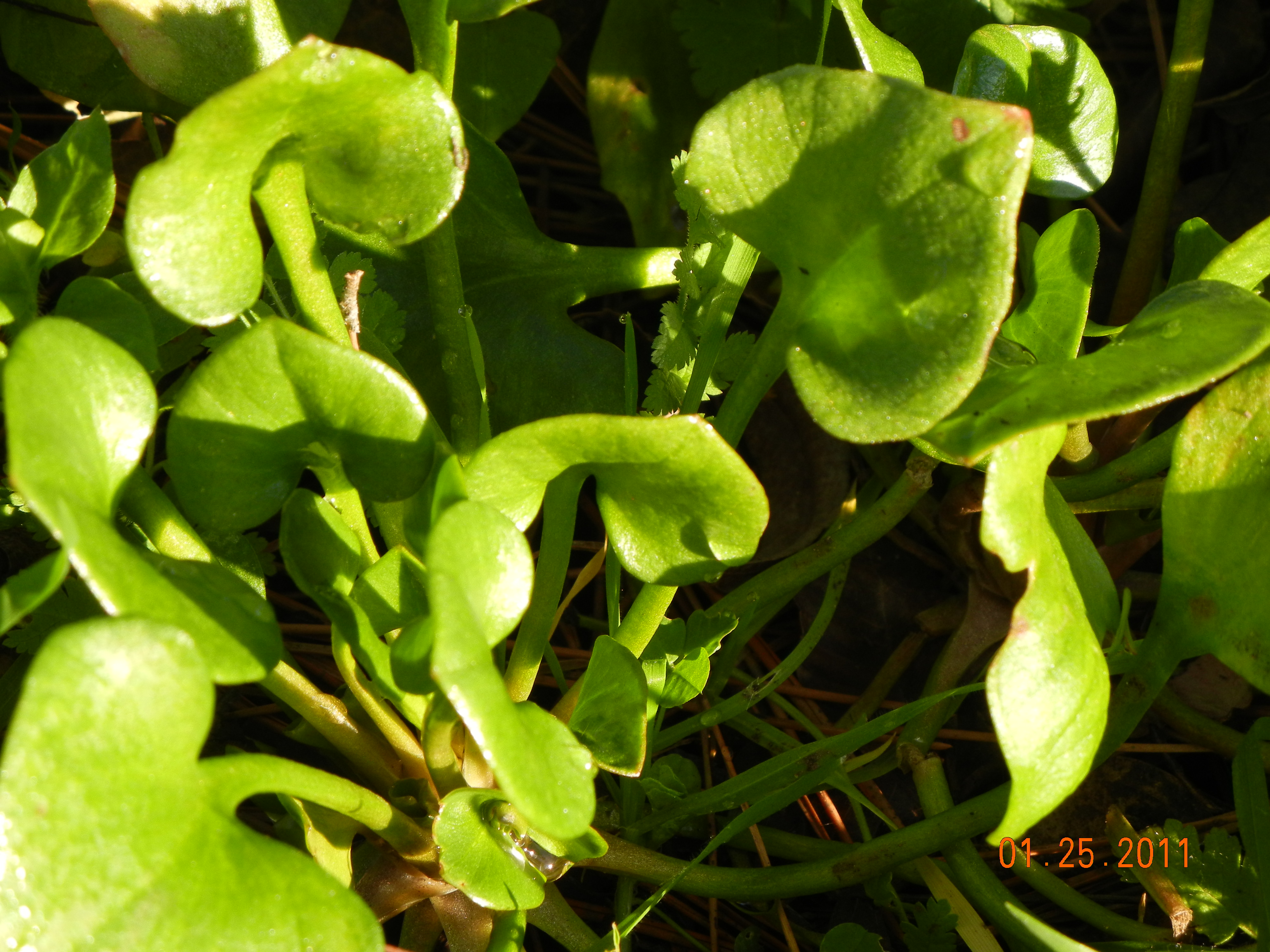
Miner’s lettuce (Claytonia perfoliata) is a short, bright green annual plant with fleshy leaves, with a texture like spinach. It grows in the wintertime in the Central Valley and along the Pacific Coast, and in early spring in the Sierra foothills. The gold rush miners ate it to augment their limited diet, and to prevent scurvy.

In January and February miner’s lettuce springs up all over the patch of ground between our front lawn and the road. We have quite a spread of it. I pick it to put in salads, and my grand-daughters like it to snack on when they are playing at grandma’s place. When I nibble on it, I like to think of the connection to the forty-niners, and the native Californians who also enjoyed this springtime delicacy.

Posted in Uncategorized | Leave a comment

January 1841

In January 1842 Bidwell was living at Bodega Bay and supervising work at Fort Ross. But where was he and what was he doing a year earlier in 1841?

He had staked a claim in the Platte Purchase in Missouri the fall of 1939, but a year later his claim was jumped by a man he described as “a sort of desperado.” Being under 21 years of age, Bidwell had no legal claim to the title, and lost his land to the ruffian. He spent the winter teaching school and trying to figure out what to do next.

John Bidwell was different from the usual run of frontier schoolteachers. According to his biographer, Rockwell Hunt, his teaching methods became the wonderment of both his students and their parents. Frontier children were generally a rough and unruly lot, and they were kept in line with strict corporal punishment. Children who were rowdy or didn’t pay attention were beaten or whipped. Everyone expected a teacher to use this kind of punishment daily. So it came as a surprise that John Bidwell did not whip his students. Years later one of them described what school was like with Mr. Bidwell as the teacher:

“The first day passed on, the second, the third, the fourth, the fifth, and one week passed, and to the surprise of all but the teacher not a scholar was whipped. To the utter astonishment of all the neighborhood, children and parents alike, not one felt the rod; and so month after month passed, and it seemed that one of the wonders of the world had struck Northwestern Missouri, in the person of a schoolteacher who would conduct a school so successfully.” (Hunt, p. 28)

Posted in Uncategorized | 1 Comment

Adventures in Fort Management

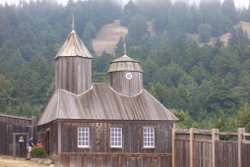
Fort_Ross_California_1843

Fort Ross in 1843. Courtesy of the Center for Sacramento History

At Bodega and Fort Ross John Bidwell took charge of removing the Russian property that John Sutter had purchased. It wasn’t just the cannons, the muskets, and other equipment that he took. The houses and buildings themselves were demolished and shipped to Sutter. He wrote:

During the time my occupation consisted in demolishing the houses at Fort Ross, and shipping the lumber up the Sacramento River, and sending almost everything in the shape of personal property. Russian plows, yokes, carts, house furniture, and everything transportable that could be made useful at Sacramento were sent.

All of these items, including lumber, were scarce commodities in early California, so all of it was valuable.

Even large circular threshing-floors (eras) in which the Russians were in the habit of tramping out their grain with bands of wild horses. These floors were made in the most substantial manner–the floors being made of hewn plank–six inches thick and perfectly matched together so tight that they would even hold water. The sides were planked about 8 feet high, with 4 1/2 in redwood lumber also hewn, for there was no such thing as sawmills there.

Elsewhere Bidwell described these floors as being some 100 feet in diameter, which is enormous.

Since they were tight enough to hold water, Bidwell had the idea of transporting them by towing them behind a boat, like a raft. This was attempted with one of the threshing floors, but it swamped and started to sink, so instead they had to take it apart to ship it.

I wish I could have seen the attempt.

Posted in Uncategorized | Leave a comment

Dan Barnett reviews John Bidwell

Dan Barnett’s review of John Bidwell: The Adventurous Life of a California Pioneer appeared in the Chico Enterprise-Record today. You can read it here.

I’ve been running out in the dark every Thursday morning for the past two months to pick up the paper, hoping his review was in The Buzz. And there it was this morning. Thanks, Dan!

My only quibble with his very pleasing review is that he calls it a book for teens. Teen will enjoy it, so will adults looking for a good short biography of Bidwell, and kids in grades 4-8. It’s probably a bit difficult for most readers in grade 4, but 4th grade teachers will find it invaluable, (if I do say so myself) since 4th grade is when California history is taught.

So if you’ve always wanted to know more about John Bidwell, this book is a good place to start. Contact me at bidwellbook (at) gmail.com, or check your local library!

Posted in Uncategorized | Leave a comment

More on those muskets

“By the way, I once shot off one of those old muskets. On one occasion when out with two Indians our dogs treed a California lion. The lion stood one hundred and fifty feet above on two limbs looking down at us, till I sent for one of the old muskets and shot him. The recoil of that weapon nearly knocked me down, bruised my face, lamed my shoulder, and still lingers unfaded on the page of my memory.” (Address to the Society of California Pioneers, p. 10)

Posted in Uncategorized | Leave a comment

A Long and Curious Journey

Arriving at Fort Ross in January 1842, John Bidwell undoubtedly found it cold, wet, and windy. But he went right to work, overseeing the job of packing and shipping every useful item at the Russian settlement to Sutter.

“Sutter bought them out — cattle and horses; a little vessel of about twenty-five tons burden, called a launch; and other property, including forty odd pieces of old rusty cannon and one or two small brass pieces, with a quantity of old French flint-lock muskets pronounced by Sutter to be of those lost by Bonaparte in 18l2 in his disastrous retreat from Moscow.” (Life in California Before the Gold Discovery, p. 168)

There’s no reason to believe Sutter wouldn’t have recognized Napoleonic-era muskets when he saw them. He was born in Switzerland in 1803, and grew up in a Europe convulsed by the Napoleonic wars. As a young man he served in the Swiss army, although he was only ten years old when Napoleon’s Grande Armee suffered its devastating retreat from Moscow in 1813.

It was one of the most lethal military campaigns in world history. An army of 449,000 men invaded Russia; only 22,000 returned to France. Even before any major battle, Napoleon’s army was diminished by disease, desertions and casualties sustained in minor encounters. Extensive losses occurred in battle. As the army retreated, men died of starvation and disease, or they were captured and executed. The final deadly blow was dealt by “General Winter” as the remnants of Napoleon’s army struggled through the hostile and frozen landscape that was Russia in the grip of winter.

Thousands and thousands of muskets must have been left behind, fallen from the hands of Napoleon’s defeated troops. Some of them ended up in the hands of the Russian-American Fur Company. They crossed Siberian Russia and the Bering Strait, and traveled southward with the trappers until they reached California. There at Fort Ross, sold to John Sutter, they made their way by boat down the coast and up the San Francisco Bay and the Sacramento River until John Sutter put them into the hands of his Native American soldiers and Spanish American vaqueros. A long and curious journey for the weapons of Napoleon’s Grande Armee.

Posted in Fort Ross, John Sutter | 3 Comments

January 8, 1842

“On the 8th of January ’42, I left Capt. S’s, in his employ for the Russian settlement. I descended the Sacramento in a launch of 30 tons, into the Bay of St. Francisco. I landed at Sousalita [Sausalito] pronounced Sow sa le ta, on the N. side of the Bay, in full view of the vessels lying at anchor at port St. Francisco. I here took it by land and in 3 days arrived at this place which is about 6 miles from Bodaga [sic], the Russian port, and 60 miles north of Port St. Francisco.” (A Journey to California, 1841: The Journal Account)

After about five weeks at Sutter’s Fort, eating ducks and learning Spanish, John Bidwell set out to take up his new assignment: dismantle Fort Ross. John Sutter had bought Fort Ross from the Russian-American Company the previous summer. John Bidwell would spend the next 14 months there, supervising the transfer of cattle and horses overland, and the shipment of weapons and equipment by boat to Sutter.

Posted in Fort Ross | Leave a comment

Do svidaniya, Russian-American Company!

The Russians are leaving! the Russians are leaving! — that was the news going around Sutter’s Fort when John Bidwell arrived there in the fall of 1841.

The Russian-American Company had established itself in northern California first in 1811. They built a settlement on the coast at Fort Ross, and later expanded southward to Bodega Bay. They held a charter from Spain which allowed them to hunt for furs in California and also to grow crops. Fort Ross was not only a base for fur-trading, it was also a source of foodstuffs for the Russian settlements in Alaska.

But by the mid-1830’s the fur haul was dwindling and the charter had expired. The Russians decided to pull out of Fort Ross. They put everything they had in California up for sale and the only taker was John Sutter. In the summer of 1841 he bought Fort Ross from the Russians, lock, stock, and barrel, for $30,000. Sutter acquired a wooden stockade complete with cannons, muskets, carts, tools, plows and thousands of cattle and horses. The only thing he didn’t get was the land, because the Russians didn’t own the land.

Sutter bought the fort and all its contents for $30,000, but of course he didn’t have $30,000. He agreed to pay off the debt in wheat over the next several years. But he never harvested enough wheat to fully pay off that debt. Sutter definitely got the better part of the deal with the Russians.

Sutter’s next problem was how to transport the contents of Fort Ross from the coast to his land grant on the Sacramento River. What he needed was a capable and reliable agent to do the job. Enter John Bidwell. When Sutter met Bidwell, he know he had found the man who could take care of his Fort Ross project.

Posted in Uncategorized | 1 Comment

Christmas in California, 1841

John Bidwell spent his first Christmas in California at Sutter’s settlement. Sutter himself hadn’t been there very long, and was only just getting started with his plans for fields and a fort.

“The settlement, if it could then be so designated, was in an embryo state. No crops had been raised; grain had been sown, but owing to an unprecedentedly dry season, it had failed to mature.” (Then, as now, the weather was unpredictable, and marginal for growing wheat without irrigation.)

“There was no such thing as bread, so we had to eat beef, and occasionally game, such as elk, deer, antelope, wild geese, and ducks. Our Christmas dinner that year was entirely of ducks.” (Colusa County, p. 37)

No mashed potatoes, no rolls, no jello salad, no Christmas cookies, or cheesecake, or pecan pie. Just ducks for Christmas dinner. But they wouldn’t go hungry, for there was no shortage of ducks and geese along the river. And John Sutter surely had a cask of brandy tucked away for special occasions. A merry California Christmas!

Posted in Uncategorized | Leave a comment