More on those muskets

“By the way, I once shot off one of those old muskets. On one occasion when out with two Indians our dogs treed a California lion. The lion stood one hundred and fifty feet above on two limbs looking down at us, till I sent for one of the old muskets and shot him. The recoil of that weapon nearly knocked me down, bruised my face, lamed my shoulder, and still lingers unfaded on the page of my memory.” (Address to the Society of California Pioneers, p. 10)

Posted in Uncategorized | Leave a comment

A Long and Curious Journey

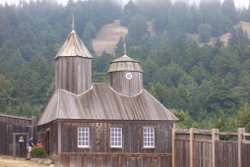
Arriving at Fort Ross in January 1842, John Bidwell undoubtedly found it cold, wet, and windy. But he went right to work, overseeing the job of packing and shipping every useful item at the Russian settlement to Sutter.

“Sutter bought them out — cattle and horses; a little vessel of about twenty-five tons burden, called a launch; and other property, including forty odd pieces of old rusty cannon and one or two small brass pieces, with a quantity of old French flint-lock muskets pronounced by Sutter to be of those lost by Bonaparte in 18l2 in his disastrous retreat from Moscow.” (Life in California Before the Gold Discovery, p. 168)

There’s no reason to believe Sutter wouldn’t have recognized Napoleonic-era muskets when he saw them. He was born in Switzerland in 1803, and grew up in a Europe convulsed by the Napoleonic wars. As a young man he served in the Swiss army, although he was only ten years old when Napoleon’s Grande Armee suffered its devastating retreat from Moscow in 1813.

It was one of the most lethal military campaigns in world history. An army of 449,000 men invaded Russia; only 22,000 returned to France. Even before any major battle, Napoleon’s army was diminished by disease, desertions and casualties sustained in minor encounters. Extensive losses occurred in battle. As the army retreated, men died of starvation and disease, or they were captured and executed. The final deadly blow was dealt by “General Winter” as the remnants of Napoleon’s army struggled through the hostile and frozen landscape that was Russia in the grip of winter.

Thousands and thousands of muskets must have been left behind, fallen from the hands of Napoleon’s defeated troops. Some of them ended up in the hands of the Russian-American Fur Company. They crossed Siberian Russia and the Bering Strait, and traveled southward with the trappers until they reached California. There at Fort Ross, sold to John Sutter, they made their way by boat down the coast and up the San Francisco Bay and the Sacramento River until John Sutter put them into the hands of his Native American soldiers and Spanish American vaqueros. A long and curious journey for the weapons of Napoleon’s Grande Armee.

Posted in Fort Ross, John Sutter | 3 Comments

January 8, 1842

“On the 8th of January ’42, I left Capt. S’s, in his employ for the Russian settlement. I descended the Sacramento in a launch of 30 tons, into the Bay of St. Francisco. I landed at Sousalita [Sausalito] pronounced Sow sa le ta, on the N. side of the Bay, in full view of the vessels lying at anchor at port St. Francisco. I here took it by land and in 3 days arrived at this place which is about 6 miles from Bodaga [sic], the Russian port, and 60 miles north of Port St. Francisco.” (A Journey to California, 1841: The Journal Account)

After about five weeks at Sutter’s Fort, eating ducks and learning Spanish, John Bidwell set out to take up his new assignment: dismantle Fort Ross. John Sutter had bought Fort Ross from the Russian-American Company the previous summer. John Bidwell would spend the next 14 months there, supervising the transfer of cattle and horses overland, and the shipment of weapons and equipment by boat to Sutter.

Posted in Fort Ross | Leave a comment

Do svidaniya, Russian-American Company!

The Russians are leaving! the Russians are leaving! — that was the news going around Sutter’s Fort when John Bidwell arrived there in the fall of 1841.

The Russian-American Company had established itself in northern California first in 1811. They built a settlement on the coast at Fort Ross, and later expanded southward to Bodega Bay. They held a charter from Spain which allowed them to hunt for furs in California and also to grow crops. Fort Ross was not only a base for fur-trading, it was also a source of foodstuffs for the Russian settlements in Alaska.

But by the mid-1830’s the fur haul was dwindling and the charter had expired. The Russians decided to pull out of Fort Ross. They put everything they had in California up for sale and the only taker was John Sutter. In the summer of 1841 he bought Fort Ross from the Russians, lock, stock, and barrel, for $30,000. Sutter acquired a wooden stockade complete with cannons, muskets, carts, tools, plows and thousands of cattle and horses. The only thing he didn’t get was the land, because the Russians didn’t own the land.

Sutter bought the fort and all its contents for $30,000, but of course he didn’t have $30,000. He agreed to pay off the debt in wheat over the next several years. But he never harvested enough wheat to fully pay off that debt. Sutter definitely got the better part of the deal with the Russians.

Sutter’s next problem was how to transport the contents of Fort Ross from the coast to his land grant on the Sacramento River. What he needed was a capable and reliable agent to do the job. Enter John Bidwell. When Sutter met Bidwell, he know he had found the man who could take care of his Fort Ross project.

Posted in Uncategorized | 1 Comment

Christmas in California, 1841

John Bidwell spent his first Christmas in California at Sutter’s settlement. Sutter himself hadn’t been there very long, and was only just getting started with his plans for fields and a fort.

“The settlement, if it could then be so designated, was in an embryo state. No crops had been raised; grain had been sown, but owing to an unprecedentedly dry season, it had failed to mature.” (Then, as now, the weather was unpredictable, and marginal for growing wheat without irrigation.)

“There was no such thing as bread, so we had to eat beef, and occasionally game, such as elk, deer, antelope, wild geese, and ducks. Our Christmas dinner that year was entirely of ducks.” (Colusa County, p. 37)

No mashed potatoes, no rolls, no jello salad, no Christmas cookies, or cheesecake, or pecan pie. Just ducks for Christmas dinner. But they wouldn’t go hungry, for there was no shortage of ducks and geese along the river. And John Sutter surely had a cask of brandy tucked away for special occasions. A merry California Christmas!

Posted in Uncategorized | Leave a comment

Grizzlies

Today the only grizzly bears to be seen in California are on the state flag. But in John Bidwell’s day, grizzlies were a common sight, and a significant danger. California in 1841 was a land abounding in wild game–deer, antelope, and elk roamed the valley, and salmon and other fish filled the streams. Where there is meat, there will also be predators, and chief among these was the grizzly bear. Bidwell reported that “The grizzly bear was an hourly sight. In the vicinity of streams it was not uncommon to see thirty or forty in a day.” He tells the following story about his friend, Jimmy John.

Jimmy got tired of eating beef, and decided that he would get himself some bear meat, and so went out with an old Rocky Mountain hunter named Bill Burrows.

“It was only a walk or one, two or three miles to find bear, so they started and soon came in sight of one, a monster in size, feeding in the tall grass not far from the river timber, on the west side of the Sacramento River. . . Jimmy John went to within fifty yards of the bear and fired, the old mountaineer screaming at him, “You fool! Don’t go there! Come back!” But Jimmy was one of those strange individuals you may see once in a life-time, who never seem to know what fear is.”

Jimmy shot at the bear, wounding it, and the bear broke into the thicket of grapevine and willow on the riverbank. Jimmy followed right after him, but after fifteen minutes came out greatly disappointed, because he had not been able to kill the bear.

“He said he had bad luck because he got within six feet of the bear and fancied he was wounded, and when the animal opened his mouth, he wanted to make sure work of it by thrusting his muzzle into it, but the bear suddenly took to his heels and scampered off still deeper into the thicket.” (Colusa County, p. 37)

Bad luck or good luck? Escaping the jaws of a wounded grizzly may not have been such bad luck after all.

Posted in Uncategorized | Leave a comment

“Everybody goes to Sutter’s”

It seems that in 1841 California, Sutter’s establishment was like Rick’s Cafe Americaine in Casablanca.

“Nearly everybody who came to California made it a point to reach Sutter’s Fort. Sutter was one of the most liberal and hospitable of men. Everybody was welcome—one man or a hundred, it was all the same.” (Echoes of the Past, p. 169)

John Bidwell spent the month of December at Sutter’s settlement. The first order of business was to learn the Spanish language. Alta California, as it was then known, was a province of Mexico, and to accomplish anything there Bidwell was going to have to know the language. Even the Indians, if they spoke any language other than their native tongues, spoke Spanish, “that being the language of the country,” as Bidwell wrote, “and everybody had to learn something of it.”

So he got right to work learning Spanish, and in five weeks had a good basic grasp of it, which would improve as he spent more time in California. In later years his wife, Annie, would be quite proud of his ability to speak Spanish. He spoke it so well, and with such a good accent, she maintained, that the Spanish ambassador complimented him on it.

Posted in John Sutter | Leave a comment

John Sutter

John Augustus Sutter (born Johann August Suter in 1803) claimed to have been a captain in the Swiss Guard, and to further that image, bought himself a uniform jacket in St. Louis, before heading westward. He may have served in the Swiss military, but he was never an officer. Fleeing debt and leaving behind in Switzerland a wife and five children, he emigrated to the United States in 1834.

After some time in Santa Fe and St. Louis, he joined a party of missionaries traveling to Oregon, arriving there in October 1838. Sutter wanted to settle in California, but he had to take a circuitous route to get to his goal. Rather than travel overland, he took ship at Fort Vancouver for the Sandwich Islands. There he found that the only ship going to California was sailing to Alaska first, so along with some Kanakas, as Hawaiians were then called, he embarked for Sitka. After a month there, the ship sailed for California, where John Sutter arrived on July 1, 1839.

A year later Sutter became a Mexican citizen in order to qualify for a land grant. By the summer of 1841, while the Bidwell-Bartleson Party was still trekking across the Great Basin, Sutter settled himself on 48,000 acres of land granted to him by the Mexican governor. His rancho was located where the Sacramento and Americans Rivers came together in central California. This was an area unsettled by the Mexicans, who clustered along the Mission Trail near the coast. Sutter named his settlement New Helvetia after his native land of Switzerland (Helvetia in Latin) and set about planning how to build his inland empire.

Posted in Uncategorized | 2 Comments

November 28. 1841

John Bidwell and his two friends arrived at Sutter’s establishment on November 28th, 1841. Sutter had himself only been there a few months, and had not yet built Sutter’s Fort. At best he had the two-story adobe that still stands in the middle of the fort.

Bidwell later wrote, “On the eighth day we came to Sutter’s settlement; the fort had not then been begun. Sutter received us with open arms and in a princely fashion, for he was a man of most polite address and the most courteous manners, a man who could shine in any society.”

Sutter had arrived in California from Oregon, by way of Hawaii by way of Sitka, Alaska, in 1839, accompanied by 10 Hawaiians (or Kanakas, as they were then called). After becoming a Mexican citizen in 1840, he was granted a tract of land, in June of 1841, where the Sacramento and American Rivers met. Sutter was a man with wide-ranging ideas on how to make money in California. He envisioned a valley filled with farms, mills, shops, and men, all working to develop the riches of California. And he, John Sutter, would be in charge of it all. To realize his dreams he needed manpower, and lots of it. He was hiring fur trappers, vaqueros, farm laborers, and skilled craftsmen, if he could find them.

Sutter was delighted to meet John Bidwell. This was just the kind of man he needed. A man who knew how to write clearly, keep accounts, survey property lines, and draw maps was a rare find indeed. He promptly hired him as his clerk.

For his part, John Bidwell took to Sutter right away. Sutter was everything Marsh was not: cheerful, generous, hospitable. Bidwell would work for Sutter off and on for the next 8 years.

Posted in Uncategorized | Leave a comment

November 27, 1841

John Bidwell and his two companions had spent a week slogging through rain and mud on their way to Sutter’s. They were out of provisions, hungry and tired. On the day before they arrived at Sutter’s the weather finally cleared.

“The storm abated. The sun came out through masses of clouds, vast herds of antelopes seen and I went in advance to kill some game, there being no gulch or depression in the surface which was not filled with water, whereby I could possibly approach. I failed to do more than frighten the antelope, and cause them to gather in a larger band by roaming around as all who saw antelope can readily understand. Having crawled upon the ground until my gun was wet and unfit to rely upon . . . I resolved to discharge it, wipe it out and reload. Holding it at an angle of 45 degrees slowly went off. Going on in the direction we were traveling, at a distance of more than half a mile I think, I saw an antelope, and supposed he had ended his days there—on examination I found my ball had struck in his eye.”

Antelope for dinner, no doubt!

Posted in Uncategorized | Leave a comment