
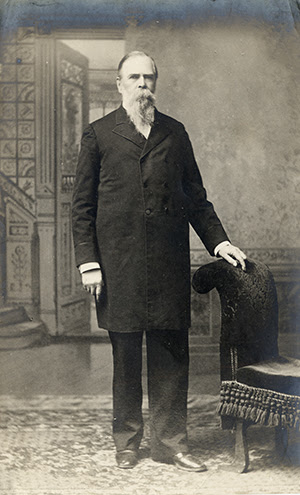
Does this photograph of John Bidwell look familiar? If you ever visited Bidwell Mansion, it might stir a memory in the back of your mind. The stance, the long black coat, the forthright gaze — isn’t that a lot like the painting that hung in the main hall?
In 1891 Annie prevailed upon John to have a full-length photograph taken at I.W. Taber’s photography studio in San Francisco. Five months after his death in 1900 she ordered “a life-size copy from the negative of Beloved,” from Taber. Later that year, while in Washington, she took the print to the studio of Alice Reading in Baltimore to discuss having Bidwell’s portrait painted. Alice M. Reading was the daughter of Pierson B. Reading, a Sacramento Valley pioneer and friend of John Bidwell from the Sutter’s Fort days.
Annie would prove difficult to satisfy. In 1903 she brought Alice Reading and the unfinished portrait home to Chico with her. Frustrated that Alice couldn’t re-produce the ideal portrait she saw in her mind, she took Alice to Sacramento to show her a portrait of Gov. Manuel Micheltorena for inspiration.
The work on the portrait suffered a setback in August when Alice was thrown from a horse and broke her collarbone. Franklin Lusk, Bidwell’s attorney and a close friend, examined her work to date and “thought the life size portrait wonderfully good likeness, even in unfinished state.”
By December both Annie Bidwell and Alice Reading were sick in bed at the Mansion. Annie sent for Dr. Ella Gatchell to see Alice, and was told “Alice should go home as she was homesick, doctor said – and tired of painting.” Alice had tried, but no amount of reworking could please Annie. Alice was given her final payment, and the artist was free to return to her studio in Baltimore.
The painting shows General John Bidwell in the same pose and same costume as the Taber photograph, but rather than a photographer’s prop chair, his hand rests on his Daniel Webster chair, and rather than the studio’s painted backdrop, the background is that of a leafy forest.
The painting hung in the Mansion until Annie’s death. In her will she deeded it to the State of California. It was taken to Sacramento, where it was displayed in the State Capitol for many years. In 1966 it was returned, and hung in its former place in the Bidwell Mansion main hall (Chico Enterprise Record, June 25, 1966).
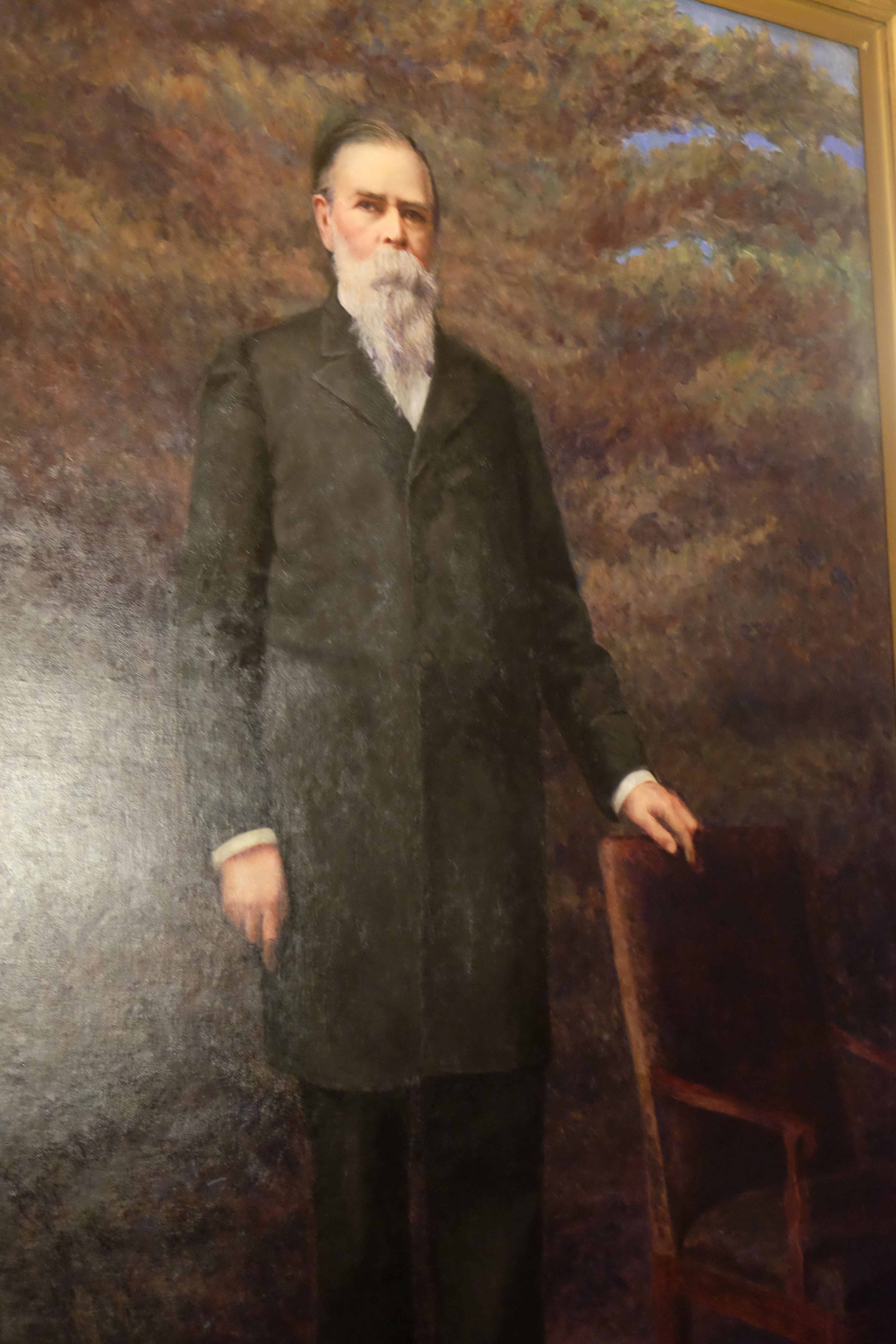
As visitors were told, and many schoolchildren remember, the General’s eyes seem to follow the viewer no matter where in the hall they stood. Known as “ubiquitous gaze” or “pursuing eyes,” this is an effect of perspective and a technique of the trompe-l‘oeil (trick of the eye) school of painting. Certain portraits, such as the Mona Lisa and the portrait of John Bidwell, give the impression that the subject’s eyes are following the viewer.
This painting became one of the defining objects in the Mansion. Its place in the main hall, its imposing scale, and the famous effect of the General’s “following eyes” ensured that it remained in the memory of visitors long after they left the house. In this way, perhaps its legacy fulfilled Annie’s purpose even more fully than she imagined.








Very Interesting. Yes I remember the Generals eyes following you around the room’ Think that was the first photograph where I had that experience. Very memorable. Glad I had it, especially since it is no longer available. Thanks for posting this. Chuck