Farewell to Jennie Carter

Jennie Carter wrote for The Elevator from July 1867 to December 1874. She may have written more, but a number of issues of The Elevator are missing in the years leading up to her death in 1881. Her last offering was a story for Christmas, not a cheerful tale, but a true tale of rival cousins that ended in tragedy on a Southern plantation.

Have you often thought, dear reader, that this world would be far nicer if no one said harsh things, never reproved when necessary, if they had heard wrong, smile and pass on. There are many, yes, the majority who do just do, others like true heroes, count the cost and speak against wrong. Those are our moral surgeons who sever a limb that the body may live.

Jennie Carter: A Black Journalist of the Early West, pp. 129 (19 December 1874)

Jennie was just such a “moral surgeon,” who did not hesitate to call out wrongs, whether it was the evils of slavery or drunkenness on the street. She wrote in support of women’s rights, temperance, equal education for all children, and the rights of black citizens to have a say in government and community affairs.

Jennie died on August 10, 1881 of what sounds like a heart attack. She was only 50 years old, possibly 51. (My thanks to the author of Following Deer Creek, a Nevada County blog, for making this obituary available.)

The Daily Transcript (Nevada City) 12 August 1881

“When I die, I hope no one will eulogize me, but simply say Mrs. Trask has gone to sleep. That will be the truth.” Jennie Carter, writing as “Semper Fidelis,” The Elevator 9 December 1867.
Posted in Jennie Carter, Uncategorized | Leave a comment

A Grand Celebration

For her column in The Elevator Jennie Carter reported on a grand celebration in Nevada City.

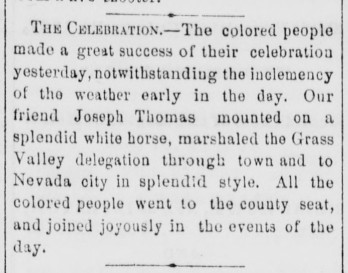
Grass Valley Morning Union 13 April 1870

Jennie wrote:

Mr. Editor.– The celebration here on the 12th was a decided success, and has done much to give influence to the colored people. Notwithstanding snow and mud in the morning, the Grass Valley folks were in time, and were met on the edge of town by the Lincoln Club with music, and escorted to the Congregational Church, where all listened to a sermon by Rev. Alexander Packer [Parker], most appropriate to the occasion . . .

At the church a procession was formed, which was something to be proud of here in the Sierras, headed by our band, which can’t be beat.

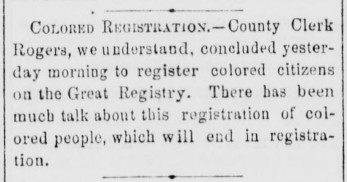
Jennie’s husband, Dennis D. Carter, was the band leader. But what were the citizens celebrating? They were marking the ratification of the 15th amendment to the U.S. Constitution, which prohibits denying or abridging a citizen’s right to vote “on account of race, color, or previous condition of servitude.” The amendment was certified on March 30, 1870, and men of color wasted no time in getting their names on the Great Register (although the state of California had rejected the amendment, and would not ratify it until 1962).

Grass Valley Morning Union 13 April 1870

The school children, Lincoln Club, with their beautiful banner, citizens on foot and in carriages, marched through the principal streets, eliciting from many on the sidewalks a hearty “God bless you,” and “ain’t this glorious,” and even the Democrats wreathed their faces with smiles, and only one ventured to spit his spite.

Jennie was consistently critical and scornful of the Democratic Party, which had opposed rights for African Americans.

The procession entered the theater, where the children sang “America,” and several speeches were given. “I never saw an audience kept in such complete good nature, and never did the Democracy [the Democrats] receive a more direct dressing.” (By which she means a dressing-down, or scolding.)

The day proved to be pleasant, the streets soon dried, and all walked about with ease until evening, when a grand ball wound up the affair here.

Jennie Carter: A Black Journalist of the Early West, pp. 90-91 (excerpts)
Posted in Black History Month, Jennie Carter, Uncategorized | Leave a comment

Free Museum Presentation

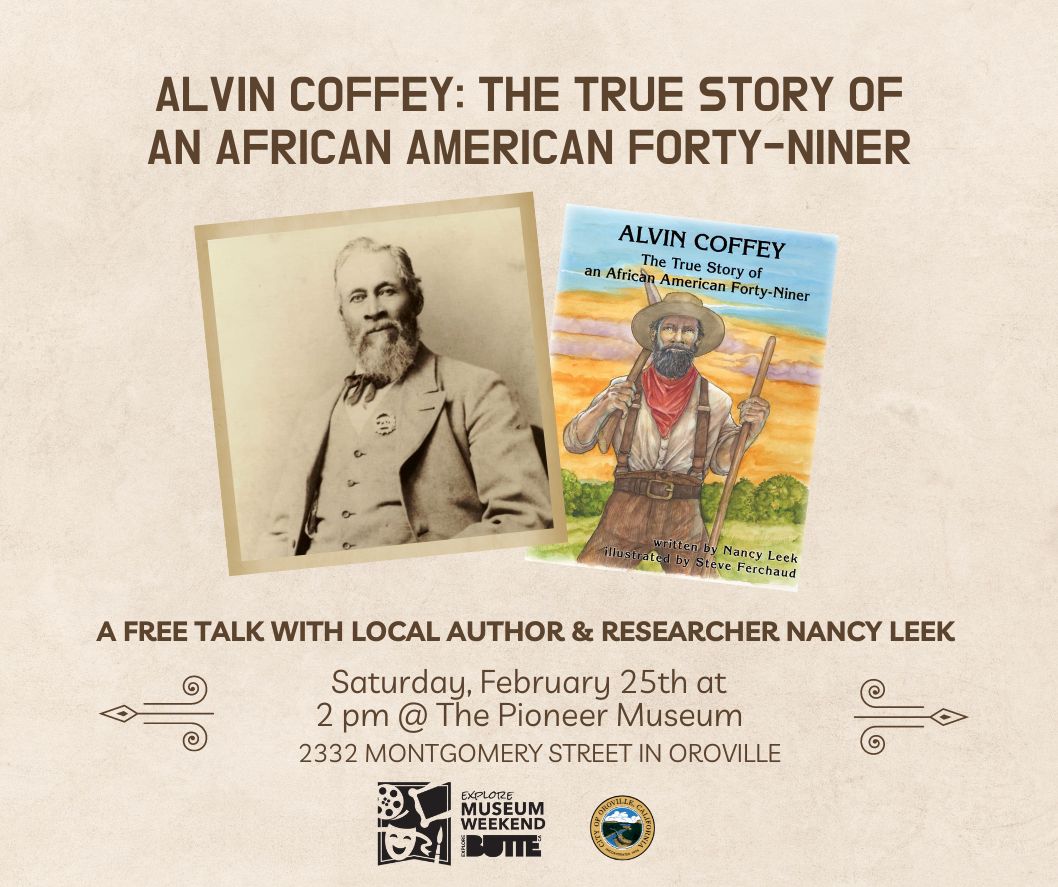
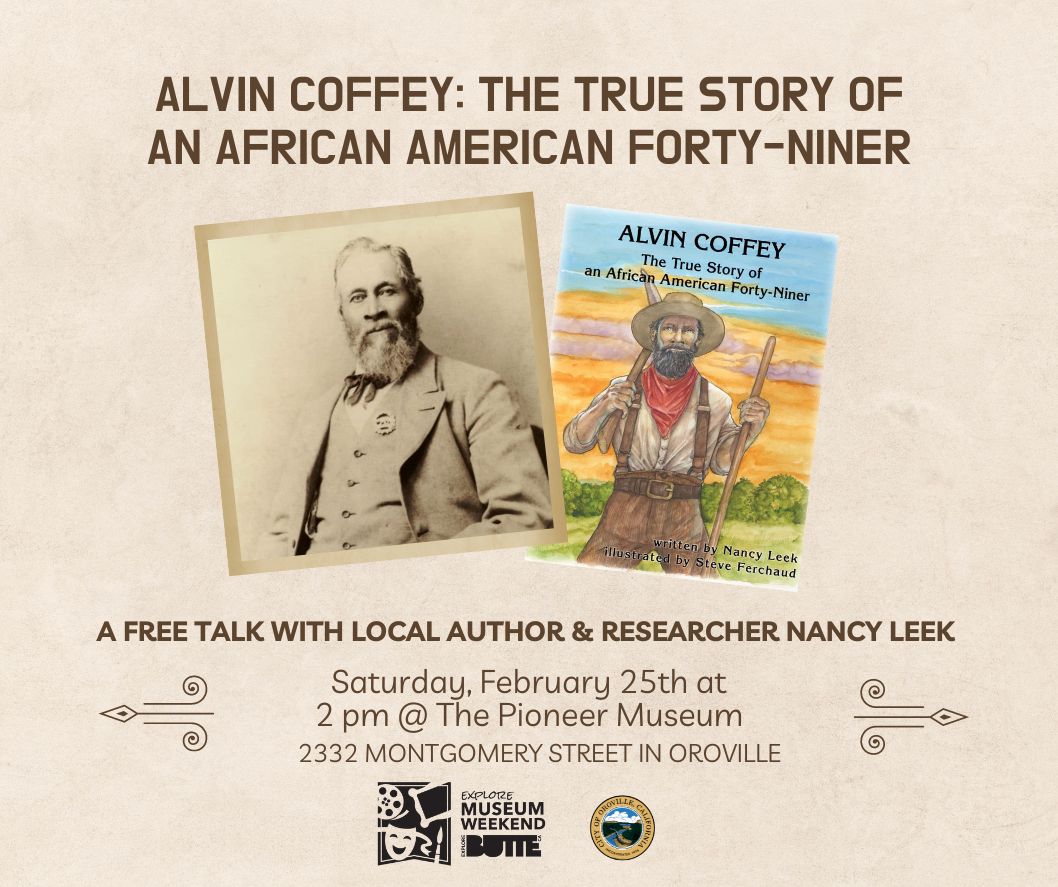
It’s free museum weekend in Butte County and I will be giving a free talk at the Pioneer History Museum in Oroville. Please come and meet me, enjoy the museum, and learn about Alvin Coffey and Black Slavery in Gold Rush California. It’s a fascinating and little-known topic.

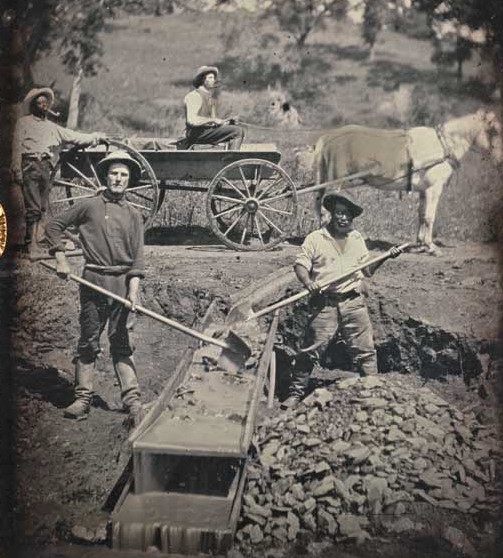
Black and white miners working together at Spanish Flat, 1852. California State Library.
Posted in Uncategorized | Leave a comment

Jennie Carter Visits Oroville

Jennie Carter, African-American journalist writing for The Elevator, predicted the future of California in all its scenic variety and human diversity.

Oroville, June 13, 1869

Mr. Editor,–California as a part of Uncle Sam’s domains is truly an important part, and that she will furnish homes for thousands of Europe’s poor, Asia’s industrious and Africa’s once despised is a thing only of days. To know the greatness of our state one must ravel its length and breadth, visit its mountains and valleys, hills and plains. California embraces all climates; it has regions of perpetual summer, and Sierras where eternal winter reigns, fields ever bright with perennial green, and forests always glowing with Autumnal beauty.

Oroville, the county seat of Butte County, is a pleasantly located town, connected by Railroad with Marysville, and of course, easy of access to San Francisco, the city of cities of California. From Marysville here is one continuous plain, a level country sparsely settled although a great part of the land is under cultivation, but I should think from what I saw not properly cultivated.

(Jennie thought the farms of the valley lacked the “neatness and thrift” of New England farms, due to the “ever-restless feeling” of money-making of California folks.)

Oroville was small — 1425 residents in 1870. Jennie found “very few colored people” living in Oroville. She admired the streets and houses of Oroville.

That the people of Oroville are imbued with taste is manifest in the improvements made, the regularity of the Streets — the comfortable houses and yards full of fruit trees and flowers. I think I have seen no prettier place in California for a home than Oroville. It is a mining town, but surrounded by land fit for agriculture which argues well for the continued prosperity of the place.

Jennie Carter: A Black Journalist of the Early West, pp. 73-74 (excerpts)

The local paper (the Weekly Butte Record) didn’t impress her as anything better than an “itemized journal” that “answers the people for an advertizing medium,” but didn’t offer much beyond that. Nevertheless, she saw in Oroville not only a pleasant town, but a place rich with agricultural promise.

Blacksmith shop on Montgomery Street, Oroville c. 1868
Posted in Jennie Carter, Uncategorized | 2 Comments

Jennie and Dennis Carter

Jennie occasionally used stories from her husband’s life to illustrate her writings. In 1866 she had married Dennis Drummond Carter in Nevada County, California. Dennis was born free in Virginia in 1814. After the death of his father, his mother took her family to Philadelphia to preserve their freedom. He came to California around 1852, not long after the harrowing incident recorded here.

He was a popular musician and band leader in Nevada City. He was also considerably taller than the average man. In the following column Jennie calls him Mr. Trask (since she wrote as Ann J. Trask).

Mud Hill, December 12, 1868.

Mr. Editor.– “Six feet two inches;” so said Mr. Trask to an inquiry in regard to his height. I told him I thought he was mistaken; he said not, for he was measured, and had his measurement recorded at Harper’s Ferry in the summer of ’51, as he was returning from Sulphur Springs, Va., where he had been for several weeks with the other members of Frank Johnson’s band.

Judge his indignation when he arrived at Harper’s Ferry; he was asked who he belonged to, if he had any scars upon him, and then measured, and told he would have to stay over night as no colored person could travel after 4 o’clock P.M. He stood up and in his wrath I guess he was six feet three inches, he pronounced curses on that State. They then threatened him with the lash, and he told them to proceed, that the first one to lay hands on him would die. And their courage was no greater then than years after, when John Brown, with a handful of men frightened the whole State, for they told Mr. Trask they knew he was a free nigger, he was so independent, and they have long since suffered all the curses Mr. Trask pronounced upon them. . .

Born free, living in Philadelphia, associating with men and women, respected as a gentleman, the insult will never be forgotten. And when anyone asks him his height he will say six feet two inches, and think of that occurrence.

Jennie Carter: A Black Journalist of the Early West, p. 53
Morning Union (Grass Valley) 16 April 1873

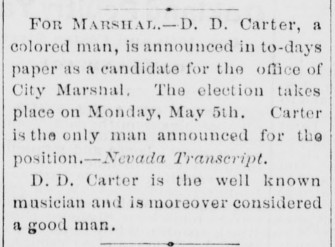
I wish I could find a photograph of Dennis and Jennie Carter but I haven’t seen one so far. Dennis Carter was active in community affairs, serving on juries, running for office, active in the Republican Party and the Masons. He died in 1894, having survived his wife by 13 years.

Posted in Jennie Carter | 1 Comment

Jennie Carter on Women’s Art

Letter from Nevada County. Mud Hill, May 3, 1868

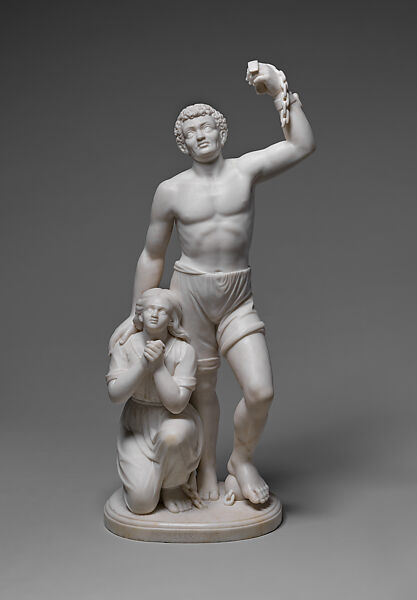
Mr. Editor:– All women admire the beautiful. Here lies a broad field for woman’s talent–painting, sculpting, music, all the fine arts. Here her intuitive faculties can have full play; she can work around her own fireside–and gentlemen, there are many artists among us who adorn their own homes with what you are pleased to call knickknacks. All these things have given her pleasure in creation, and if encouragement were given, more than one Edmonia Lewis might gratify our vision with beautiful creations in marble.

. . . How proud we all feel of our own Miss Greenfield, and rejoice when the Anglo Saxon race had given to the world no sweeter singer than our own Black Swan.

What adorns our own homes more than pictures? Good pictures have a refining influence on the mind, and who of us would be without the portrait of the great and good Lincoln? Let us encourage our children in the use of the pencil and if the artist lurks there we shall soon perceive it. . .

The great world of letters is open to women, and those that have leisure know not, until perused, the pleasure derived from good books as companions. There is no scandal, no backbiting, no recriminations, no criticisms of surroundings, and when you close the book, then put your reflections on open paper.

Jennie Carter: A Black Journalist of the Early West, pp. 33-34 (excerpts)
Forever Free, by Edmonia Lewis
Posted in Jennie Carter, Uncategorized | 2 Comments

More from Jennie Carter, Black California Journalist

Some time ago I wrote about Jennie Carter, who lived in Nevada City and wrote letters and columns for the Elevator (San Francisco) newspaper. At the time I didn’t have a book about her, but now I do, and I plan to give you more of her enjoyable and encouraging writings.

The book is Jennie Carter: A Black Journalist of the Early West, edited by Eric Gardner and published by the University Press of Mississippi. Gardner has collected all the columns he could find, but some issues of the Elevator are missing, and Jennie may have written for other periodicals under other names. Like many 19th century writers, she used a nom de plume. At first she called herself Ann J. Trask, and claimed to be a woman some twenty years older than she really was, living at “Mud Hill” in Nevada County. Most of her columns are signed “Semper Fidelis.” Who knows what other pseudonyms she may have used for other publications.

Her early columns were directed at children, but she soon found herself writing for everyone. She had great hopes for the young rising generation, free from the bondage of the past. She wrote:

Children, you hear a great deal said about color by those around you, see attention given white persons by your friends that is wholly unmerited, while those of darker skin are treated with cool neglect. Such are wrong, and that you may avoid like mistakes I write this for you to read. Let your motto be, civility to all, servility to none. Those reminders of bondage we must get out of the way as soon as possible; and while we would treat all with respect, we should not talk about color, light and dark, black and white.

It is a mistake to think we are elevated by having white associates. Ten to one they are ashamed to be seen in our company, and only endure us for the help we give them in doing their drudgery. . . .

Now children, we do not expect to get the older ones right in this matter, but we want you to come up right, for nations and people, like individuals, have to form characters. I wish to impress it upon all that we are passing through a transition state, forming a character that shall tell on millions yet to come, and this world is looking on with over critical eyes to see us assume our places among men. . . .

Throw away prejudices of caste and color. Strive to grow in ways mental, moral, as well as physical. Let our young men adopt none of the vices of the Anglo-Saxon; our young women have all refinements of those around them, and the dear children every encouragement to study. Oh, that we might awake to the importance of a thorough, universal education. It is already acknowledged that we have the capacity; let not the world say that we lack the energy.

Jennie Carter: A Black Journalist of the Early West, pp. 4-5

Wise words! But Jennie didn’t always write in a moralizing mood. She often told stories drawn from her childhood, and painted pictures of everyday life. In the next few days I’ll give you more from “Semper Fidelis.”

Posted in Jennie Carter | 4 Comments

Free Museum Weekend!

February 25th and 26th is Free Museum Weekend in Butte County, with more events and activities than anyone could possibly fit into one weekend. All participating museums, galleries, and cultural centers will offer free admission from 10am-4pm all weekend, and not only that, each museum has a new exhibit or extra offering for the weekend.

I’ll be in Oroville, speaking at the Pioneer History Museum on “Alvin Coffey and Slavery in California.” Come meet me at 2:00 p.m. — I’d love to meet you. The museum has a great collection sure to please any history buff.

Before or after you can visit some of the other great history venues in Oroville: the C.F. Lott home, the Chinese Temple, the Butte County Historical Society Museum, or Bolt’s Antique Tool Museum. So many choices!

Posted in Uncategorized | 1 Comment

A Valentine from the Bard of Butte

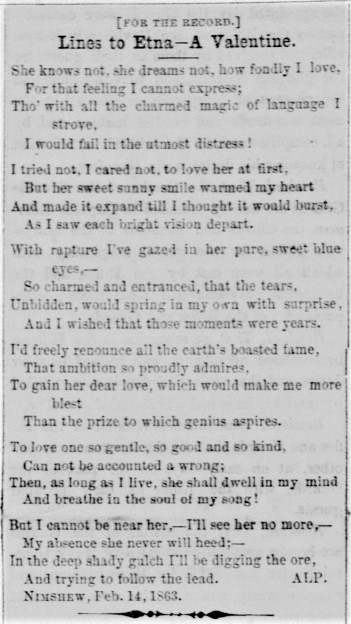
Our very own Bard of Butte, poet Pres Longley, penned this valentine one hundred and sixty years ago. It appeared in the Weekly Butte Record on February 28, 1863, and undoubtedly touched many a lonely miner’s heart.

Lines to Etna -- A Valentine

She knows not, she dreams not, how fondly I love,
  For that feeling I cannot express;
Tho' with all the charmed magic of language I strove,
  I would fail in the utmost distress!

I tried not, I cared not, to love her at first,
  But her sweet sunny smile warmed my heart
And made it expand till I thought it would burst,
  As I saw each bright vision depart.

With rapture I've gazed in her pure, sweet blue eyes,--
  So charmed and entranced, that the tears,
Unbidden, would spring in my own with surprise,
  And I wished that those moments were years.

I'd freely renounce all the earth's boasted fame,
  That ambition so proudly admires,
To gain her dear love, which would make me more blest
  Than the prize to which genius aspires.

To love one so gentle, so good and so kind,
  Can not be accounted a wrong;
Then, as long as I live, she shall dwell in my mind
  And breathe in the soul of my song!

But I cannot be near her,-- I'll see her no more,--
  My absence she never will heed:--
In the deep shady gulch I'll be digging the ore,
  And trying to follow the lead.    ALP
Nimshew, Feb. 14, 1863

Who Etna was we do not know, but ALP was his pen name, a rearrangement of the initials of his name, Alexander Preston Longley. Happy Valentine’s Day, Pres!

Posted in Pres Longley, Uncategorized | Leave a comment

Lucy and Freedom

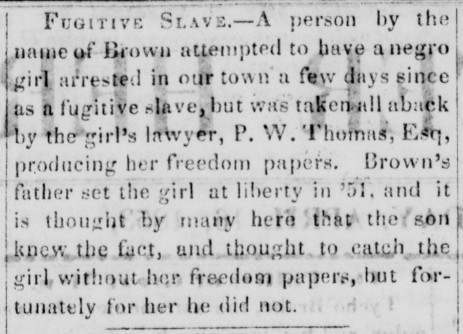
Black history in California has many tales to tell of slavery and freedom. Here is just one, the story of a girl named Lucy, who proved her freedom in spite of an attempt to re-enslave her.

Placer Herald 16 April 1853

In the same issue of the Placer Herald, an item explained that Lucy had been set free in 1851 by James Brown Sr., but that the son hoped to “catch the girl without her freedom papers” and take her back to Missouri as a slave. Fortunately for Lucy, she had friends, included lawyer P.W. Thomas.

Posted in Black History Month | 1 Comment