President Lincoln and California

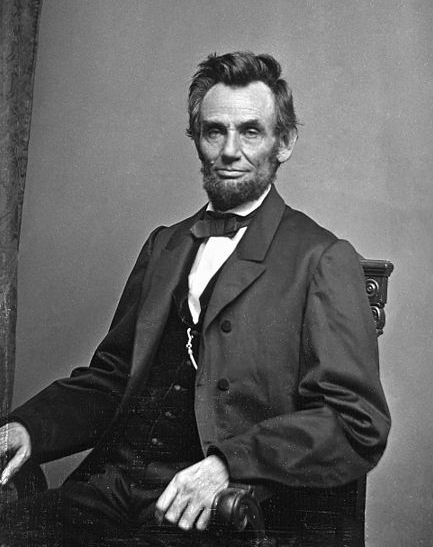
Happy Birthday to President Abraham Lincoln, born on February 12, 1809.

Although he never visited California, he was very aware of its importance in the Union and hoped one day to see it for himself.

To his life-long friend Charles Maltby, who served as Superintendent of Indian Affairs for California, he wrote:


“I have long desired to see California; the production of her gold mines has been a marvel to me, and her stand for the Union, her generous offerings to the Sanitary Commission, and her loyal representatives have endeared your people to me; and nothing would give me more pleasure than a visit to the Pacific shore…”

Not long before he left for Ford’s Theater on the last evening of his life, Lincoln discussed California with House Speaker Schuyler Colfax (for whom Colfax, California is named). Colfax was about to leave on a trip to California and Lincoln said to him:

“During the war, when we were adding a couple of million dollars every day to our national debt, I did not care about encouraging the increase in the volume of our precious metals. We had the country to save first. But now that the rebellion is overthrown and we know pretty nearly the amount of our national debt, the more gold and silver we mine makes the payment of that debt so much the easier.

Tell the miners from me, that I shall promote their interests to the utmost of my ability; because their prosperity is the prosperity of the nation, and we shall prove in a very few years that we are indeed the treasury of the world.”

quoted in “Abraham Lincoln and California ” https://www.abrahamlincolnsclassroom.org/abraham-lincoln-state-by-state/abraham-lincoln-and-california/

If only Lincoln had lived! As a promoter of the transcontinental railroad, he might have been on the first train the California, to see her marvelous gold mines and prosperous cities. John Bidwell, who met Lincoln in 1864, would have been happy to welcome him to his home in Chico.
Posted in Abraham Lincoln | 3 Comments

A Black Vaquero in Butte County

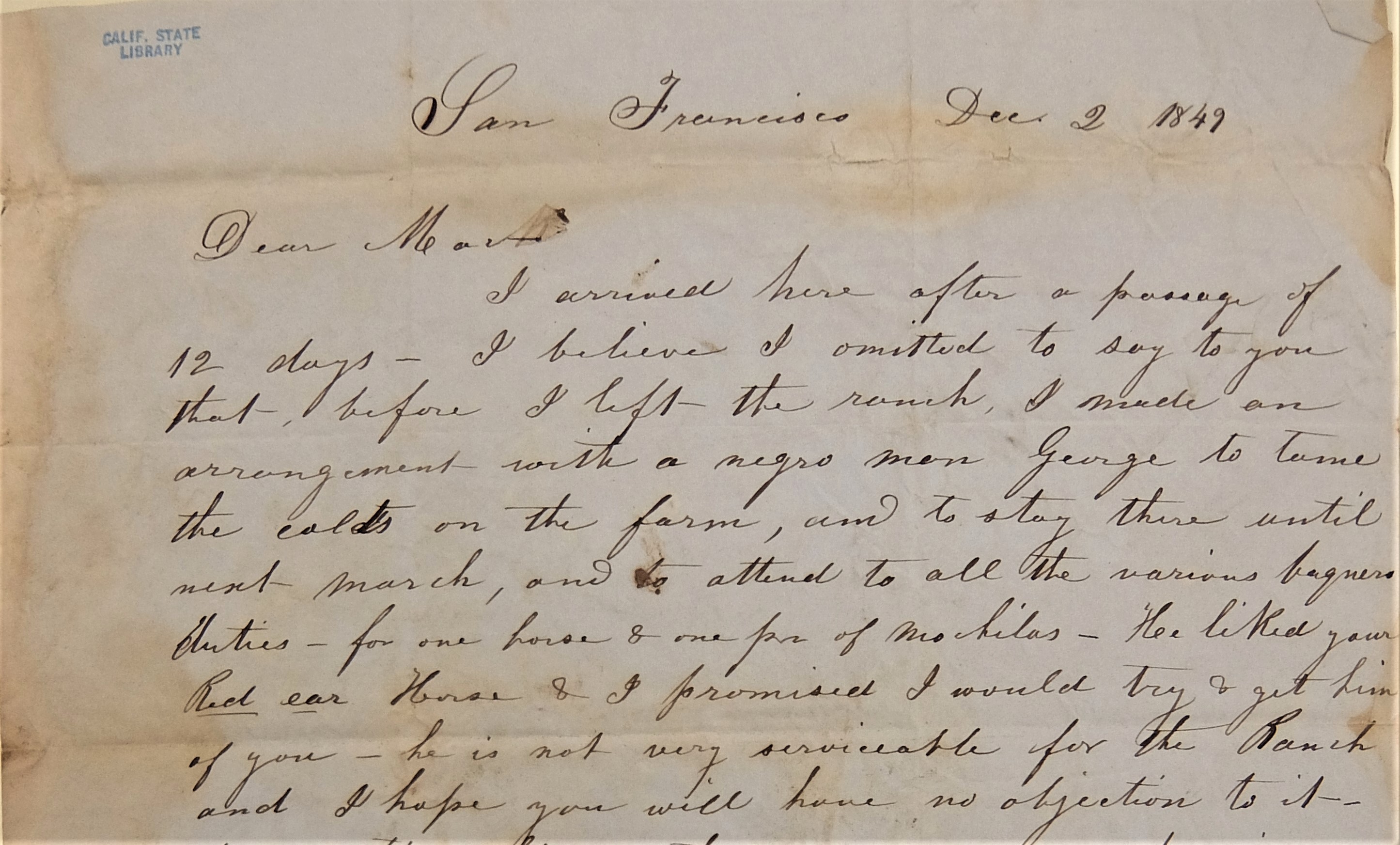
Letter from John Bidwell to George McKinstry 2 Dec. 1849

Let’s begin Black History Month with a little item from early days on Rancho Chico.

What kind of men did John Bidwell hire to work on Rancho Chico? In 1849 good reliable men were hard to come by — most men were off in the hills hunting for gold. But Bidwell needed workers, and here we see him hiring a “negro man George” to tame horses. Skill was more important than color.

San Francisco  Dec. 2. 1849

Dear MacK,

            I arrived here after a passage of 12 days – I believe I omitted to say to you that, before I left the ranch, I made arrangement with a negro man George to tame the colts on the farm, and to stay there until next March, and to attend to all the various vaquero duties for one horse & one pr. of mochilas – He liked your Red ear horse & I promised I would try & get him of you – he is not very serviceable for the Ranch and I hope you will have no objection to it – I mention this so that you may not give any orders for him – I have not been able to get any more Garden Seeds for the Ranch – but will try tomorrow & write you again – I hope you did not omit to send what you had by Doct. Clinton.

            The Steamer Oregon arrived yesterday from Panama – I learned nothing new except that the cholera is at Mazatlan – 450 passengers.

                                                Yours truly, J. Bidwell

Bidwell had just been elected to the California State Senate. He was on his way to conduct business in Sacramento and San Francisco before going to San Jose to serve in the legislature. I am not quite sure who he left in charge at Rancho Chico — it may have been Alfred H. Stout.

We don’t know anything else about George. Not his surname, or where he was from, or where he went. We do know what he was paid for three months work with the colts: a “red ear” horse that he liked the looks of and a pair of mochilas.

Mochila was the Spanish word for a saddlebag. Nowadays the word is used for a backpack or knapsack, but George would have been asking for saddlebags to go with his horse.

A pair of 19th century saddlebags
Posted in Black History Month | 1 Comment

A Good-Natured Hint About California

I have written twice before about the California Gold Rush as seen in comic books of the time, here and here. Here’s another one by an English artist: A Goodnatured Hint about California.

The motto on the cover says: “Here we are on Tom Titler’s ground picking up gold and silver,” a line from a children’s game. You might also notice that you could buy the book for one shilling plain, or two shillings and sixpence colored. Hand-coloring illustrations was a home industry for many struggling families and individuals.

Alfred Crowquill was the pseudonym of British cartoonist Alfred Henry Forrester. In 1849 he capitalized on the gold mania by illustrating and publishing this little comic book. It tells the story of “Mivins,” a London clerk. “He reads of California! He dreams of California!” (and a rain of gold coins) and then leaves his mother and takes ship for the promised land.

Mivins has to carry his own luggage and cook his own food. He eats roast squirrel (I hope that’s a squirrel and not a rat). He sleeps in a barrel.

He meets an old-timer (“a highly respectable men” with a bandanna on his head), finally arrives at the diggin’s, but fails to find gold (because he is using a sieve for a gold pan).

You can read the entire little book at the Internet Archive or at the California State Library. The illustrations above are from the Internet Archive.

Posted in comics | Leave a comment

Chickens at Rancho Chico

All this talk about the price of eggs reminded me of this letter, written by one of John Bidwell’s employees in 1851.

Letter courtesy California State Library, John Bidwell Papers.

Edward Shackelford Darlington, who was only 19 or 20, can’t resist spoofing the etiquette of 19th century letters. It looks like something Mark Twain would write.

Here is the text, but the bare text cannot do justice to Darlington’s courtesy and flourishes.

Neal’s Oct. 24th [1851]

Major,

I neglected to tell you to have water placed in the chicken coop – also in the small pans around the house. This is absolutely necessary for the preservation of the health of the feathered tribe. – By complying with the requests herein named you will much oblige

Yours very respectfully

with great regard

Your obt servant

in great haste etc.

E. Shackelford Darlington

Eggs were a valuable commodity in Gold Rush California, routinely costing one dollar per egg, at a time when back East, you could get a dozen for 20 cents. Gold seekers often mentioned the high price of foodstuffs in their letters home. No wonder that Ed Darlington was concerned to preserve “the health of the feathered tribe.”

I have a flock of chickens myself and they keep us well-supplied with eggs. I don’t know if I save any money, but they are fun to have. They are entertaining to watch, they eat up kitchen scraps, they produce fertilizer for the vegetable garden, and I always have fresh eggs.

Posted in Uncategorized | Leave a comment

Happy Gold Discovery Day!

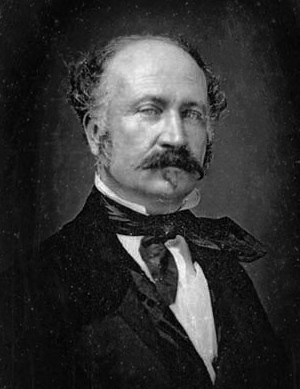
John A. Sutter in 1850, the earliest photograph.

John Sutter needed lumber. He was always building — on his fort, around the fort, up at his farm. He also planned to sell lumber to the settlers who were coming into California  in increasing numbers. He needed a sawmill.

In his New Helvetia Diary, where he kept a daily record of events and comings and goings at the fort, John Sutter wrote:

Aug. 27: Made a contract and entered in partnership with Marshall for a sawmill to be built on the [American] fork.

Marshall was a skilled carpenter and wheelwright. He had come to California via Oregon in 1845.

John Bidwell wrote out the contract, although he had his doubts about the advisability of the plan. He had inspected the site at Coloma himself, and thought that the American River canyon was too rocky and narrow for safely rafting lumber downstream to Sutter’s Fort. Later he would write:

I wrote the contract between Sutter and him [Marshall] to build the mill. Sutter was to furnish the means; Marshall was to build and run the mill, and have a share of the lumber for his compensation. His idea was to haul the lumber part way and raft it down the American River to Sacramento, and thence, his part of it  . . . . down to San Francisco for a market. . . . It is hard to conceive how any sane man could have been so wide of the mark, or how anyone could have selected such a site for a sawmill. Surely no other man than Marshall ever entertained so wild a scheme . . . and no other man than Sutter would have been so confiding and credulous as to patronize him.

But in the end it didn’t matter. Marshall, who was a skilled carpenter and wheelwright, hired Indians and soldiers from the Mormon Battalion to get the sawmill built. It was coming along nicely until January 24, 1848, when Jim Marshall found little flecks of gold in the tailrace of the mill.

And the rest is history.

Sutter’s Mill
Posted in John Sutter | Leave a comment

February Is Black History Month

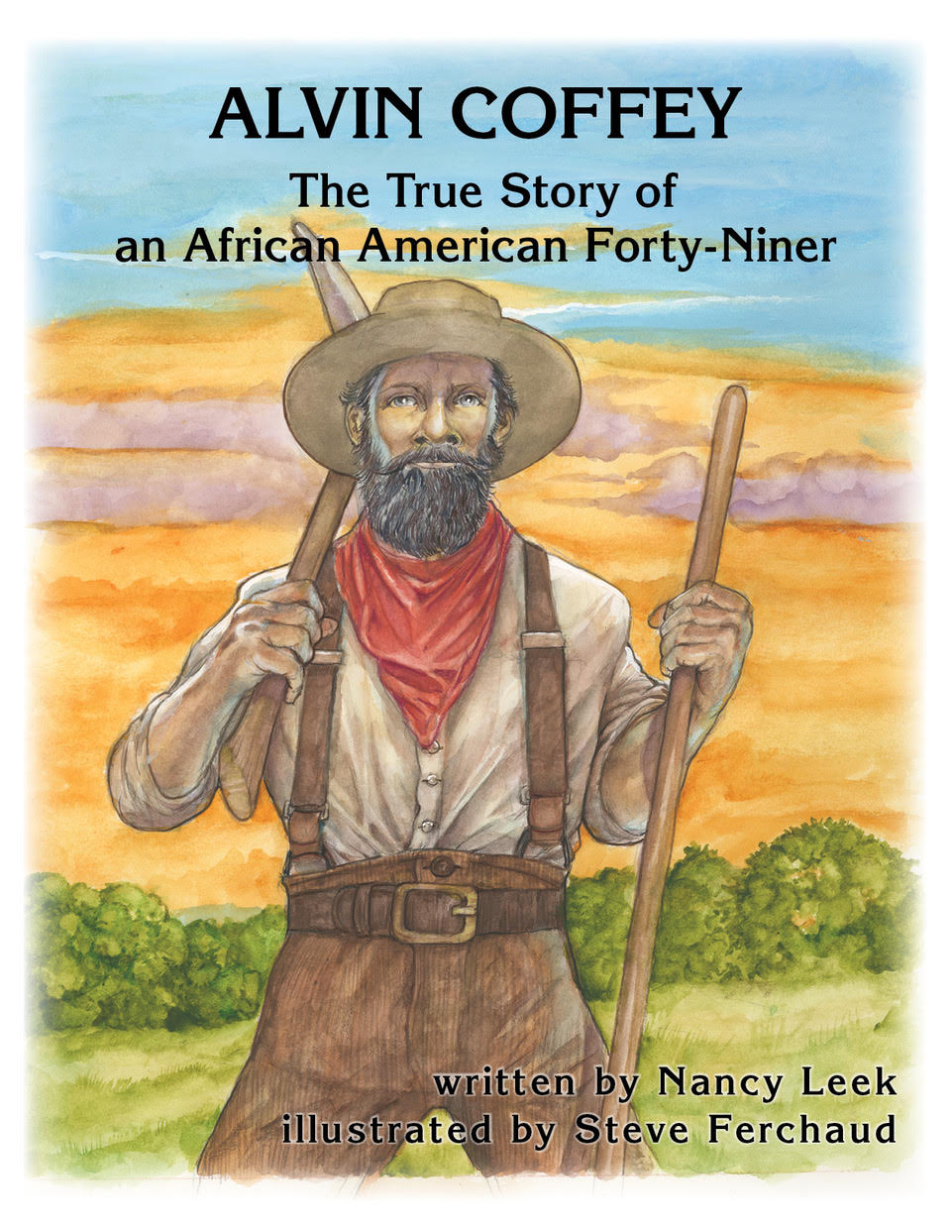
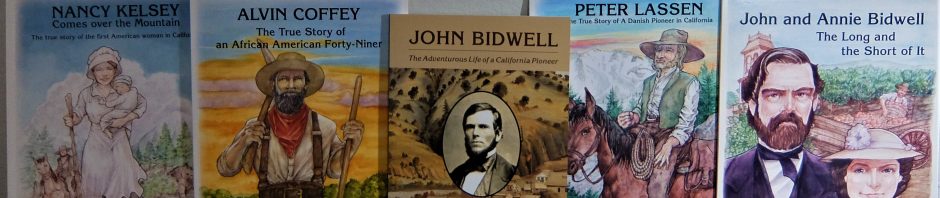
Get ready for Black History Month! Alvin Coffey is the ideal book to highlight black history in California.

As 4th grade students study the Gold Rush, they learn about the prospectors who came seeking gold in the rivers and streams of our Golden State. Too often the image presented is a white prospector. But men came from every country and every race and ethnicity on the face of the earth.

There were men (and some women) from Mexico, Central America, Chile and Peru. They came from Australia and the isles of the sea. They came from every European country and from China and Japan.

Black miners came as both enslaved and free. Free blacks from the Northern States came looking for gold, but also for freedom from prejudice and greater opportunities.

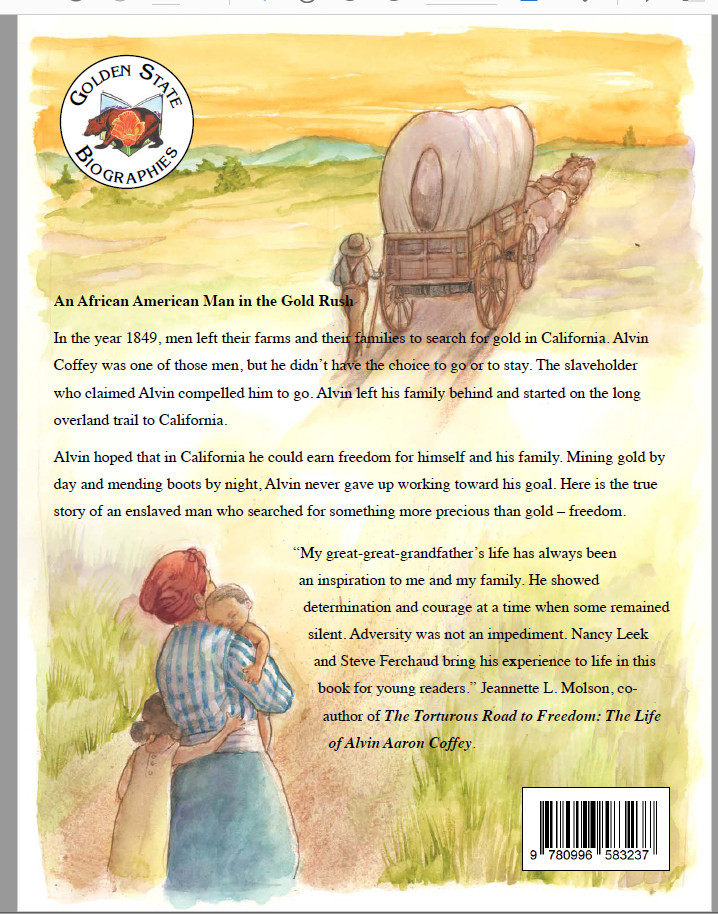
Enslaved men from the South, like Alvin Coffey, had the choice made for them by those who claimed to own them as property. But Alvin knew it was an opportunity to earn his freedom and freedom for his wife and children. It must have been galling for Alvin to labor to make another man rich. But he persisted, hoping that the money he earned on his own time would buy him a better life.

My book is is deeply researched, historically accurate, and visually appealing, with full color illustrations on every page by Steve Ferchaud.

You may not think a picture book is for you, but you can buy one for a school library, a 4th or 5th grade teacher, or a grandchild or young friend. It’s an exciting story with an inspiring message.

Books are available from the Association for Northern California Historical Research (ANCHR), from Amazon, or directly from me. Just send me an email at goldfieldsbooksca@gmail.com.

I’d love to hear from you!

I am also available to do presentations to schools and groups. I love talking to kids, and I am pretty good with adults too. Contact me to visit your class or organization.

Posted in Uncategorized | Leave a comment

Finnicum, Father and Son

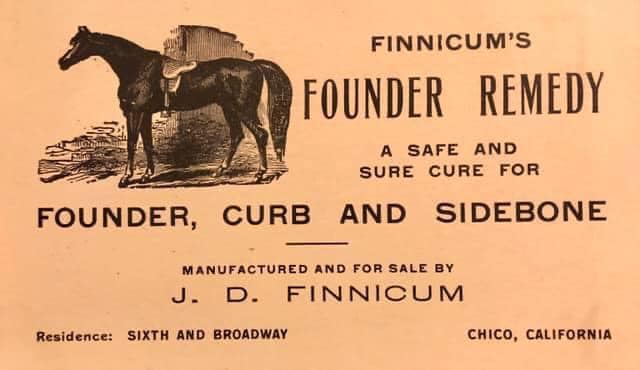
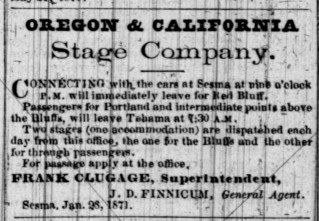
When Randy Taylor posted this business card on Facebook, I figured that J.D. Finnicum must be the same man as “Joe Finnicum, the Jehu” immortalized in poetry by Pres Longley. But that is not the case. James Duncan Finnicum, stage proprietor and veterinary surgeon, was the father of Merriman “Joe” Finnicum, who, like his father, was well-known around Butte County as a stagecoach driver.

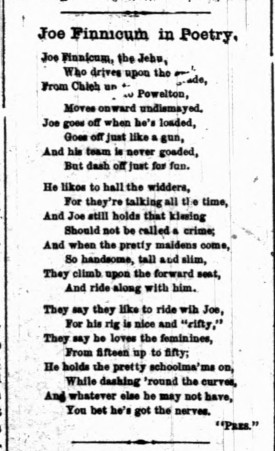
Longley’s poetic tribute appeared in the Chico Weekly Enterprise on December 23, 1892:

Joe Finnicum, the Jehu,
Who drives upon the grade,
From Chico up to Powelton,
Moves onward undismayed.
Joe goes off when he’s loaded,
Goes off just like a gun,
And his team is never goaded,
But dash off just for fun.

He likes to hall the widders,
For they’re talking all the time,
And Joe still holds that kissing
Should not be called a crime;
And when the pretty maidens come,
So handsome, tall and slim,
They climb upon the forward seat,
And ride along with him.

They say they like to ride with Joe,
For his rig is nice and “nifty,”
They say he loves the feminines,
From fifteen up to fifty;
He holds the pretty schoolma’ms on,
While dashing ‘round the curves,
And whatever else he may not have,
You bet he’s got the nerves.

James D. Finnicum was born in Pennsylvania in 1827. He came to California by sea with his wife and three children in 1858. He began driving a stagecoach in 1860. According to George Mansfield’s History of Butte County:

In 1870 he came to Chico and entered the employ of the California Stage Company, driving from Chico to Red Bluff, one trip daily. In 1872 the company moved their office from Chico to Tehama and he became their agent. From there they removed to Red Bluff, running their stages to Redding, Mr. Finnicum still continuing as their agent. Leaving the service of this company, he returned to Chico and purchased the stage line from Chico to Oroville. He continued driving himself, one round trip a day. He continued the business for about twenty-four years, until twenty years ago, when he sold out. Sometime in the fall of that year he began running a stage from Chico to Newville. He also ran a line from Oroville to Biggs. During his long career as stage-driver he often carried large sums of money, which, as well as the passengers who accompanied him, were safely delivered. He was an excellent judge of horses and his long experience in connection with them enabled him to successfully doctor them when sick. (pp. 519-520)

Chico Weekly Enterprise 18 March 1871

James D. Finnicum died at the age of 97 on April 6. 1925 and is buried in the Chico Cemetery.

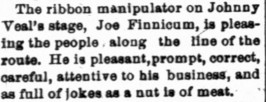
James’s son Merriman, known as Joe, was born in Ohio in 1855 and came to California at the age of three. He began driving his father’s stage between Oroville and Chico at the age of seventeen, making a round trip every day. He drove for his father for about ten years, and then took a variety of other stage-driving jobs around the North State. His popularity as a “ribbon-manipulator” is attested to by this news item:

“From Butte Creek” Chico Weekly Enterprise 17 Nov1893

Later he worked for the Northern Electric Railroad, the city of Chico, and at the time of his death was working for the Sacramento Northern Railroad. It was a life spent in transportation.

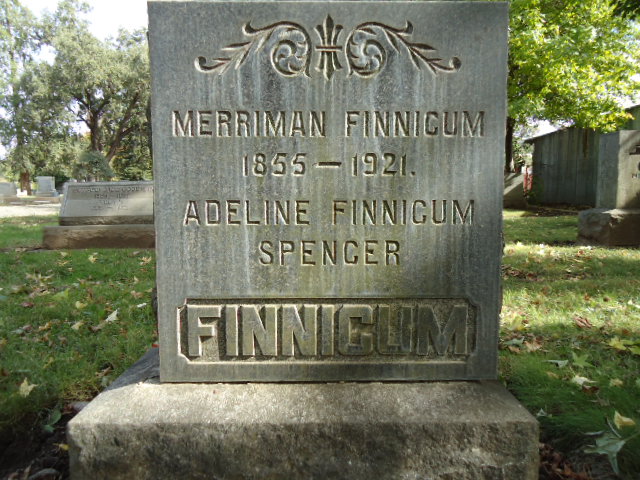
Joe Finnicum died before his father at the age of 65 and is also buried in Chico Cemetery.

Posted in Stagecoaches, Uncategorized | Leave a comment

The Floods of 1852

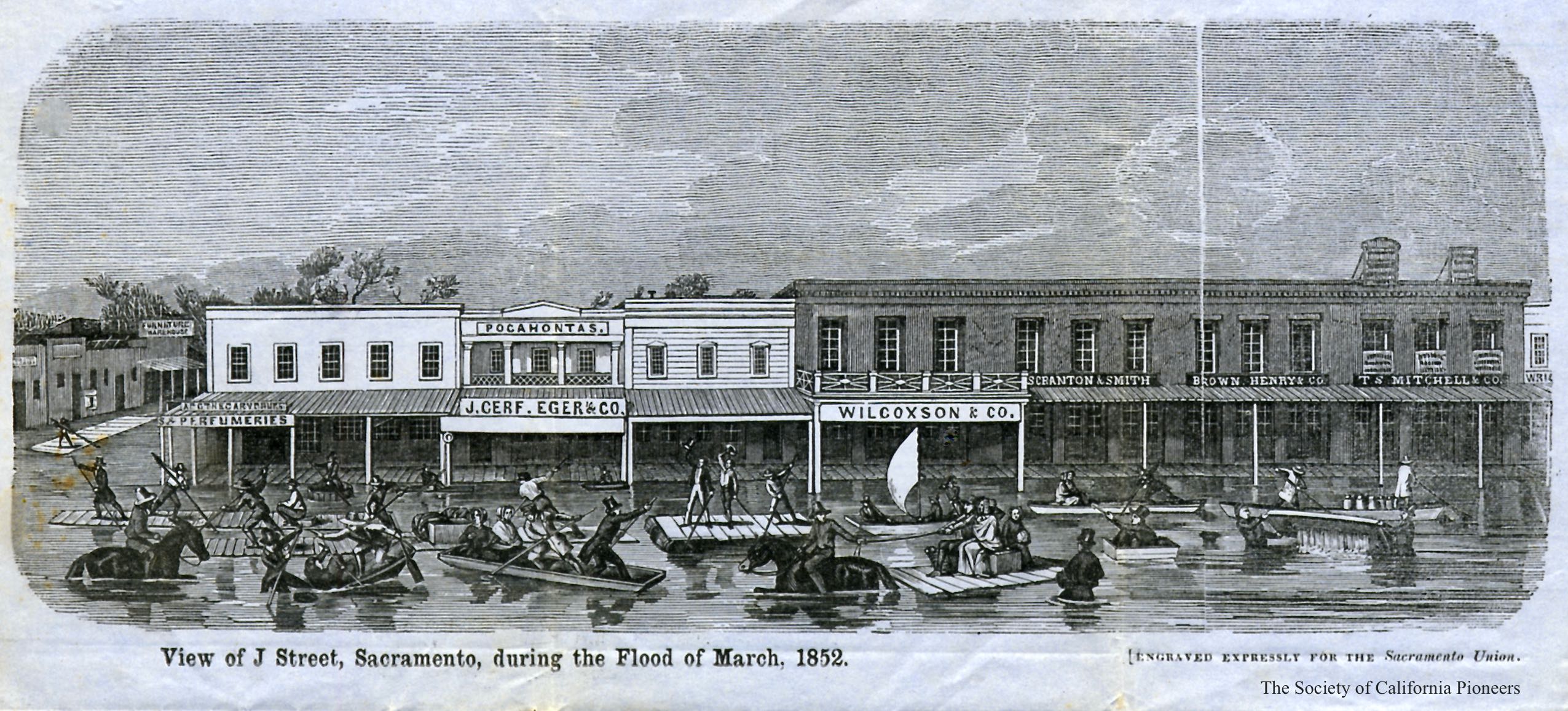
It’s a rainy January all over California this year, a welcome relief after several years of drought. I have written before about the floods in Sacramento in 1850 and in 1862. Flooding came again in 1852.

A lettersheet depicting the flood of 1852, courtesy of the Society of California Pioneers

Determined to build on the low-lying land at the junction of the Sacramento and American Rivers, the residents and businessmen of Sacramento City built levees to hold back the rivers after the flood of 1850. The American River levee was breached early on the morning of March 7, 1852.

The river was swollen with rain and with the melting snow of the Sierras. The earthen levee and its sluice gate were no match for the power of the raging river.

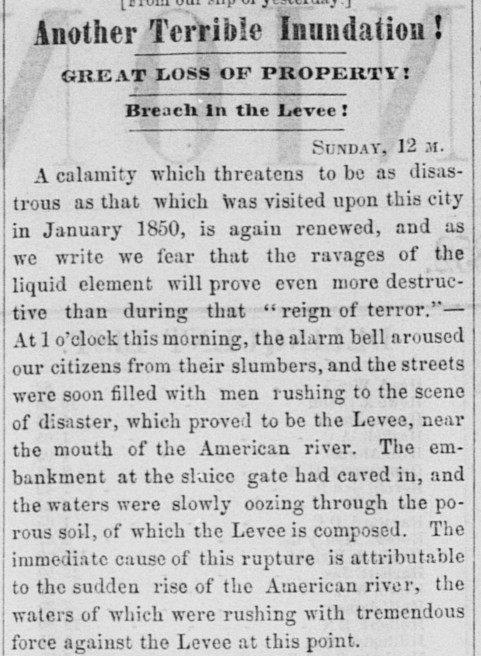
Timber, hay, bags of barley, and dirt in immense quantities were thrown into the gap, but all without avail. In spite of their utmost efforts, however, the stream steadily increased in volume until it loosened the earth upon which the timbers of the sluicegate rested. This occurred at 2 o’clock, and directly after the waters hurled all their strength against the bridge, which was instantly swept into the slough.

Trees, scows, boats, tents, all were cngulphed and carried down the current in one solid mass, until they reached the bridge which connected the foot of Third street with the peninsula be- ■ tween the Slough and the American river. The i force of the shock was so great that the bridge was snapped like a pipe stem, thus cutting off all communication between the two points.

Sacramento Daily Union, 8 March 1852

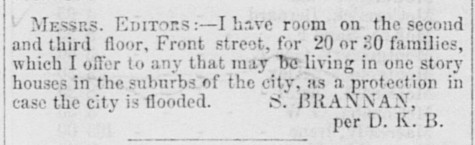
Residents fled, first on foot and then in boats and make-shift rafts. Sam Brannan offered shelter on the second and third floors of his warehouse. It was a kindly offer, and good for publicity too.

Sacramento was not the only city affected by flooding. The same issue of the Sacramento Daily Union reported that Marysville, at the conjunction of the Yuba and Feather Rivers, was also flooded. A Mr. Langton reported that he “washed his face in the Yuba river on Saturday morning before leaving his bed.” He said that the city was inundated everywhere below High Street, adobe building were collapsing, there was a great loss of property, and flour and other provisions were ruined.

No doubt flooding was seen in Butte County too, but since the Weekly Butte Record did not begin publication until 1853, I don’t know what John Bidwell and friends observed along the Sacramento and Feather Rivers.

Posted in Uncategorized | Leave a comment

For Auld Lang Syne and the Days of ’49

My mother, being of Scottish heritage, was fond of the song “Auld Lang Syne” and we would gather round and sing it every New Year’s Eve. Since this blog is about “auld lang syne” or the days long past, I got to thinking of another old song about long-gone days, in this case, “The Days of Forty-Nine.” Here is the first verse, as collected by Alan Lomax in Cowboy Songs and Other Frontier Ballads:

 We are gazing now on old Tom Moore,
A relic of bygone days;
'Tis a bummer too, they call me now,
But what cares I for praise?
It's oft, says I, for the days gone by,
It's oft I do repine
For the days of old when we dug out the gold
In those days of Forty-Nine.

Another, more familiar version of the first verse goes:

I'm old Tom Moore from the bummer's shore 
in the good old golden days
They call me a bummer and a gin sot too, 
but what cares I for praise ?
I wander around from town to town 
just like a roving sign
And all the people say, "There goes Tom Moore, from the days of '49."

CHORUS:
In the days of old, the days of gold
How oft'times I repine,
 for the days of old
When we dug up the gold, 
in the days of '49

You can sing along with Sourdough Slim, a Northern California native and the “Last of the Vaudeville Cowboys,” in this clip

Welcome to 2023! I hope this year will be a golden year, with happiness, prosperity, and everything you could wish for.

Posted in Days of '49 | Leave a comment

A Chico Christmas Eve, 1869

From John Bidwell’s diary for 1869:

Sat. December 25.  Christmas – Rained last night with a furious wind – Boys & girls of the town invited and had a high old time –

That “high old time” happened at the Chico Pavilion, in spite of the stormy weather. The Pavilion was on Broadway, between 4th and 5th Streets and across from the Plaza.

On January 1, 1870, the Northern Enterprise reported on the party:

“On Friday night (Christmas Eve), there was a grand rally of the little ones and a larger number of the “old folks” at the Pavilion to celebrate, in an appropriate way, this Christmas occasion. No night of this season, and during our stay in the Sacramento valley for three years, no night of like storm and unpleasantness has occurred. This wind blew a hurricane and the rain fell as if the windows of heaven were open; yet through mud and rain they came until a vast crowd assembled.

Pleasant countenances and the merry laugh gave evidence that all were bent upon enjoyment; and though the wind might howl and the rains pour down, they would be indifferent to all extraneous influence and hold themselves only to the purposes which had drawn them together, and with heart and soul yield to the happy impressions which so per-eminently belong to this occasion. Indeed, we never saw a happier crowd.

Three large trees literally groaning under the weight of presents. It spoke well for the liberality of our people, of kinsman and friend, who, notwithstanding the hardness of the times, went down into the pocket and contributed bounteously to the occasion.

The mirth and jollity, anxiety and eagerness, which prevailed during the distribution from the trees, required to be seen to be fully appreciated. Everything went off pleasantly and we have yet to hear of one dissatisfied person in the whole large assembly. May the same fraternal feeling be at all times cultivated by our citizens.”

Posted in Christmas | 6 Comments