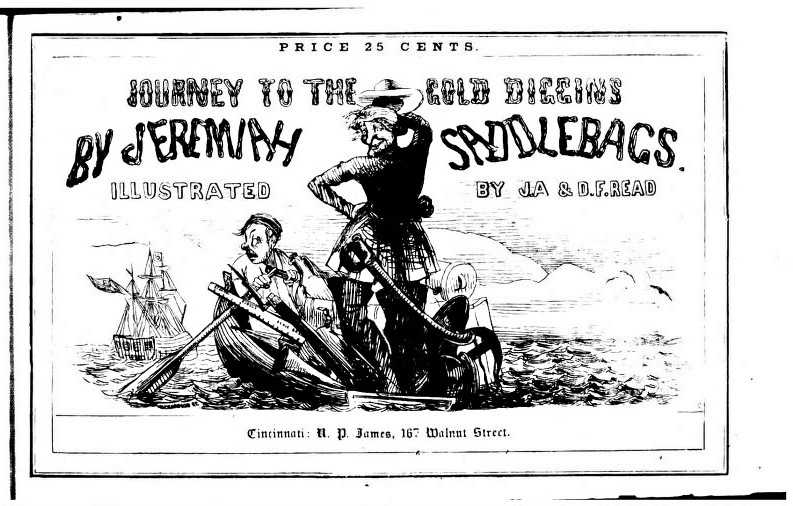
Considered the first ever American comic book, Journey to the Gold Diggins, by Jeremiah Saddlebags, is a humorous look at the California Gold Rush. It was written and illustrated by J. A. and D. F. Read (James Alexander and Donald F. Read). I don’t know anything about the originators of this work, but it showed exactly what gold-seekers could expect — mostly disaster and penury. The two author/illustrators didn’t waste any time in 1849 getting their timely picture book into print.
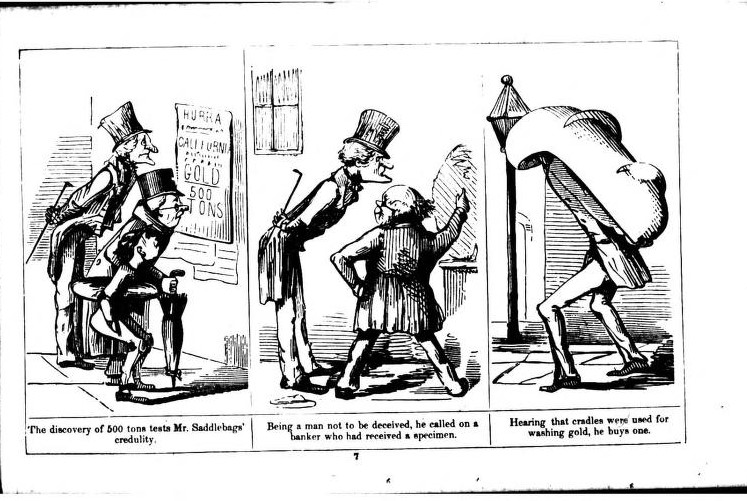
They probably didn’t have to actually make the trip to know what was in store. Jeremiah Saddlebags, a “man of fashion” is bit by the gold bug and decides to seek his fortune in California. Being totally ignorant and credulous, he buys himself a baby’s cradle to take along.
He makes the journey on the Panama route, where he encounters stereotypical natives and pirates and wrestles an alligator. Arriving in San Francisco, he is disappointed to see that every building is a tent.
He makes it to the diggins, where he finds a lump of gold, but loses it on his journey home.
The original book is rare and certainly quite expensive to acquire. It was reprinted in 1950 by the Grabhorn Press in a limited edition, and one of those can be had for $50 to $100. A knock-off reprint is available on Amazon — you gotta wonder where it’s from, with a vague description like this: “We expect that you will understand our compulsion in these books.”
The best and easiest way to read it is online, either at Yale Digital Collections or at the Internet Archive. I wrote about another illustrated satiric look at the Gold Rush from the same era in an earlier post here.
My interview with Nancy Wiegman on Nancy’s Bookshelf was broadcast today on NSPR 91.7 FM. You can listen in by going to the NSPR Nancy’s Bookshelf webpage.
Nancy interviewed me about my new book about black pioneer Alvin Coffey. You can order the book from Amazon or purchase from one of the local vendors listed on the My Books tab.
The interview was recorded a couple of weeks ago, just after I got back from a trip. It sounds better than I expected, considering that I was getting over the cold I picked up in Germany and that I had to get myself very very close to the microphone on my monitor. NSPR’s engineers can work wonders in maximizing audio quality.
The interview was a lot of fun. It’s always a pleasure to spend some time with Nancy W. Go and have a listen!
Lola kept up a steady pace of lecturing in 1857-1860. She not only toured throughout the eastern states, but had a successful tour of England and Scotland. The popularity of her lectures and books put her on a sound financial footing, and she could afford to give generously to religious and charitable causes. She attended a Methodist church weekly and lived modestly. Gone were the extravagances of her youth.
She lectured as Lola Montez but referred to herself privately as Mrs. Heald, the name of her deceased second husband. She also still proudly claimed the title of Countess of Landsfeld.
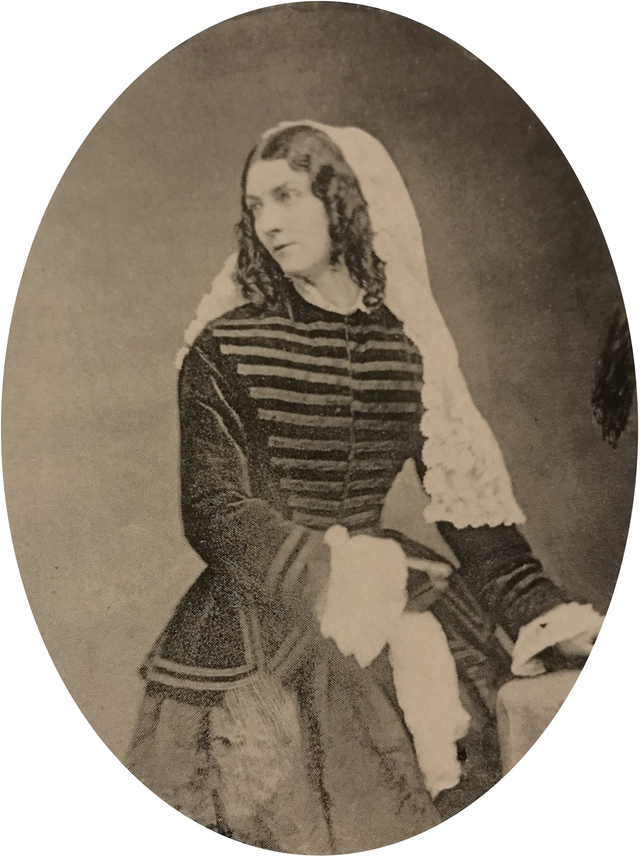
Lola Montez in 1858 with a new shorter hairstyle
On Saturday, June 30, 1860 she suffered a stroke. Paralyzed on her left side, she was looked after by friends. Slowly she recovered some powers of speech and mobility and by December she hoped for a full recovery. She began visiting the women at the New York Magdalen Society’s refuge for women who were trying to escape prostitution. As one who had suffered the mockery and scorn of society herself, she sympathized with their plight.
An excursion in the open air in December brought about a setback. She developed pneumonia and on January 17, 1861 she died. She was forty years old.
A number of sources have attributed her death to tertiary syphilis (looking at you, Wikipedia). Bruce Seymour, the author of the most thorough biography of Lola makes no mention of this. Surely a stroke and pneumonia was enough to bring about her death. Likely the notion of syphilis is a rumor in the “wages of sin” vein that some people find satisfying.
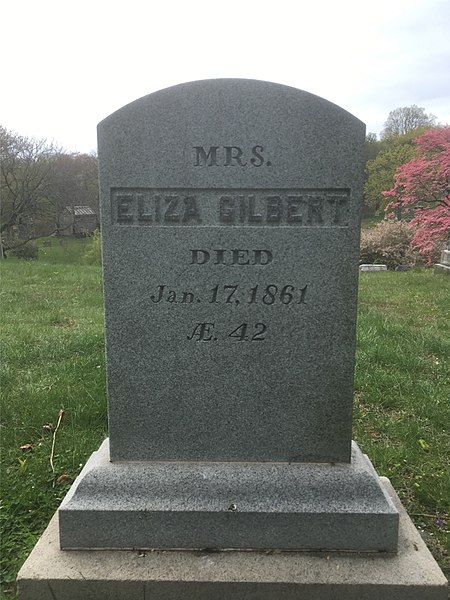
Her friend, Mrs. Buchanan, who had known her as a schoolmate in Scotland, saw to her burial at the Green-Wood Cemetery in Brooklyn. Her tombstone gives her name as “Mrs. Eliza Gilbert,” the name her friend knew her as in school. Lola Montez was no more.
Lola’s headstone. The age given is probably incorrect. She was always inconsistent about her birthdate.
Lola returned from her Australian tour in 1856 a changed woman. It had been a successful tour, but on the voyage back to the United States her leading man and lover, Frank Folland, fell overboard and was drowned. Or he may have committed suicide. No one knew what caused his death, but Lola blamed herself.
Frank Folland had a wife and children in Cincinnati and Lola vowed to assist them if she could. She vowed to change her ways and seek a more spiritual life. She also must have realized that she couldn’t go on performing as she had in the past. She tired more easily, she was no longer as young and fresh as she had been, and she was prone to recurring bouts of malaria.
She took her plan to change her way of life seriously. She put her considerable collection of jewelry up for sale, intending to use the money to benefit Folland’s family. A lady’s jewelry was considered her insurance, her retirement fund, so this was no small gesture.
Folland’s wife wanted nothing to do with the notorious Madame Montez, but when Lola went back east she took his sister Miriam under her wing and promoted her career on the stage.
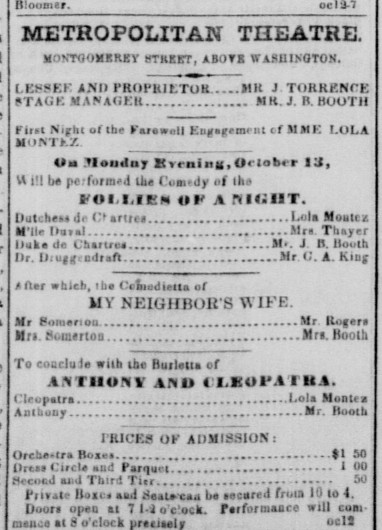
Daily Alta California 12 October 1856
Lola didn’t leave the theater life immediately. She was still popular and did several performances in San Francisco and Sacramento.
Here is an advertisement for her farewell performance. “Follies of a Night” was one of her most popular comedies. She also appeared in a burletta (a short comic opera) of “Anthony and Cleopatra.” Her partner was Junius Booth, of the famous Booth family of actors. One of his brothers was John Wilkes Booth.
She even occasionally favored the audience with her famous Spider Dance.
She made a brief return to Grass Valley and sold her cottage. Then she headed east.
She continued to perform for a short time, but her heart wasn’t in it. Instead she reinvented herself as a lecturer. That was less tiring and just as rewarding as life on the stage.
She lectured on her own life, although she was still prone to exaggeration and invention. Her account of her life can’t always be trusted. She also gave lectures on “Beautiful Women,” “The Wit and Women of Paris,” and “Comic Aspects of Love.” She was praised for her wit and her clear, pleasing voice.
She turned her lecture on beautiful women into a book entitled The Arts of Beauty, or Secrets of a Lady’s Toilet. Much of her advice is still pertinent. She told her readers to avoid commercial beauty products and gave recipes for such things as tooth powder and skin cleanser made from natural products.
She told her readers to pay close and dutiful attention to all aspects of their face and figure if they would cultivate beauty. She gave such advice as “To ensure the great charm of a beautiful mouth requires unremitting attention to the health of the teeth and gums.”
Lola in 1858. Daguerreotype by Henry Meade
Above all she encouraged her readers to rely on exercise, fresh air, moderation in habits, and cleanliness to enhance their natural beauty. It is advice that will never go out of style.
On July 4th 1849, Charles Ross Parke wrote in his journal that:
I determined to do something no other living man ever did in this place and on this sacred day of the year, and that was to make Ice Cream at the South Pass of the Rockies.
Dreams to Dust: A diary of the California Gold Rush, by Charles Ross Parke, p. 46
South Pass
South Pass, a low saddle between two ranges of the Rocky Mountains, made passage of the Rockies possible for wagon trains. Many of the travelers noted that they found ice and snow there in the middle of the summer.
Parke’s company had two milk cows, so he had plenty of milk.
I procured a small tin bucket which held about 2 quarts. This I sweetened and flavored with peppermint — had nothing else. This bucket was placed inside a wooden bucket, or Yankee Pale [sic], and the top put on.
Nature had supplied a huge bank of course snow, or hail, nearby, which was just the thing for this new factory. With alternate layers of this, and salt between the two buckets and the aid of a clean stick to stir with, I soon produced the most delicious ice cream tasted in this place. In fact, the whole company so decided, and as a compliment drew up in front of our tent and fired a salute, bursting one gun but injuring no one.
This is almost exactly how my husband and I make ice cream — in a hand-cranked White Mountain ice cream maker, which has an inner metal bucket and an outer wooden pail. Although we don’t have to milk our own cow or get ice from a snowbank.
Ice Cream on the 4th is an old tradition, and long may it wave!
From the Chico Enterprise Weekly, here is what you could expect on July 4, 1877:
The patriotic citizens of Chico, always ready to do homage to the birthday of a great and glorious Republic, made this the one hundred and first anniversary no exception. The weather was most favorable, with the sweet south wind coming in refreshing zephyrs to temper the sultry Summer sun. The joyous occasion was ushered in at midnight by the ringing of a merry peal from the city bells. At sunrise a salute was fired from the old cannon which has hone good service in this city for sixteen years, on many similar occasions, and the bells again took up the chorus, waking the unconscious sleeper to the fact that the day’s rejoicing had opened, and that loyal hearts were even now astir to welcome in the day and throw “old glory” to the breeze.
The 4th of July celebration was an all-day affair. A large crowd, including many from surrounding communities, assembled at the Armory and the Engine house to watch the mustering of the militia and the firemen. At 9:30 a.m. the festivities began with a parade through the streets, ending at “the grove near the Sierra flume.” The program that followed consisted of music by the Chico Brass Band, an invocation by the Rev. J.W. Ellis, a song from the Chico Glee Club, and the reading of the Declaration of Independence.
This was followed by a poem written for the occasion and read by George F. Nourse. The poem, The People’s Pioneer Line, was quite a lengthy one and was printed in the newspaper. It likened the nation to a railway line:
‘Tis just one hundred years and one ago, With thirteen cars we pulled from Station One, And under orders steamed along quite slow, Making by day and night our wondrous run. From time to time we lengthened out our train, By adding on new freshly peopled cars, Til now our line does thirty-eight maintain, And on our flag there’s just as many stars.
The poem was followed by an oration, given by J.F. Hutton, “full of eloquence and original thought”and also printed in full. According to the newspaper report:
There was a breathless silence prevailed during the delivery of the oration, and at its close the audience broke forth in rapturous applause. The benediction was then given and a rush was made for the tables.
The tables were laden with barbecued meat, several oxen having been cut into quarters and roasted for 12 hours. 1800 pounds of beef were served, along with a dozen hams, plenty of bread, and a variety of pickles.
Next came the “Comicalities” or the “Parade of Horribles,” described by the reporter as the “most ludicrous, comical and laughable exhibition we have seen in many a day.” After a solemn morning assembly and a good meal, it was time for some entertainment.
The Parade of Antiques and Horribles was an old New England custom in which folks dressed up in grotesque costumes and rode old nags to make fun of local dignitaries and current events. The morning parade was a stirring procession of soldiers, bands, and notable citizens in carriages. The afternoon parade was a parody to lighten the day’s mood.
The Chico parade featured a “burlesque on the City Police force and the City Fathers,” and a depiction of “Brother Jonathan and his family going West in an old cart.” “About half a dozen lengths of stovepipes on wheels burlesqued the artillery representation in the forenoon’s procession.”
I haven’t seen any photos of Chico’s Parade of Horribles, and I don’t know how long the custom lasted. Here’s a photo from a New England parade in the same period.
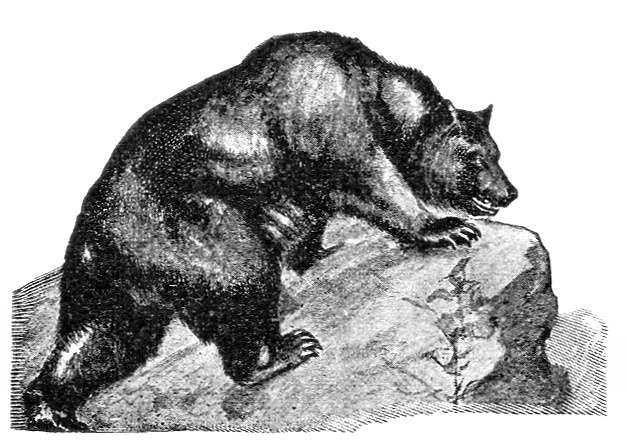
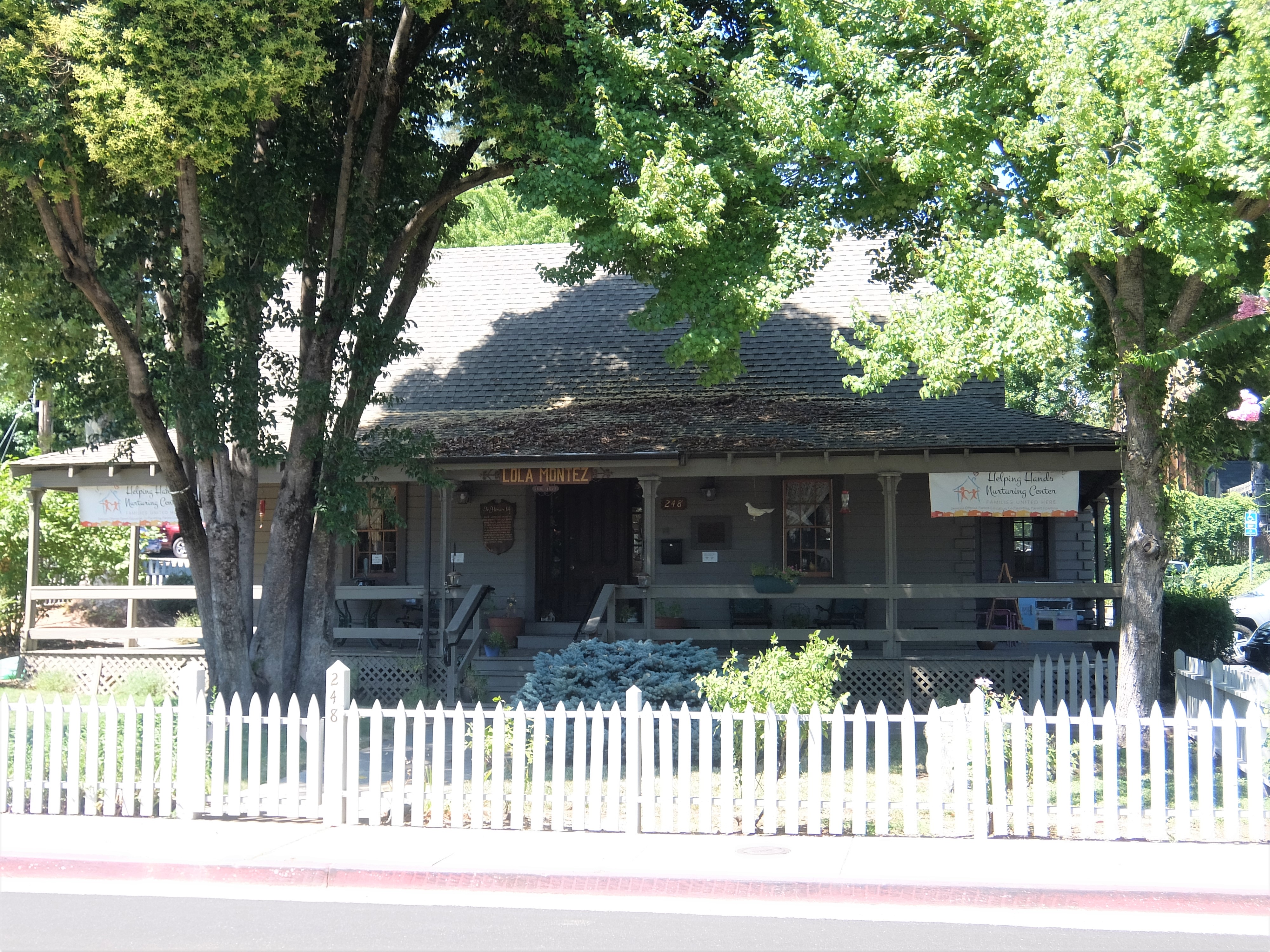
In this contemporary picture of Lola’s cottage on Mill Street in Grass Valley, you can see a bear and a lady on the right. Lola Montez was fond of animals and kept a grizzly bear cubs in her yard. You can see that the bear is on a chain.
Lola met with an accident with her pet while feeding him sugar cubes from her hand. A report from Grass Valley published in the Sacramento Daily Union stated:
The event of most general interest in town today is the attack on Madame Lola Montez by her pet grizzly bear. While feeding him with sugar from her hand, he caught her hand in his mouth, and wounded it badly; he struck at her with his paw, but fortunately did not reach her. A man standing near caught a club, and by a stroke across bruin’s head, caused him to let go his hold, and thereby probably saved the life of the Countess. (9 February 1854)
The story was widely reported. Frank Soule, journalist and editor of the California Chronicle, responded in verse
Lola and Her Pet

One day when the season was drizzly,
  And outside amusement were wet,
Fair Lola paid court to her grizzly,
  And undertook petting her pet.

But ah, it was not the Bavarian,
  Who softened so under her hand,
No ermined kind octogenarian,
  But Bruin, coarse cub of the land.

So all her caresses combatting,
  He crushed her white slender hand flat,
Refusing his love to her patting,
  As she refused hers to Pat.

On, had her pet been him whose glory
  And title were won on the field,
Less bloodless hap ended this story,
  More easy her hand had been Heald!

But since she was bitten by Bruin,
  The question is anxiously plied;
Not if 'tis the Countess's ruin,
  But whether the poor bear has died?
(“Pat” refers to her third husband, Patrick Hull. “Heald” (George Heald) was her second husband, whose name she continued to use after she kicked out Pat Hull.)
From San Francisco and Sacramento, Lola took her performances to Marysville and then up into the foothills to Grass Valley and Nevada City. She drew appreciative crowds wherever she went, always to see her famed Spider Dance and sometimes in the hopes of theatrical fireworks. If she was greeted with boos and hisses, she would stride to the footlights, scold the perpetrators, and then carry on with her performance. Critics who panned her dancing were threatened with pistol or horsewhip in the hands of the tempestuous faux Spaniard.
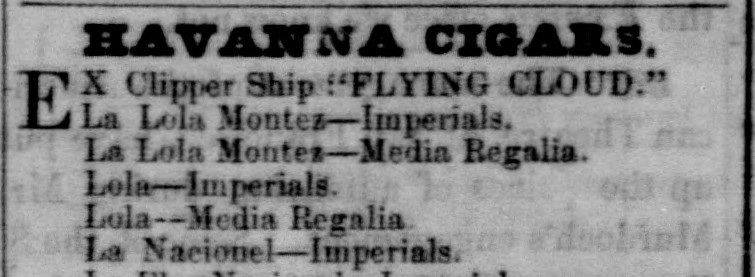
Her fame had spread far and wide. Everyone knew the name of Lola Montez. Mines, racehorses, ships, and cigars were named for her.
But perhaps she was growing tired of life on the boards and the constant travel. She liked the looks of Grass Valley. Probably the scenery and fresh mountain air reminded her of her time in the Bavarian Alps. She wanted to settle down.
During her time in Munich and Paris she had always chosen the most expensive, the most splendid mansion she could find. But there were no mansions in Grass Valley. She was content to purchase a small one-story white cottage on Mill Street. You can still see it today.
In 1853 Grass Valley was a small city of only 2,000 people, but it was the sixth largest town in California. It was home to several mines, including the Empire Mine (now a state park) which would become the richest mine in California history. Gone were the days of placer mining and the single prospector with gold pan and cradle. The future was in quartz mining, burrowing deep into the earth, and stamp mills that crushed the ore to extract the gold. Steam and water-driven mills filled the air with the constant din of industrial mining. Lola invested $20,000 in the Empire Mine.
Nevada Journal (Nevada City) 5 August 1853
Lola settled into her cozy cottage. Her fights with Patrick Hull, her latest husband, escalated and she soon sent him packing. Instead she surrounded herself with admirers and animal pets. She kept several kinds of birds, including a parrot, four dogs, a horse, a goat, and two grizzly bear cubs.
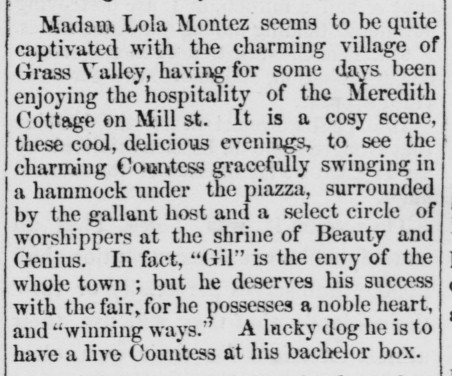
(I am not sure who “Gil” is in this news article, but presumably he was the owner of the cottage that he sold to Lola.)
Lola enjoyed her life in Grass Valley. She was accepted by its residents — she had her eccentricities, but so did many others. But after almost two years in her mountain retreat she grew restless. And perhaps she needed to replenished her funds. She wanted to travel again, and she decided on a tour of Australia.
She never returned but she was fondly remembered in Grass Valley and nearby Nevada City. One newspaper editor wrote:
Madam Lola (as she chose to be called while a resident of this town) although eccentric in some respects, did many acts indicative of a kind and benevolent disposition. We recall her riding many miles over the hills to carry food and medicine to a poor miner. More than once she watched all night by the bedside of a child whose mother could not afford to hire a nurse. . . . Lola was one of the lions of our town; and visitors from below, clerical as well as lay, while taking a look at our quartz mills, invariably sought an introduction to her, and always returned delighted from an hour’s chat at her hospitable cottage.
National Gazette (Nevada City) 11 November 1858, as quoted in Bruce Seymour, Lola Montez: A Life.
I’ve been meaning to write more about Lola Montez in California, but first I had to do some research. I checked out a biography from the library — Lola Montez: A Life, by Bruce Seymour. This is the definitive biography, “drawing on unpublished archives on four continents,” as the blurb says. I thought I was just going to read the section on Lola in California, but I got pulled in by the fascinating details and entertaining writing and had to begin at the beginning. If you want to read a gripping biography, this fills the bill.
Lola left Europe at the end of 1851 to escape another failed marriage, accusations of bigamy (her first husband was still alive), and mounting debts. She was thirty-one years old, but claimed to be younger, and was still youthful looking. She contacted a theater manager and made plans to go back on the stage, not just as a dancer, but in plays as well. Although her voice was not strong, she generally made a good impression in roles like Lady Teazle in Sheridan’s The School for Scandal, and playing herself in a self-serving drama called Lola Montez in Bavaria. She knew how to trade on her notoriety.
Starting in New York City, she played in cities from Boston to Charleston and Cincinnati to New Orleans with considerable success. Theater-goers came to see the notorious “Countess de Landsfeld” and got their money’s worth, especially if she concluded the program with her famous Spider Dance.
But California, the land of golden opportunity, beckoned. San Francisco was no longer a city of tents and transient miners. It was fast becoming a center of wealth and culture. Lola had not made any arrangements beforehand to appear in any theater, but she quickly arranged to appear in The School for Scandal at the American Theater. She didn’t bring her own acting company with her –the other parts in the play would be taken by members of the theater’s resident company, who probably already knew this classic comedy.
Daily Alta California 27 May 1853
Reviews were good, the theater was packed, and with ticket prices at five times the New York price, the money poured in. Lola took in $16,000 in her first week at the American Theater.
On this date — June 21 — in 1879 the notorious stage robber Black Bart held up a stage coach near Forbestown in Butte County. It was his first robbery in the year 1879 and his ninth robbery since he began his career in 1875. This incident would be followed by two more robberies in October in Shasta County. He generally committed his crimes in the summer and fall, and then retired to San Francisco to live off his ill-gotten gains over the winter.
Here is the notice from the Chico Weekly Enterprise reporting that robbery. No name is given the robber and according to the report, he didn’t get much from the robbery.
Chico Weekly Enterprise 27 June 1879
Of all the stagecoach robbers in California history — and there were many — Black Bart is the name that still holds a place in the minds of the public.
Why does he remain the most famous hold-up artist in California history?
One reason is the length of his career. He committed 28 robberies and eluded capture for eight years. That’s a long time in a chancy business.
Another reason is his choice of pseudonym and his penchant for advertising himself by leaving notes in verse at the scene of the crime.
His real name was Charles Boles, but “Black Bart”, a name he seems to have picked out of thin air, sticks in the memory. His verse was crude, but it caught the public’s attention, especially when he signed himself as “Black Bart, the Po-8.”
It also helped that he was a “gentleman bandit.” He was never cruel or vicious. He didn’t molest women. He didn’t murder stagecoach drivers or passengers. He politely asked the driver to “Please throw down the box” while holding a shotgun that he would later claim wasn’t even loaded.
For eight years, from July 1875 to to November 1883, “Bart” got away with it. Wells Fargo detectives and county sheriffs couldn’t catch him. A left-behind handkerchief with a laundry mark was his undoing. Black Bart was finally captured and sent to San Quentin prison in November 1883. He spent five years in prison and disappeared from public notice after his release in 1888.








 goldfields