Margaret Hecox Discovers Gold

Margaret Hecox came to California overland with her husband Adna and four children in 1846. It was a long and arduous journey, but at least they did not take the Hastings Cut-Off (as did the Donner Party). They met Lansford Hastings and he suggested it, but they had a guide, Old Caleb Greenwood, who advised against it.

Margaret M. Hecox, Discoverer of Gold

As they came down the western slope of the Sierra Nevada, Mrs. Hecox discovered gold:

In a little valley by the Yuba River we went into camp for a day or two. How pretty it was at this place and, although we were all tired out, we enjoyed everything, feeling happy that we were now so near our journey’s end.

It was on the Yuba River that Mrs. Aram and I discovered what we afterwards knew to be gold. We were busy at our washing down near the stream, when something brightly gleaming in the water attracted our attention. It looked like sands of gold. I gathered my apron full of the shining specks and carried it to Mr. Hecox, saying I thought it was gold.

He laughed at me and seemed to consider it a good joke. This made me angry and I threw it away. I have always been sorry that I did not keep it and wait until I could have it tested. I am sure now that it was gold. It was just like the dust they brought from the mines two years later.

Let that be a lesson to the men out there to listen to their wives.

The same day Mrs. Aram called to me in an excited manner, “Mrs. Hecox, do come here quick; I do believe I have found gold!” And so it proved to be the pure metal. It was thoroughly tested at the time. The men marked the spot, some of them declaring that they would return some day and search for more of it; but they never did.

The piece that Mrs. Aram found was about the size of a silver dime. The specimen I believe is still in the possession of Mrs. Aram’s daughter.

Mrs. Aram’s little nugget was given more credence than Margaret Hecox’s specks of gold dust. But they were both gold and if those emigrants had staked a claim there and then, they might be hailed as the discoverers of gold in California, rather than James Marshall.

This account comes from the book California Caravan: the 1846 Overland Trail Memoir of Margaret M. Hecox, edited and with an introduction by Richard Dillon, published by the Harlan-Young Press in San Jose in 1966.

Posted in Uncategorized | 2 Comments

John Steele Goes Home

John Steele left California in June 1853, after almost three years as a gold miner. His intention was to land at Acapulco and journey to Mexico City, and then to the Gulf where he could take another ship to the States. He wanted to see something of the country and people, and practice his Spanish. But the day he left San Francisco the papers announced that a military coup in Mexico City had thrown the country into a revolution. It was not a good time to tour Mexico. He took the Nicaragua route instead.

John Steele — photo from findagrave.com

In the introduction to his narrative Steele writes:

Returning to Wisconsin, the author spent some time in study, and was engaged in teaching in southwest Missouri when the Civil War began; joined the Union Army, and at the close of the war became a minister in the Methodist Episcopal church; and is now a member of the West Wisconsin Conference.

This journal, written without thought of publication, has been laid aside through all the busy intervening years. Recently, having occasion to refer to it, the author was impressed with the fact that here was faithfully delineated the everyday life and experience of the average miner, and under conditions which only California, in that early day, could furnish. (p. 117-118)

He spent the last dozen years of his life in Lodi, Wisconsin, where his account was published in 1901 as a 90-page pamphlet. It has become a classic of California Gold Rush literature.

Here are the various incidents, just as they happened: ludicrous, solemn, serious, tragic, inexpressibly sad, but always interesting. (p. 118)

John Steele died in Lodi on October 6, 1905.

Posted in John Steele | 2 Comments

John Steele’s Last California Adventure

On June 18, 1853, John Steele received a letter from an old friend, Edward D., who was studying at the University of Wisconsin (founded in 1848). Many of Steele’s friends had left the goldfields; he was feeling lonely and he wanted to further his education. It was time to go home. But his adventures in California were not yet over.

He bid farewell to Capitan Juan, the headman of the Indian village, and a few other friends. He took the stage to Sacramento and then a steamboat to San Francisco, where

. . . . an incident was added to my experience, which emphasized the adage, “Eternal vigilance is the price of liberty,” and other things. (p. 327)

He had been accompanied on both the stagecoach and the steamboat by a burly stranger who seemed to know that he had been for some time in the mines and was now going home. The man was friendly and suggested a hotel they could stay at, but Steele had already chosen the Atlantic Hotel near Long Wharf as his stopping place. The stranger agreed that it was a good place and followed him there. He also tried to get Steele to join him in a drink, but Steele refused. You may recall that he was a temperance man and did not drink alcohol.

Long Wharf, early 1850s. California History Room, California State Library.

The next day Steele went to buy his return ticket home.

It was early in the forenoon and on a thronged street when I again met the stranger. We recognized each other, and in passing he unawares crowded me against a door, which was on a level with the sidewalk, and with a sudden push thrust me inside.

Instead of the usual revolver, I carried two single shooters in a place prepared inside my coat; and with my right hand trying to prevent his shutting the outer door, with my left hand I cocked one, drew it, but just then saw another man, standing in a side door, and as I raised the pistol he disappeared and shut the door.

In an instant I drew the other pistol with my right hand, when the man who had pushed me in disappeared through a door on the opposite side and it was shut.

Bewildered, I stood for a moment with a cocked pistol in either hand, and on regaining presence of mind, saw that the room was only about six feet square, but containing three doors. Coming in from the street there was a door on the right and left, through which the men had disappeared. (p. 329)

Steele went back out the front door, and meeting a policeman, tried to get him to arrest the man who had assaulted him. The policeman brushed him off. So Steele went on his way, congratulating himself that he was still alive and “in possession of my liberty, passage and expense money.”

Steele had a few choice words for law enforcement (or the lack thereof) in San Francisco.

The city government at that time was entirely in the hands of the saloon element, gamblers, and thugs. Up to this time more than twelve hundred murders had been known and registered, and there were reasons to believe twice that number had been committed; and yet not a criminal had been brought to justice. Policemen, police courts, officers of all grade were implicated in crime, even to Judge Terry of the United States District Court. (p. 330)

It’s no wonder John Steele felt it necessary to carry two pistols to protect himself against thieves and murderers. He could have ended up a corpse in doorway.

George Northrup posing as a gold miner with tools and two pistols.
Posted in John Steele | Leave a comment

John Steele and Slavery in California

In Camp and Cabin with John Steele — part 9

John Steele, young man from a small town in Wisconsin, enjoyed the diversity of people that he met in California. He encountered Mexicans and Chileans, native California Indians, Chinese, and black Americans. He is never disparaging about any of these people on account of their race or origin. His criticisms are only aimed at those who harmed or took advantage of their neighbors.

The saddest story he relates concerns a man brought to California as a slave. At Downing’s Ravine, on the American River, he meets a man named Elijah Barker, “a colored man about forty years old, a slave, whose owner, James Barker, had brought him from Georgia.”

James (aka “Jeems”) Barker was an “unsteady” character. Having wasted his money, he wanted to return to Georgia where living was cheaper. In order to get the money he needed, he hired out Elijah and used his earnings to pay for his passage. When James Barker departed from California, he left Elijah to work on his own and return to Georgia later.

But he discovered a mine, and working on his own account, was soon in possession of considerable gold. Very industrious, he worked in his mine during the day and often in the evenings washed clothes for the miners. . . He was intelligent and sociable, and related many incidents, some humorous, others exceedingly sad, all of which gave me an inside view of slavery. (p. 261)

Spanish Flat, 1852. California History Room, California State Library

John Steele assisted Elijah by reading and writing his letters for him and helping him in business matters. He learned that Elijah had a wife and two children back in Georgia, who were owned by another slaveholder named Grove.

Hearing that Mr. Grove wanted to sell his slaves to finance a trip to California, Steele encouraged Elijah to buy his wife and children himself and have Grove bring them to California along with him. Whatever it cost, Steele would assist him to get his family to California, where they could all be free together. To do so was the greatest wish of Elijah’s heart, and yet he said that, “it can’t be done.”

At last he received a letter from James Barker, ordering him to return to Georgia with some other white men who were planning to go back.

When they were ready to start, he came to bid me good-bye; and I made my final appeal, urging him to rescue his wife and children, and showing how happy they could all live together in California. It was evidently his greatest desire; but instead of acquiescence he utterly broke down and wept for a long time.

At last, with great effort, overcoming his emotion, he wiped away his tears and rising up, said with deep solemnity, “Massa John, de Lord heard me promise Massa Jeems dat I’d come back, an ob cose I will.”

He had given his word, and nothing could tempt him to change his mind. He could see no honorable way out of the promise he had made.

From that time he seemed to me like one of the saints or martyrs. All his life a slave, and yet so near to God. . . In the presence of such faithfulness I felt humbled.

With an earnest prayer for my salvation, prosperity, and happiness, bidding me good-bye he started for Georgia and slavery. But he died on the way; Massa Jeems obtained his earnings, and his wife and children were sold with the Grove estate; and yet it is possible that they are all together in a better home than all the wealth in California could furnish. (p. 263)

It is both heart-breaking and infuriating. Having never lived in the South, Steele could scarcely conceive of the horrors of slavery: the back-breaking toil, the whippings, the tearing apart of families. But he saw first-hand how slave owners used religion and family feeling to trap men like Elijah.

Elijah Barker’s story is the counterpart to that of Alvin A. Coffey, the negative to his positive. Both men were brought to California as slaves, both left wives and children behind in the South, and both were described as intelligent, industrious, and honest. How many enslaved persons succeeded in winning their freedom, as Alvin did, and how many were defeated like Elijah? We like to think of California as a free state, one that never endorsed slavery, but the histories of men like Alvin and Elijah tell a different story.

Posted in Elijah Barker, John Steele | Leave a comment

John Steele Meets Joaquin Murrieta

In Camp and Cabin with John Steele — part 8

After vaccinating the Indian village near Coloma, John Steele left Downing’s Ravine to make a tour of the Southern Mines. He was always in search of information, and he wanted to explore along the Mokelumne, Calaveras, and Stanislaus rivers. While in San Andres he had an encounter with a famous figure, and a brush with danger.

About this time a Mexican named Joaquin, a notorious desperado and leader of a gang, who, by murder and robbery, were a terror to the country, had been traced to the neighborhood of San Andres. 

Steele was about to meet the noted outlaw Joaquin Murrieta, whose fame had not yet spread to the Northern Mines.

One evening, while at supper in a hotel, he, being unknown to any about the place, seated himself at the supper table. Back of him was an open window, and some twenty feet below was a water ditch probably ten feet wide, and on the opposite side were piles of broken rock. He faced the door and windows, which opened upon the street, and as I sat nearly opposite to him at the table, my back was towards the door.

He was a fine looking man and I had no idea who he was, but judging from his appearance that he was Mexican, and wishing to improve every opportunity to practice my newly acquired Spanish, I gave him the usual salutation, “Como le va, Senor?” (How do you do, Sir,?”)

“Muy bien, De donde V.?” (Very well, where are you from?”) “Del norte, cerca de Coloma.” (From the north, near Coloma).

As neither he nor any of his gang had operated in that region, he was evidently sure that I had no suspicion as to who he was, and so the conversation ran on.

Just a friendly chat between two strangers.

Suddenly he arose, turned to the window, and as several shots were fired, sprang out. Whether he was hit I do not know, but it was a desperate jump across the ditch upon those rocks; and although it was hardly dark, he disappeared in a large growth of chaparral just beyond and made his escape.

Steele himself was subjected to a rigorous examination by the sheriff — after all, he had been in friendly conversation with the bandit and might be part of his gang. Even after he and his friend convinced the sheriff of their innocence, they were still in danger from an excited crowd who thought they ought to be lynched. As soon as they could safely go, they returned to Coloma.

A year after this incident, on July 25, 1853, Joaquin was tracked down and shot by a band of rangers. His head was cut off and the grisly relic was exhibited along with the hand of “Three-Fingered Jack.” Ever since then the claim that the head was really that of Joaquin has been disputed.

Had John Steele really met the famous bandit chief? I like to think he did. Later the legend grew up that Joaquin had survived, and more and more legends accumulated around the romantic figure of a wronged man turned outlaw. Murrieta and his gang were made famous by John Rollin Ridge (“Yellow Bird”) in his sensational book The Life and Adventures of Joaquin Murieta, published in 1854 and still available.

You can read more about Joaquin in numerous places on the internet, including the Wikipedia entry, and the always entertaining Straight Dope.

Posted in Uncategorized | Leave a comment

Frontier Justice in Placerville

In Camp and Cabin with John Steele — part 7

Steele met his share of desperadoes and lowlifes during his time in California. He tells of several men murdered in their tents for their gold. He worried about being a victim himself. He saw criminals harass and bully law-abiding folks, and sometimes the “reckless interference” he witnessed “brought them to grief.” Here is his example:

One afternoon in the latter part of August, 1852, I went to Placerville for supplies. After I had completed my purchases and was ready to return, I discovered two desperate characters on horseback parading the streets. Both were, or pretended to be, intoxicated, and flourishing large revolvers, they rode furiously while shouting to people on the streets, “Hunt your holes! Hunt your holes!” (p. 271)


In other words, find a place to hide. Steele stayed inside his “hole,” in the store for some time, until he thought the men had gone. But no sooner did he venture out, than they came riding back, on the sidewalk no less,  “flourishing their pistols and howling at the top of their voices.” Walking a short way ahead of him, Steele saw a large man.

His clay-stained clothing indicated that he was a miner; a coat lay on his left arm; attached to his belt a large revolver hung at his back; and on the set of his pantaloons was a large patch, evidently a piece from a flour sack, as it bore the mark Extra Fine.Nearer came the the man on horseback, still flourishing his pistol and shouting,  “Clear the track! Clear the track!”

A shot from the horseman’s pistol glanced along the sidewalk. The miner’s hand had been laid upon his pistol; now it was instantly drawn and fired.The rider threw up his arms; then he made an effort to grasp the saddle, but fell heavily to the sidewalk; the horse shied into the middle of the street and the rider on the opposite side went quietly down to the South Fork, a noted gambling headquarters. 

When I reached the body, the miner stood beside his victim; with some emotion he said, “I’m powerful sorry I had to do it; but I won’t be shot at nor run over if I can help it.” (p. 272-273)

They tried to raise the wounded man, but his body hung “limp and lifeless” as the blood flowed from his chest. “He was a fine looking young man,” notes Steele, and could well have been still in his teens. His was a life ended too soon, recklessly thrown away.

A birdseye view of Hang Town (Placerville), showing the famous hanging tree to the left of the Empire building, ca. early 1850’s. Courtesy University of Southern California
Posted in Uncategorized | 1 Comment

A Tale of Vaccination

In Camp and Cabin with John Steele — part 6

Early in the spring of 1852 John Steele left the diggings in northern California and set out to explore the coast region between San Francisco and Monterey. He met up with Don Jesus Chico, a Californio whom he had once helped to round up some cattle, and Don Jesus invited him to go on a cattle drive with his son to Los Angeles. Seeing this as an excellent opportunity to see the state and learn Spanish, Steele readily accepted. Learning Spanish would come in handy.

In May 1852 he returned to his old diggings, a place called Downing’s Ravine.

On reaching Downing’s Ravine and learning that smallpox was prevalent among the miners, fearing exposure and attack [of the disease], I immediately returned to Sacramento for the purpose of being vaccinated, and remained until it became effective. (p. 249)

Upon his return to Downing’s Ravine he met up with the chief of the local native tribe. He calls them the Columbia Indians. Now that he knew Spanish he could converse with Captain Juan, who told him that smallpox in the village had killed one person and other were sick. Steele explained vaccination to him.

I showed him my arm, telling him I had no fear, for after a person was vaccinated smallpox would not make him very sick, and taking some of the virus from my arm, I vaccinated the chief and his son, who happened to be with him.

Having in my cabin a hawk’s wing, I took a quill, and filling it with the virus from my arm, went with him to the village and vaccinated quite a number, showed them how, and advised them to vaccinate every one, old and young. (p. 250)

Red-shouldered hawk feather

In Steele’s day, the hollow spine of a feather from a large bird, a quill, could be used as a pipette. Quills were used for writing with ink, but they were also used to carry small amounts of liquid or powder, gold dust, and in this case, pus from a smallpox inoculation.

John Steele didn’t hesitate to get vaccinated, and he did the kind and neighborly thing in helping Captain Juan and his village to get vaccinated too. We should all be like John Steele.

Posted in John Steele | Leave a comment

Reading “In Camp and Cabin”

By the way, if you are enjoying these extracts from the account of John Steele, you can read it for yourself online. Free!

The book is available at Google Play or at archive.org. Just search by title in the search bar (not the Wayback Machine, which is for webpages).

It’s a short book, but one of the best forty-niner accounts that I know. It was originally published in 1901, when Steele was 69 years old. He died in 1905.

I have been using the Lakeside Classics edition, and that’s the one that my page numbers refer to. Archive.org has both the original edition (left), and the Lakeside Classics edition, which was published in 1928.

Posted in John Steele | Leave a comment

The Pledge of a Temperance Man

In Camp and Cabin with John Steele — part 5

After leaving the mining camp of “Mr. Lawson” (Peter Lassen), John Steele and his buddy John Donnelley started back to Downieville by way of the American Ranch, where they knew they could get food. I had no idea where American Ranch was, but my friend David Brown knows:

American Ranch was founded by H. John Bradley at the site of modern downtown Quincy. There is a plaque noting the location on Main Street. American Valley, the valley in which Quincy is located, recalls the ranch name. Accounts differ as to exactly when the ranch, which catered to travelers, was founded. Bradley had ambitions for the area akin to Bidwell’s, albeit on a smaller scale. He promoted the community which grew around the ranch and had a leading role in the partition of Plumas County from Butte in 1854 and Quincy becoming its county seat.

As a heavy snow storm came up, the men arrived at two over-crowded cabins. There was no room for them, but a kindly prospector gave them the use of a tent, where they could enjoy “the unusual luxury of sleeping with our boots off.” (p. 190) The storm continued through the night and by morning they awoke to find themselves under a snowdrift. They went to one of the cabins to see if they could get breakfast.

Some two hundred men were sheltering in this “unfinished hotel,” and it was noon before they could get their meal. For three dollars each in gold dust they got “a cup of coffee, a slice of fried bacon, and a piece of bread broken from a cake which had been taken hot from before the fire; but it was all delicious beyond expression.”

The storm continued for several days and some of the men had nothing else to do but drink. Steele encountered a drunk who insisted that he drink with him.

I tried to move away, when he exclaimed, “Hold on, you think I’m drunk, and are ashamed to drink with me, but I’ll make you do it”; and seizing a bottle, poured a quantity of liquor in two glasses that stood on the bar, pushed one toward me, and, at the same time producing a revolver, remarked, “There now, take that glass of liquor, or the contents of this pistol.” He evidently meant, drink or die.

“Wait a moment, “said I, “my partner can explain this.”

Donnelley was called. “Here is Mr. Donnelly, my partner; we crossed the plains together. He knows whether I ever drink with any one; now, Mr. Donnelley, did you ever see me drink with any one?”

“No sir, I never did.”

“Did you ever hear me give a reason for not drinking?”

“I’ve heard you say you were pledged against it.”

Now turning to the man, who had put up his pistol, I said, “A gentleman like you would not ask anyone to break his word.”

“Of course not, and here’s my hand on it.”

So we shook hands, and the affair was settled; but I was more than glad of being pledged against drinking. (p. 193)

A young man to make Annie Bidwell and Frances Willard proud. Young John Steele might have been a member of the Sons of Temperance, a fraternal society dedicated to abstinence.

Posted in John Steele | Leave a comment

John Steele and Peter Lassen

In Camp and Cabin with John Steele — part 4

On Saturday, February 1, 1851, John Steele and his friend John Donnelley left “Downie’s Diggings on Poorman’s Creek”, with the goal of hiking to Big Meadows to rejoin their company. Downie’s Diggings (not the same as Downieville) seems to have been somewhere between Downieville and Washington, which is on the South Fork of the Yuba River. Someone who is better acquainted with the area than I might know where they were and be able to trace their route.

One object in selecting our route and making our journey in this way was to obtain a general knowledge of the gold mines. We might have selected an easier way, but we wanted to visit the best mining region, and this took us across the spurs of the great Sierra Nevada. (p. 164)

They didn’t have much luck prospecting along the way, and they had only packed enough food for two weeks. The terrain was rough, with steep ascents and descents and icy rivers to cross. (Just imagine taking off all your clothes, so they won’t get wet, and doing a polar bear swim in February in the mountains.)

They worried that the natives would be hostile and did their best to avoid encountering Indians. By February 14 they reached Big Meadows, only to find that their company was nowhere to be found. Reluctantly and with hungry stomachs, they started back to Downieville. (On the map, Big Meadows was located where Lake Almanor is now.) It is roughly 100 miles from Big Meadows to Downieville.

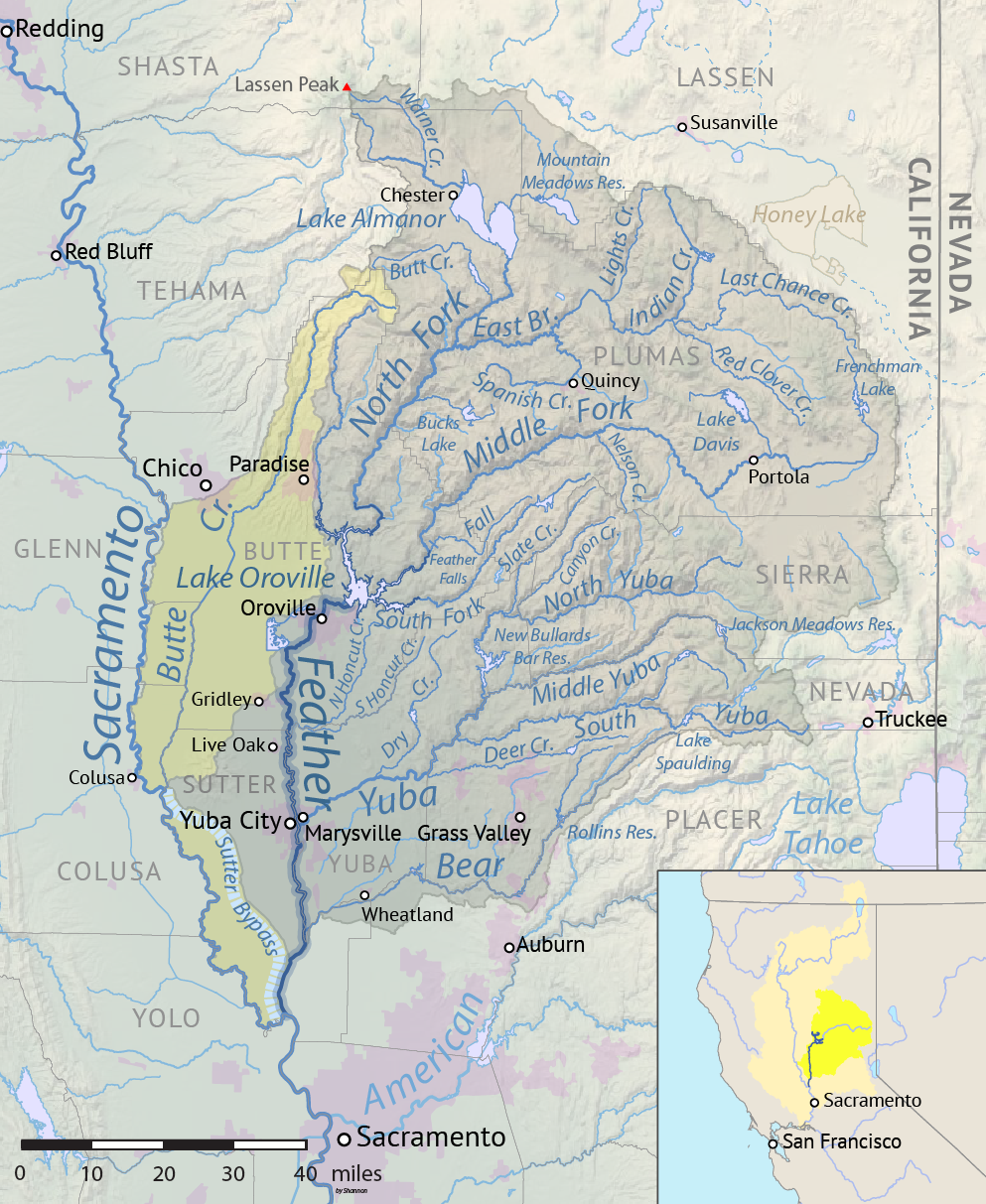
Feather River drainage. By Shannon1 – Own work, CC BY-SA 4.0, https://commons.wikimedia.org/w/index.php?curid=46854411

Steele and Donnelley tried to stave off hunger by chewing pine bark. Soon they began to hear faint voices, or the clang of mining tools, but they couldn’t find any humans. After some hunting around, they decided the sounds must be an illusion.

However, in several miles we were surprised and delighted to find Mountaineer Lawson’s mining camp. There were several while men and Pah Ute Indians working a placer mine on the bank of the river. Coming down the river, we saw that when we had taken for the valley of the north fork of the Feather River was only a deep gulch, and the main stream, which we had visited above the Big Meadows, lay over the mountains toward the northwest. (p. 184)

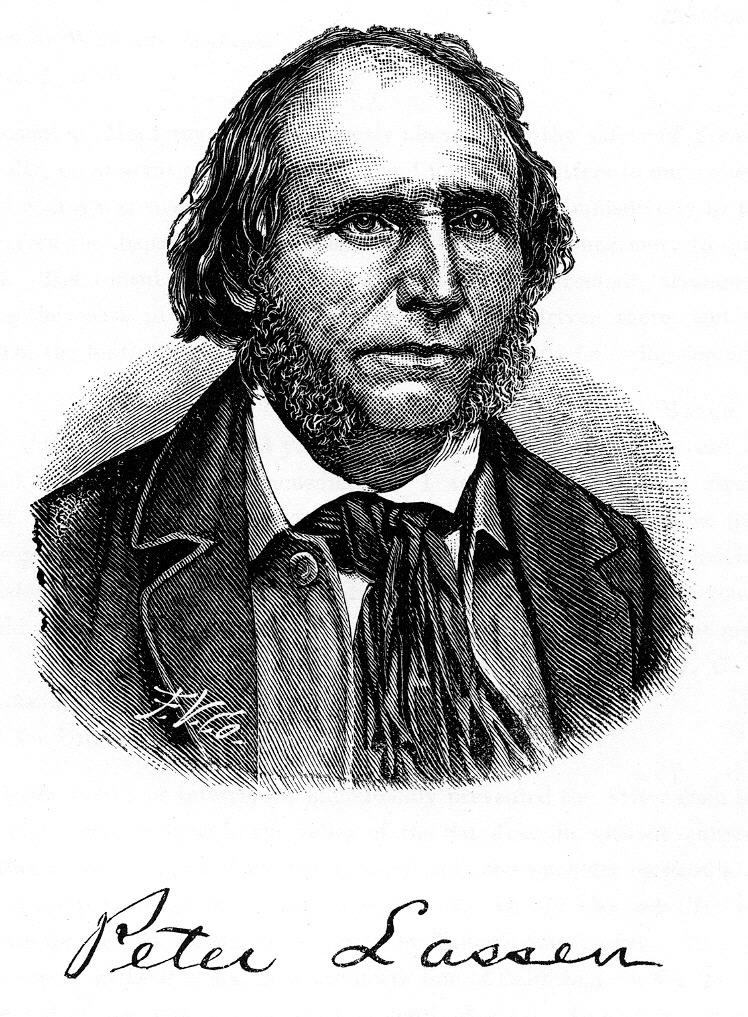
Who was “Mountaineer Lawson”? It must have been Peter Lassen, who was famous as an old settler and pioneer who loved exploring the mountains. Contemporary sources often spell his name “Lawson,” because that is the way he pronounced it. Influenced by the spelling, we today pronounce it like “lass”, but that’s not the way he said it.

Lassen had set off to prospect for gold in the summer of 1850, and is known to have mined at Rich Bar, which was located on the East Branch of the North Fork of the Feather River. That’s where Steele and Donnelley found him.

From Mr. Lawson we obtained some flour and bacon, and in a few minutes I had a cake baking in one of their skillets. While waiting for the cake, Lawson, who was familiar with all that region, inquired of Donnelley about our journey, which was candidly described. Whereupon Lawson bluffly replied, “Don’t tell me any such stuff as that; I know that country; it’s not far from a hundred and sixty miles; you fellows never made that trip without eating.” (p. 185)

Sounds like Peter Lassen. Steele and Donnelley were insulted at “having our veracity questioned . . . and as we had already paid for the flour and bacon, refused to have any further conversation with him.”

The starving men had to pay for their flour and bacon! You think Lassen could have spared them a meal.

Posted in John Steele, Uncategorized | Leave a comment