Colonel John H. Harper was convicted of the crime of robbery against Mrs. B.M. Evoy on the stage near Neal’s Ranch in Butte County in May 1853. He was sentenced to seven years imprisonment, but was pardoned by the governor after two years and then disappeared to Nicaragua.
All along he maintained his innocence, but since her $1800 worth of gold was found in his cloak, that evidence convinced the jury.
But was he really guilty?
More than thirty years went by, and then an item appeared in the Weekly Butte Record, reprinted from the Shasta Democrat. “Early settlers”, they said, might recall the robbery of Mrs. Evoy on the stagecoach near Neal’s Ranch, “for which robbery Colonel J.H. Harper was tried, convicted, and sentenced to State Prison.”
Some years ago Judge J.P. Haynes of the then Eighth Judicial District sentenced a man at Crescent City to the State Prison. After receiving his sentence, the prisoner sent for Judge Haynes and acknowledged to him about as follows:
“I was a passenger in the stage with Colonel Harper and several others when the woman was robbed. When she discovered her loss, and the money could not be found in the stage, Colonel Harper proposed that ever [sic] person be searched. We all stepped out and I went up close to the Colonel, who had on a cloak, I dropped the purse and money into one of his pockets, where it was found, and of course he was deemed the guilty one and convicted, though innocent. While I, the guilty one, escaped. You can rely on what I tell you, Judge, for it is true.”
Weekly Butte Record 19 March 1887
It was a passenger named Cummings who found the gold in Harper’s pocket. Although the man is not named in this article, it would seem to be Cummings again, who had continued a life of crime. If his story was true, it exonerates poor unjustly accused Col. Harper.
After being arrested for the theft of Mrs. Evoy’s gold, Col. John H. Harper of Trinity County languished in the Hamilton (Butte County) jail for the next six months. He was unable to raise the bail, which was set at $7000, an enormous amount. All along he insisted on his innocence and said that Cummings must have planted the gold on him. He was nearly lynched by a mob incensed that a man could so heartlessly rob an old lady.
While he awaited trial he desperately tried to get character witnesses to come forward to attest to his good reputation and to the fact that he had been traveling with his own money upon him, but no one came forward by the time the trial was held in December 1853. The judge was J.W. McCorkle.
On 31 December 1853, the Weekly Butte Record reported Mrs. Evoy’s testimony:
The principal witness, Mrs. Evoy, says that he paid such particular attention to her and her satchel in which the gold dust was deposited that her suspicions were aroused, and when at the Dry Creek House w[h]ere the money was first missed she fastened the guilt upon Harper, there being but one other passenger in the stage of whom she had no suspicion. On their return to Neal’s Ranch a search was proposed, to which Harper slightly objected. The other passenger whose name is Cummings was willing to be searched and when the search was made, the bags containing the gold dust was found on the person of Harper, or in the pocket of his cloak. This was so palpable that all were satisfied of his guilt, and when no hope was left him he sank back and exclaimed I am ruined!
Col. Harper’s lawyer had little to offer in his defense. He referred to his distinguished career and begged the mercy of the jury to save his client from “ignominy and shame.” Then Col. Harper stood up and delivered a lengthy and heartfelt speech in his own defense.
His appeals were most eloquent, and brought tears to the eyes of many who listened !o him He seemed perfectly free from embarrassment during the delivery of his speech. He remarked that he stood alone, without friends, money, or influence. It would be a heart of stone that would not deeply sympathise with the prisoner when he alluded to his aged father and pious mother, under whose holy precepts and examples he had been nurtured and prayerfully admonished against the commission of evil deeds. . . .
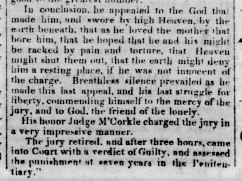
In conclusion he appealed to the God that made him, and swore by high Heaven, by the earth beneath that as he loved the mother that bore him, that he hoped that he and his might be racked by pain and torture, that Heaven might shut them out that the earth might deny him a resting place, if he was not innocent of the charge. Breathless silence prevailed as he made this last appeal, and his last struggle for liberty commending himself to the mercy of the Jury and to God the friend of the lonely.
Shasta Courier 7 January 1854
This eloquent appeal touched the hearts of many, including the editor of the Butte Record. Nevertheless, the jury quickly returned a verdict of guilty and Col. Harper was sentenced to seven years in the penitentiary.
He serve two years of his sentence and then was pardoned by Governor Bigler. He wasted no time in boarding a steamship for Nicaragua. According to Mansfield’s History of Butte County, He there became “a commander of rebel forces in a Nicaraguan rebellion.” (Mansfield, p. 154) If so, he took part in William Walker’s Filibuster War in Central America.
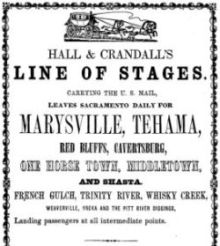
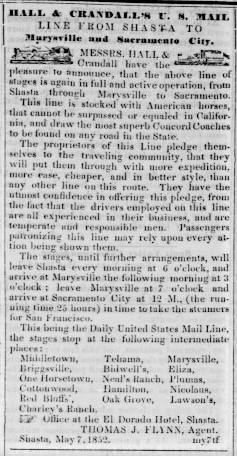
On Wednesday, May 25, 1853, Mrs. Bridget M. Evoy was traveling by Hall & Crandall stagecoach from Shasta to Marysville. When the stage stopped at Dry Creek House she discovered that the gold she was carrying in a carpetbag was missing.
This was no small amount of gold dust. She had $1800 in two purses and both were missing. This is the equivalent of $51,800 today.
Although Mrs. Evoy was described by the Shasta Courier as “an old lady of about 70 years of age,” she was no frail and vulnerable female. She was a 61-year-old widow, long accustomed to faring for herself. and a shrewd businesswoman. At the age of 58 she led her family to California, riding horseback from St. Louis, Missouri. By 1853 she owned property in Marysville, Yuba City, and the mining community of Briggsville in Shasta County, where she ran a boarding house.
She had just sold a piece of real estate in Briggsville, and was taking the proceeds, together with money earned from running “California House,” to the bank in Marysville.
According to an article in the Shasta Courier, when she discovered her loss, she immediately informed the other passengers. Among the passengers were two men, Colonel John H. Harper, a former state senator from Trinity, and a man named Cummings. The the northbound stage arrived and all the passengers got out to be searched.
One of the passengers, Colonel Harper of Trinity, threw off his cloak at once, and requested that he might be searched. Another passenger [Cummings] immediately picked up the cloak, and took out of the side pocket a purse of gold with the name of the lady marked on it. On further search they found another purse in his coat pocket containing upwards of a thousand dollars.
The stagecoach returned to Neal’s Ranch, and the next day Col. Harper had a hearing before Justice Thomas S. Wright and was detained in the Hamilton jail to await trial.
To give you an idea where these places are located, Neal’s Ranch was about 10 miles south of Rancho Chico. Neal Road and the landfill are located there today. Dry Creek House was located ten miles south of Neal’s Ranch, about where Sohnrey’s Family Foods is located today on Hwy. 99.
Mrs. Bridget M. Evoy was an enterprising woman of the Gold Rush. She came to California with her family on the Lassen Trail in 1849. She earned her gold by successfully running a hotel or boarding house called the “California House” in Briggsville.
Briggsville has completely disappeared into the dust of time, but it was located near the flourishing mining town of Shasta in Shasta County. Mrs. Evoy appears on the 1852 California census. She gave her age as 46 years old. But her tombstone says she was born in 1791 in County Wexford, Ireland, so in 1852 she was at least 60 years old. But why should a lady have to answer an intrusive question like that?
I learned about Mrs. Evoy from a descendant of hers, Mr. Craig Harwood, who contacted me in the hope that I could help him to find out more about the family’s experience coming to California. I can’t say that I was much help, but we did find that we each had a tidbit of information about Mrs. Evoy and her connection to John Bidwell.
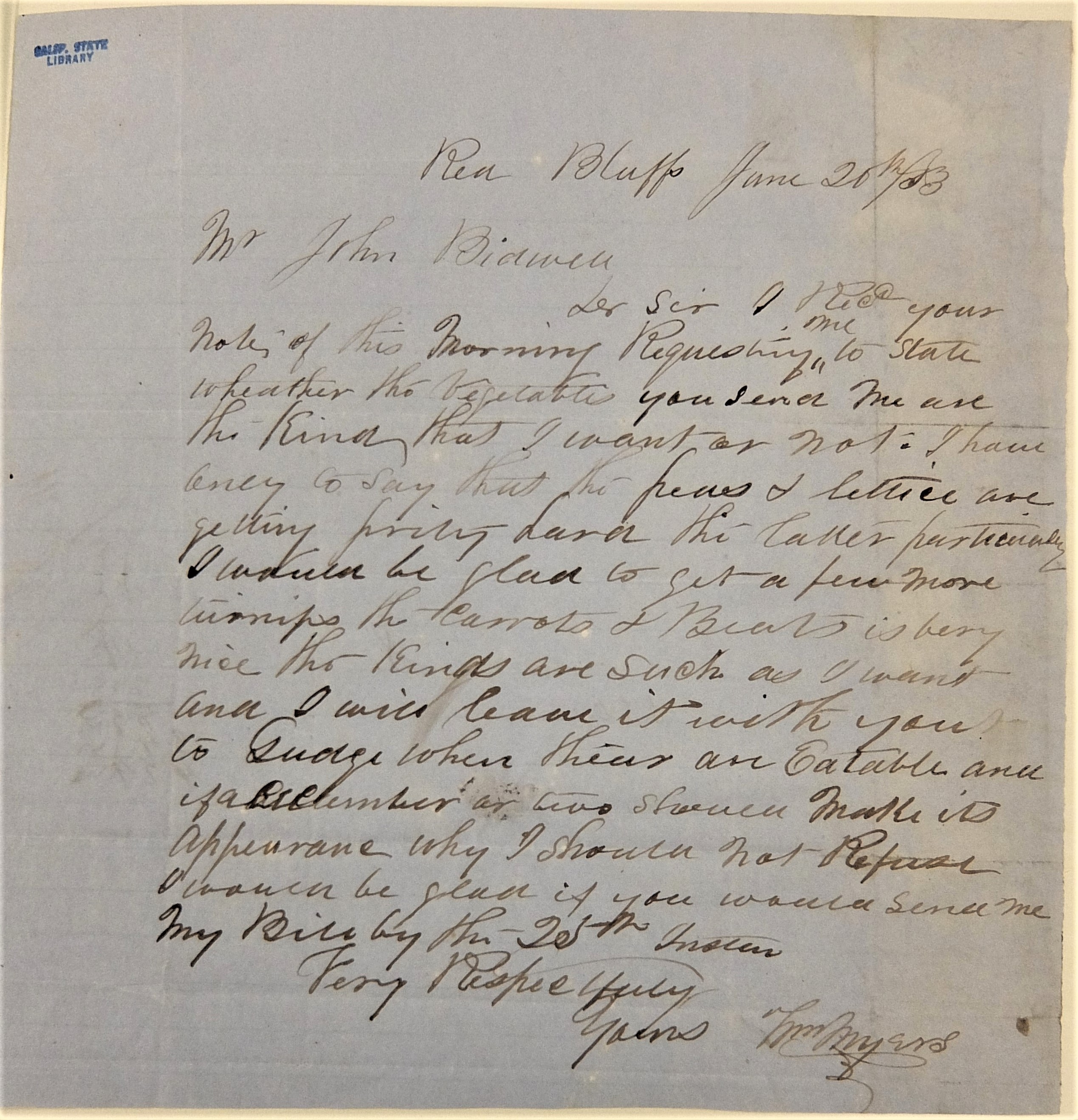
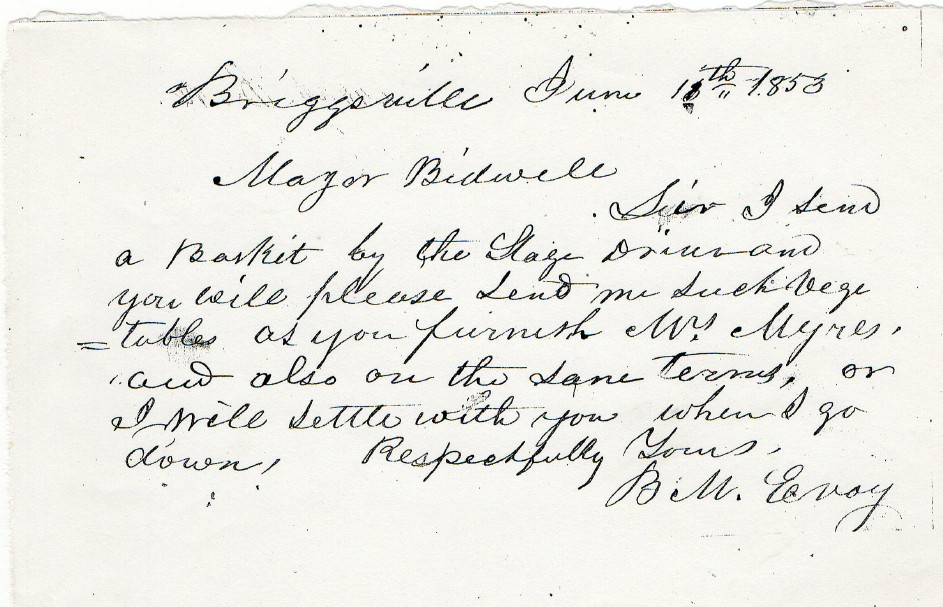
On June 11th, 1853 Mrs. Evoy wrote to Bidwell asking him to send her a basket of vegetables.
John Bidwell Papers, California State Library
Major Bidwell– Sir I send a basket by the stage driver and you will please send me such vegetables as you furnish Mrs. Myres, and also on the same terms, or I will settle with you when I go down. Respectfully yours, B.M. Evoy
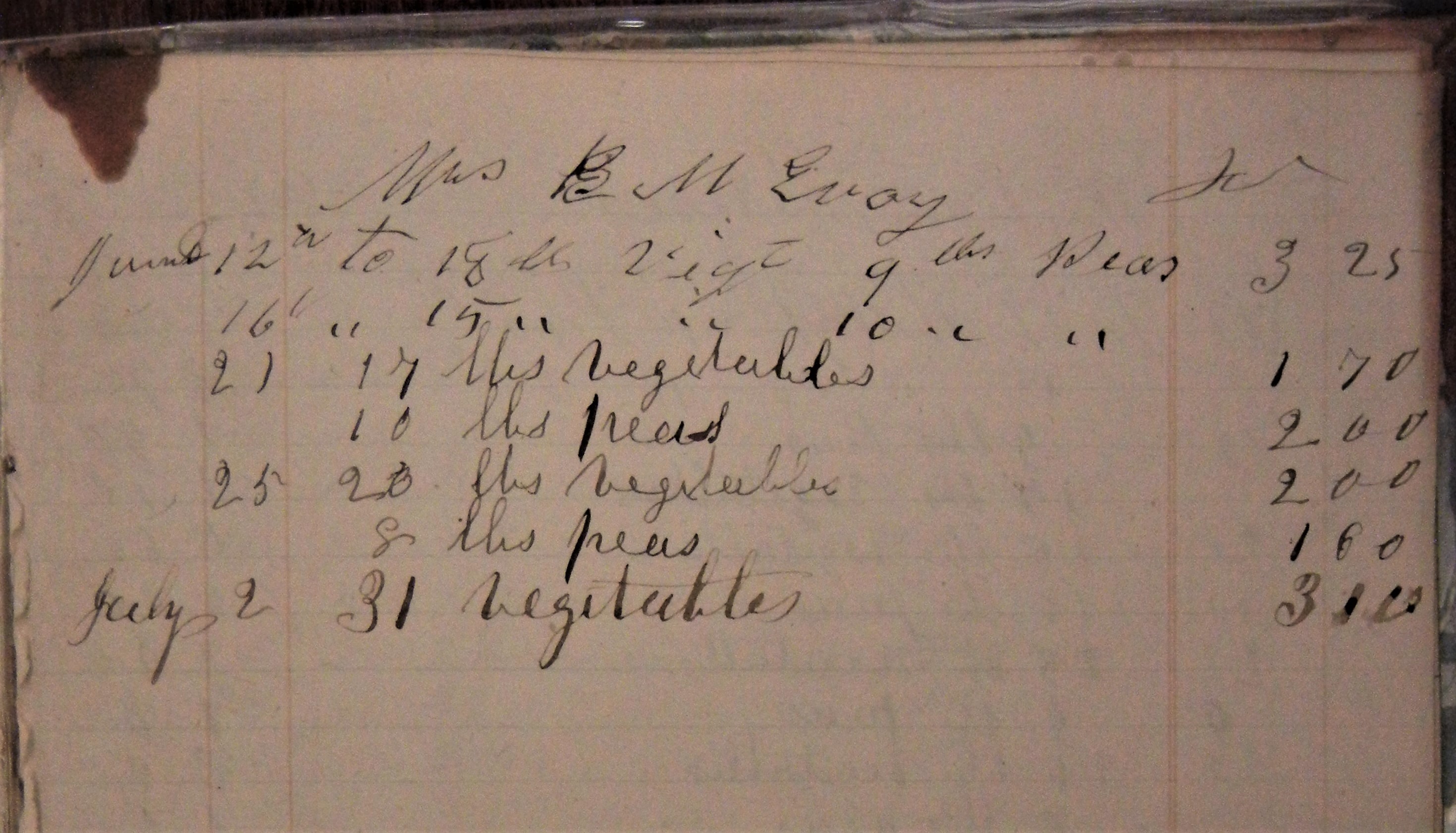
Fresh vegetables were not easy to come by in Gold Rush California, but Major Bidwell had a thriving garden. In the back of an old ledger he kept a record of what was planted when for the year 1853. In April and May he (or his crew) had planted peas, onions, carrots, cabbage, cauliflower, lettuce, parsnips, cucumbers, beets, corn and melons. There is even an entry for one of his best customers, Mrs. B.M. Evoy.
California State Library
Prompt service, as you can see. She wrote her letter on the 11th and sent it with the stage driver. On the 12th, 18 pounds of assorted vegetables and 9 pounds of peas were on their way back to her. It looks like peas were 20 cents a pound, which sounds cheap enough now but was probably high for the time. All prices in California were high.
I hope the miners she cooked for appreciated the fine fresh vegetables she served.
Next time: Mrs. Evoy’s adventure on the stagecoach
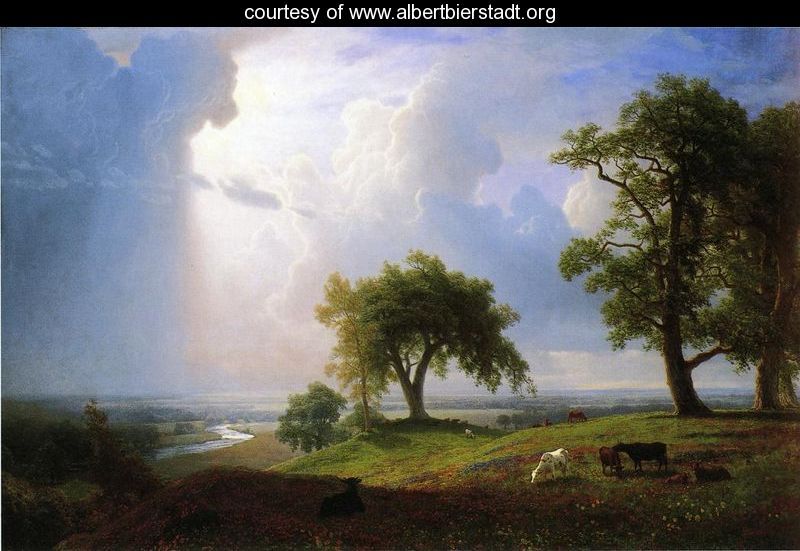
A painting that looks like a photo, The Sierra Nevada from the Head of the Carson River, by Albert Bierstadt
I had to sympathize with the writer of this item on SFGate about the argument over whether to say “the Sierra” or “the Sierras” when referring to the mountain range between California and Nevada. (SFGate is the online media outlet of the San Francisco Chronicle.) The author, Freda Moon, is a travel journalist who wrote “a breezy little story” about traveling from the Bay Area to Lake Tahoe in which she referred to the mountains as “the Sierras.”
Like you do. But a number of readers took her to task, and not all of them were polite about it.
It’s a question I have wondered about myself. When writing a book or a blog post about pioneers coming over the mountains into California, I have puzzled over how to refer to the mountains. Is it simply Sierra Nevada? Is calling them the Sierras okay? Since I often write for children, should I clarify by writing “the Sierra Nevada range” or “the Sierra Nevada mountains”? Even though that is redundant? Do kids know what a “range” is in this context? ‘Tis a puzzlement.
The word “sierra” in Spanish is already plural and means a range or chain of mountains. No need to add an “s”. Ms. Moon goes deep into the pros and cons. She consulted historians and grammarians. She asked Paul Brians, retired Professor of English at Washington State University and the author of “Common Errors in English Usage.” He concluded that “Some object to the familiar abbreviation ‘Sierras,’ but this form, like ‘Rockies’ and ‘Smokies’ is too well-established to be considered erroneous.”
My own conclusion is that if you are just chatting with your friend about going hiking in the Sierras, that’s fine. But if you are writing formally, and don’t want snarky comments from language purists, go with Sierra Nevada. But not just Sierra, because that might be mistaken for the Sierra Madre in Mexico or the Sierra de Cordoba in Argentina.
My idea of a fabulous 4th of July includes eating a hamburger, corn on the cob, and watermelon, singing the Star Spangled Banner, watching fireworks, and listening to a live band play The Stars and Stripes Forever.
I would like to hear The Declaration of Independence read aloud too, but I haven’t heard that on the 4th in decades.
I may not get all those wonderful things this year, but at least I can watch and listen to the U.S. Army Field Band and Soldier’s Chorus play and sing the Stars and Stripes Forever.
Did you know that John Philip Sousa not only wrote the march, but he wrote lyrics for it too? And I don’t mean “Be kind to your web-footed friends,” as fun as that is. I mean real patriotic lyrics.
I didn’t know that until quite recently. Here they are:
First strain Let martial note in triumph float And liberty extend its mighty hand A flag appears ‘mid thunderous cheers, The banner of the Western land. The emblem of the brave and true Its folds protect no tyrant crew; The red and white and starry blue Is freedom’s shield and hope.
Let eagle shriek from lofty peak The never-ending watchword of our land; Let summer breeze waft through the trees The echo of the chorus grand. Sing out for liberty and light, Sing out for freedom and the right. Sing out for Union and its might, O patriotic sons.
Second strain 𝄆 Other nations may deem their flags the best And cheer them with fervid elation But the flag of the North and South and West Is the flag of flags, the flag of Freedom’s nation. 𝄇
Trio Hurrah for the flag of the free! May it wave as our standard forever, The gem of the land and the sea, The banner of the right. Let tyrants remember the day When our fathers with mighty endeavor Proclaimed as they marched to the fray That by their might and by their right It waves forever.
Grandioso Hurrah for the flag of the free. May it wave as our standard forever The gem of the land and the sea, The banner of the right. Let tyrants remember the day When our fathers with mighty endeavor Proclaimed as they marched to the fray, That by their might and by their right It waves forever.
The “first strain” must be very tricky to sing at the pace the march is usually played. The Army chorus in this video sing the “Trio” and “Grandioso” which really function as the chorus of the piece.
And if you want something thoroughly silly, you can watch a rendition from the Muppet Show, with Sam the Eagle, the Swedish chef, Beaker, Bobo, Animal, a bewigged penguin, and some chickens.
Hurrah for the flag of the free! Long may it wave. Have a fabulous Independence Day!
Our celebrations of Independence Day are pretty tame compared to the way they enjoyed the Fourth in Chico in 1876. Here’s the July 4th entry from Bidwell’s diary in 1876:
Tues. July 4 Warm, very – no wind. = Bells rang & cannon & anvils roared all last night – Celebration went off well – good oration by Rev. Mr Dickerman – Fireworks & ball in evening. = Lost our greyhound, Roamer = Haynes had watermelons ripe in town. =
The celebration was announced in the newspaper a few days before the event. Citizens were urged to decorate their buildings with “evergreens, flags, and appropriate emblems.”
The Butte Record published a report of the proceedings the following Saturday. Everybody turned out for the “patriotic exercises”. Here is an excerpt about the parade and the speeches:
The Pavilion, where the parade concluded and the speeches were given, stood on Broadway between 4th and 5th.
An oration by a public figure was a must. That would be followed by the reading of the Declaration of Independence and a lengthy patriotic poem, which the Record printed in full. It was a day-long event, and as Bidwell notes, it started the night before, and went on well into the evening of the 4th with fireworks and dancing.
Watermelons were a feature, then as now. Roamer the greyhound was frightened by all the noise. He was found a few days later seven miles away at Hog Springs, on the Humboldt Road.
Bells ringing and cannon firing were a popular way to mark Independence Day. But what’s this about “anvils roared?” How do they do that?
If you didn’t have a cannon (or even if you did), “firing the anvil” was a great way to generate noise and excitement in the 19th century. All you needed were two anvils and some black powder, which you could get from your friendly neighborhood blacksmith. Here’s what you do:
(I don’t recommend trying this at home, even if you do happen to have an anvil. It’s very dangerous.)
Take one anvil and turn it upside down. On the underside is a hollow about the size of a brick. Pour in some gunpowder and place a fuse or a trail of gunpowder. Then place the other anvil right side up on top. When you light off the gunpowder, you will get a terrific explosion and the top anvil will fly at least a hundred feet in the air. It will come down too, so clear the deck.
You can find some examples of anvil firing on YouTube, like this one.
This well-known photograph shows a black miner in the California goldfields. It was taken at Auburn Ravine in 1852, but the man’s name is unknown. Was he free or was he enslaved? Did he strike it rich? Was the gold his to keep or did a slaveholder claim it?
With the discovery of gold in 1848, prospectors poured into California. Southern slaveholders saw an opportunity to prosper by working slaves in the goldfields. Free Negroes also came to California, and by the census of 1852 there were approximately 2200 African Americans in California, the majority being enslaved persons. They came overland, working as teamsters (as Alvin Coffey did), and cooks and servants. They came by ship, as sailors and accompanying Southern gold-seekers, like George Washington Dennis.
Some were able to earn the money to buy their freedom, as G.W. Dennis did by working in a gambling house. Others fled and were protected by sympathetic friends. Alvin Coffey noted that “If I’d run away, there’d have been plenty to hide me and protect me.” But Alvin knew that if he ran he would lose any chance of returning to Missouri and rescuing his family.
Were slaves ever sold in California? Undoubtedly they were, but evidence can be hard to find. In his book California’s Black Pioneers, Kenneth G. Goode quotes a notice that appeared in a Sacramento newspaper, the Democratic State Journal in 1852. That paper is not available online, but here is part of the text:
NEGRO FOR SALE — On Saturday the 26th inst., I will sell at public auction a Negro Man, he having agreed to said sale in preference to being sent home. I value him at $300, but if any or all of his abolition brethren wish to show that they have the first honorable principle about them, they can have an opportunity of releasing said Negro from bondage by calling on the subscriber, and the Southern House, precious to that time and paying $100.
Goode, California’s Black Pioneers, p. 60
His “abolition brethren” did indeed come up with the $100 to buy the freedom of their friend, showing that they had more “honorable principles” than the seller.
Another advertisement appeared in the Sacramento Transcript:
Sacramento Transcript 1 April 1850
Note in this case that the buyer is not actually purchasing the girl, but her indenture, which will be in force for two years. One hopes she was released at the end of that period, if not before.
Comic books have been around longer than you might think, and the California Gold Rush of 1849 proved to be a gold mine (so to speak) for satiric artists. One of the most entertaining is called Outline History of an Expedition to California, Containing the Fate of the All You Can Get Mining Association by an author-illustrator calling himself XOX. The title page illustration bears the name S.F. Baker at the lower right, so perhaps that was his name.
The story concerns a young New England merchant named Jonathan Swapwell who gets gold fever and joins a company of would-be miners headed for California. The mining association splits up into three groups: one goes by way of Cape Horn, one goes the Panama route, and one travels overland, giving the artist the opportunity to depict the perils of each. Which route Jonathan takes isn’t clear, but he ends up in California and makes a living selling good to miners.
Yale University Library
Jonathan overhears a plan to rob his store, so he and his partner Pat (a cartoon Irishman) pack up their gold and go to San Francisco to catch the next steamer home. Meanwhile, the men who took the Panama route are still waiting for a boat on the Pacific side of the Isthmus.
Yale University Library
The comic strip tale is bookended by two panels that frame the story. The opening panel shows Death and the Devil laying a trap in California to lure men to their deaths.
Yale University Library
The closing panel shows the two filling the large cavity left in the land with the bones of the deceased.
Bumpass Hell, that is, in Lassen National Volcanic Park. With grandchildren visiting from Wisconsin, and temperatures over 100 degrees in the valley, a trip to Hell turned out to be cooler than staying at home. The trail to Bumpass Hell is a 3-mile round trip, most of it pretty level, until the descent into the infernal regions.
Jeff in Hell
The story of how Bumpass Hell got its name is pretty well known. Kendall V. Bumpass, local cowboy, hunter, and guide, discovered the geothermal basin near Lassen Peak and scalded his leg when he broke through the crust over a hot pool. I wondered: What more could I find out about the unfortunate Mr. Bumpass?
I figured the incident would have been reported in the papers so I turned to the California Digital Newspaper Collection. Searching on the name Bumpass in the Red Bluff newspapers, I found a few references, but nothing about his famous accident. It turns out to be there, but the quality of the image is so poor that OCR can’t turn it into readable, searchable text. Searching by date ( Exploring Lassen County’s Past pin-pointed the incident to September 1865) I found the article.
K.V. Bumpass
According to Exploring Lassen County’s Past,
On September 10, 1864, Pierson Reading and Kendall Vanderhook Bumpass filed a claim there for “all the minerals there for mining purposes.”
During that first trip, Bumpass stepped through the crust and burned his foot, but he seems to have recovered sufficiently to continue his activities. He named the place Hell after this experience.
The following year, Watson Chalmers, editor of the Red Bluff Independent, went on an exploration in the mountains, which he reported about over several weekly issues of the Independent. He hired Kendall V. Bumpass to guide him and his companion to Lassen Peak and his namesake Hell.
Returning from the adventures of Feather River, and the natural curiosities of Willow Lake, we prepared for an ascent to the top of Lassen Butte, and the region rejoicing in the name of Bumpass Hell. . . . we took up the line of march with Mr. K. V. Bumpass as guide, an old and experienced mountaineer, whose services we had secured to conduct us to the infernal regions.
Mr. Chalmers couldn’t resist a classical reference, and quotes Virgil’s line facilis descensus averno, “the descent to Hell is easy.”
Passing up a mountain to the left of the lake {Lake Helen} and crossing a ridge, we came upon the evidences of a near approach to the sulphur regions. A small stream of hot sulphur water flowed beneath as we clambered along the precipitous side of the mountain. The sulphur water seemed to be destructive to all vegetation, nothing growing on the sides of the mountain save a few spots of grass. The whole vicinity seems unfit for the habitation of living animals, a few grouse alone disturbed the solitude which were quickly bagged by the hunters for supper. The scene of desolation became more dreary as we went up and clouds of steam met our gaze. At last the trail leads up a very steep point of the mountain, perfectly white, looking like a bed of chalk or plaster Paris. On turning the ridge, all the wonders of Hell were suddenly before us. Were it not for the fearful noise, I should suggest a camp meeting upon that spot.
Geothermal activity at Bumpass Hell today is no longer noisy. Chalmers joked that this vision of Hell would be a fitting backdrop for a religious revival.
Riding round the East end of the basin to the North side we tied our horses and prepared to go down for a close inspection. Casting our eyes to the North end we see a large pool of hot water boiling up in the air in many places; adjacent to this pool are several boiling springs of the blackest, nastiest mud that ever was made into pies by school boy urchins. The mud springs, of which there were a large number, were about three or four feet in diameter perfectly circular, the surface of the mud being about four feet below the surface of the basin. Casting in a large rock the mud flew into the air and the spring resumed its regular boilings. Stepping carefully between the spring to the middle of the basin and we came up in the entrance to the headquarters of hell itself. From a large opening in the side of the basin and the edge of the mountain, there went forth a volume of steam with a roar perfectly terrific. Our curiosity overcame all fear of danger and heedless of the warnings of our guide we crowded along a little ridge about a foot in width crumbled away on either side into a pool of boiling water, and with distended necks we gazed into the roaring cavern. The noise perfectly resembles that made by the steamboat at the levee blowing off steam. Every place we stepped was hot, everything we touched was hot.
Bumpass Hell has calmed down quite a bit since 1865. There is still steam and bubbling mudpots, but no mud boiling up into the air or steamboat-like roars. Just as they were about to leave, K.V. Bumpass had his accident.
As we were about to depart from the place, our guide, after cautioning us to be careful where we stepped, that the surface was treacherous, suddenly concluded with Virgil that the “descent to Hell was easy,” for stepping upon a slight inequality in the ground he broke through the crust and plunged his leg into the boiling mud beneath, which clinging to his limb burned him severely. If our guide had been a profane man I think he would have cursed a little; as it was, I think his silence was owing to his inability to do the subject justice . . . A bank of snow lay conveniently near, and taking a handkerchief and binding up the scalded limb with snow and [?] our guide, after planning out our future route, returned to the lake to his camp.
Red Bluff Independent 18 October 1865
Searching the newspaper didn’t turn up any following report on his condition, although it could well be there. Mr. Bumpass had to have his injured leg amputated, but he remained active until his death in 1885 at the age of 76.