The Stars and Stripes Forever

My idea of a fabulous 4th of July includes eating a hamburger, corn on the cob, and watermelon, singing the Star Spangled Banner, watching fireworks, and listening to a live band play The Stars and Stripes Forever.

I would like to hear The Declaration of Independence read aloud too, but I haven’t heard that on the 4th in decades.

I may not get all those wonderful things this year, but at least I can watch and listen to the U.S. Army Field Band and Soldier’s Chorus play and sing the Stars and Stripes Forever.

Did you know that John Philip Sousa not only wrote the march, but he wrote lyrics for it too? And I don’t mean “Be kind to your web-footed friends,” as fun as that is. I mean real patriotic lyrics.

I didn’t know that until quite recently. Here they are:

First strain
Let martial note in triumph float
And liberty extend its mighty hand
A flag appears ‘mid thunderous cheers,
The banner of the Western land.
The emblem of the brave and true
Its folds protect no tyrant crew;
The red and white and starry blue
Is freedom’s shield and hope.

Let eagle shriek from lofty peak
The never-ending watchword of our land;
Let summer breeze waft through the trees
The echo of the chorus grand.
Sing out for liberty and light,
Sing out for freedom and the right.
Sing out for Union and its might,
O patriotic sons.

Second strain
𝄆 Other nations may deem their flags the best
And cheer them with fervid elation
But the flag of the North and South and West
Is the flag of flags, the flag of Freedom’s nation. 𝄇

Trio
Hurrah for the flag of the free!
May it wave as our standard forever,
The gem of the land and the sea,
The banner of the right.
Let tyrants remember the day
When our fathers with mighty endeavor
Proclaimed as they marched to the fray
That by their might and by their right
It waves forever.

Grandioso
Hurrah for the flag of the free.
May it wave as our standard forever
The gem of the land and the sea,
The banner of the right.
Let tyrants remember the day
When our fathers with mighty endeavor
Proclaimed as they marched to the fray,
That by their might and by their right
It waves forever.

The “first strain” must be very tricky to sing at the pace the march is usually played. The Army chorus in this video sing the “Trio” and “Grandioso” which really function as the chorus of the piece.

And if you want something thoroughly silly, you can watch a rendition from the Muppet Show, with Sam the Eagle, the Swedish chef, Beaker, Bobo, Animal, a bewigged penguin, and some chickens.

Hurrah for the flag of the free! Long may it wave. Have a fabulous Independence Day!

Posted in Uncategorized | Leave a comment

A Chico Fourth of July — Centennial Version

Weekly Butte Record 1 July 1876

Our celebrations of Independence Day are pretty tame compared to the way they enjoyed the Fourth in Chico in 1876. Here’s the July 4th entry from Bidwell’s diary in 1876:

Tues. July 4
Warm, very – no wind. = Bells rang & cannon & anvils roared all last night – Celebration went off well – good oration by Rev. Mr Dickerman – Fireworks & ball in evening. = Lost our greyhound, Roamer = Haynes had watermelons ripe in town. =

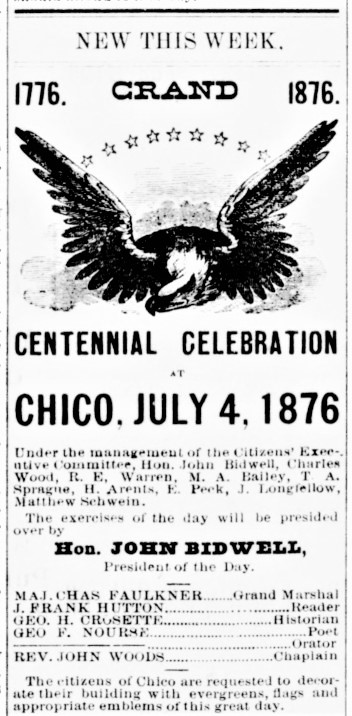
The celebration was announced in the newspaper a few days before the event. Citizens were urged to decorate their buildings with “evergreens, flags, and appropriate emblems.”

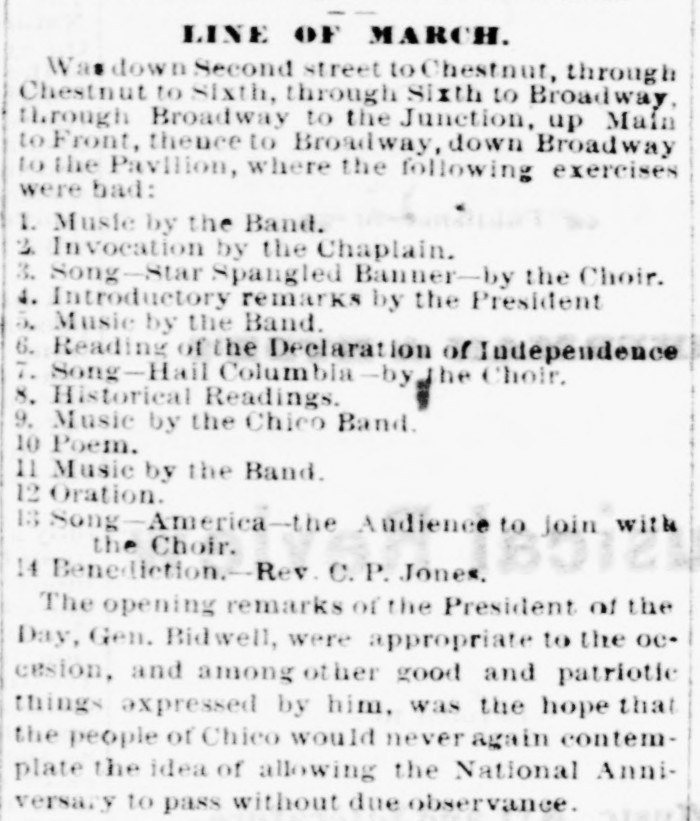
The Butte Record published a report of the proceedings the following Saturday. Everybody turned out for the “patriotic exercises”. Here is an excerpt about the parade and the speeches:

The Pavilion, where the parade concluded and the speeches were given, stood on Broadway between 4th and 5th.

An oration by a public figure was a must. That would be followed by the reading of the Declaration of Independence and a lengthy patriotic poem, which the Record printed in full. It was a day-long event, and as Bidwell notes, it started the night before, and went on well into the evening of the 4th with fireworks and dancing.

Watermelons were a feature, then as now. Roamer the greyhound was frightened by all the noise. He was found a few days later seven miles away at Hog Springs, on the Humboldt Road.

Bells ringing and cannon firing were a popular way to mark Independence Day.  But what’s this about β€œanvils roared?” How do they do that?

anvil

If you didn’t have a cannon (or even if you did), β€œfiring the anvil” was a great way to generate noise and excitement in the 19th century. All you needed were two anvils and some black powder, which you could get from your friendly neighborhood blacksmith. Here’s what you do:

(I don’t recommend trying this at home, even if you do happen to have an anvil. It’s very dangerous.)

Take one anvil and turn it upside down. On the underside is a hollow about the size of a brick. Pour in some gunpowder and place a fuse or a trail of gunpowder. Then place the other anvil right side up on top. When you light off the gunpowder, you will get a terrific explosion and the top anvil will fly at least a hundred feet in the air. It will come down too, so clear the deck.

You can find some examples of anvil firing on YouTube, like this one.

Posted in Uncategorized | Leave a comment

Slavery in California

This well-known photograph shows a black miner in the California goldfields. It was taken at Auburn Ravine in 1852, but the man’s name is unknown. Was he free or was he enslaved? Did he strike it rich? Was the gold his to keep or did a slaveholder claim it?

With the discovery of gold in 1848, prospectors poured into California. Southern slaveholders saw an opportunity to prosper by working slaves in the goldfields. Free Negroes also came to California, and by the census of 1852 there were approximately 2200 African Americans in California, the majority being enslaved persons. They came overland, working as teamsters (as Alvin Coffey did), and cooks and servants. They came by ship, as sailors and accompanying Southern gold-seekers, like George Washington Dennis.

Some were able to earn the money to buy their freedom, as G.W. Dennis did by working in a gambling house. Others fled and were protected by sympathetic friends. Alvin Coffey noted that “If I’d run away, there’d have been plenty to hide me and protect me.” But Alvin knew that if he ran he would lose any chance of returning to Missouri and rescuing his family.

Were slaves ever sold in California? Undoubtedly they were, but evidence can be hard to find. In his book California’s Black Pioneers, Kenneth G. Goode quotes a notice that appeared in a Sacramento newspaper, the Democratic State Journal in 1852. That paper is not available online, but here is part of the text:

NEGRO FOR SALE — On Saturday the 26th inst., I will sell at public auction a Negro Man, he having agreed to said sale in preference to being sent home. I value him at $300, but if any or all of his abolition brethren wish to show that they have the first honorable principle about them, they can have an opportunity of releasing said Negro from bondage by calling on the subscriber, and the Southern House, precious to that time and paying $100.

Goode, California’s Black Pioneers, p. 60

His “abolition brethren” did indeed come up with the $100 to buy the freedom of their friend, showing that they had more “honorable principles” than the seller.

Another advertisement appeared in the Sacramento Transcript:

Sacramento Transcript 1 April 1850

Note in this case that the buyer is not actually purchasing the girl, but her indenture, which will be in force for two years. One hopes she was released at the end of that period, if not before.

Posted in Uncategorized | Leave a comment

A Cartoon Expedition to California

Comic books have been around longer than you might think, and the California Gold Rush of 1849 proved to be a gold mine (so to speak) for satiric artists. One of the most entertaining is called Outline History of an Expedition to California, Containing the Fate of the All You Can Get Mining Association by an author-illustrator calling himself XOX. The title page illustration bears the name S.F. Baker at the lower right, so perhaps that was his name.

It has a great title page — very Gorey-esque.

Yale University Library

The story concerns a young New England merchant named Jonathan Swapwell who gets gold fever and joins a company of would-be miners headed for California. The mining association splits up into three groups: one goes by way of Cape Horn, one goes the Panama route, and one travels overland, giving the artist the opportunity to depict the perils of each. Which route Jonathan takes isn’t clear, but he ends up in California and makes a living selling good to miners.

Yale University Library

Jonathan overhears a plan to rob his store, so he and his partner Pat (a cartoon Irishman) pack up their gold and go to San Francisco to catch the next steamer home. Meanwhile, the men who took the Panama route are still waiting for a boat on the Pacific side of the Isthmus.

Yale University Library

The comic strip tale is bookended by two panels that frame the story. The opening panel shows Death and the Devil laying a trap in California to lure men to their deaths.

Yale University Library

The closing panel shows the two filling the large cavity left in the land with the bones of the deceased.

Yale University Library

You can view the entire book courtesy of Yale University Library.

Posted in Uncategorized | Leave a comment

I Went to Hell and So Can You

Bumpass Hell, that is, in Lassen National Volcanic Park. With grandchildren visiting from Wisconsin, and temperatures over 100 degrees in the valley, a trip to Hell turned out to be cooler than staying at home. The trail to Bumpass Hell is a 3-mile round trip, most of it pretty level, until the descent into the infernal regions.

Jeff in Hell

The story of how Bumpass Hell got its name is pretty well known. Kendall V. Bumpass, local cowboy, hunter, and guide, discovered the geothermal basin near Lassen Peak and scalded his leg when he broke through the crust over a hot pool. I wondered: What more could I find out about the unfortunate Mr. Bumpass?

I figured the incident would have been reported in the papers so I turned to the California Digital Newspaper Collection. Searching on the name Bumpass in the Red Bluff newspapers, I found a few references, but nothing about his famous accident. It turns out to be there, but the quality of the image is so poor that OCR can’t turn it into readable, searchable text. Searching by date ( Exploring Lassen County’s Past pin-pointed the incident to September 1865) I found the article.

K.V. Bumpass

According to Exploring Lassen County’s Past,

On September 10, 1864, Pierson Reading and Kendall Vanderhook Bumpass filed a claim there for β€œall the minerals there for mining purposes.”

During that first trip, Bumpass stepped through the crust and burned his foot, but he seems to have recovered sufficiently to continue his activities. He named the place Hell after this experience.

The following year, Watson Chalmers, editor of the Red Bluff Independent, went on an exploration in the mountains, which he reported about over several weekly issues of the Independent. He hired Kendall V. Bumpass to guide him and his companion to Lassen Peak and his namesake Hell.

Returning from the adventures of Feather River, and the natural curiosities of Willow Lake, we prepared for an ascent to the top of Lassen Butte, and the region rejoicing in the name of Bumpass Hell. . . . we took up the line of march with Mr. K. V. Bumpass as guide, an old and experienced mountaineer, whose services we had secured to conduct us to the infernal regions.

Mr. Chalmers couldn’t resist a classical reference, and quotes Virgil’s line facilis descensus averno, “the descent to Hell is easy.”

Passing up a mountain to the left of the lake {Lake Helen} and crossing a ridge, we came upon the evidences of a near approach to the sulphur regions. A small stream of hot sulphur water flowed beneath as we clambered along the precipitous side of the mountain. The sulphur water seemed to be destructive to all vegetation, nothing growing on the sides of the mountain save a few spots of grass. The whole vicinity seems unfit for the habitation of living animals, a few grouse alone disturbed the solitude which were quickly bagged by the hunters for supper. The scene of desolation became more dreary as we went up and clouds of steam met our gaze. At last the trail leads up a very steep point of the mountain, perfectly white, looking like a bed of chalk or plaster Paris. On turning the ridge, all the wonders of Hell were suddenly before us. Were it not for the fearful noise, I should suggest a camp meeting upon that spot.

Geothermal activity at Bumpass Hell today is no longer noisy. Chalmers joked that this vision of Hell would be a fitting backdrop for a religious revival.

Riding round the East end of the basin to the North side we tied our horses and prepared to go down for a close inspection. Casting our eyes to the North end we see a large pool of hot water boiling up in the air in many places; adjacent to this pool are several boiling springs of the blackest, nastiest mud that ever was made into pies by school boy urchins. The mud springs, of which there were a large number, were about three or four feet in diameter perfectly circular, the surface of the mud being about four feet below the surface of the basin. Casting in a large rock the mud flew into the air and the spring resumed its regular boilings. Stepping carefully between the spring to the middle of the basin and we came up in the entrance to the headquarters of hell itself. From a large opening in the side of the basin and the edge of the mountain, there went forth a volume of steam with a roar perfectly terrific. Our curiosity overcame all fear of danger and heedless of the warnings of our guide we crowded along a little ridge about a foot in width crumbled away on either side into a pool of boiling water, and with distended necks we gazed into the roaring cavern. The noise perfectly resembles that made by the steamboat at the levee blowing off steam. Every place we stepped was hot, everything we touched was hot.

Bumpass Hell has calmed down quite a bit since 1865. There is still steam and bubbling mudpots, but no mud boiling up into the air or steamboat-like roars. Just as they were about to leave, K.V. Bumpass had his accident.

As we were about to depart from the place, our guide, after cautioning us to be careful where we stepped, that the surface was treacherous, suddenly concluded with Virgil that the β€œdescent to Hell was easy,” for stepping upon a slight inequality in the ground he broke through the crust and plunged his leg into the boiling mud beneath, which clinging to his limb burned him severely. If our guide had been a profane man I think he would have cursed a little; as it was, I think his silence was owing to his inability to do the subject justice . . . A bank of snow lay conveniently near, and taking a handkerchief and binding up the scalded limb with snow and [?] our guide, after planning out our future route, returned to the lake to his camp.

Red Bluff Independent 18 October 1865

Searching the newspaper didn’t turn up any following report on his condition, although it could well be there. Mr. Bumpass had to have his injured leg amputated, but he remained active until his death in 1885 at the age of 76.

Posted in Bumpass Hell | Leave a comment

The Bear Flag and John Bidwell

A romanticized illustration of the raising of the Bear Flag

What did John Bidwell think of the Bear Flag Revolt and the famous Bear Flag raised at Sonoma? Not much, if you asked him, and more than one person did ask.

I like our state flag — I think it’s a handsome flag, and it reminds us of the history of California and how the Golden State came to be part of the Union. But the entire incident of the Bear Flag revolution, the Mexican War, and the creation of the flag is not as glorious and romantic as we might like to think. John Bidwell called it “an unjustifiable war.”

Bidwell mentions the flag briefly in β€œFremont in the Conquest of California,” published in the Century Magazine in February 1891. Another version appeared shortly thereafter in the big midsummer edition (4 July 1891) of the popular San Francisco magazine The Wasp. His account from the Century is well known β€” it appears in Echoes of the Past and online at The Museum of the City of San Francisco.Β  The version he told the Wasp is fuller, but less well known.

With regard to the bear flag incident, which has been so much heralded in romance and history, there was no further basis than a spirit of amusement among a few of the men. In the plaza in front of the residence of Gen. Vallejo, in Sonoma, stood a flag-staff which that gentleman had used when he was Military Commander of California, previous to the time of Castro. The Mexican flag had not floated on it for several years or since the retirement of Vallejo from office. When Fremont’s vanguard of mountaineers took possession of Sonoma, after sending Gen. Vallejo and other as prisoners to Sutter’s Fort, it was suggested that some kind of a flag be made and put on the deserted pole. Some one suggested that the new flag should represent a bear rampant, with lifted paw in the act of crushing a coyote, but that was too much for the artistic ability of any one present, so the plan was simplified to a plain bear. This was simply for amusement and without any idea of selecting the emblem of an independent movement against the Mexican authorities.

One of the men was William Todd (since the war of the Rebellion I met Mr. Todd and learned from him that he was a nephew of Mrs. Abraham Lincoln, and brought up in Abraham’s family), who found a small quantity of old reddish paint and with it attempted to make, on a piece of common brown cloth, the representation of a bear, and the same was run up on the flag-pole. The whole affair was ludicrous. Only a few men – two or three – possibly four or five at most – had anything to do with it, and certainly no officer or prominent men took any part. Mexicans looking at the flag were heard to say β€œcoche,” a localism for pig or small hog. The flag was flying when Fremont was in Sonoma, but I doubt he ever noticed it or knew it was there, and this is all there was at the time to the bear flag incident, but it seemed to lend itself readily to romance, and in a short time was distorted and misrepresented until the story went out to the world that an independent movement on foot in California had formally adopted this flag as a standard.

BearFlag2

Grizzly bear or pig β€” you decide.

So it was all just a lark. Making up a flag while waiting for the real war to happen. Or so John Bidwell says. He didn’t get to Sonoma until a few days after the Bear Flag had been run up the flagpole.

John Bidwell never saw the California state flag as we know it today. California didn’t have a state flag until 1911. (There is an excellent history of the Bear Flag at the virtual Bear Flag Museum.) The 1846 Bear Flag was the inspiration for the flag we know and love today, and I think John Bidwell would have liked the way it turned out.

Posted in bear flag | 1 Comment

In Search of Alvin A. Coffey

Today my friend Josie and I went in search of Alvin Coffey‘s presence in Tehama County. I am working on a picture book biography of Coffey, an African American pioneer, and I wanted to see where he lived and where he is buried.

It was a beautiful day for a drive in the country. We drove along Paskenta Road, on the west side of Tehama County, until we came to Elder Creek. Alvin Coffey bought a farm here in 1872. He raised hay and turkeys, and a family of children, on the farm. It’s a lovely location — gently rolling land with a view of the Coast Range to the west and the foothills of the Cascades to the east. It’s summertime, so the grass is dry and the creek has barely any water in it, but in the spring I imagine the grass is lush, the flowers are blooming, and the creek is running with cold, clear water.

Alvin Coffey farm, from Paskenta Road.

I don’t know who the land belongs to now — not the Coffey family — and there is a gate, so I couldn’t get any closer. The old farmhouse is gone, but I still would have liked to get a closer look.

Elder Creek

We then drove into Red Bluff, to the Oak Hills Cemetery. The manager, Leland Owens, was very helpful. He not only looked up the location of the Coffey graves for us, but he led us to them.

The Coffey plot at Oak Hill Cemetery, Red Bluff

The middle marker is Alvin’s. Jeannette Molson tells me that there used to be a headstone, but that is gone, and there is only a marble marker flush with the soil to mark Alvin’s grave. His wife’s grave is to the left and their son John W. to the right. In the second row are the graves of sons Stephen Ware Coffey and Charles Oliver Coffey, and Charles’s wife Jennie Elenora (Scott) Coffey.

His wife Mahala has a headstone, with her maiden name – Mahala Tindall — engraved across the top.

Other Coffey family members are buried in this cemetery, including the youngest daughter, Ora Fina Coffey Williams.

Posted in Alvin A. Coffey | Leave a comment

A Gold Rush Letter

This random one-off letter from G.W. Lawson to Charles L. Hansicker is in the Sutter’s Fort Pioneer Collection at the California State Library, along with papers from John Bidwell, John Sutter, and George McKinstry. It’s a glimpse of the news of the day from a rich mining camp that would become Nevada City. There is one word in the first line that baffles me, otherwise it is pretty easy to read. Here is the entire letter:

Nevada April 27th 1850

Dear Charley

Β Β Β Β Β Β Β Β Β Β Β  As you are [kindee?] connected with the press now I want to tell you some few things concerning this diggings & if they are worth repeating put them in the paper if not I hope they will interest you enough to secure your perusal. I also wish to correct a statement made in the paper about β€œGold Run”. It is not wanting in water as stated but the water has just subsided enough to let all hands in, and it will last long enough to work out all the claims. Today I went up the run its length, one company of five men washed down the forenoons work, & shewed it to me, 4 & Β½ pounds of grain gold. [Inserted] Evening: one of the company has just come in & informed me that the days work is 12 pounds. Ain’t that some? 20,000 is asked for some claims of 120 or 40 feet. East Branch (close by it) is now attracting attention. 3000 is asked for claims of 60 feet. I think Deer Creek itself will turn out very rich. They are turning it here every foot. A gentleman tells me tonight that he saw 9 pounds which was taken out of a small space on the side of Sugar Loaf Mountain (close to this place). Don’t it go ahead of anything.

The place is growing from 1 to 4 houses a day. Seeing so much earth throwed out today suggested to me a way of building a Rail Road to California. Let the government, or a Great Company, collect about 100,000 of the poor laboring men of the states such as would like to come & have not the means, manage them in sections completing along as fast as practicable. In that way, supplies from the States could be furnished the laborers by the road itself cheap and one year would bring them all here. Reward each man with a good gold claim when he got here (this the Government could do) & thus a road could be built upon the labor of men wishing to get here either by the Gen. Government or a heavy company. Don’t laugh now.

I have not heard from home, & though weighing out the dust half my time I get homesick. I should like to β€œscratch gravel” in that direction, wouldn’t you, Charles. But when we get back, won’t there be some β€œprospecting” about them diggings, β€œstriking of leads,” & perhaps some β€œjumping of claims.”

I meant to have written you more, but so many are in, talking and using me that I can’t think of what I would write & the mail is in haste.

Yours truly, G.W. Lawson

A little sleuthing in the census records of 1850 and I discovered that Charles Hansicker, age 24, was employed as a printer by the Sacramento Transcript. The statement about water that the writer corrects in the first paragraph appeared in the paper on April 12, 1850.

G.W. Lawson didn’t make it into the 1850 census, which was a hit-and-miss affair, but seems to have remained in California. George W. Lawson shows up up in the 1860 census: a 38 year old lawyer, living at Rose Bar Township in Yuba County, married to Mary, with baby son Herman.

Charles Hansicker served in the Mexican War as a 2nd lieutenant. After the war he probably returned to Indiana, but when the news of gold in California hit the States, he joined the rush for gold. He soon turned from mining to printing, first working at the Sacramento Transcript, and then founding the Sacramento Daily Union.

20 March 1851

He returned to Indiana in 1853. His “prospecting,” as his buddy George joshes, was successful and he married Gabriella Preble. They had two daughters. Unfortunately, he died of consumption (tuberculosis) in 1859.

The address on the letter
Posted in Uncategorized | 3 Comments

Saturday Night at the Mines

Saturday Night at the Mines, by Charles Christian Nahl

A while back I wrote about one of my favorite paintings, Sunday Morning in the Mines, by Charles Christian Nahl. Here is a companion piece by the same artist, Saturday Night at the Mines.

Who do we see in this painting? Six men, one of them asleep in his bunk in the background. Highlighted by his white shirt and his central position is one miner soberly weighing the result of a week’s worth of gold-mining. He is watched by a young man in a dark shirt, who is smoking a pipe, and a man standing, wearing a red shirt. On the right a young man kneels at the fireplace and stirs their evening pot of beans.

On the left is another red-shirted miner who is obviously enjoying his bottle. His slovenly posture contrasts with the alertness of the other red shirted man and the diligence of the cook.

This painting was purchased by Mrs. Jane Stanford, wife of Governor Leland Stanford, and at one time hung in the state capitol. One reference said that it is in the Stanford University Museum of Art, but a search of that website (now the Cantor Arts Center) doesn’t turn it up. So I can’t tell you for sure where you can see it. Sunday Morning in the Mines is in the Crocker Art Museum in Sacramento.

Before he did this painting, C.C. Nahl did another version of this picture with his friend and fellow artist Frederick A. Wenderoth. It is a lithograph titled Miner’s Cabin: Results of the Day. Here is the hand-colored version by Wenderoth and Nahl, made in 1852. The lithograph would inspire Nahl’s painting Saturday Night at the Mines twenty years later.

Miner’s Cabin: Results of the Day, by Wenderoth and Nahl


The image is reversed, the table is gone, and so is the drunkard with his bottle. Other elements remain similar: the man kneeling to cook at the fireplace, the moon shining in the open doorway, the gear on the floor and the shelves, the sleeper in his bunk. The tall man in the center strikes the same pose as the red-shirted man in the painting.

And, just for fun, here is another painting by F.A. Wenderoth.

Little Terrier, by Frederik A. Wenderoth
Posted in Charles C. Nahl | 4 Comments

The First Wagon Train to California

On this date one hundred and eighty years ago, the first emigrant wagon train to leave for California headed out on the Oregon Trail. Known today as the Bidwell-Bartleson Party, they teamed up with a group of Catholic missionaries and started from Sapling Grove, Kansas Territory. Here is John Bidwell’s journal entry for that day:

Wednesday, 19th. This morning the wagons started off in single file; first the 4 carts and 1 small wagon of the missionaries, next 8 wagons drawn by mules and horses, and lastly, 5 wagons drawn by 17 yoke of oxen. It was the calculation of the company to move on slowly till the wagon of Chiles overtook us. Our course was west, leaving the Kanzas no great distance to our left, we traveled in the valley of the river which was prairie excepting near the margin of the stream. The day was very warm and we stopped about noon, having traveled about 12 miles.

This afternoon we had a heavy shower of rain and hail. Several Kanzas Indians came to our camp; they were well armed with bows and arrows, and some had guns. They were daily expecting an attack by the Pawnees, whom they but a short time ago had made inroads on, and had massacred at one of their villages a large number of old men, women, and children, while the warriors were hunting buffalo.

Last year one of my pandemic projects was to post from John Bidwell’s travel journal every day. I don’t plan to do that again this year, but if you are interested in following the pioneers on the trail, you can start with this post.

The Oregon Trail, by William Henry Jackson
Posted in Bidwell-Bartleson Party | Leave a comment