The Bear Flag and John Bidwell

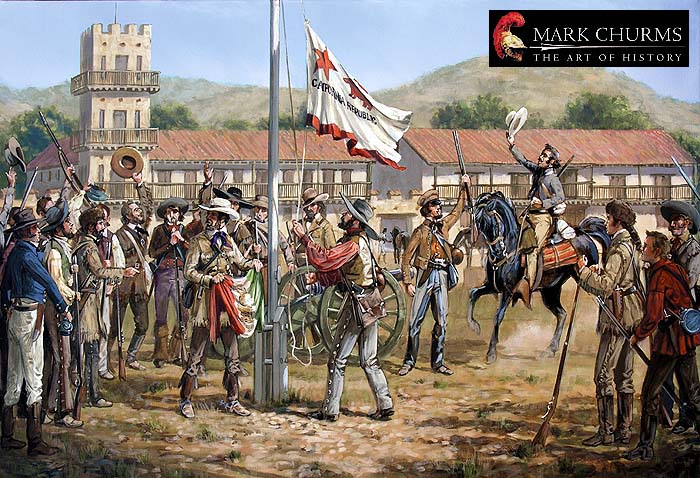
A romanticized illustration of the raising of the Bear Flag

What did John Bidwell think of the Bear Flag Revolt and the famous Bear Flag raised at Sonoma? Not much, if you asked him, and more than one person did ask.

I like our state flag — I think it’s a handsome flag, and it reminds us of the history of California and how the Golden State came to be part of the Union. But the entire incident of the Bear Flag revolution, the Mexican War, and the creation of the flag is not as glorious and romantic as we might like to think. John Bidwell called it “an unjustifiable war.”

Bidwell mentions the flag briefly in “Fremont in the Conquest of California,” published in the Century Magazine in February 1891. Another version appeared shortly thereafter in the big midsummer edition (4 July 1891) of the popular San Francisco magazine The Wasp. His account from the Century is well known — it appears in Echoes of the Past and online at The Museum of the City of San Francisco.  The version he told the Wasp is fuller, but less well known.

With regard to the bear flag incident, which has been so much heralded in romance and history, there was no further basis than a spirit of amusement among a few of the men. In the plaza in front of the residence of Gen. Vallejo, in Sonoma, stood a flag-staff which that gentleman had used when he was Military Commander of California, previous to the time of Castro. The Mexican flag had not floated on it for several years or since the retirement of Vallejo from office. When Fremont’s vanguard of mountaineers took possession of Sonoma, after sending Gen. Vallejo and other as prisoners to Sutter’s Fort, it was suggested that some kind of a flag be made and put on the deserted pole. Some one suggested that the new flag should represent a bear rampant, with lifted paw in the act of crushing a coyote, but that was too much for the artistic ability of any one present, so the plan was simplified to a plain bear. This was simply for amusement and without any idea of selecting the emblem of an independent movement against the Mexican authorities.

One of the men was William Todd (since the war of the Rebellion I met Mr. Todd and learned from him that he was a nephew of Mrs. Abraham Lincoln, and brought up in Abraham’s family), who found a small quantity of old reddish paint and with it attempted to make, on a piece of common brown cloth, the representation of a bear, and the same was run up on the flag-pole. The whole affair was ludicrous. Only a few men – two or three – possibly four or five at most – had anything to do with it, and certainly no officer or prominent men took any part. Mexicans looking at the flag were heard to say “coche,” a localism for pig or small hog. The flag was flying when Fremont was in Sonoma, but I doubt he ever noticed it or knew it was there, and this is all there was at the time to the bear flag incident, but it seemed to lend itself readily to romance, and in a short time was distorted and misrepresented until the story went out to the world that an independent movement on foot in California had formally adopted this flag as a standard.

BearFlag2

Grizzly bear or pig — you decide.

So it was all just a lark. Making up a flag while waiting for the real war to happen. Or so John Bidwell says. He didn’t get to Sonoma until a few days after the Bear Flag had been run up the flagpole.

John Bidwell never saw the California state flag as we know it today. California didn’t have a state flag until 1911. (There is an excellent history of the Bear Flag at the virtual Bear Flag Museum.) The 1846 Bear Flag was the inspiration for the flag we know and love today, and I think John Bidwell would have liked the way it turned out.
Posted in bear flag | 1 Comment

In Search of Alvin A. Coffey

Today my friend Josie and I went in search of Alvin Coffey‘s presence in Tehama County. I am working on a picture book biography of Coffey, an African American pioneer, and I wanted to see where he lived and where he is buried.

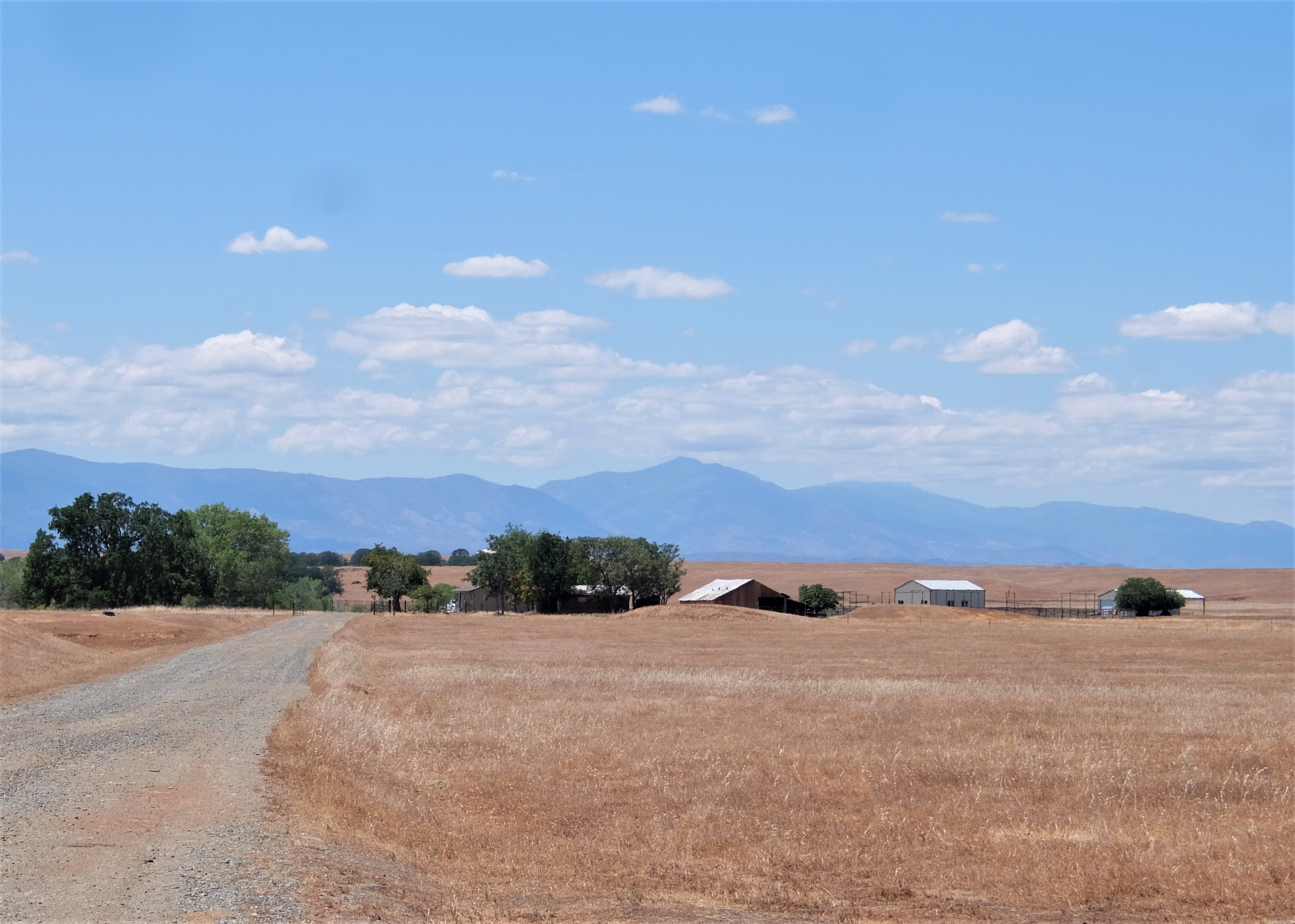
It was a beautiful day for a drive in the country. We drove along Paskenta Road, on the west side of Tehama County, until we came to Elder Creek. Alvin Coffey bought a farm here in 1872. He raised hay and turkeys, and a family of children, on the farm. It’s a lovely location — gently rolling land with a view of the Coast Range to the west and the foothills of the Cascades to the east. It’s summertime, so the grass is dry and the creek has barely any water in it, but in the spring I imagine the grass is lush, the flowers are blooming, and the creek is running with cold, clear water.

Alvin Coffey farm, from Paskenta Road.

I don’t know who the land belongs to now — not the Coffey family — and there is a gate, so I couldn’t get any closer. The old farmhouse is gone, but I still would have liked to get a closer look.

Elder Creek

We then drove into Red Bluff, to the Oak Hills Cemetery. The manager, Leland Owens, was very helpful. He not only looked up the location of the Coffey graves for us, but he led us to them.

The Coffey plot at Oak Hill Cemetery, Red Bluff

The middle marker is Alvin’s. Jeannette Molson tells me that there used to be a headstone, but that is gone, and there is only a marble marker flush with the soil to mark Alvin’s grave. His wife’s grave is to the left and their son John W. to the right. In the second row are the graves of sons Stephen Ware Coffey and Charles Oliver Coffey, and Charles’s wife Jennie Elenora (Scott) Coffey.

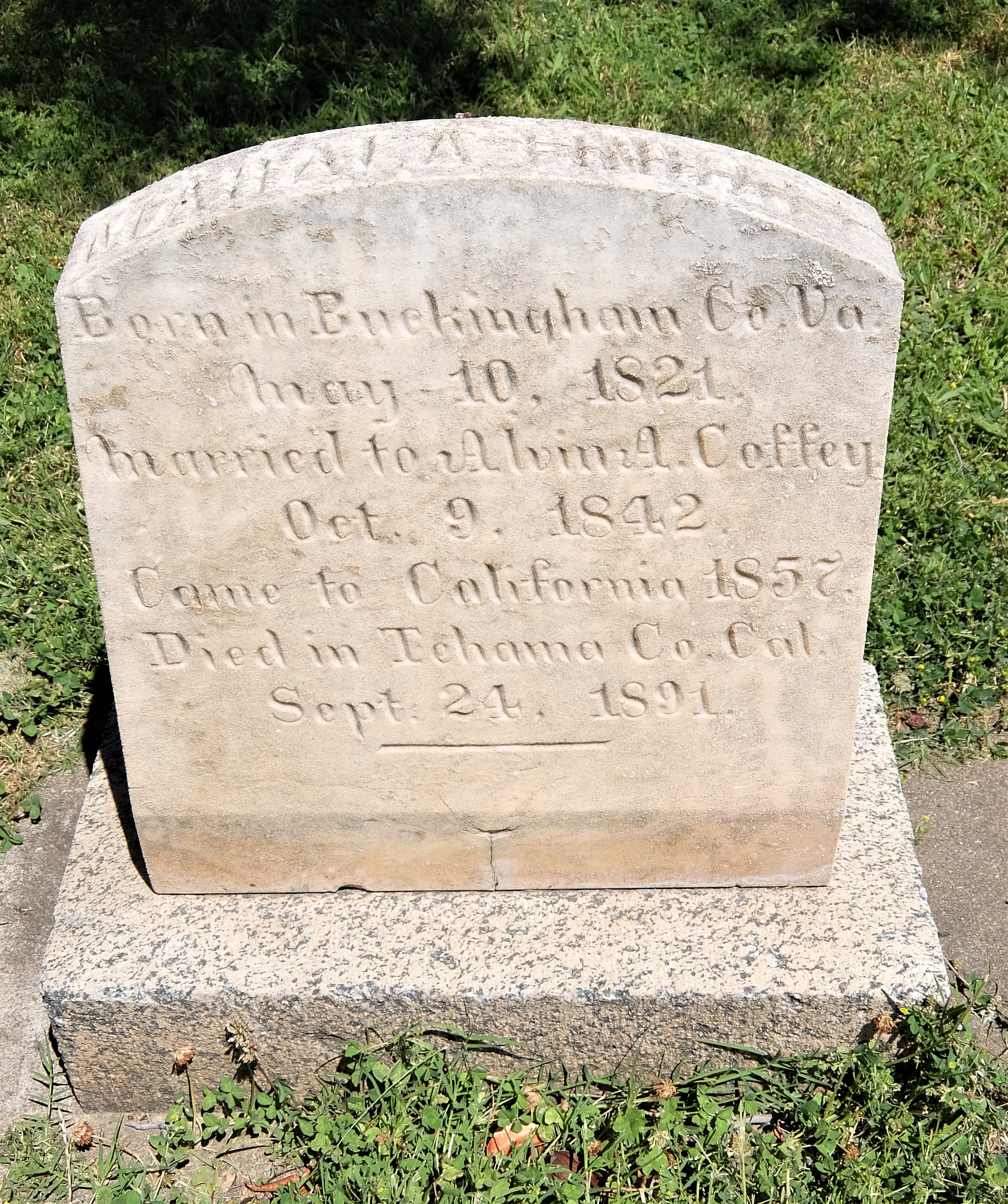
His wife Mahala has a headstone, with her maiden name – Mahala Tindall — engraved across the top.

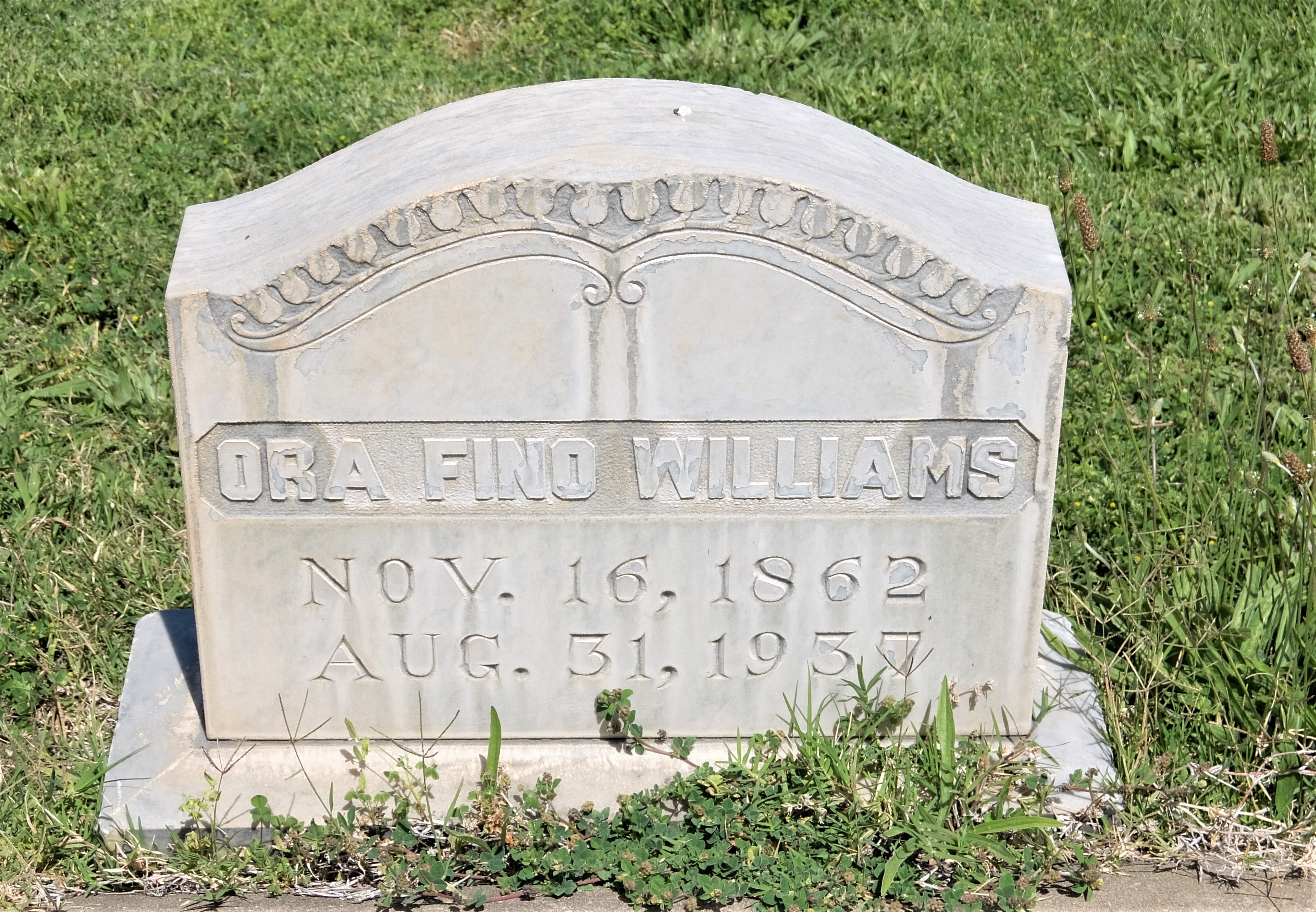
Other Coffey family members are buried in this cemetery, including the youngest daughter, Ora Fina Coffey Williams.

Posted in Alvin A. Coffey | Leave a comment

A Gold Rush Letter

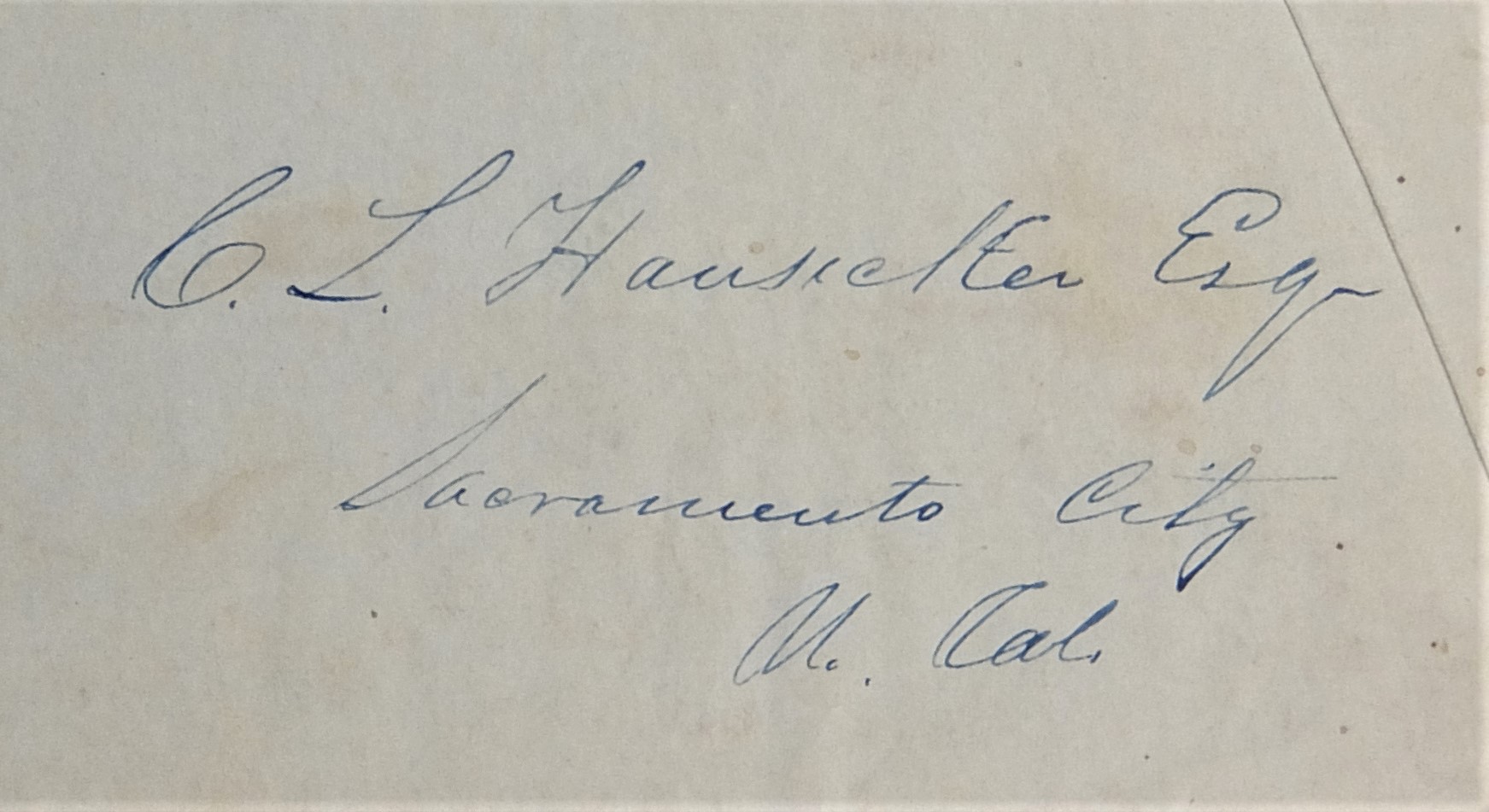
This random one-off letter from G.W. Lawson to Charles L. Hansicker is in the Sutter’s Fort Pioneer Collection at the California State Library, along with papers from John Bidwell, John Sutter, and George McKinstry. It’s a glimpse of the news of the day from a rich mining camp that would become Nevada City. There is one word in the first line that baffles me, otherwise it is pretty easy to read. Here is the entire letter:

Nevada April 27th 1850

Dear Charley

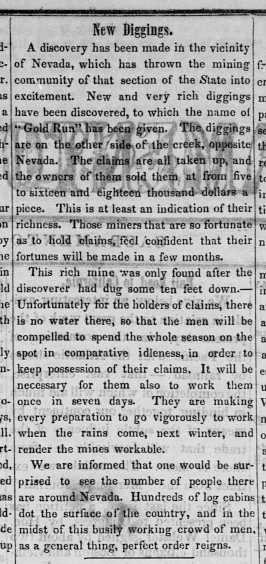
            As you are [kindee?] connected with the press now I want to tell you some few things concerning this diggings & if they are worth repeating put them in the paper if not I hope they will interest you enough to secure your perusal. I also wish to correct a statement made in the paper about “Gold Run”. It is not wanting in water as stated but the water has just subsided enough to let all hands in, and it will last long enough to work out all the claims. Today I went up the run its length, one company of five men washed down the forenoons work, & shewed it to me, 4 & ½ pounds of grain gold. [Inserted] Evening: one of the company has just come in & informed me that the days work is 12 pounds. Ain’t that some? 20,000 is asked for some claims of 120 or 40 feet. East Branch (close by it) is now attracting attention. 3000 is asked for claims of 60 feet. I think Deer Creek itself will turn out very rich. They are turning it here every foot. A gentleman tells me tonight that he saw 9 pounds which was taken out of a small space on the side of Sugar Loaf Mountain (close to this place). Don’t it go ahead of anything.

The place is growing from 1 to 4 houses a day. Seeing so much earth throwed out today suggested to me a way of building a Rail Road to California. Let the government, or a Great Company, collect about 100,000 of the poor laboring men of the states such as would like to come & have not the means, manage them in sections completing along as fast as practicable. In that way, supplies from the States could be furnished the laborers by the road itself cheap and one year would bring them all here. Reward each man with a good gold claim when he got here (this the Government could do) & thus a road could be built upon the labor of men wishing to get here either by the Gen. Government or a heavy company. Don’t laugh now.

I have not heard from home, & though weighing out the dust half my time I get homesick. I should like to “scratch gravel” in that direction, wouldn’t you, Charles. But when we get back, won’t there be some “prospecting” about them diggings, “striking of leads,” & perhaps some “jumping of claims.”

I meant to have written you more, but so many are in, talking and using me that I can’t think of what I would write & the mail is in haste.

Yours truly, G.W. Lawson

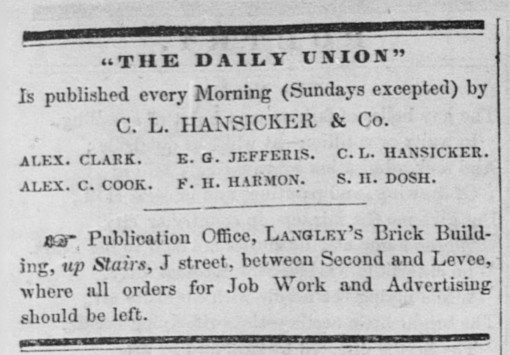
A little sleuthing in the census records of 1850 and I discovered that Charles Hansicker, age 24, was employed as a printer by the Sacramento Transcript. The statement about water that the writer corrects in the first paragraph appeared in the paper on April 12, 1850.

G.W. Lawson didn’t make it into the 1850 census, which was a hit-and-miss affair, but seems to have remained in California. George W. Lawson shows up up in the 1860 census: a 38 year old lawyer, living at Rose Bar Township in Yuba County, married to Mary, with baby son Herman.

Charles Hansicker served in the Mexican War as a 2nd lieutenant. After the war he probably returned to Indiana, but when the news of gold in California hit the States, he joined the rush for gold. He soon turned from mining to printing, first working at the Sacramento Transcript, and then founding the Sacramento Daily Union.

20 March 1851

He returned to Indiana in 1853. His “prospecting,” as his buddy George joshes, was successful and he married Gabriella Preble. They had two daughters. Unfortunately, he died of consumption (tuberculosis) in 1859.

The address on the letter
Posted in Uncategorized | 3 Comments

Saturday Night at the Mines

Saturday Night at the Mines, by Charles Christian Nahl

A while back I wrote about one of my favorite paintings, Sunday Morning in the Mines, by Charles Christian Nahl. Here is a companion piece by the same artist, Saturday Night at the Mines.

Who do we see in this painting? Six men, one of them asleep in his bunk in the background. Highlighted by his white shirt and his central position is one miner soberly weighing the result of a week’s worth of gold-mining. He is watched by a young man in a dark shirt, who is smoking a pipe, and a man standing, wearing a red shirt. On the right a young man kneels at the fireplace and stirs their evening pot of beans.

On the left is another red-shirted miner who is obviously enjoying his bottle. His slovenly posture contrasts with the alertness of the other red shirted man and the diligence of the cook.

This painting was purchased by Mrs. Jane Stanford, wife of Governor Leland Stanford, and at one time hung in the state capitol. One reference said that it is in the Stanford University Museum of Art, but a search of that website (now the Cantor Arts Center) doesn’t turn it up. So I can’t tell you for sure where you can see it. Sunday Morning in the Mines is in the Crocker Art Museum in Sacramento.

Before he did this painting, C.C. Nahl did another version of this picture with his friend and fellow artist Frederick A. Wenderoth. It is a lithograph titled Miner’s Cabin: Results of the Day. Here is the hand-colored version by Wenderoth and Nahl, made in 1852. The lithograph would inspire Nahl’s painting Saturday Night at the Mines twenty years later.

Miner’s Cabin: Results of the Day, by Wenderoth and Nahl


The image is reversed, the table is gone, and so is the drunkard with his bottle. Other elements remain similar: the man kneeling to cook at the fireplace, the moon shining in the open doorway, the gear on the floor and the shelves, the sleeper in his bunk. The tall man in the center strikes the same pose as the red-shirted man in the painting.

And, just for fun, here is another painting by F.A. Wenderoth.

Little Terrier, by Frederik A. Wenderoth
Posted in Charles C. Nahl | 4 Comments

The First Wagon Train to California

On this date one hundred and eighty years ago, the first emigrant wagon train to leave for California headed out on the Oregon Trail. Known today as the Bidwell-Bartleson Party, they teamed up with a group of Catholic missionaries and started from Sapling Grove, Kansas Territory. Here is John Bidwell’s journal entry for that day:

Wednesday, 19th. This morning the wagons started off in single file; first the 4 carts and 1 small wagon of the missionaries, next 8 wagons drawn by mules and horses, and lastly, 5 wagons drawn by 17 yoke of oxen. It was the calculation of the company to move on slowly till the wagon of Chiles overtook us. Our course was west, leaving the Kanzas no great distance to our left, we traveled in the valley of the river which was prairie excepting near the margin of the stream. The day was very warm and we stopped about noon, having traveled about 12 miles.

This afternoon we had a heavy shower of rain and hail. Several Kanzas Indians came to our camp; they were well armed with bows and arrows, and some had guns. They were daily expecting an attack by the Pawnees, whom they but a short time ago had made inroads on, and had massacred at one of their villages a large number of old men, women, and children, while the warriors were hunting buffalo.

Last year one of my pandemic projects was to post from John Bidwell’s travel journal every day. I don’t plan to do that again this year, but if you are interested in following the pioneers on the trail, you can start with this post.

The Oregon Trail, by William Henry Jackson
Posted in Bidwell-Bartleson Party | Leave a comment

Ten Years and a Thousand Posts

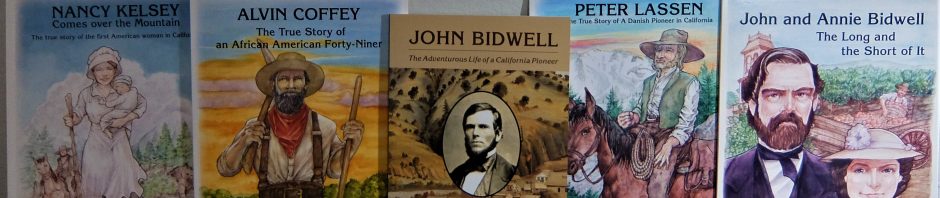
I started this blog ten years ago to promote the book I wrote about John Bidwell, and to note any bits of Northern California history that caught my fancy. Now I have reached my one-thousandth post, and it’s time to remind you about my books and other projects.

Since that first book I have written three more and have a fourth in the works. I have also collaborated on a variety of books, mostly with the Association for Northern California Historical Research. Between that and my big garden, I manage to keep myself busy and out of trouble.

I live in Chico, California, a city founded by pioneer John Bidwell, so two of my books are about his remarkable life. If you ever come to Chico, be sure and visit Bidwell Mansion State Historic Park. Their home is packed with history. One of my most enjoyable activities has been writing historical vignettes for events at the Mansion and acting in them. I portray the cook, Florence Proud, a real person who didn’t always get along with the rest of the help.

In writing John and Annie Bidwell: The Long and the Short of It, I realized how much I like the format of the picture book biography. It’s fun to work with illustrator Steve Ferchaud, and I like bringing history to the youngest readers. Limiting the text to what will fit on 32 pages, with plenty of room for pictures, forces me to concentrate my writing and make every word count. Plus I love doing the research, so even though most of it doesn’t make it into the book, I have learned a lot about my protagonist.

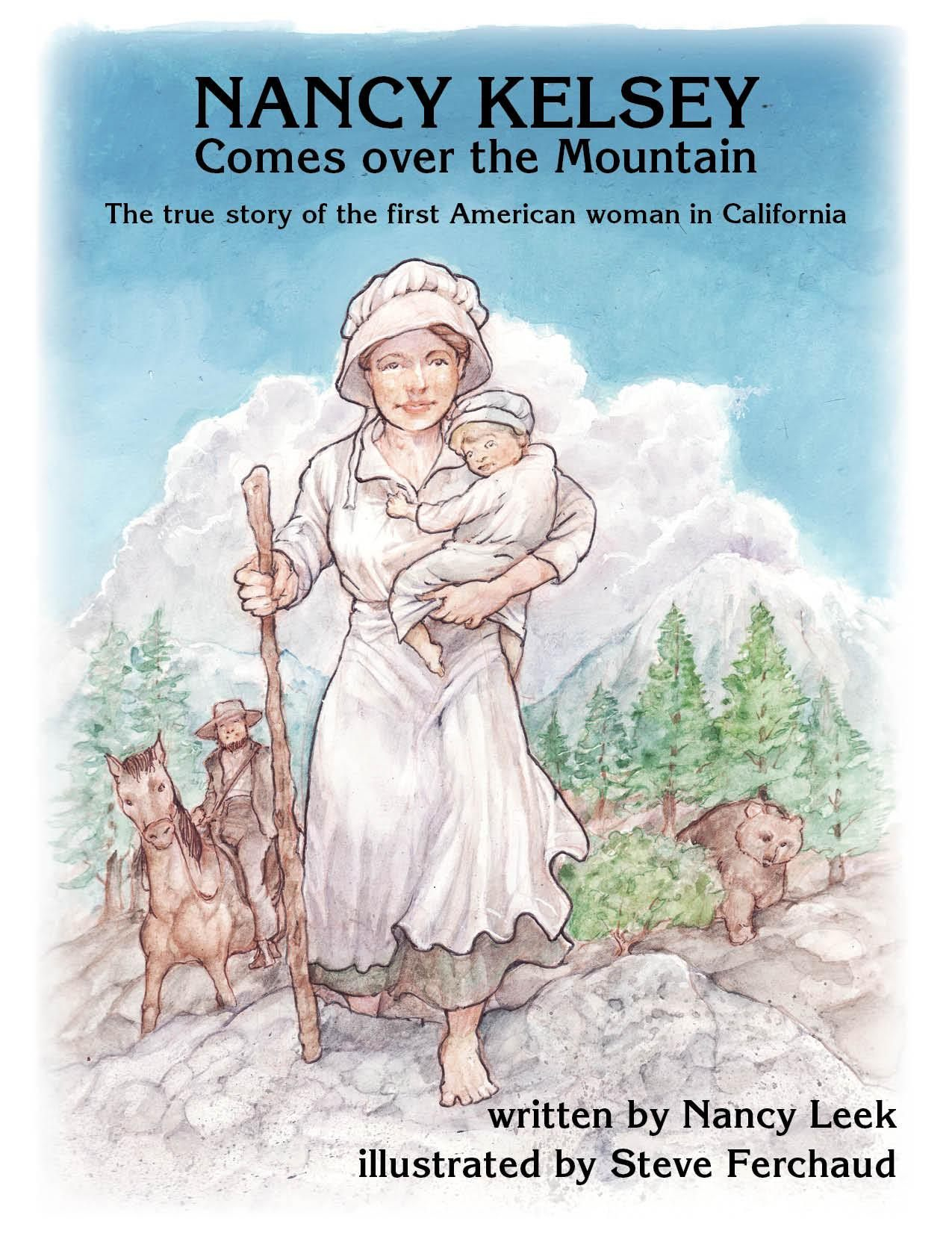
I wrote about Nancy Kelsey, the first American woman to come over the Sierra Nevada mountains into California. She came as a seventeen-year-old young mother, carrying her young daughter in her arms. She saw so much of California history: Sutter’s Fort, the Bear Flag Revolt, the Gold Rush, Indian encounters, life in town and life on the ranch.

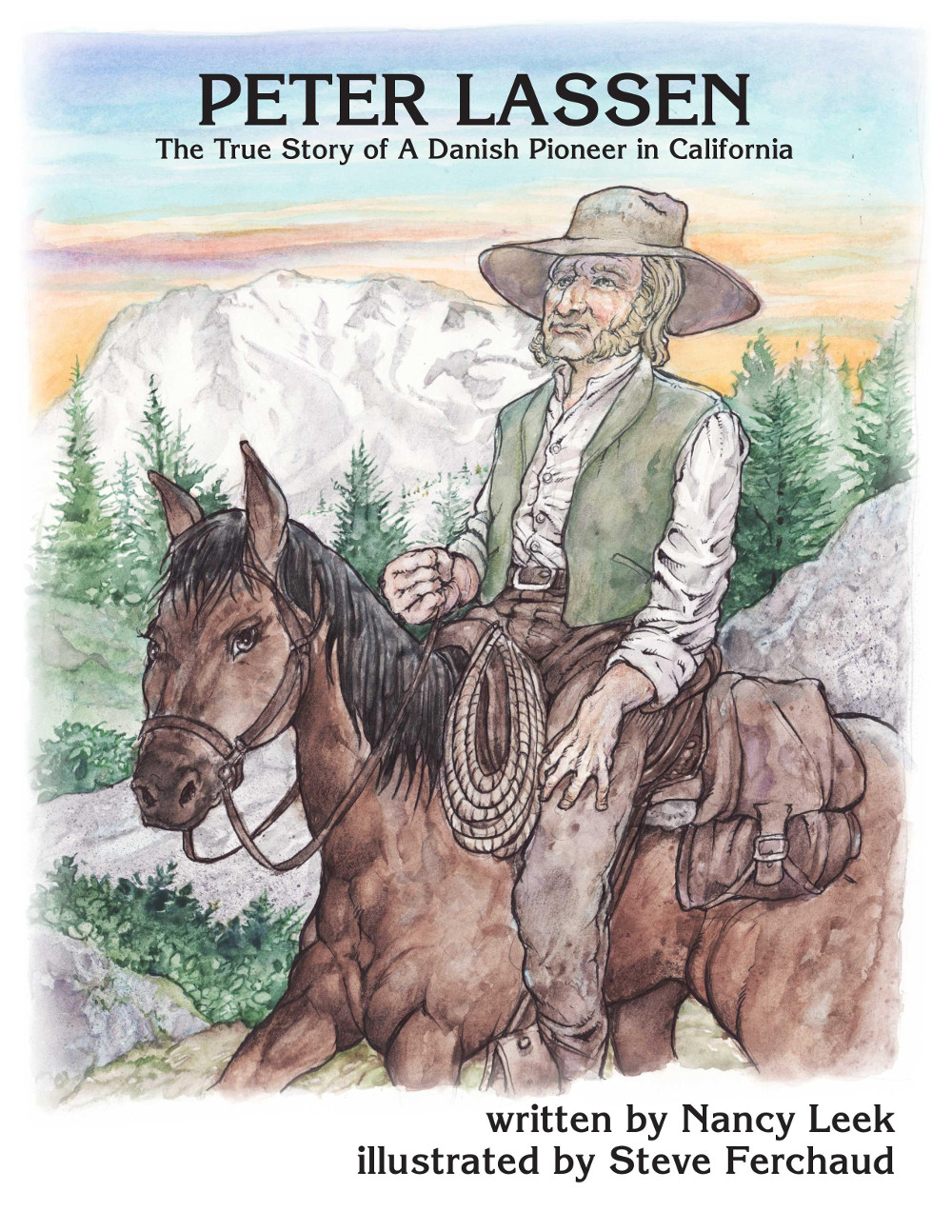
I did another book on Peter Lassen, the Danish pioneer for whom Lassen County, Lassen Peak, Lassen National Volcanic Park, and so many other landmarks are named. His ranch was just up the road, a half-hour drive from where I live, where the town of Vina is now.

Peter Lassen was quite the character, and I wish I could have known him and Nancy Kelsey and many more of those early inhabitants of California.

In between my own books I have worked on a number of other projects. Together with John Rudderow I edited the poems of Pres Longley, a miner and a minor poet. I still like to open that book and read a one of his poems now and then. He could turn a verse on just about anything.

Since John Bidwell not only wrote in a daily journal, but also kept all his letters, receipts, and other papers, I have been able to mine that trove for two articles for The Diggin’s, the quarterly of the Butte County Historical Society. One was on his life-long friendship with Nelson Blake, and the other about “The Lady with the Blue Silk Umbrella.” Both articles look at California around 1850 through the eyes of the people who were there when it happened.

I’ve also worked with the Association for Northern California Historical Research (ANCHR) on several books, such as The Road to Cherokee, Ten Miles of Archeology on the Humboldt Wagon Road, and Conversations with the Past. ANCHR’s upcoming book on John Brown’s family in Red Bluff will have a chapter by me on rival newspapers in Red Bluff during the time that the Browns were living there.

This last year of staying close to home seemed to me to be the ideal time to write another picture book biography. But who to write about? I want to like my subject, so I don’t want to do an out-and-out villain. Some people have already had plenty written about them, while others seem too obscure to warrant a book. I couldn’t decide.

Then a couple of months ago I read about Alvin Coffey, a man who made three overland journeys to California. The first time he came as a slave, but the last time he came as a free man, bringing his wife and children with him. Here was a man who had worked through incredible difficulties to gain the precious prize of freedom. That’s the book I have started on, and I can’t wait to see what Steve can do with his pen and brush. Pretty soon I’ll be sharing some of those illustrations with you.

Here I am as Florence the cook in the kitchen with Annie’s secretary, played by Marquita Goodman. Soon we will be presenting events again at Bidwell Mansion, after taking a year off.

So that’s the history of the last ten years. I hope to keep writing and sharing the fascinating history of northern California with you for many more.

Posted in Uncategorized | 3 Comments

Jennie Carter on Equality

Jennie Carter, African American journalist in California, had some strong words when it came to issues of civil rights and equality. Her “Letter from Nevada County” in The Elevator on September 25, 1868 comes down hard on Southern Democrats, including those living in California, who objected to the Fourteenth Amendment, which declared “all persons born or naturalized in the United States” to be citizens thereof, with the same privileges and immunities and entitled to equal protection under the law. The amendment’s ratification had been certified on July 28, 1868.

The Elevator 25 September 1868

This did not sit well with former slave owners in the South. And their attitude did not sit well with Jennie Carter. The entire letter, filled with righteous indignation, is worth reading.

Mud Hill, Sept. 12, 1868. Mr. Editor : —There is in the present political campaign less bitterness than heretofore at the North, while at the South it is increased tenfold. A Democrat said the other day, that the feeling exhibited South was “caused by negroes seeking equality, and the people would not endure it and the despotism it brought them.” They can’t stand despotism. I think they ought to, for they have dealt largely in that material.

Until the rebellion, who dared to express an opinion adverse to human bondage south of Mason and Dixon’s line? who dared read the first clause of the Constitution—”All men are born free and equal”—and give it a literal interpretation? and who dared preach the whole gospel—that master and servant were equal? Who dared to be seen reading the New York Tribune. All must put a lock on their lips, or suffer imprisonment and death. I know what I write, having spent a great portion of my life there; and often have I been told if I were a man I would be hung: and for what? why, for saying slavery was wrong. 

I recollect one time, in B___ county, Kentucky, I sat up all night with a poor slave mother, who lay in spasms, caused by the selling to a negro trader of her little boy, not three years of age. When in the morning her master came to her cabin to see how she was, I began to plead with him in humanity’s name; and when that would not move him, I told him God was just, and would not suffer such things forever. He told me I had said enough to hang me.

They had better not talk of despotism and military rule now. I am sure they have more liberty than they ever allowed others. They can all speak their minds fully—even curse the Government that ought to have hung them; and now that we have the blood-bought right to speak of Christianity, humanity, morality and justice, and they cannot muzzle us, they cry “negro equality!”

We do not desire equality with them. I hope none of us are so low and so lost to all that is noble as to wish to change places with those slave owners (all Democrats), who before the war raised men and women for the market—selling their own flesh and blood, separating husband and wife, parent and child. No, we never expect to be bad enough to be their equals. As regards color, the slave-holders did all they could to produce equality. I know many of them whose daughters in the big house were not as light as their daughters in the cabin. And when I the Democrats say, “Want your daughter to marry a nigger?” I tell them many of your daughters have married negroes, and many more would have done it, but you choose to sell them to white men to become victims of their lust. Shame! I say, l am tired of listening to their falsehoods, and thankful that the Chinese can rest. Last year it was Chinese and Negro; this year not one word about the ” moon-eyed celestials”; and next year they will be patting you on the shoulder, saying, “Come friend, give us your vote.” Then should everyone have the courage to say, “Depart, I never knew you, ye workers of iniquity.”  SEMPER FIDELIS

Posted in Uncategorized | Leave a comment

May 9, 1841 — Go West, Young Man

A pledge was drawn up in which every signer agreed to purchase a suitable outfit, and to rendezvous at Sapling Grove in what is now the state of Kansas, on the 9th of the following May, armed and equipped to cross the Rocky Mountains to California.

We called ourselves the Western Emigration Society, and as soon as the pledge was drawn every one who agreed to come signed his name to it, and it took like wildfire. In a short time, I think within a month, we had about five hundred names.

John Bidwell, The First Emigrant Train to California
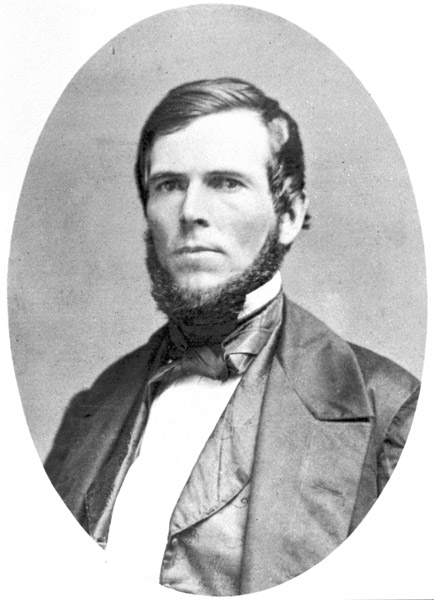
John Bidwell in 1850

After losing his farm in Missouri to a claim-jumper, 20-year-old John Bidwell “resolved to go elsewhere.” He was not the only one dissatisfied with life in fever-ridden Missouri, and after hearing about the benefits and beauty of California from fur trapper Antoine Roubidoux, neighbors and correspondents from as far away as Kentucky and Arkansas signed up to go.

That was in the early months of 1841. Doubts and hesitations soon set in, fueled by the criticisms of local merchants and a newspaper letter that warned of problems with the Mexican government. By May—

membership of the society began dropping off, and so it happened at last that of all the five hundred that signed the pledge I was the only one that got ready; and even I had hard work to do so, for I had barely means to buy a wagon, a gun, and provisions.Indeed, the man who was to go with me, and who was to furnish the horses, backed out, and there I was with my wagon!!

And yet, John Bidwell was determined to leave Missouri and set out for California. He found another partner, gathered a few more people, and arrived at Sapling Grove around May 12. There they found a few more wagons ready to go, and at the last minute, partnered up with a party of Catholic missionaries. By May 18th they were ready to hit the trail.

For more about Sapling Grove as a rendezvous point and the Bidwell-Bartleson Party, you can watch this video from the Oregon-California Trails Association.

Posted in Uncategorized | 2 Comments

Mother’s Day 1915

On May 9, 1914, President Woodrow Wilson issued a proclamation establishing the second Sunday in May as a day for honoring mothers and calling on government officials to display the flag to show “love and reverence for the mothers of our country.” By this time most states had already made it an official holiday.

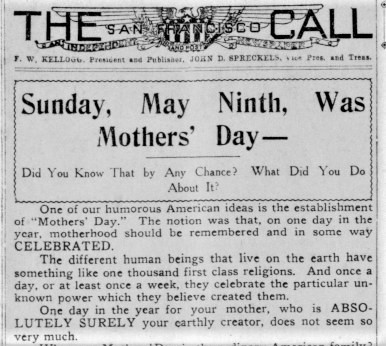
The San Francisco Call newspaper asked its readers on May 15, 1915 whether they had done anything for their mothers on May 9th (which, like this year, was a Sunday). “What did you do about it?” they asked.

After chiding its readers for neglecting Mother, the column ended with this call to action — not to give Mother flowers or brunch — but to give her the VOTE.

Women already had the vote in state elections in California (since 1911) and in several other (mostly Western) states. Not until 1920 would women throughout the United States enjoy the right to vote.

Note that last line — American Indians would not be classified as citizens with the right to vote until the passage of the Snyder Act in 1924.

Happy Mother’s Day!
Posted in Uncategorized | Leave a comment

Jennie Carter, African American Journalist

In June of 1867, Philip Bell, editor of The Elevator, received a letter from a correspondent named Ann J. Trask. She said that she lived at Mud Hill in Nevada County and offered to write short stories for children.

The Elevator was a weekly newspaper published in San Francisco for the black community. Mrs. Trask was a faithful reader of the paper and thanked editor Bell for his “efforts in behalf of our people.”

“Ann J. Trask” was not the woman’s real name. Like so many newspaper correspondents of the day, she preferred to use a pseudonym. In later writings she also used the byline “Semper Fidelis.” Her true name was Mary Jane (Jennie) Carter, and she lived in Nevada City with her husband, Dennis D. Carter.

Jennie had grown up in New Orleans, a free person of color. Although her maiden name and her parents are unknown, she seems to have had a comfortable upbringing and a good education. She came to California around 1860 with her first husband. Just what happened to him is also unknown, but in 1866 she married Dennis D. Carter, a musician and band leader.

Stories were drawn from her childhood, like the first one, about the death of her beloved dog Nino and the kindly neighbor who helped to bury her pet. She usually had a moral to express, but did it in a pleasing and engaging manner.

Here is the beginning of a column she wrote about race relations. Jennie Carter knew what was what, but she strove to promote unity and harmony among people of all colors.

“Civility to all, servility to none” is still a worthwhile maxim.

Toward the end of the column she writes, “Well, Mr. Editor, I see I have made a mistake. I commenced writing for the children, and have would up writing for everybody.” And that’s the way it would go. All ages would read and enjoy her words.

You can read writings by Jennie Carter by accessing The Elevator on the California Digital Newspaper Collection. A book about her — Jennie Carter: A Black Journalist of the Early West, by Eric Gardner — brings all the columns together, but I haven’t acquired the book. You can read some of it on Amazon. I am looking forward to reading more of her writings. She sounds like someone whom it would be a delight to know. Too bad that I can’t find a picture of her.

Posted in Jennie Carter | Leave a comment