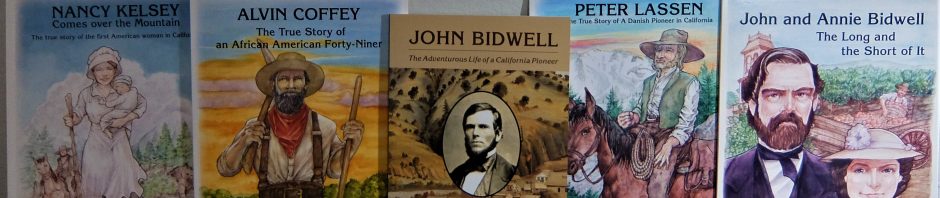
May 9, 1841 — Go West, Young Man

A pledge was drawn up in which every signer agreed to purchase a suitable outfit, and to rendezvous at Sapling Grove in what is now the state of Kansas, on the 9th of the following May, armed and equipped to cross the Rocky Mountains to California.

We called ourselves the Western Emigration Society, and as soon as the pledge was drawn every one who agreed to come signed his name to it, and it took like wildfire. In a short time, I think within a month, we had about five hundred names.

John Bidwell, The First Emigrant Train to California
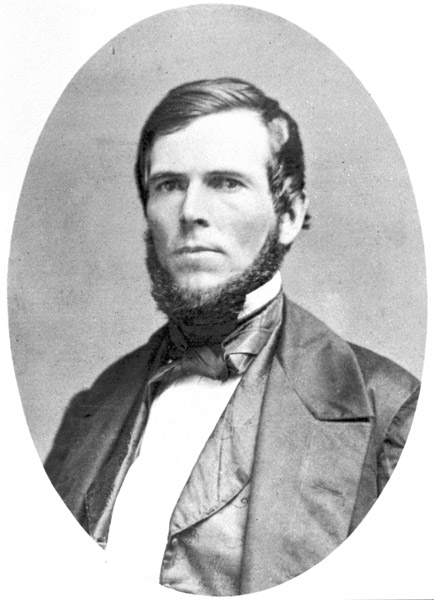
John Bidwell in 1850

After losing his farm in Missouri to a claim-jumper, 20-year-old John Bidwell “resolved to go elsewhere.” He was not the only one dissatisfied with life in fever-ridden Missouri, and after hearing about the benefits and beauty of California from fur trapper Antoine Roubidoux, neighbors and correspondents from as far away as Kentucky and Arkansas signed up to go.

That was in the early months of 1841. Doubts and hesitations soon set in, fueled by the criticisms of local merchants and a newspaper letter that warned of problems with the Mexican government. By May—

membership of the society began dropping off, and so it happened at last that of all the five hundred that signed the pledge I was the only one that got ready; and even I had hard work to do so, for I had barely means to buy a wagon, a gun, and provisions.Indeed, the man who was to go with me, and who was to furnish the horses, backed out, and there I was with my wagon!!

And yet, John Bidwell was determined to leave Missouri and set out for California. He found another partner, gathered a few more people, and arrived at Sapling Grove around May 12. There they found a few more wagons ready to go, and at the last minute, partnered up with a party of Catholic missionaries. By May 18th they were ready to hit the trail.

For more about Sapling Grove as a rendezvous point and the Bidwell-Bartleson Party, you can watch this video from the Oregon-California Trails Association.
Posted in Uncategorized | 2 Comments

Mother’s Day 1915

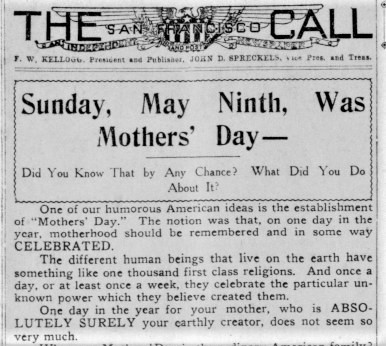
On May 9, 1914, President Woodrow Wilson issued a proclamation establishing the second Sunday in May as a day for honoring mothers and calling on government officials to display the flag to show “love and reverence for the mothers of our country.” By this time most states had already made it an official holiday.

The San Francisco Call newspaper asked its readers on May 15, 1915 whether they had done anything for their mothers on May 9th (which, like this year, was a Sunday). “What did you do about it?” they asked.

After chiding its readers for neglecting Mother, the column ended with this call to action — not to give Mother flowers or brunch — but to give her the VOTE.

Women already had the vote in state elections in California (since 1911) and in several other (mostly Western) states. Not until 1920 would women throughout the United States enjoy the right to vote.

Note that last line — American Indians would not be classified as citizens with the right to vote until the passage of the Snyder Act in 1924.

Happy Mother’s Day!
Posted in Uncategorized | Leave a comment

Jennie Carter, African American Journalist

In June of 1867, Philip Bell, editor of The Elevator, received a letter from a correspondent named Ann J. Trask. She said that she lived at Mud Hill in Nevada County and offered to write short stories for children.

The Elevator was a weekly newspaper published in San Francisco for the black community. Mrs. Trask was a faithful reader of the paper and thanked editor Bell for his “efforts in behalf of our people.”

“Ann J. Trask” was not the woman’s real name. Like so many newspaper correspondents of the day, she preferred to use a pseudonym. In later writings she also used the byline “Semper Fidelis.” Her true name was Mary Jane (Jennie) Carter, and she lived in Nevada City with her husband, Dennis D. Carter.

Jennie had grown up in New Orleans, a free person of color. Although her maiden name and her parents are unknown, she seems to have had a comfortable upbringing and a good education. She came to California around 1860 with her first husband. Just what happened to him is also unknown, but in 1866 she married Dennis D. Carter, a musician and band leader.

Stories were drawn from her childhood, like the first one, about the death of her beloved dog Nino and the kindly neighbor who helped to bury her pet. She usually had a moral to express, but did it in a pleasing and engaging manner.

Here is the beginning of a column she wrote about race relations. Jennie Carter knew what was what, but she strove to promote unity and harmony among people of all colors.

“Civility to all, servility to none” is still a worthwhile maxim.

Toward the end of the column she writes, “Well, Mr. Editor, I see I have made a mistake. I commenced writing for the children, and have would up writing for everybody.” And that’s the way it would go. All ages would read and enjoy her words.

You can read writings by Jennie Carter by accessing The Elevator on the California Digital Newspaper Collection. A book about her — Jennie Carter: A Black Journalist of the Early West, by Eric Gardner — brings all the columns together, but I haven’t acquired the book. You can read some of it on Amazon. I am looking forward to reading more of her writings. She sounds like someone whom it would be a delight to know. Too bad that I can’t find a picture of her.

Posted in Jennie Carter | Leave a comment

More about Alvin A. Coffey

from The Tortuous Road to Freedom, by Jeannette L. Molson and Eaul D. Blansett, Jr.

Back in February I wrote about Alvin A. Coffey, African-American forty-niner. Thanks to Eaul Blansett, co-author of The Tortuous Road to Freedom, I now have more sources for his story.

My favorite sources are always first person accounts. Alvin left one account in an interview with the Society of California Pioneers, which is the basis of my first post about him. Now I have another. It sounds like it comes from a newspaper, but I don’t know which one — there’s no indication of the source or date. It’s an interview done when Alvin was a resident of the Home for Aged and Infirm Colored People at Beulah (now part of Oakland) so it must have been between 1899 and 1902.

Alvin and Dr. William Bassett came to California in 1849. Dr. Bassett was sick nearly the entire time, while Alvin mined for gold during the day and did jobs for other miners in the evenings. He never forgot how his master treated him when they left in 1851. Here is his account:

By and by the doctor he didn’t get no better and he made up his mind he wanted to go home. So he had me bring out the dust and weigh it. And I poured his sack in one pile on the table in one place and it weighed out $5600, and I poured my sack out in another place on the table and it weighed a little over $600.

I didn’t say nothing to him about it. He knew it was mine and just how I earned and saved it after paying all the camp expenses, so I just watched to see what he’d do. And when he’s weighed it out he just swept it over to the other pile, and I knew he’d taken that too, for his own.

But I didn’t say anything. If I’d run away there’d have been plenty to help me and protect me, but I just acted peaceably and helped him about getting ready to go away, and one day we went aboard the Panama steamer. We went home by way of New Orleans and up the Mississippi river.

All this time you needn’t think I’d forgotten about my $600 and one ounce savings, or how he’d grabbed it, but I never said a word, because if I did I knew he’d play mad and put me on the block at New Orleans sure and get maybe $1400 or $1500 for me. And I was homesick for a sight of Mahala and the children.

So there you have it. Bassett had cheated him and stolen his money, but he “never said a word.” Alvin’s paramount concern was to return to his wife and children. As much as the modern reader might want to see him knock his master down, and take all the money and run, he had to bide his time so that he could see his family again.

Bassett did indeed sell him when they got back to Missouri, but he sold him to the woman who “owned” his wife and children. They were together again, and after three years, Alvin was able to get back to California and earn his own freedom and that of his entire family.

Posted in Alvin A. Coffey | Leave a comment

On the Trail with Videos from OCTA

If you are a history buff, if you’ve wondered what it would be like to be a pioneer, if you want to trace the trail that brought your great-grandpa to California, then you will enjoy the videos produced by the Oregon-California Trails Association.

Their videos are collected on this YouTube page. You can learn about John Bidwell, Sapling Grove, and the First Wagon Train to California.

You can see several videos on African-American pioneers who helped to blaze the trails, like one about Hiram Young, wagon maker.

You can watch their latest on the Butterfield Overland Stage.

The collection is growing all the time as they roll out a new video every week. Subscribe and enjoy new videos from the people who know the overland trails.

Posted in Uncategorized | 1 Comment

Stephen Hill and Slavery in the Golden State

California was admitted to the Union in 1850 as a free state. Nevertheless, slaves were brought to California by slave-owning southerners both before and after statehood, and the slave owners usually got away with it. Slaves made the effort to escape or free themselves, but just as often the courts would return them to their owners.

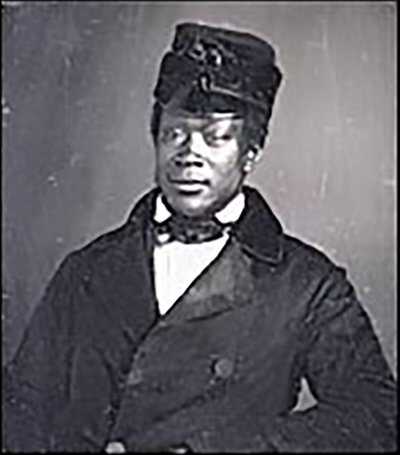
Stephen Spencer Hill

The experience of Stephen Spencer Hill is a case in point.

Hill was brought to California as a slave in 1849 from Arkansas by a man named Wood Tucker. When Tucker returned to Arkansas in 1853, he went back without Hill. Stephen Hill claimed that he had purchased his freedom from Tucker, but he doesn’t seem to have had the papers to prove it. That would cause him no end of trouble.

Hill remained on land near Sonora that either he or Tucker had purchased. He made improvements on it, clearing trees and planting crops. He also mined for gold, and the discovery of a nine-ounce gold nugget gave him the funds to buy farming equipment. His prosperity did not last.

A white man named Own R. Rozier claimed that Hill was still a slave and that he, Rozier. was an agent for Wood Tucker. He had Hill arrested.

As a black man, Hill could not testify in court. He was not without friends though. He was popular and well-liked among miners in the area, and they hired an attorney for him and harvested his crops. The court contacted Wood Tucker in Arkansas, who claimed by return letter that Hill was his slave. The magistrate handed him over to Rozier.

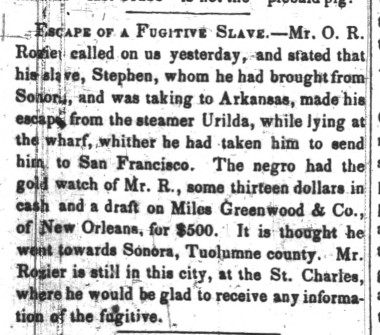
San Joaquin Republican 25 Sept 1854

All was not lost. The night before Hill was due to leave on a steamer from Stockton for the return trip to Arkansas, Hill’s friends got Rozier drunk and Hill escaped. Rozier placed the above ad in the San Joaquin Republican, claiming that Stephen Hill was both an escaped slave and a thief. Rozier never did recapture the fugitive. Stephen Hill remained free in California, but he lost his land claim.

What happened to him after his escape? I wish I knew. This is all the information I have. I hope he was successful in maintaining his freedom, a precious and elusive right for a black man in 19th century California.

Two places where you can read about Stephen Hill on the web are:

PBS: African Americans in the Gold Rush and Five Views: A History of Black Americans in California

Posted in Uncategorized | 2 Comments

George Washington Dennis — African-American Forty-Niner

I’ve been reading Delilah Beasley’s classic work on African-Americans in California, The Negro Trail Blazers of California, published in 1919. Ms. Beasley spent years researching the stories of blacks in California. I got the book from the public library, but it is also available at Google Books and the Internet Archive.

Southern slave owners who came to California for the Gold Rush often brought at least one slave with them. Although California was admitted to the Union as a free state in 1850, slavery continued in the state before the Civil War.

One such slave was George Washington Dennis. Here is his story, as told by his son Edward Dennis.

George Washington Dennis came to California September 17, 1849, with the gambling party that opened the ‘Eldorado Hotel’ in San Francisco. This party of gamblers was from New Orleans and was composed of the following persons: Green Dennis, a slave trader, from Mobile, Alabama; Joe and Jim Johnson, from Ohio, and Andy McCabe. . . While en route from Panama to San Francisco, the gamblers lost and re-won Mr. Dennis three different times. He was their slave and therefore chattel property.

The Negro Trail Blazers of California. p. 119

Those Louisiana gamblers knew a money-making opportunity when they heard about it. They were doing their own version of a gold rush.

Upon reaching California, the gamblers set up a tent, which they had brought with them, as a hotel and gambling den. The gambling went on night and day. Green Dennis, George W. Dennis’s owner, told him that “that if he would save his money he could purchase his freedom.”

George W. Dennis was given the position of porter of this hotel at a salary of $250 per month. Mr. Dennis, very anxious to secure his freedom and at the same time to start life with a little money, saved the sweepings from the gambling tables and at the end of three month he paid, in five and ten cent pieces, the sum of $1000, and received a bill for himself from Green Dennis, who was his father and also his master.

It staggers the mind that a man would keep his own son as a slave or sell him. But that was slavery in the United States, all legal and customary at the time.

$250 a month seems like a high salary, when you consider that in the States a man might work all year for that amount. But everything was different in California, and that included prices and wages. And those gamblers must have been raking it in. Gambling was the most popular entertainment in gold rush San Francisco.

Notice too that Dennis carefully sifted through the straw and trash that he swept up each day and saved any coins or bits of gold he found. He soon had the price of his freedom.

George W. Dennis had another person whose freedom he wished to buy, and that was his mother. He paid his father $950 for her. Two of the gamblers, Joe and Jim Johnson, went back to the States to get cattle and while there, found his mother and returned with her.

Upon the arrival of his mother in San Francisco, Mr. Dennis rented one of the gambling tables at $40 per day for the privilege of his mother serving hot meals in the gambling house on it. Eggs were selling at $12 per dozen, apples 25 cents apiece, and a loaf of bread $1. While her expenses were heavy, she averaged $225 a day.

That must have been a good business. She lived a long life in California with her son. George W. Dennis did quite well for himself. He bought and sold land in San Francisco, ran a livery stable, and later was a coal merchant, and prospered.

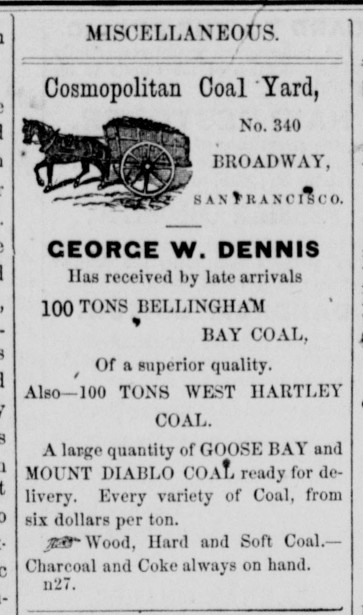
This advertisement appeared in the newspaper The Elevator, running for several issues in 1868. The Elevator was an African-American paper begun in 1865 which aimed at the progress and uplift of the black race in California.

Dennis married and had a large family of children, and made sure that they each got a good education. When he died in 1916 the San Francisco Call said he was widely known and “probably the oldest negro in California.”

Posted in Uncategorized | Leave a comment

Titus Hale Encounters a Desperado

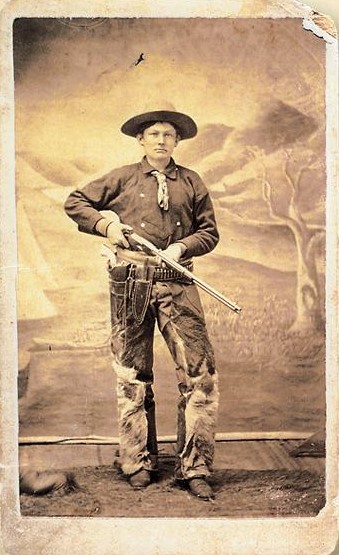
Maybe a fellow like this, with his Winchester ’73 rifle

In his autobiography written for the Society of California Pioneers, Titus Hale has one more good story to tell:

I passed through the so-called trying times without any great amount of trouble or anxiety, and it was not till 1899 that I ever looked into a gun that was held by a man who contemplated murder.

I was building a levee at Marcuse, Sutter County and had about fifty men at work. At noon one day the Foreman and I were talking and all the men lounging around, when a man whom the Foreman had just discharged, demanded his pay in coin. Now I had never paid any one coin, but always gave the men whom we discharged, checks on the Bank. These checks were good anywhere and all the merchants were glad to get them and it was no hardship on the men as all discharged men went in to town (Marysville) where the Bank was located, and men were informed of this rule before they went to work, but that fellow wanted coin.

He had a Winchester rifle drawn on us, we knew it was loaded. There were fourteen charges in the Magazine. Now we had no money in the camp and we tried to explain the matter to the scamp, but all the answer we got was – “give me my money, or I will kill you.”

The Foreman attracted his attention more than I and I walked away. The fellow fired at the foreman, but missed him. The bullet went close to a dozen of the men but hit no one. It was not long till the camp was deserted, the shooter had it to himself and he left. The Sheriff caught and landed him in jail before night.

We prosecuted him and sent him to States Prison for life; he was an ex-convict and had been sentenced for life for murder and pardoned out, later he was sent for ten years for rape and had only been at liberty three months when he was sent back again where I hope he will stay, for he was the most disagreeable man I ever met.

“The most disagreeable man I ever met” is certainly an understatement.

Nothing remains of the town of Marcuse in Sutter County today. If you are curious, you can read about it in the January 2013 newsletter of the Sutter County Historical Society.

Posted in Uncategorized | Leave a comment

Titus Hale — Still More Adventures of a Teen-Age Forty-Niner

The flood about used up my capital and my lease of the lot only ran till June 1st so I concluded to abandon pies, cakes and nuts and on March 4th 1850 started for Georgetown; I was at Coloma and saw the Mill where gold was discovered.

We settled at Oregon Canõn. I was thought too young to work with the men, so I hunted up a claim for myself. I made $600 out of my claim, which my Father sent home to my Mother. That was the first money sent home by any of our party.

After digging out our claims at Oregon Canõn we went to Spanish Bar -say in May- we had indifferent success here, later we went to Shirt-tail Canõn, and that trip was a failure.

Autobiography and Reminiscence of Titus Hale, Society of California Pioneers

Titus and his father tried mining in a variety of places. You never could tell where you might strike it rich. They went back to Sacramento, but not for long. They went to Rough and Ready, then Deer Creek, and when they had put together $1500 they left for Missouri. They traveled the Panama route to New Orleans and then up the Mississippi River to St. Louis.

I was not pleased with St. Louis wages, they were too low. The first work I had was a clerk in a wholesale grocery at $10 per month. As I boarded with my employer I had to dress fairly well so I could save but little although my salary was increased to $16 per month after a short time. It required three years for me to save money enough to come back to California.

$10 a month or even $16 must have seemed paltry to a young man who remembered the California goldfields, where a lucky man might find that in a day. Even selling nuts in Sacramento he had made a profit of $10 in one day. So Titus Hale came back to California and made his life here, farming and ranching. He married and raised a family of seven children, and served as president of the Society of California Pioneers.

Posted in Titus Hale | Leave a comment

Titus Hale — More Adventures of a Teen-Age Forty-Niner

Titus Hale was an enterprising young man at sixteen years of age.

A few days after that [the election] we sold our team, and I engaged in business peddling Nuts. I bought my first stock from R. Gelston, 25 lbs. for $6.25. I used an old champaign basket, had a hoop tied on to it for a handle. I commenced work at Noon and sold out before midnight, profit $10.

After I had accumulated about $300. I put a small tent house on the lot of Suydam and Galloway, next door to the corner of 4th St. now J., where I sold pies, cakes, nuts, etc. I had about $600. stock when the flood came. During the time of the overflow, I boarded on the Brig Toronto. Among the boarders was our respected brother Paul – he was partner with Dr. White of St. Louis, Mo. Among the guests on the Toronto, whom I remember, were – Dr. White and family; Miss Caroline Fairchild – a most beautiful young lady -; Major Dudley, Joe Bassett; Mr. Patrick. The Proprietors, were Mayhem and Hite.

Autobiography and Reminiscence of Titus Hale, Society of California Pioneers

Roland Gelston was captain of the bark Whiton and sold his stock from his ship. He brought the first shipload of merchandise directly to Sacramento from the Eastern states. Titus doesn’t say what kind of nuts he bought from Gelston, but in July John Bidwell bought 22.5 pounds of shelled almonds from him for 80 cents a pound. Titus’s nuts must have been in the shell to be cheaper than that.

The principle entertainment was gambling and young Titus gave that a try too. But only once.

During the time I was peddling nuts, Mr. F. A. Hihn – of Santa Cruz- was peddling candy. We both frequented the Auctions. Among the Auctioneers, were Major Dudley and Dr. Pierson Starr – I followed the crowd at the auctions in day-time, and at the Gambling houses at night.

There were about fifteen boys in Sacramento during the winter of ‘49. Most of them took to drink. (I never drank liquor unless administered to me by a Doctor, and only three times in that way.) Some of the boys were making lots of money gambling, so one evening I concluded to change my business. I left my basket of nuts at home and went down town with the intention of making a fortune out of the Gamblers, as some of my companions had done. I bet, 50 cts. on Monte and won, I continued through the evening to win and lose, at midnight I had lost the original investment, 50 cts. I have never bet on anything since.

Smart boy.

Faro, by J.D. Borthwick
Posted in Titus Hale, Uncategorized | Leave a comment