Johnson of Johnson’s Ranch

When Pablo Gutierrez died in 1845, John Sutter put his land grant up for sale. The ranch was bought by William Johnson. What do we know about Johnson?

Not a lot — we don’t even have a picture of him. He came to California as the mate of the shop Alciope in 1840. He was either a native of Boston or possibly an immigrant from Ireland. From 1842 on he owned a lighter (a flat-bottomed barge) in partnership with Jacob Leese. It would have been used to transfer cargo from ships in San Francisco Bay to shore.

Together with Sebastian Keyser, he bought the ranch on the Bear River in 1845 and lived there until 1852 when “he either died or went to the Sandwich Islands,” according to Bancroft’s Pioneer Register. Mountain man James Clyman recorded in his diary his stay at Johnson’s Ranch in April 1846..

Mr. Jonson who owns the Ranche is like all of his california neighbours 15 miles from the nighest inhabitant and not even a track leading to or from his place at this season of the year although in a dry time the emigration from the states pass.
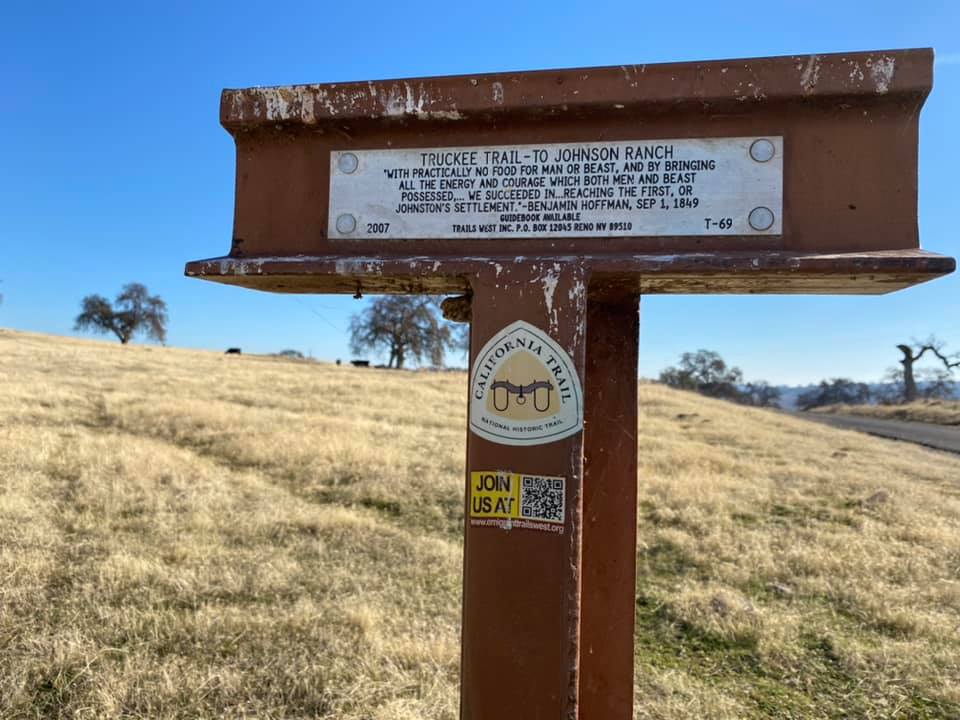
A California Trail marker at Johnson’s Ranch

Johnson’s Ranch was the first sign of “civilization” that emigrants from the States came to in California. It was a welcome resting place. From here they could proceed to Sutter’s Fort, or to Nevada City, or to Marysville, all of which were between 15 to 40 miles away. Most famously it was the site where the survivors of the Donner Party convalesced.

One of those survivors was Meriam “Mary” Murphy. She wrote:

My older sister had gone to San Francisco and I was without a home, an orphan and not quite eighteen, when Mr. Johnson asked me to go riding with him one afternoon while he rounded up some horses.

Knowing I was uncertain of my future, and having fallen in love with me, Mr. Johnson proposed marriage. In June 1847, at the age of eighteen, I became Mrs. Johnson. For several months I was busy serving to all of Mr. Johnson’s wishes, doing his cooking and washing and trying to make a home out of a cattle ranch. I knew he was a crude man and I sometimes overlooked many of his faults; but I could not love a man who abused me with the rest of the ranch hands. He proved to be a drunken sot. Because of that I got in touch with the rest of my family and secured an annulment of my marriage from the church.
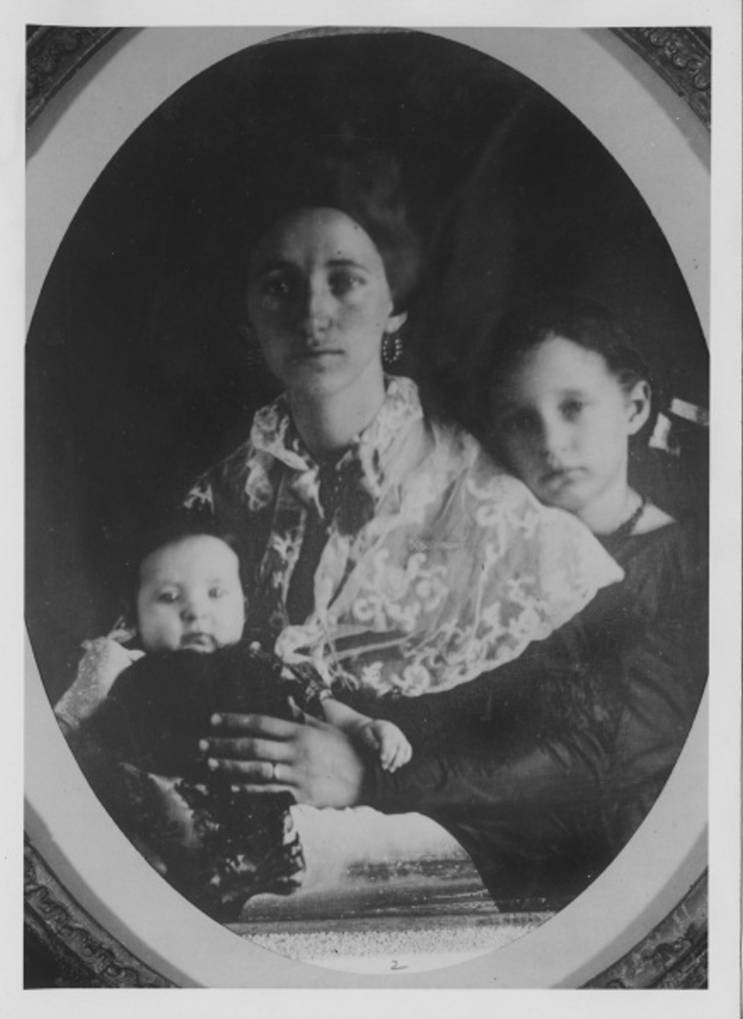
Mary Murphy Covillaud

Mary was actually younger than eighteen, maybe as young as fourteen when she married Johnson. Her birth date (as per findagrave.com) was 15 November 1831.) An orphan, and only a teenager, treated as roughly as any ranch hand, and enduring drunkenness and domestic violence — Mary had good cause to leave the marriage. By November of the same year she had left Johnson.

Mary went to Cordua’s Ranch, located at the junction of the Feather and Yuba Rivers, and there she met and married a Frenchman, Charles Covillaud, in December 1848. He took over the ranch from Cordua and founded the town of Marysville, which he named in honor of his wife.

Mary and Charles had five children. She died in 1867 at the age of 35 and is buried in the Catholic cemetery in Marysville.

According to her obituary in the Marysville Daily Appeal (28 Sept. 1867), “She was a woman of more than ordinary intellect, and possessed a kind, generous and noble disposition. All who knew her, loved her.”
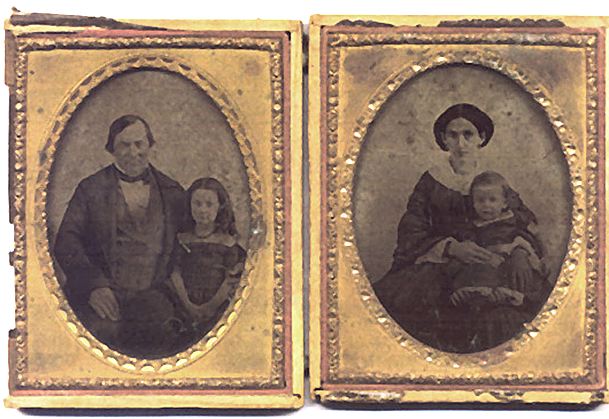
This lovely little daguerreotype of Charles and Mary and two of their children belongs to the Couillaud family descendants in France and can be viewed on rootsweb.com.
Posted in Mary Murphy Covillaud, William Johnson | 7 Comments

Christmas with the Bidwells

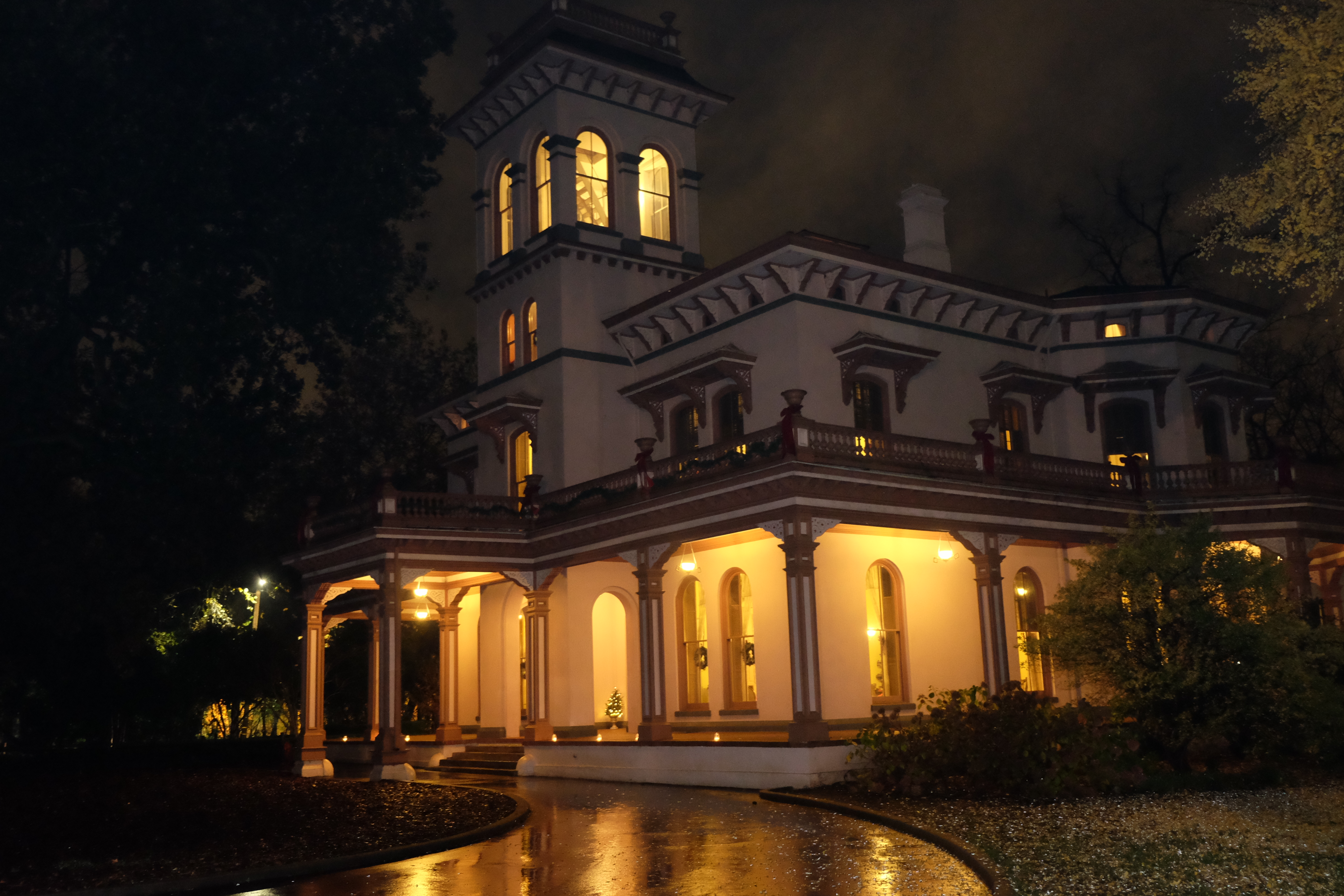
Every December the Bidwell Mansion Association hosts a holiday event at Bidwell Mansion for members and guests. Although conditions are different this year, we couldn’t let 2020 go by without “Christmas with the Bidwells” so we put together a virtual holiday party.

In this YouTube video you will tour General Bidwell’s office, find out what’s cooking in the kitchen with Florence the cook, hear stories from Peter the coachman, and listen to Annie tell you about her plans for Christmas shopping. You’ll also enjoy piano and fiddle music in the parlor, just like John and Annie might have listened to.

Adrienne Glatz plays Annie, Nick Anderson is John Bidwell, Mike Swann is Peter, and that’s me as Florence the cook. Video recording by Elizabeth Quivey, editing by Adrienne Glatz, and music by Alicia Glatz (piano) and Joel Quivey (violin).

Enjoy! And have a merry Christmas and a Happy New Year!

Posted in Uncategorized | 2 Comments

The Founder of Johnson’s Ranch

—was not named Johnson.

On December 22, 1844, Pablo Gutierrez, one of John Sutter’s employees, was granted five square Mexican leagues (22,197 acres) along the Bear River by the governor of Alta California. He built an adobe house, acquired some cattle, and made plans to become an independent rancher. Unfortunately, fate would soon cut short his dreams.

But before his untimely end, Pablo Gutierrez and John Bidwell went looking for gold. Both the men had been working at Sutter’s Hock Farm, in what is today Sutter County. When Pablo went exploring his rancho along the Bear River, he realized that the land bore signs of gold, just as he had seen down in Mexico. He came back to the Hock Farm and told Bidwell about it.

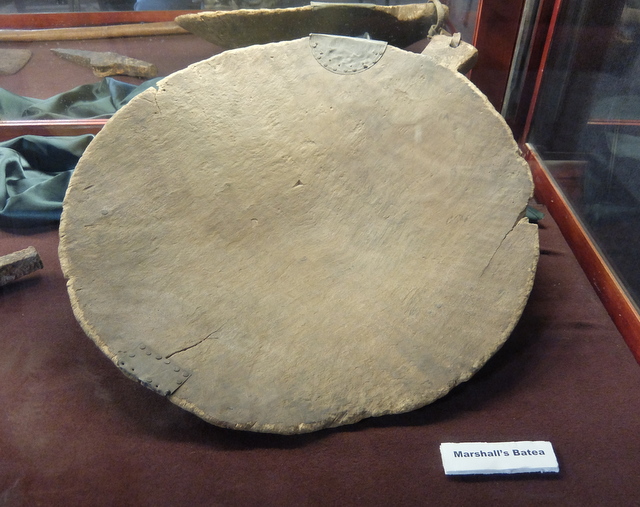
Bidwell tells this story in his memoir Life in California Before the Gold Discovery. And I have recounted it in an earlier post. Pablo told Bidwell, in Spanish, that what they needed to recover the gold was a batea. Bidwell had become fairly fluent in Spanish over the previous two years, but he didn’t know what a batea was.

James Marshall’s batea, in the Coloma State Park museum

Pablo offered to go down to Mexico to get one. But before he could do so, an insurrection broke out against the Mexican governor of Alta California, Manual Micheltorena. The governor was disliked by native Californios, including the former governor, Juan Bautista Alvarado and military leader Jose Castro. They complained that he was too friendly with Americans and was giving them too much land.

John Sutter, the recipient of a vast Mexican land grant, sided with Governor Micheltorena and used Pablo Gutierrez as a courier. As John Bidwell relates:

Sutter sent him with despatches to the governor, stating that we were organizing and preparing to join him. Pablo returned and was sent again to tell the governor that we were on the march to join him at Monterey. This time he was taken prisoner with our despatches and was hanged to a tree, somewhere near the present town of Gilroy. That of course put an end to our gold discovery; otherwise Pablo Gutierrez might have been the discoverer instead of Marshall.

So who was Johnson?

Sutter, as the executor of Pablo Gutierrez’s estate, put the ranch up for auction in April 1845. The successful bidder was William Johnson, a sailor who had come to California on a Boston ship around 1840. He became partner with Jacob Leese (who married General Vallejo’s sister) and they operated a boat on the Sacramento River.

Johnson, and another partner of his, Sebastian Keyser, paid $150 for the ranch. Quite a bargain!

More about Johnson next time. And someday, more about Keyser, who also held the Llano Seco Ranch in Butte County.

Posted in Pablo Gutierrez, William Johnson | Leave a comment

Good News for Johnson’s Ranch

We made a tortuous journey through the snow before we came to the headwaters of the Yuba river, where there were mules to carry us down to Johnson’s Ranch. . . . I stayed several days at the ranch, enjoying the comforts of civilization again, but I never could erase from my mind the sight of the dying people left behind at the lake. Mr. Johnson, a former merchant seaman, had built a substantial adobe building and was engaged in cattle raising on the Bear river.

Mary Murphy, survivor of the Donner Party disaster

Johnson’s Ranch figures large in California history. John C. Fremont and Kit Carson camped there. The Stevens-Townsend Party, the first to bring wagons over the Sierra Nevada, traversed the ranch. The U.S. Army had an outpost there at Camp Far West. It was a resting place and river crossing for many a pioneer and forty-niner.

And most importantly, it was the gathering place for the rescue parties that set out to retrieve the remnants of the Donner Party, and the first civilized dwelling-place that received the survivors.

And yet . . . how many Californians know where Johnson’s Ranch is? Who has visited it and seen the remains of Johnson’s adobe and the ford where countless wagons crossed the Bear River? Is there a monument there? Is it a state park? Or has it faded from memory?

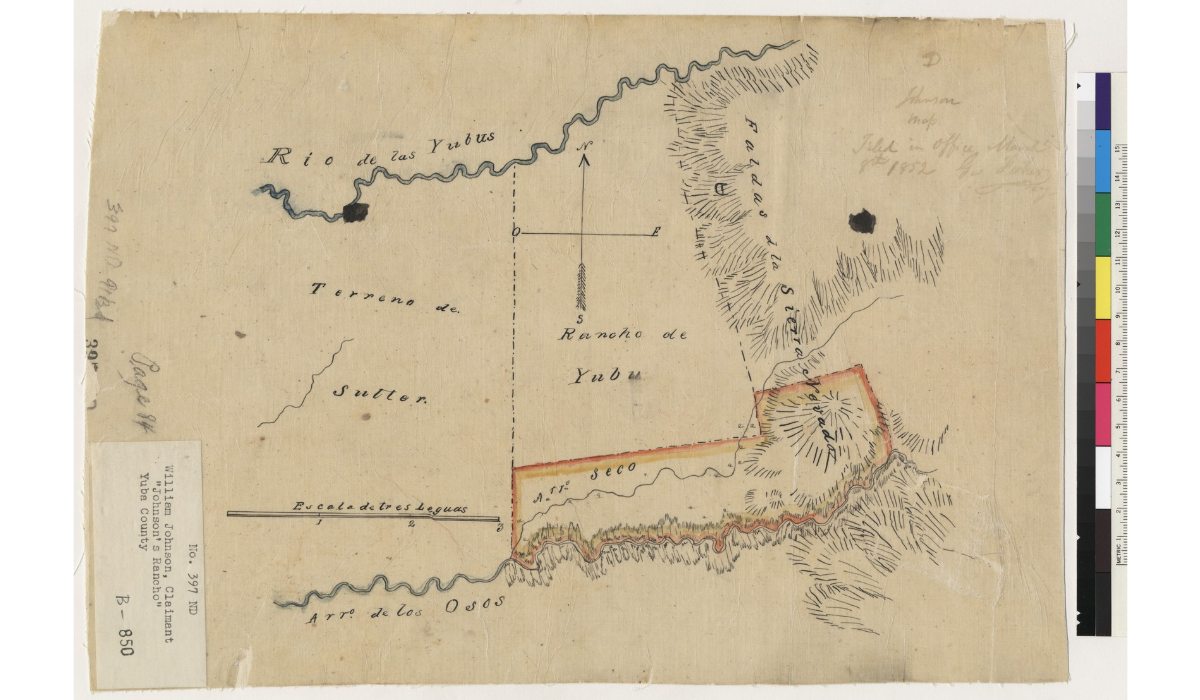
Diseno of Johnson’s Ranch, probably by John Bidwell. Yuba River at the north, Bear River at the south.

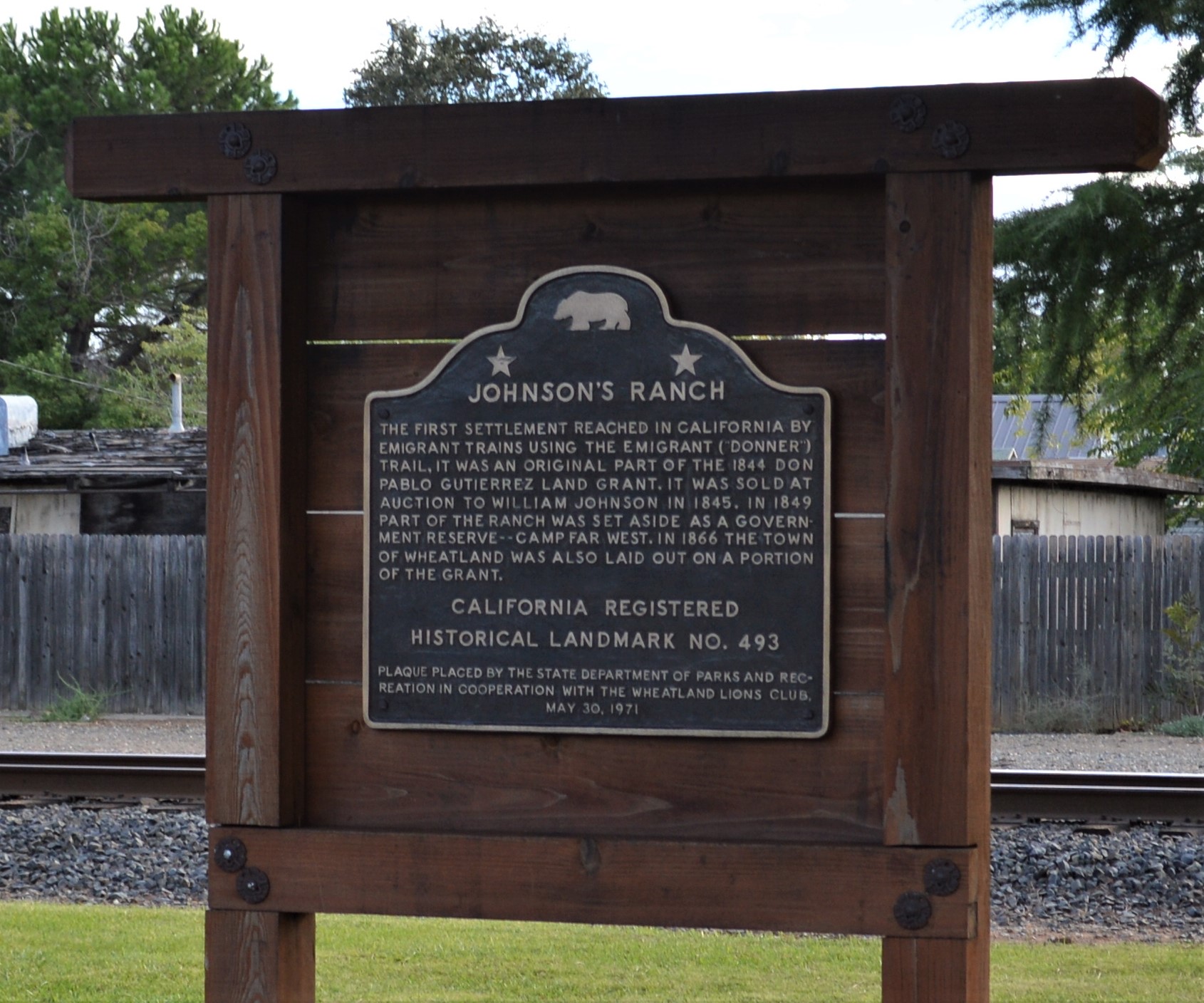
There is a marker along Highway 65 in Wheatland, about 20 miles north of Roseville.

The ranch itself is still in private hands. Some archeological work was done back in the 1980s by Jack and Richard Steed (see their book The Donner Party Rescue Site). They located the site of Johnson’s adobe house, the Burtis Hotel, and the river crossing. But these historic sites on the ranch are still inaccessible to the general public.

That is about to change. Writing in Trail Talk, the newsletter of the California-Nevada chapter of the Oregon-California Trails Association, Bill Holmes reports that he has made contact with the ranch owner and ranch manager, and they are eager to have Johnson’s Ranch recognized as the important historic site that it is. Bill Holmes was primarily interested in locating the site of Camp Far West. Although known to be located near the still extant cemetery, the actual placement of the camp was in doubt. He believes he has pinpointed the location of the camp.

Will we be able to have a look ourselves? According to Mr. Holmes, “The next step in our written plan is to create, build and install interpretive panels for each historic site plus the trail itself. ” The property owner is interested in preserving the historic points of interest and making them available to the public, with parking and maybe even a museum. It’s an exciting time for Johnson’s Ranch and I hope someday soon to be able to visit it.

Posted in Uncategorized | 3 Comments

Old Pairs of Jeans

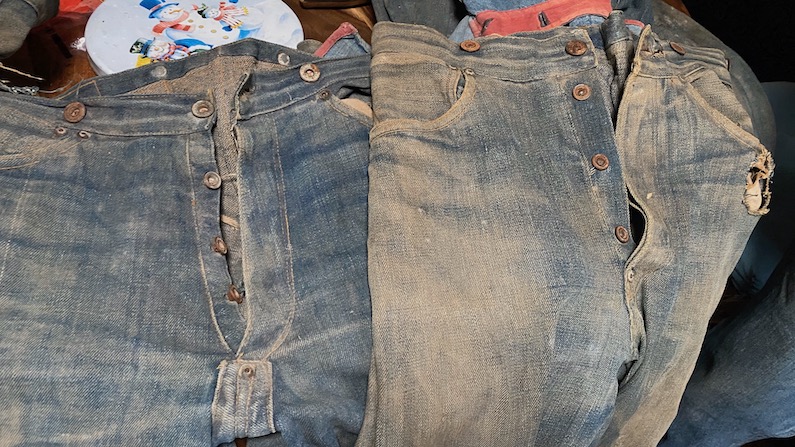
You probably have a few old pairs of jeans in your closet. But probably not 125 years old (and if they are, they are worth a lot of money). Eight pairs of jeans were found earlier this year down in a mine in Arizona — three pairs of Levis and the rest a rival brand called Stronghold.

Why were they left at the bottom of a mine? It’s a mystery.

To read about this find and see more pictures, go to this article at RV Lifestyle.

These may not be the oldest Levis ever found. The Levi Strauss company first began making workman’s trousers in 1873. The Levi Strauss archive has a pair from the 1880s. But jeans from the 1890s are rare enough to make them collectable and museum-worthy and worth a nice bit of moolah.

How can you tell that the jeans are an early pair? There are a few identifying features:

–Donut buttons on the fly. Zippers weren’t in use yet. Donut buttons have a depression like a donut hole in the middle.

–Only one back pocket.

–No belt loops. The pants were held up by suspenders, which attached to buttons on the waistband.

–A cinching strap on the back, like you sometimes find on vests.

–The leather brand patch located in the middle of the back.

–A strengthening rivet at the crotch. This was later removed from the design when cowboys complained about the rivets getting too hot when they crouched around a campfire. (Ouch!)

These early jeans would have been dyed with plant-based, not artificial indigo. That makes them more likely to fade over time, but down in the mine they were well preserved.

If you are intrigued by old jeans, you can read more about the history of Levis at the Levi Strauss & Co. Heritage blog.

Posted in Uncategorized | Leave a comment

Books for Christmas

Something they want,
Something they need,
Something to wear, 
Something to read.

I don’t recall that recommendation being around when my kids were little, but it fits my long-established philosophy of Christmas gift-giving. And as a librarian and devoted book reader myself, the last injunction was particularly important. Everybody needs a good book (or many good books) for Christmas!

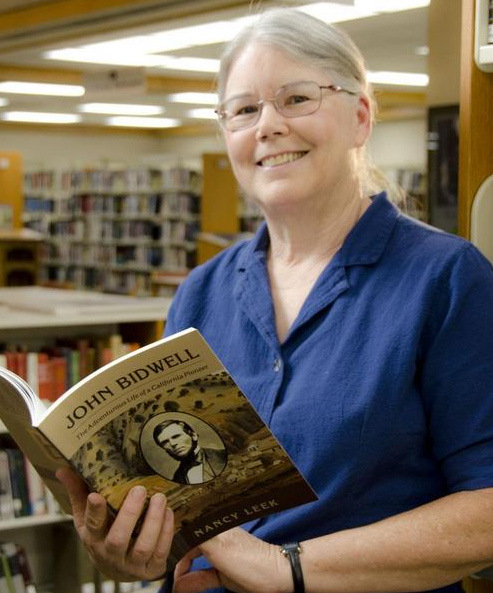
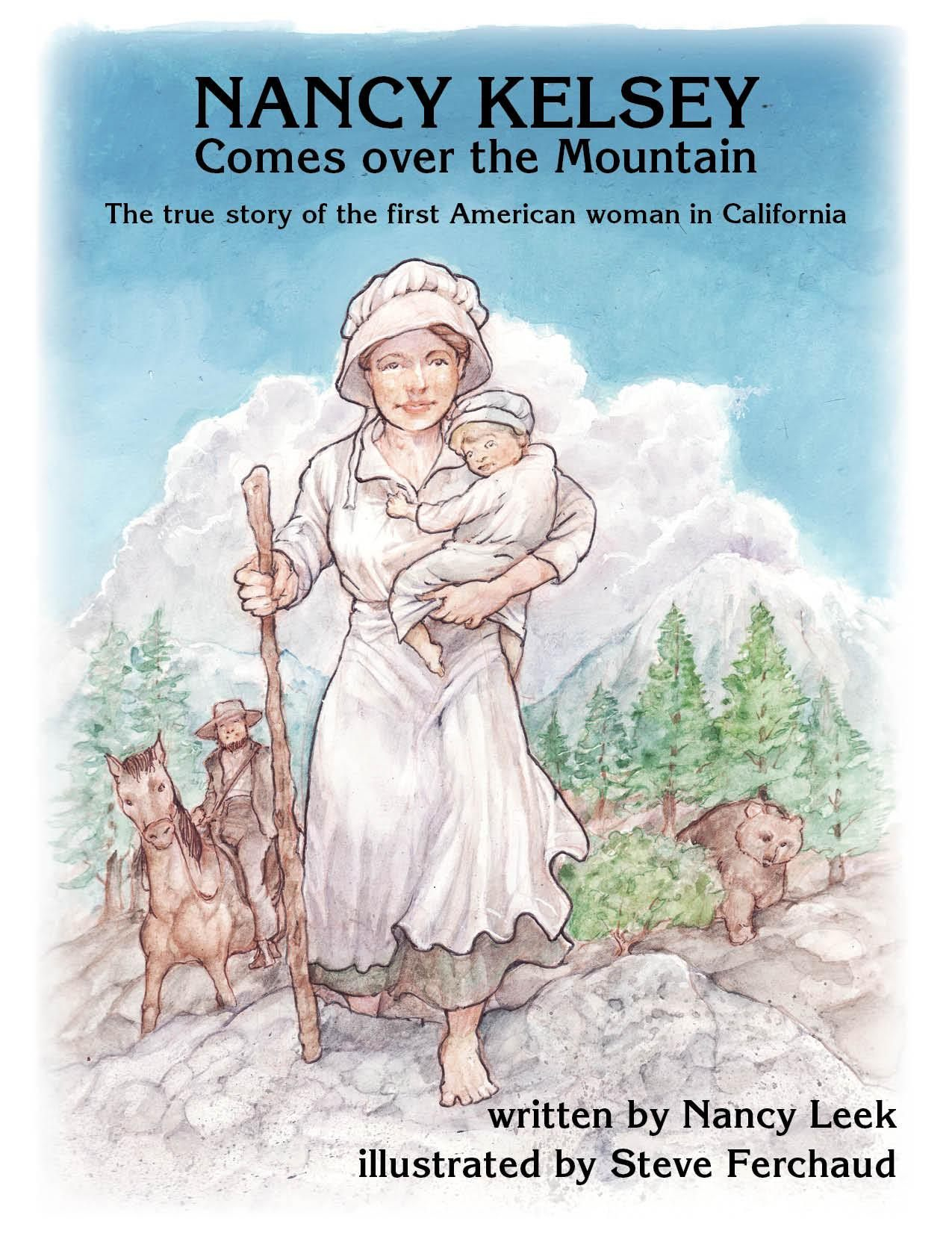
So if you are shopping for books this holiday season, please consider my books as gifts for children or adults. You can find them on Amazon or at anchr.org. At the ANCHR website you will find a host of other titles about Northern California history. History makes great gifts!

There’s more information about where to buy and how to order my books on the My Books tab at the top of this page.

Happy holiday reading!!!

Posted in Uncategorized | Leave a comment

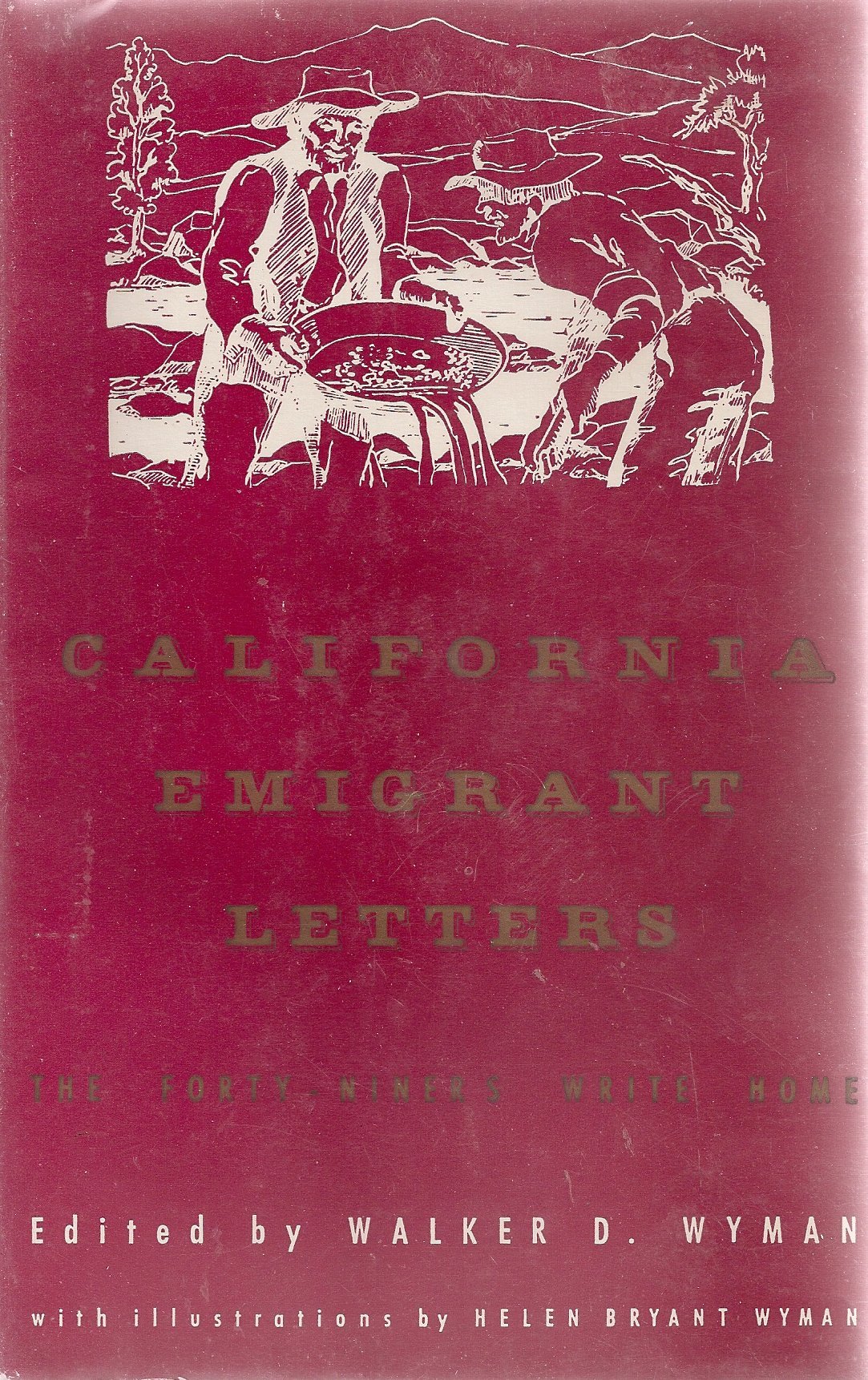
California Emigrant Letters

Feather River, Sept. 29, 1849

Now I will tell you what we have done since we got here; we have worked eight days and have made $16,000 — we have had extremely good luck, are on the Feather River, and pretty well up at its head, about 600 miles from Sacramento City. This is no farming country . . . I would not bring a family here for any consideration, for many reasons too tedious to mention, but you will do well to leave your family and come yourself for I believe there is a fortune for everyone who will come and get it . . .

So wrote Robert and Charles Springer, forty-niners, to S.W. Springer (probably their father). The letter was printed in the St. Joseph Adventure newspaper on February 1, 1850.

Editor Walker D. Wyman collected letters that were sent home and printed in local newspapers, mainly from newspapers in Missouri. Newspaper editors were eager to print news from the goldfields, and many a letter written to parents and friends ended up being published in newspapers for all to read. California Emigrant Letters was published in 1952 — you can buy a used copy for around $10 or find it in many public libraries in California.

The book quotes from numerous letters and collects the extracts under such chapter headings as “Overland in 1849,” “Life in the Mines,” and “Law, Order, and Religion.” The letters are lively and packed with colorful detail.

What has broken loose in the States? [writes a resident of Ft. Laramie] About every five minutes during the day, a white top wagon with a pick-axe slung to its side, rolls in from the frontier, stops for a few minutes, while the driver, with the “want of gold” stamped upon his appearance, enquires for the shortest cut to California.

Not all forty-niners were as lucky as the Springer brothers, but all seem to agree that the gold was “inexhaustible,” a word that shows up over and over in the letters.

In regard to the extent and richness of the mines, there is but one opinion here, that is, that they are inexhaustible.

“M.M.” Missouri Republican, March 22, 1850

The labor attending digging is of the most unpleasant character, and well calculated to try a man’s constitution and see of what material it is composed. About the time the mines were first discovered, persons could, with but little labor, go along the margin of the river and make far more than they can now by laboring all day. The cream has been taken off, in short, yet there is an abundance, of gold here and will be for years.

Anonymous, Missouri Statesman, March 1, 1850

For the emigrant seeking advice on how to outfit himself for the overland journey, M.M. explains in his letter what kind of wagon to select (“new, or as good as new, and made of the very best timber”), how to select your team of oxen, what staples to pack (“125 pounds of bacon and 125 pounds of flour”), and how to cook beans. The letters were full of good advice to the emigrant, so that as one man wrote, they will not “be caught in the same snap I was.”

Not all the correspondents are men. A woman running a boarding house writes:

We have now been keeping house three weeks. I have ten boarders . . . We think we can make seventy-five [dollars] clear of all expenses, but I assure you I have to work mighty hard — I have to do all my own cooking by a very small fireplace, no oven, bake all my own pies and bread in a dutch oven, have one small room about 14 feet square and a little back room we use for a store room about as large as a piece of chalk.

Another woman boasts, “I have made about $18,000 worth of pies — about one third of this has been clear profit.” But it was hard work — she had to drag her own firewood off the mountains and chop it herself.

I’d love to see a fuller version of these kind of letters published anew. They are endlessly fascinating and full of the rich flavor of the Gold Rush.

Posted in Book Reviews | Leave a comment

Hellacious California

What is a California prayer book? Would you drink tarantula juice? Would you go in for pedestrianism? What was the Egg War? Would you invest in a Patent Hydro Electro Magnetic Goldometer that promised to find gold and water? (Save your money.)

Find all the answers and more in this third book from California historian Gary Noy. Focusing on the vices of 19th century Californians, Hellacious California! tells “Tales of Rascality! Revelry! Dissipation! and Depravity! and the Birth of the Golden State“. If you like history that is both authentic and entertaining, this is your book.

Gary Noy digs deep into primary sources — letters, journals, memoirs, and early newspapers — to find the stories that bring the great bachelor party that was Gold Rush California to rip-snorting life. He has chapters on gambling, drinking, tobacco, dueling, entertainment, sports, and swindles. In the chapter on eating and dining he illustrates the difference between getting a meal at a stagecoach stop and dining in style at The Poodle Dog in San Francisco. Here is J. Ross Browne describing mealtime on the road:

At the first tinkle of the bell the door was burst open with a tremendous crash . . . The whole house actually tottered and trembled at the concussion, as if shaken by an earthquake. Long before the main body had assaulted the table the din of arms was heard above the general uproar; the deafening clatter of plates, knives, and forks, and the dreadful battlecry of “Waiter! Waiter! Pork and beans! Coffee! Beefsteak! Sausage! Potatoes!” . . . It was a scene of destruction and carnage long to be remembered.

If this whets your appetite, take a look at the book trailer for Hellacious California!

By the way, a California prayer book was a deck of cards. Tarantula juice, as you probably guessed, was one of the many names for liquor. Pedestrianism was the popular sport of endurance walking. The Egg War was the competition for murre eggs from the Farallone Islands. With chickens in short supply, food suppliers turned to seabird eggs.

Posted in Book Reviews, Uncategorized | Leave a comment

John Bidwell in 1850

One reason I like to write about John Bidwell is that he makes such a good lens for looking at the history of California. He was involved with many aspects of early California (politics, mining, agriculture, education), he knew everyone, he saved his letters and kept a journal. Information about Bidwell’s life is abounding, while such information can be hard to find about many other men and women.

An article by myself has just been published in The Diggin’s, the quarterly journal of the Butte County Historical Society. The genesis of the article was a short piece I wrote commemorating Bidwell’s participation in California statehood. When Congress passed and President Fillmore signed the act making California the 31st state of the Union, Bidwell was the man who brought the news and the documents to California.

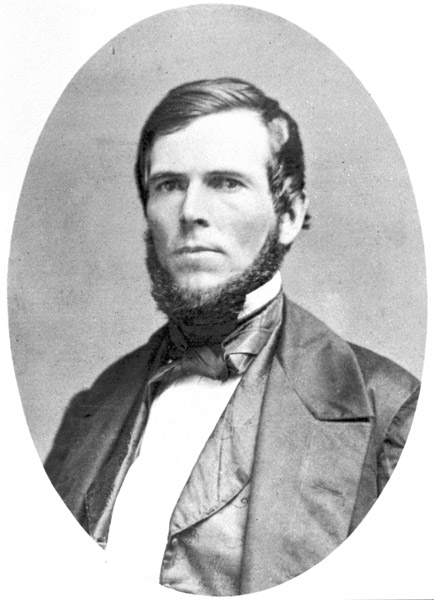
sc 17336 John Bidwell photograph ca 1850

The more I looked into Bidwell’s activities in 1850, the more there was to see. He had just bought Rancho Chico and was working to establish a ranch. At the same time he was winding up his survey of Sutterville, seeking to get his land title confirmed, serving in the state senate, escorting a block of gold-bearing quartz for the Washington Monument to D.C., promoting statehood in the halls of Congress, and visiting family and friends that he hadn’t seen for nearly a decade. He seems to have done a little unsuccessful courting along the way too.

Daily Alta California September 9, 1850

In New York he had his portrait taken at Mathew Brady’s photography studio. He also had a daguerreotype done of Raphael, the Maidu boy he had brought with him as his valet.

Raphael

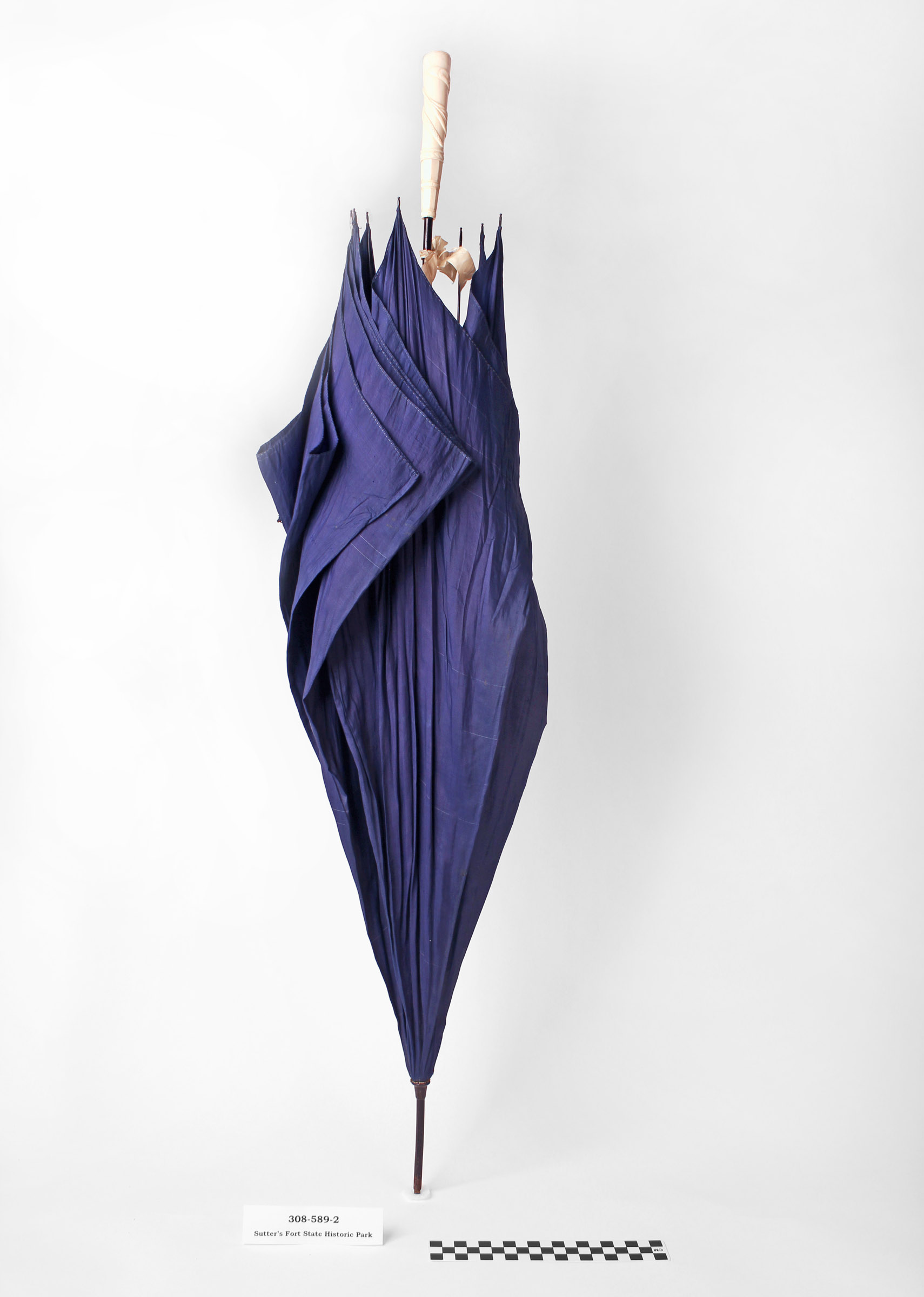
I have written before about the ladies he escorted back to California, Mrs. Maria Crosby and her daughter Mary Helen Crosby. For years afterward Helen Crosby Hensley loved to tell the tale of her blue silk umbrella and how it helped to safely bring the statehood papers to California. For my Diggin’s article, I was able to get a photo of the famous umbrella, which is in the Sutter’s Fort archives. It looks to be in fine condition for its age.

Posted in Mary Helen Crosby | Leave a comment

November 6, 1841 — The End of the Journey

Saturday, 6th. Fifteen of the Company started for a Spanish town, called the Pueblo of St. Joseph (which is situated about 40 miles from Marsh’s) to seek employment.

Members of the Bidwell-Bartleson Party didn’t waste any time sitting around at Marsh’s rancho, relaxing and recovering from their long and strenuous journey. They were made of tougher stuff than we are.

They arrived on November 4th, and on the 6th half the men set out for San Jose to look for work. The other half of the men went back to the San Joaquin Valley to hunt for game. John Bidwell decided to stay at Marsh’s for the time being, keeping an eye on the Company’s effects, and doing some local exploring.

The men who left for San Jose soon ran into trouble. They were arrested two miles from the pueblo and spent six days in the “calaboose” before they were released. Because of the “Graham Affair” of 1840, in which a few Americans fomented a rebellion against the Mexican governor, the authorities were understandably suspicious of any uninvited Americans coming into the territory.

The adobe jail at Monterey. The one at San Jose would have been similar.

The November 6th entry concludes John Bidwell’s overland day-by-day diary. It is not, however, the end of the journal. Bidwell added several pages of “Observations about the Country” detailing the vegetation, climate, and resources of California, including wages and prices. He gives his opinion about the Mexican government and outline the route to California. In conclusion he writes:

To all my acquaintances and friends who may be in bad health I would recommend a trip to California. All whom I have heard speak of the climate as regarded their health say its effects have been salutary.

And now it’s time for me to take a little salutary break from blogging, but I will be back soon with some book reviews and more explorations of life in Northern California.

Posted in Bidwell-Bartleson Party, Uncategorized | 4 Comments