Tuesday, 26th. Went S. about 3 miles and camped in a deep ravine. It was urged by some that we should kill our horses and mules — dry what meat we could carry and start on foot to find the way out of the mountains.
Some of the men still had horses or mules to ride, but as often as not they had to walk anyway because of the rocky terrain. The animals were becoming an encumbrance.
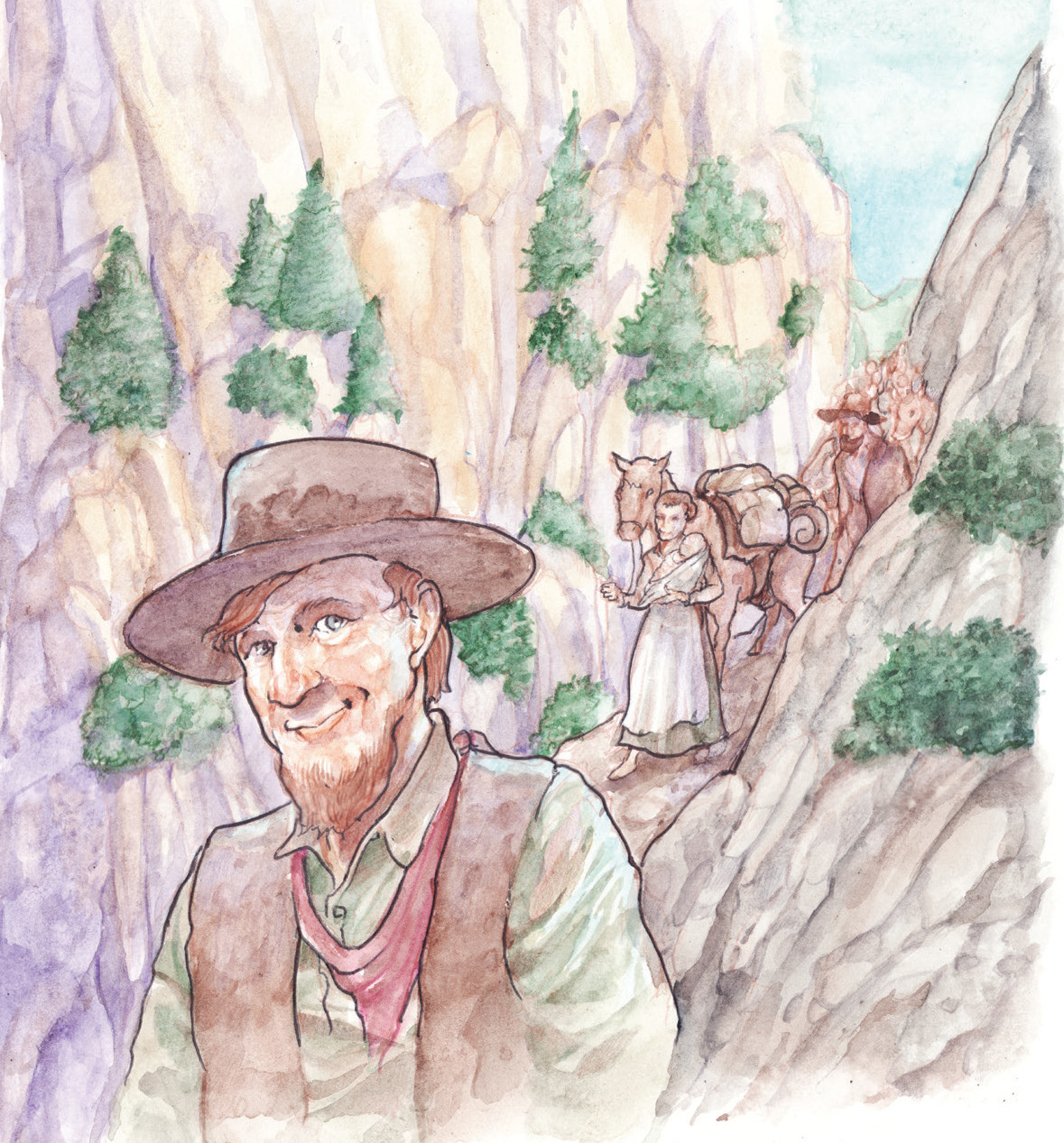
Nicholas “Cheyenne” Dawson recalled one time when they were following an Indian guide down a mountain.
We followed the Indian, and he led us along shelves of rock which overhung vast precipices. Here and there great rocks projected over the path and frequently a pack would strike against one of these rocks and over the precipice would go pack and animal, and be lost to us entirely. We all went on foot, leading our animals.
Once, I remember, when I was struggling along trying to keep Monte from going over, I looked back and saw Mrs. Kelsey a little way behind me, with her child in her arms, barefoot I think, and leading her horse — a sight I shall never forget. As we neared the stream and were passing the last projecting rock, old Monte struck the rock and would have gone over had I not braced myself and held him hard.
Cheyenne Dawson and Nancy Kelsey. Illustration by Steve Ferchaud.
Monday, 25th. Went about 6 miles and found it impossible to proceed. Went back about 2 miles and encamped — dug holes in the ground to deposit such things as we could dispense with. Did not do it, discovering the Indians were watching us, among them was the old, rascally pilot.
As they came down in elevation, they encountered more and more Indians. The natives were wary of these interlopers — some of them had experience of the missions and had escaped to return to the mountains.
Although most of the men did not cache their belongings, one man did. “Cheyenne” Dawson recalled:
Green, whose pack of lead which he clung to most solicitously, had been growing heavier for his weakened animal, took Grove Cook with him, and going off into some gulch secreted or cached it.
Talbot H. Green had with him a heavy bundle of “lead,” which in spite of its weight he refused to abandon until they were in the Sierras. Later he and Cook, with an Indian guide, would go back to find it. Green and his lead were not what they seemed, and you can read all about it in The Sensational Saga of Talbot H. Green.
The Company was on short rations. They had killed their last ox three days before. Game was amazingly scarce in the mountains. They shot a wildcat and a few squirrels, but never any deer. They tried eating acorns, but the bitter tannin in the untreated acorns made them sick.
Years later Bidwell could still vividly recall how he longed for good food, especially bread.
Some of the meat of one of the mules had been saved in case of an emergency for it was evident the meat of the last ox would soon be consumed. When it was gone, most if not all of us refused to touch the mule meat for some time. I was always so fond of bread that I could not imagine how any one could live without it. How the people in the Rocky Mountains [the trappers] had been able to live on meat alone was to me a mystery.
When our flour began to give out, the idea of doing without bread was painful to me, and by great economy my mess managed to eke out their flour a short time longer than the others. It was bad enough to have poor beef, but when brought to it we longed for fat beef and thought with it we might possibly live without bread. But when poor mule meat stared us in the face, we said if we could only have beef, no matter how poor, we could live. (1877 Dictation)
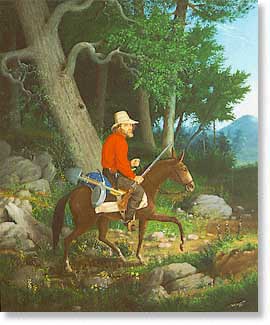
The Lone Prospector, by Alburtus Del Orient Browere, 1853. Courtesy of the Oakland Museum
Saturday, 24th. Concluded the Co. had gone north. I travelled E., found no trail — traveled S. — came to the place where I left the Company yesterday morning, having made a long quadrangle in the mts., 8 by 10 miles — took the trail of the Company. They had with great difficulty descended to the river, [I] saw where they staid last night. Distance about 6 miles. Ascended on the S. side of the creek a high precipice. I overtook them; they had traveled today 10 miles.
They had hired an Indian pilot who had led them into the worst place he could find and absconded. 5 horses and mules had given out; they were left. I learned likewise that two hunter (A. Kelsey and Jones) started shortly after I did, and had not returned; part of a horse was saved to eat.
The Company was making very slow progress, and it must have felt like no progress at all. They feared they might wander about in the canyons for weeks until the snows caught them and they perished.
While Bidwell was off on his his detour to the grove of sequoias, the rest of the company had hired an old Indian to pilot them out of the mountains. They were sure that he had led them “into the worst place he could find” and left them there. They suspected the Indians of wanting their horses for food.
Before Bidwell caught up with his companions late on the 24th, they abandoned five of their horses and mules. On his way back to join the group, Bidwell came upon the Indians cutting the beasts up for meat.
Many [animals] gave out and had to be left, the men carrying on their backs what they could of the burdens and leaving the rest. And here I witnessed a most horrible sight. For many miles the Indians were cutting the animals to pieces and carrying away the meat, poor as it was, for food. Late in the night I overtook the company. (1877 Dictation)
The Sierra Nevadas, by Albert Bierstadt. Hard to admire the scenery when you are lost and starving.
Friday, 23rd. Having no more meat than would last us 3 days, it was necessary to use all possible exertions to kill game, which was exceedingly scarce. For this purpose I started alone, very early in the morning, to keep some distance before the Company, who had concluded to continue as near as possible to the creek on the N. side. I went about 4 miles -–met the Indian who came to us last night — obtained a little provision made of acorns — got an Indian boy to pilot me to his house. He took me down the most rugged path in all nature — arrived on the banks of a river at least 3/4 of a mile perpendicular from where I started with him — found no more provision, continued down the river — oak in abundance, buckeye, and a kind of maple.
The mountains, which walled in the stream, were so steep that it was with great difficulty I scaled them — having in one place come within an inch of falling from a craggy cliff down a precipice nearly a fourth of a mile perpendicular. 4 long hours I labored before I reached the summit — proceeded directly to intercept the trail of the Company. Mts. covered with the largest and tallest pines, firs, &c., thick copses of hazel &c. — travelled till dark over hills, dales, crags, rocks, &c., found no trail — lay down and slept.
You would think that Bidwell would take someone else with him, but he doesn’t seem to have heard of the buddy system. His idea was to range around looking for game to shoot, then intersect the trail of the Company and rejoin them further along. Needless to say, he never found any game, and the others weren’t doing much better. In Echoes of the Past he says:
When we killed our last ox [on the 22nd] we shot and ate crows or anything we could kill, and one man shot a wildcat. We could eat anything.
Although he found no game, he did make a fascinating discovery. Many years later he wrote:
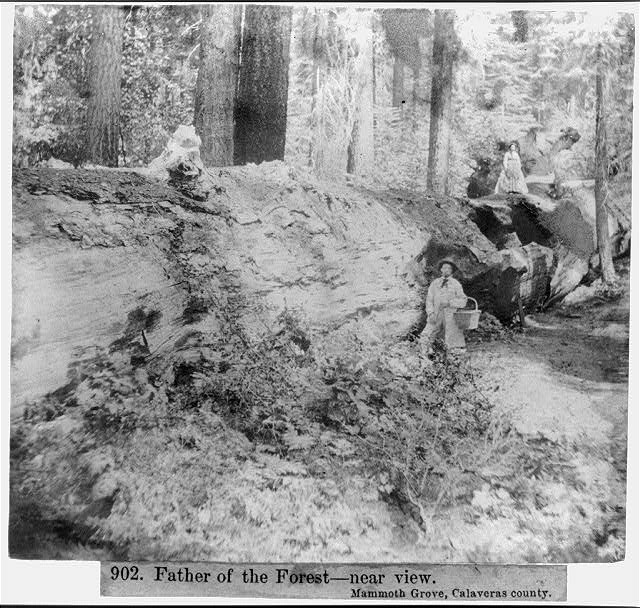
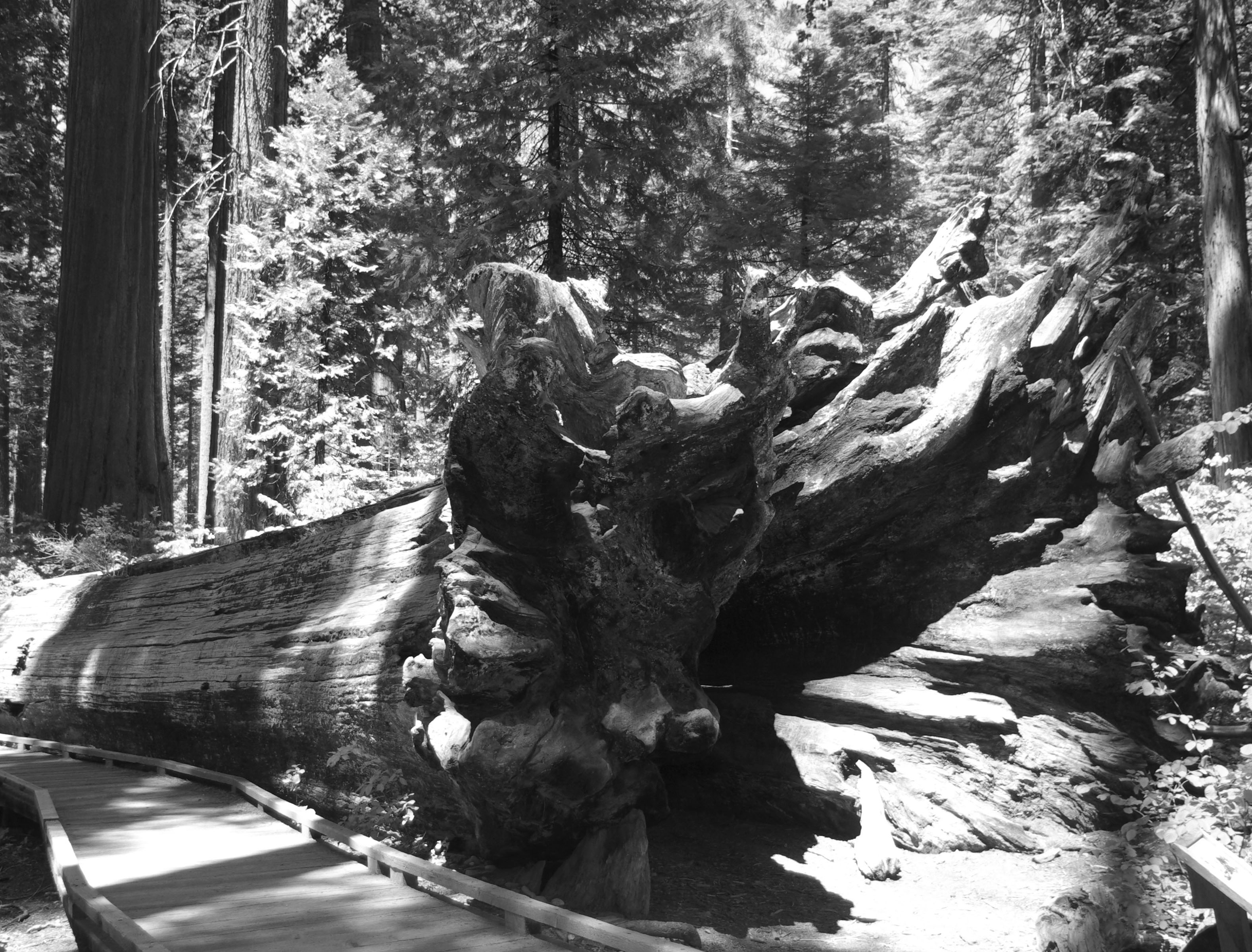
Just at dark I came to an enormous fallen tree and tried to go around the top, but the place was too brushy, so I went around the butt, which seemed to me to be about twenty or twenty-five feet above my head. This I suppose to have been one of the fallen trees in the Calaveras Grove of Sequoia gigantea or mammoth trees, as I have since been there, and to my own satisfaction identified the lay of the land and the tree. Hence I concluded that I must have been the first white man who ever saw the Sequoia gigantea, of which I told Fremont when he came to California in 1844. (Echoes of the Past)
He didn’t know that Joseph Walker had seen those trees before him in 1833. This place is now Calaveras Big Trees State Park. For more about John Bidwell and the big trees, including a letter from Bidwell to John Muir about his discovery, click here.
The roots of the big tree that John Bidwell slept under.
Thursday, 22nd. Descended towards the river about 15 miles — had a tolerable road — arrived within about a mile of the river — could not approach nearer. Here was considerable oak, some of which was evergreen, and thought to be live oak. 3 Indians came to camp; killed the last ox — let this speak for our situation and future prospects!
Seeing pictures of the rocky streambeds lined with densely packed trees, it is no wonder that they had to travel on the ridge between the rivers. In the 1877 Dictation, Bidwell says:
Pursuing a westerly course for a few days, we found ourselves obliged to keep on top of the ridges away from the stream. On one of these ridges we killed our last ox, who was so poor, as nearly all had been for weeks, that he had no marrow in his bones, he was literally skin and bones.
That poor ox! All that rough, rocky road to travel, only to end up as a scanty meal for thirty people. It was short rations all around.
In our straitened condition it was customary for one or more to go ahead of the party in order if possible to kill some kind of game, of which there was scarcely anything. There was nothing for game to live upon because fires had destroyed everything that would burn, and the country was literally desolated. . . . The only thing in the shape of game that was killed by our whole party during our passage of the Sierra Nevada Mountains from Walker River till we reached the San Joaquin Valley consisted, so far as I can now remember, of a wildcat, a crow, and a few squirrels.
Wednesday, 21st. Our route today was much better than expected, though in any other place than the mountains it would be considered horrible. Capt. B. with his 7 or 8 overtook us, but we heard nothing of J. John. Distance about 10 miles, could see no prospect of a termination to the mts., mts., mountains!
Surrounded by mountains, and unable to proceed down the steep and rocky canyon, the party traveled along the ridge between the Middle and North Forks of the Stanislaus River. The landscape was “recently burned over” by forest fires. This desolate terrain offered no game and almost no grass for the horses, the mules, and their one remaining ox.
They are passing near the Dardanelles Cone, a prominent mountain of volcanic upthrust, maybe one of those “mts., mts., mountains!”
Sword Lake and Dardanelles Cone
In his 1877 Dictation, Bidwell describes how Bartleson’s group, who had tried to get down the canyon, spent all day retracing their steps, although the distance was no more than half a mile.
At one place it took all of the men either pushing or pulling to help each mule back up again, and for the whole distance the loads had to be carried on the backs of the men.
Wednesday, 20th. Men went in different directions to see if there was any possibility of extracting ourselves from this place without going back. They returned and reported that it was utterly impossible to go down the creek. One young man was so confident that he could pass along the creek with his horse that he started alone, in spite of many persuasions to the contrary.
Capt. B. also being tired of waiting for the explorers to return, started down the stream, which so jaded his animals that he was obliged to wait all day to rest them before he was able to retrace his steps. In the meantime the rest of the Company, suffering for want of water, were obliged to travel. We proceeded directly N. up the mountains, about 4 miles, found a little grass and water — here we killed one of the 2 oxen.
Lost in the mountains — no way of knowing where they were or how to get out — only two oxen left for food. Not a good situation.
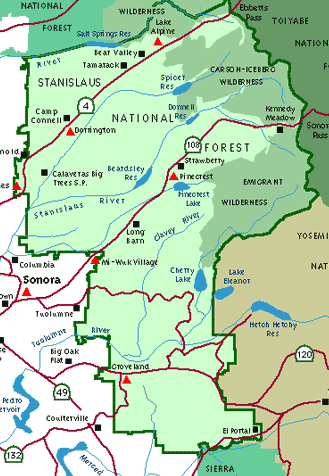
They are within the present-day Stanislaus National Forest. On the map below, they are near where Donell Reservoir is today. (At the end of the word “National.)
Among the “men who went in different directions” were John Bidwell and James John — cautious John and impulsive Jimmy. In his 1877 Dictation, and in Echoes of the Past, Bidwell tells the story of their attempt to find a way out of the canyon. The men all agreed that if any of them found a way which was passable, they were to fire a gun to alert the others.
When Jimmy and I got down about three-quarters of a mile I came to the conclusion that it was impossible to get through, and said to him, ‘Jimmy, we might as well go back; we can’t go here.’ “’Yes, we can,’ said he; and insisting that we could, he pulled out a pistol and fired. It was an old dragoon pistol, and reverberated like a cannon.
I hurried back to tell the company not to come down, but before I reached them, the captain and his party had started. I explained and warned them that they could not get down; but they went on as far as they could go, and then were obliged to stay all day and night to rest the animals. The men had to pick grass here and there where it grew among the rocks for their horses and mules. To get water, they went down to the stream and carried the water back up in cups and kettles, and even their boots, and then poured the water down the animals’ throats.
Meanwhile, Jimmy John continued down the stream on his own. His journal says:
I went on down the creek a few miles and waited for the company until night, but no one came here. I camped by the side of a frightful looking precipice. My gun fired accidentally as I lit from my horse this evening and the muzzle was so close to my head that the powder burned my ear and frightened the horse so that he jumped and knocked my gun into the creek, but I lost no time in getting it dry again.
When the others didn’t catch up with him, Jimmy continued on his own.
J. John was never more seen by any of us till we found him afterwards in California. His experience after he left us was of the severest character. He was repeatedly chased by Indians and was without anything to eat until he was nearly starved yet managed to get through to Sutter’s Fort and told S. of our being on the route. (1877 Bidwell Dictation)
They have followed Clark’s Fork to where it converges with the Middle Fork of the Stanislaus River and then followed the Middle Fork to its confluence with Dardanelles Creek. Here’s a little video of the Middle Fork of the Stanislaus.
Tuesday, 19th. Descending along the stream,we found several oak scrubs which confirmed us in the hope that we were on the waters of the Pacific. But the route became exceedingly difficult-–the stream had swelled to a river-–could not approach it-–could only hear it roaring among the rocks. Having come about 12 miles a horrid precipice bid us stop — we obeyed and encamped.
Those who went to explore the route had not time to come to any conclusion where we could pass. We had descended rapidly all day; the mts. were still mantled with forests of towering pines. The roaring winds and the hollow murmuring of the dashing waters conveyed in the darkness of the night the most solemn and impressive ideas of solitude.
To a person fond of the retiring life, this, thought I, would be a perfect terrestrial Paradise, but it was not so to us, when we knew that winter was at hand, and that Capt. Walker (the mountaineer) had been lost in these very mountains 22 days before he could extricate himself.
In July 1833, by order of Captain Benjamin Bonneville, Joseph Walker led forty men on an exploring trip across the Sierras. John Bidwell probably read about him in Washington Irving’s popular account of the Bonneville expedition. Walker and his men had spent 22 grueling days scaling granite bluffs and slogging through heavy drifts of snow. With that in mind, Bidwell had no desire to spend any more time among the beauties of a autumn season in the Sierra Nevada than he had to. The sooner they got out the better.
Monday, 18th. Having ascended a about half a mile, a frightful prospect opened before us-–naked mountains whose summits still retained the snows perhaps of a thousand years, for it had withstood the heat of a long dry summer, and ceased to melt for the season. The winds roared–-but in the deep dark gulfs which yawned on every side, profound solitude seemed to reign. We wound along among the peaks in such a manner as to avoid most of the mountains which we had expected to climb–-struck a small stream descending toward the W., on which we encamped, having come 15 miles.
Stunning views, roaring winds, and biting cold. The company is high in the Sierras, but they have crossed the summit; they find a small stream flowing westward. Jimmy John noted: “Today we crossed the main ridge of the mountains of California in the morning about 10 o’clock.” Excellent news! however, they still have a long and difficult descent ahead of them.
Sierra Nevada (or From the Head of Carson River) by Albert Bierstadt
The ascent up a steep pass in the thin air must have been exhausting. Michael Gillis writes:
After ascending the last few hundred feet in Golden Canyon, they reached the canyon’s western headwall. At an elevation of 9,425 feet, they crested the Sierra Nevada. In only four days, thanks to good weather, good luck and some savvy scouting, the Bidwell-Bartleson Party had made its way to the west side of the Sierra Nevada.
Their descent takes them down Disaster Creek to where the creek empties into Clark’s Fork of the Stanislaus River. The way down is tough, rocky, and dangerous, but they make it and camp by Clark’s Fork.
This map, from Michael Gillis’s article of “The 1841 Trans-Sierra Route of the Bidwell-Bartleson Party,” is not easy to make out. but if you can spot the little vertical arrow in the middle of the map, that is where they were on October 18th. The solid black line traces their route as far as October 20th, then the two dotted lines are two possible routes after that.
Sunday, 17th. This morning we set forth into the rolling mountains; in many places it was so steep that all were obliged to take it on foot. Part of the day we travelled through vallies between peaks, where the way was quite level — passed down and up through forests of pine, fir, cedar, &c; many of the pines were 12 ft. in diameter and no less than 200 ft. high. Encamped on the side of the mountain, so elevated that the ice remained all day in the streams — but we had not yet arrived at the summit. Killed another ox this evening — made 12 miles.
Jimmy John gave a similar account, and said, “These forests and fine streams of water have to us a beautiful appearance after traveling so long through an almost entire desert.” According to Michel Gillis, the company followed river drainages as much as possible, rather than attempting to scale mountains.
They began by climbing steeply due west out of Little Antelope Valley . . . up to Rodriguez Flat. From there they dropped down the Snodgrass Creek drainage to Silver King Creek. After a four-and-one-half mile descent along Silver King Creek, they arrived in Silver King Meadows. Heading west across this flat, timbered expanse they intersected the East Fork of the Carson River . . . The trail up the East Fork proved to be relatively flat for the first several miles with some grassy areas available to graze their jaded animals.
“The Trans-Sierra Route of the Bidwell-Bartleson Party”, Overland Journal, Winter 1998.
As they made their way up the East Fork of the Carson, the canyon became more and more narrow, until they branched off into a Golden Canyon, and there camped for the night. The ox they killed for dinner left them with two.






 goldfields