The Fate of the Fraeb Party

Henry Fraeb and his party of about 20 trappers left the rendezvous on the Green River on July 25th. The Fraeb Party headed east, toward Fraeb’s trading post on the Little Snake River, hunting for buffalo. The beaver trade was in decline, but buffalo robes were in high demand.
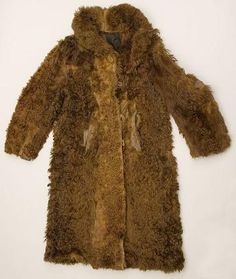
Buffalo robe coat

Earlier in 1841 Henry Fraeb and Jim Bridger had built at log trading post on the Little Snake River, near what is now the Wyoming-Colorado border. This was south of the route that the Bidwell-Bartleson Party took, in a good region for hunting buffalo.

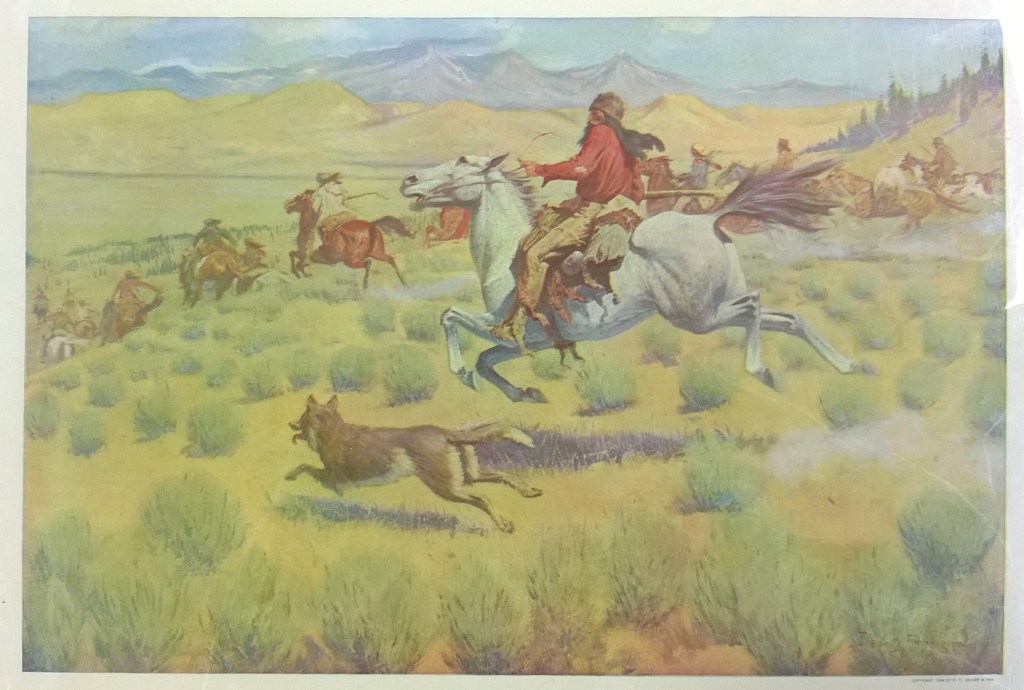
About three weeks after they met with the Bidwell-Bartleson Party, Fraeb and his group of hunters was attacked by 500 Sioux, Cheyenne, and Arapaho warriors. The battle was fierce, taking place over two days, and leaving from 40 to 50 Native Americans dead and five dead of Fraeb’s party. It’s astounding that any of them survived.

One of the survivors was Jim Baker, who had come with the Bidwell-Bartleson Party in search of Fraeb and his men. When Fraeb was killed early in the battle, he took over and directed the fight. Nearly all the horses were killed, since Fraeb’s men used their horses as a wall to shield behind.

The Bidwell-Bartleson Party went on their way, ignorant of what happened to Fraeb and his men. In “The First Emigrant Train to California,” Bidwell relates what he thought he knew about the incident:

Years afterwards we heard of the fate of that party; they were attacked by Indians the very first night after they left us and several of them killed, including the captain of the trapping party, whose name was Frapp. The whisky was probably the cause.

By the time Bidwell wrote that in 1889 he was a Prohibitionist, so he does not fail to point the moral. But since the battle did not take place until almost a month later, whiskey was probably not the cause. Some other problem caused the Indians to attack the intruders they saw as a threat.

Posted in Uncategorized | Leave a comment

July 27-29, 1841

Tuesday, 27th. Advanced upstream about 12 miles.

Wednesday, 28th. do [ditto] do. 12 do.

Thursday, 29th. do do. 12 do.

Nothing exciting going on here, so Bidwell just “dittos” his entries. They were in the southwest corner of what is now Wyoming, approaching the Wyoming-Idaho/Utah border. The weather was hot, and the land dry, but the river provided water and grass for their livestock.

This map of fur trapper rendezvous sites shows Ham’s Fork just below the 42nd parallel (the blue line). The map is borrowed from The Fur Trapper website, which has an excellent article on rendezvous from 1825 to 1840. The heyday of the beaver trade was over, and the era of the big rendezvous finished in 1840. The era of the emigrant wagon trains was beginning.

Map of rendezvous sites from http://thefurtrapper.com/home/rendezvous-sites/

Note the red line indicating the Continental Divide, and the way that the rivers seem to go every which way in this region of the Rockies.

Since there is nothing to report for the next two days, I will instead tell you of the fate of Fraeb’s fur trappers, the men who bought the whiskey from John Bartleson and friends.

Posted in Bidwell-Bartleson Party | Leave a comment

July 26, 1841

Monday, 26th. Left Green river – moved off in a W. direction – distance 12 miles — encamped on a branch of Green river called Ham’s fork. Land high, dry, and barren, except upon the streams, which afford grass in abundance; also black currants, which though not delicious are acceptable.

Wild Black Currants

Black currants, even if they were not very sweet or delicious, would have provided vital nutrition for the travelers. Black currants have an extremely high level of vitamin C, as well as good levels of potassium, phosphorus, and iron. Excellent for keeping scurvy at bay, and scurvy is always a danger when people are living primarily on meat, as these pioneers were.

Posted in Bidwell-Bartleson Party | Leave a comment

Mountain Prices

John Bidwell recorded some prices in his entry for July 25, 1841.

I will not omit to state the prices of several kinds of mountain goods. Powder which is sold by the cupful (pint) is worth $1 per cup. Lead 1.50 per lb., good Mackinaw blankets 8 to 15 dollars; sugar $1 per cupful; pepper $1 also; cotton and calico shirts from 3 to 5$; rifles from 30 to 60. In return, you will receive dressed deerskins at $3, pants made of deerskins $10, beaver skins $10, moccasins $1; flour sold in the Mts. at 50 cents per cupful, tobacco at $2 per lb., butcher knives from 1 to 3$. A good gun is worth as much as a horse; a cap lock is preferred, caps worth $1 per box.

These prices would have shocked the folks back home. For comparison, here are a few prices in Massachusetts in 1841, from Comparative Wages, Prices and Cost of Living (1885) which contains prices going back to the 1790s.

White sugar sold for 15 cents a pound (and there are several cups in a pound), flour sold for 4 cents a pound, or $7 a barrel, and pepper was 20 cents a pound. A blanket cost $5.50 but whether it was a “good Mackinaw blanket” I don’t know.

Pocket knives were 25 cents each; a butcher knife would have cost somewhat more, maybe 50 cents. Tobacco was 20 to 28 cents a pound, so you can see that the price had increased 8-fold in the mountains.

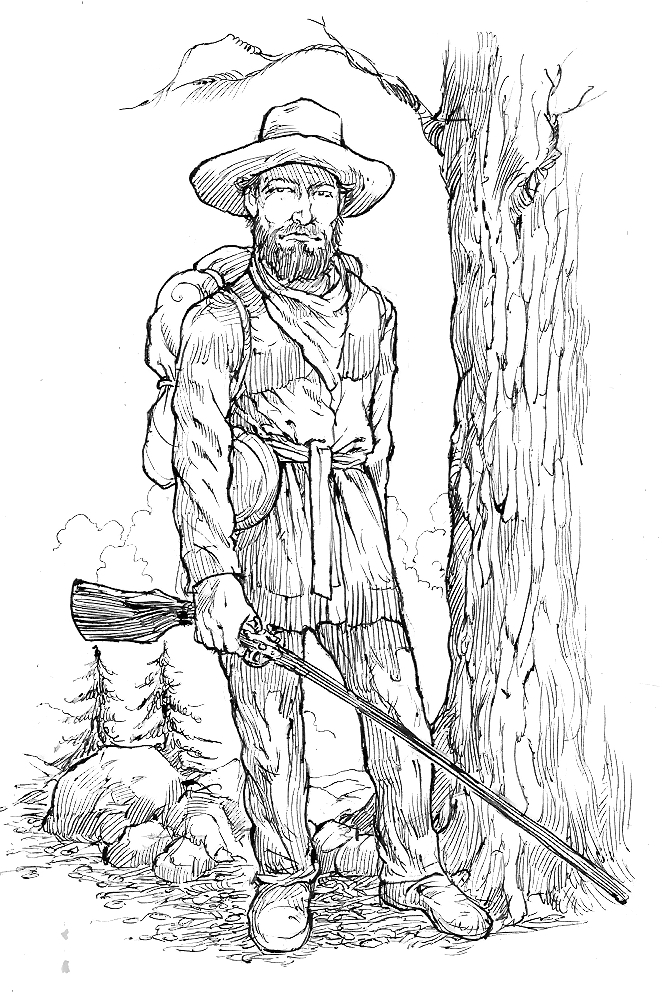
This must be where John Bidwell acquired the “buckskin suit” he mentions wearing when he and Jimmy John went to get some snow from the mountains.

Illustration by Steve Ferchaud

Posted in Bidwell-Bartleson Party | Leave a comment

July 25, 1841

Sunday, 25th. Left the rendezvous this morning, 6 of the company, viz., John Gray, Peyton, Frye, Rogers, Jones, and Romaine, started to return to the United States. Baker stopped in the mountains to trap; crossed Green river and descended it about 8 miles. Trapp and his company likewise left in search of buffalo.

Trapp, as you will recall, was Henry Fraeb (tricky name). The name also shows up as Frapp. I’ll have more about him shortly.

John Gray had been hired by the Englishman William G. Romaine to escort him on a tour of the American West. They hadn’t signed up to go to California, so it was time for them to turn back. I don’t know anything about Peyton or Jones. Bidwell describes Rogers and Amos Frye as “pleasure seekers,” what we would call tourists. Bidwell and Frye would meet up again nine years later on the East Coast. Frye came to California to work for Bidwell on Rancho Chico and died in Chico in 1852.

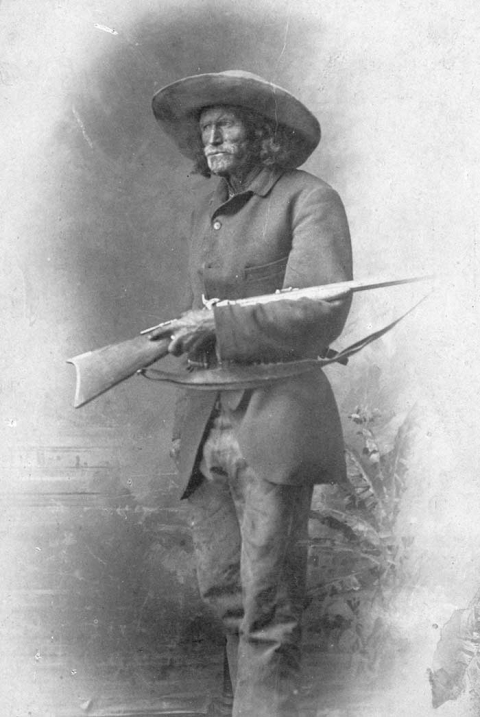
Baker, who “stopped in the mountains to trap,” was Jim Baker, a trapper who had attached himself to the company to travel to the Rockies. At this time he was a young man, about the same age as John Bidwell, but he would go on to a long career as a hunter, trapper, explorer, scout, and rancher, and an associate of John C. Fremont, Kit Carson, Jim Bridger, and other frontiersmen. There is a good article about him at WyoHistory,org.

James Baker in 1879
Posted in Bidwell-Bartleson Party | 1 Comment

July 24, 1841

Saturday, 24th. Remained at this encampment and continued our traffic with the hunters. Chiles sold his oxen, 2 yoke, and wagon, another also was left.

The hunters, or fur trappers, bought all the alcohol brought by Bartleson and others, as well as other items, like Joseph Chiles’s wagon and ox team. If the load in Chiles’s wagon was mostly whiskey, then he wouldn’t need the wagon anymore. Anything he had left he could put in someone else’s wagon.

Bidwell doesn’t say whether his group paid with money or bartered goods. It seems unlikely the hunters had much money, but they had goods the travelers could use, so it was probably mostly barter. Jimmy John says, “we stayed until the 25th and traded with the Indians and Trappers for horses and buffalo robes.” Maybe this is where Bidwell picked up the buckskin suit he later says he was wearing.

In tomorrow’s entry Bidwell will give some “mountain prices.”

Gathering of the Trappers, by Frederic Remington
Posted in Bidwell-Bartleson Party | Leave a comment

July 23, 1841 — Mountain Men

Friday, 23rd. Went to Green river — distance 8 miles — spent the remainder of the day trading with the hunters.

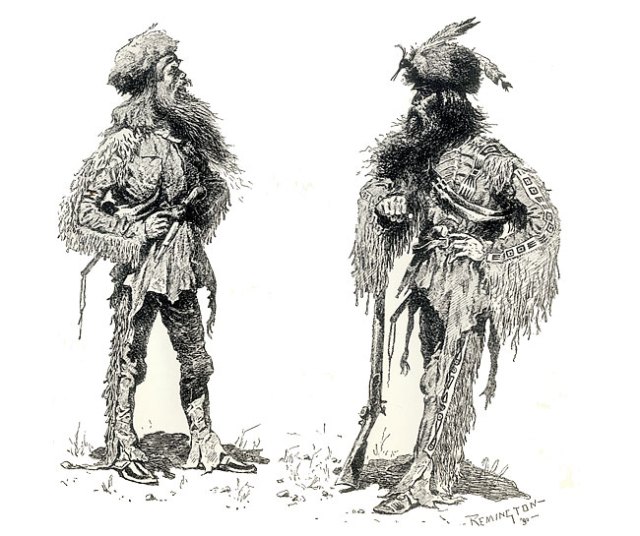
I don’t imagine John Bartleson had any problem selling the whiskey he brought with him to Fraeb’s hunters.

Mountain Men by Frederic Remington — “I took ye for an Injun!”
Posted in Bidwell-Bartleson Party | Leave a comment

July 22, 1841 — The Return of John Grey

Thursday, 22nd. Descended Big Sandy about 12 miles and stopped where we found plenty of grass — this was very acceptable as our teams were already much jaded for the want of grass.

Gray returned this evening having found Trapp’s company, which consisted of about 20 men. They had returned to meet our company, though on their way to hunt buffalo, and were now encamped on Green river about 8 miles distant. Gray had suffered much in overtaking the trappers; his mule gave out, there being no water for a great distance, and he himself was reduced so much by hunger and thirst that he was unable to walk. He was therefore compelled to crawl upon his hands and feet, and at last came up with the company in the most forlorn situation imaginable–if they had been another half mile farther, he never could have reached them.

Poor John Grey! He nearly lost his life in pursuit of the fur trappers. If anyone could have found them, it was John Grey, the half-Mohawk, half-Scottish trapper and trail guide, but he was traversing some of the most  unforgiving territory in America. It was only his skill and knowledge of the wilderness that kept him alive.

The man that Bidwell here calls “Trapp,” was generally called “Frapp” by his men. A German-American fur trader from St. Louis, his name was actually Henry Fraeb. He was a veteran fur trapper and one of the founders, with Jim Bridger and William Sublette, of the Rocky Mountain Fur Company. He had about 60 men with him.

The Rev. Joseph Williams called his outfit “a wicked, swearing company of men,” which is probably a pretty accurate description of the kind of men who lived far from civilization.

Mountain Men image from https://www.offthegridnews.com/lost-ways-found/28-survival-foods-the-mountain-men-ate/
Posted in Uncategorized | Leave a comment

July 21, 1841

Wednesday, 21st. Descended Big Sandy about 15 miles and again encamped upon it — no grass, had a little rain this evening but not enough to lay the dust.

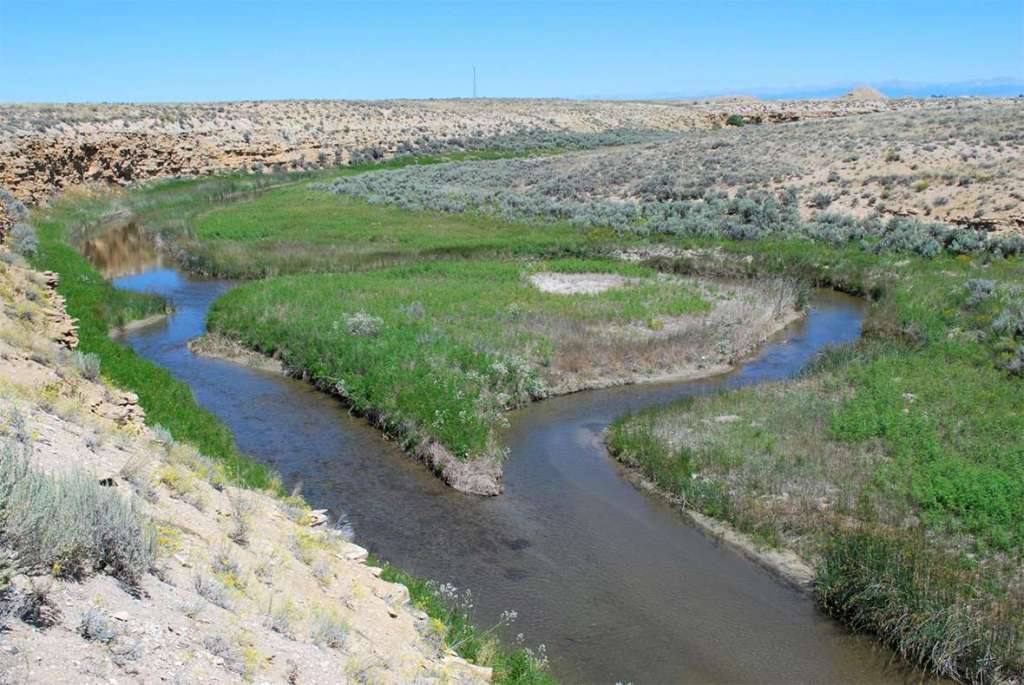
There’s a little grass in this picture, but you can see that beyond the margins of the river there is no grass at all. Grass was the fuel that powered the wagon train — the travelers would not get far without grass for the animals.

Caption from WyoHistory.org: The Big Sandy ‘is a flat-running stream over a sand bottom,’ former mountain man James Clyman wrote in 1846. Here, the river winds about a mile downstream from the Oregon Trail crossing at present Farson, Wyo. Randy Brown photo.
Posted in Bidwell-Bartleson Party | Leave a comment

July 20, 1841

Tuesday, 20th. Traveled about 18 miles in a circuitous direction, first west and then south. Country was extremely dry and dusty — no game seen but a few antelope — encamped on Big Sandy, having come about 18 miles.

Or, as Jimmy John wrote: “Traveled hard all day and did not get more than eight miles in a straight line.”

I don’t know why they were wandering around like that. Maybe looking for grass, maybe for game. Grass was scarce and the oxen, mules, and horses couldn’t get far without it.

Photo by Jacob Barlow

Posted in Bidwell-Bartleson Party | Leave a comment