Black Bart in Butte County — 1879

On this date — June 21 — in 1879 the notorious stage robber Black Bart held up a stage coach near Forbestown in Butte County. It was his first robbery in the year 1879 and would be followed by two robberies in October in Shasta County. He generally spent his winters in San Francisco, living off his ill-gotten gains of the previous summer and fall.
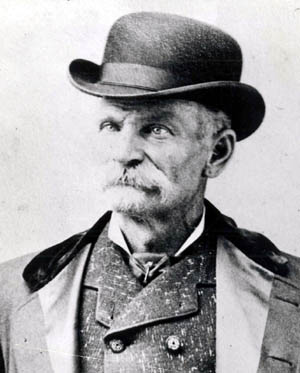
Charles Boles aka Black Bart

Bart continued to evade capture. In the last issue of the Weekly Butte Record for 1882, the paper reported that Black Bart was still on the loose.

Weekly Butte Record 30 December 1882

The editor has kindly put blanks where Bart wrote some rather coarse language. Editors were more sensitive to their readers fine sensibilities in 1882. I’m sure you can fill in the blanks.

Black Bart was finally captured and sent to San Quentin prison in November 1883. He disappeared from public notice after his release from prison in 1888. There is a theory (and a book) claiming that he spent the rest of his life as a druggist named Charles Wells in Marysville. If you want to read more about Black Bart, a good place to start is at http://www.blackbart.com/index.
Posted in Uncategorized | Leave a comment

June 20, 1841 — The Gap and Horse Creek

Sunday, 20th. Passed through the Gap — came into an extensive plain, the beautiful scenery gradually receded from view — came to a creek called Horse — passed it, reached the river again — cool and windy — having come about 23 miles.

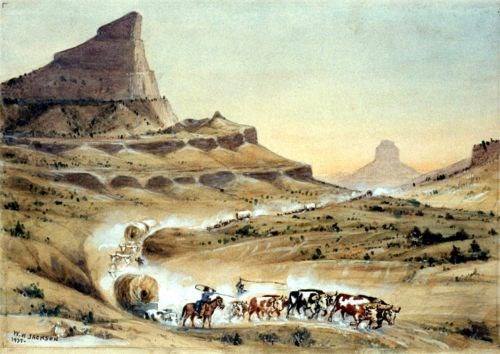
Here is William Henry Jackson’s depiction of coming “through the Gap” from the western side of Scott’s Bluff.

Scott’s Bluff, by William Henry Jackson. Courtesy of William Henry Jackson Collection, National Park Service

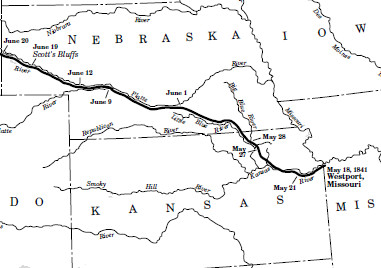
You can see Scott’s Bluff and Horse Creek on this map. They will soon be at Fort Laramie.

Posted in Bidwell-Bartleson Party | Leave a comment

June 19,1841 — Scott’s Bluff

We gradually receded from the river in order to pass through a gap in a range of high hills called Scott’s Bluffs. As we advanced towards these hills, the scenery of the surrounding country became beautifully grand and picturesque–-they were worn in such a manner by the storms of unnumbered seasons that they really counterfeited the lofty spires, towering edifices, spacious domes, and in fine all the beautiful mansions of cities. We encamped among these envious objects having come about 20 miles.

Here we first found the mountain sheep; two were killed and brought to camp. These animals are so often described in almost every little School Book that it is unnecessary for me to describe them here.

One day’s journey west of Chimney Rock the emigrants came to Scott’s Bluff, a rock formation named for Hiram Scott, a wounded fur trapper left behind to die by his companions in 1828. The fantastical shapes of the rocks were a welcome sight to travelers who had just spent weeks traversing the flatlands of the prairie.

Many travelers remarked on the fantastic forms taken by the steep-sided hills in this area of western Nebraska. More information about the history and geology of Scott’s Bluff can be found at the website for Scotts Bluff National Monument and the Oregon-California Trails Association. 

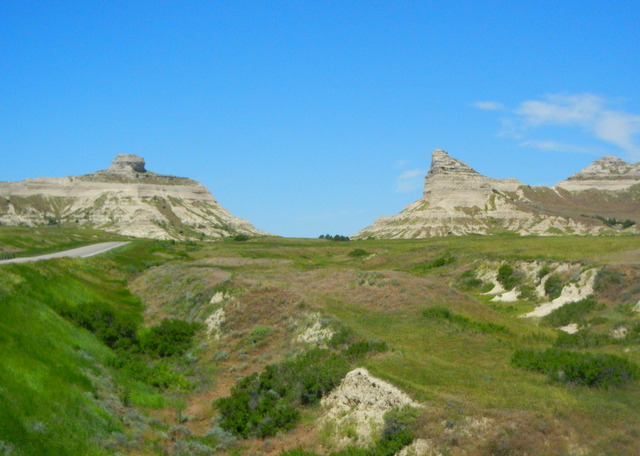
Here is what Scott’s Bluff looks like today. Much the same, except that the Bidwell-Bartleson Party had to negotiate deep ravines, like the ones in the foreground, rather than the smooth road you see on the left.

For more on traversing the Gap, see this other post on Scott’s Bluff.

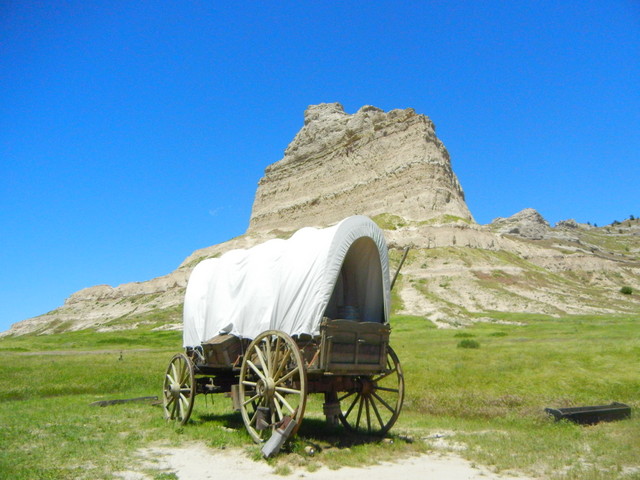
Looks like John Bidwell left his wagon behind.

Posted in Bidwell-Bartleson Party, Uncategorized | Leave a comment

June 18, 1841 — Chimney Rock

Friday 18th: At about 12 o’clock today we passed another object, still more singular and interesting. It is called by the mountaineers the Chimney, from its resemblance to that object, and is composed of clay and sand so compact as to possess the hardness of rock. It has been formed from a high isolated mound which, being washed on every side by the rains and snows of ages, has been worn down till nothing is left but the centre which stands upon an obtuse cone, and is seen towering like a huge column at the distance of 30 miles.

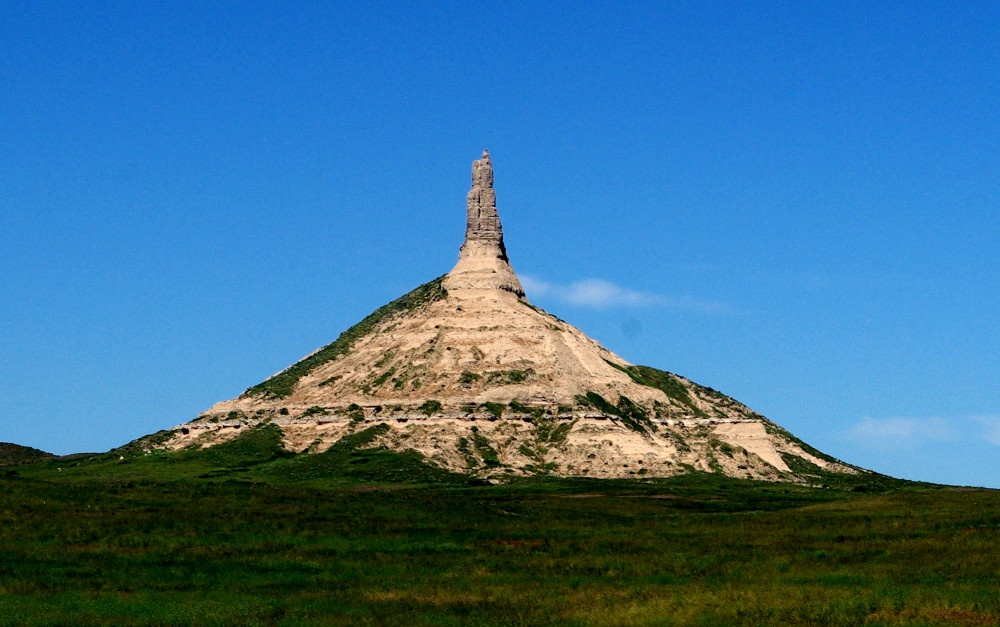
Most of the company members traveled from their campsite to Chimney Rock to get a closer view and to inscribe their names with tar and grease. No doubt the names have long since worn away. Bidwell later noted that the chimney had become shorter than when he first saw it and less square. Today it looks more like a spire, but in 1841 it really did look like a chimney. Or maybe, as Father DeSmet said, a funnel.

Engraving based on a drawing by Father Nicholas Point in 1841

Father Pierre Jean De Smet wrote of seeing “the chimney”:

It is called so on account of its extraordinary form; but instead of applying to it an appellation which is rather unworthy this wonder of nature, just because it bears some resemblance to the object after which it is named, it would have been more proper to call it “the inverted funnel” as there is no object which it resembles more. What excites our astonishment, is the manner in which this remnant of a mountain,composed of sand and clay, has been so shaped, and how it has for such a length of time preserved this form, in spite of the winds which are so violent in these parts.

And if you have ever traveled through Nebraska, you too can attest to the “violence” of the winds.

Chimney Rock today
Posted in Bidwell-Bartleson Party, Uncategorized | Leave a comment

June 17, 1841 — Courthouse Rock

Thursday 17th. Continued to coast along up the river — encamped on its banks nearly opposite to a huge isolated bluff bearing some resemblance to an immense castle in  ruins. Its distance from us no one supposed more than 1 1/2 miles, and yet it was at least 7. This deception was owing to the pure atmosphere through which it was viewed, and the want of objects, by which only, accurate ideas of distance can be acquired without measure.

The “huge isolated bluff” was probably what other pioneers called Courthouse Rock and the smaller Jail Rock. In the otherwise flat terrain of western Nebraska these features can be seen for miles around.

JailhouseandCourthouseRock-352971f3

Father De Smet described this scene in a letter to his Superior:

Sometimes the fancy presents a castle of the middle ages, and even conjures up the lord of the manor; but instead of all these magnificent remains of antiquity, we find only barren mounds on all sides, filled with cliffs formed by the falling of the water, and serving as dens to an infinite number of rattle snakes and other venomous rep times.

Nunis, The Bidwell-Bartleson Party, p. 213)
Posted in Bidwell-Bartleson Party | Leave a comment

June 16, 1841

Wednesday, 16th. Several wild horses were seen on the opposite side of the river. Advanced about 20 miles; encamped on the river, opposite to high and uneven bluffs, bearing considerable forests of pine.

Here are the bluffs as I saw them when traveling through Nebraska in 2014. The “considerable forests of pine” have disappeared.

Posted in Bidwell-Bartleson Party | Leave a comment

June 15, 1841

Tuesday, 15th. There was so sudden a change from cool to cold that we were not comfortable in our best apparel. I do not remember that I ever have experienced weather so cold at this season of the year — traveled about 16 miles.

I imagine a Midwesterner would say, “Welcome to the Great Plains, John, where the weather extremes mean that there is never a dull day.” Temperatures can go from oppressively hot to bone-chilling cold in a matter of hours.

By “best apparel” I think Bidwell means not, “our fanciest duds,” but their warmest clothes.

Posted in Bidwell-Bartleson Party | Leave a comment

June 14, 1841

Monday, 14th. The day was so cool and rainy we did not travel.

Briefest entry in the journal.

Posted in Uncategorized | Leave a comment

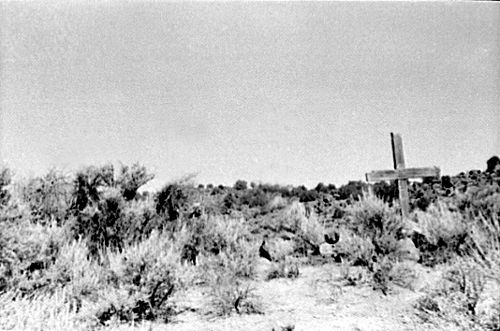
June 13, 1841 — Death on the Prairie

Sunday, 13th. A mournful accident occurred in the camp this morning–a young man by the name of Shotwell while in the act of taking a gun out of the wagon, drew it with the muzzle towards him in such a manner that it went off and shot him near the heart. He lived about an hour and died in the full possession of his senses.

This was the only death during the entire dangerous trip. George Shotwell was “buried in the most decent manner our circumstances would admit of, after which a funeral sermon was preached by Mr. Williams.”

James John vividly describes the same incident:

I was out of camp seeking oxen from the river. I heard the report of a gun and heard a Scream. I went to the camp and saw a man bleeding on the ground. He was taking his gun out of the wagon with the muzzle towards him and it discharged and shot him thru the left side. He lived about an hour and died. We buried him the the sand about a mile from the Camp.

Poor George Shotwell! It was a lesson in gun safety: never grab a gun, loaded or unloaded, by the muzzle. At Fort Laramie “the things of Mr. Shotwell were sold at auction,” and a letter was taken to his family by a returning traveler.

In spite of all their perils and hardships, this was the only death suffered by the Bidwell-Bartleson Party.

Posted in Bidwell-Bartleson Party | Leave a comment

June 12, 1841 — Ash Hollow

Saturday, 12th. Left the S. fork, and after a march of 12 miles found ourselves on the N. fork. In the afternoon passed a small ash grove of about 23 trees — timber is so scarce that such a grove is worthy of notice. We encamped on the N. fork having come about 18 miles; on leaving the S. fork we left the buffalo also.

The ash grove noted by Bidwell came to be known as Ash Hollow, a notable stopping point on the Oregon-California Trail, with good water, wood, and grass. It is now Ash Hollow State Park in Nebraska and worth visiting to see the trail ruts on steep Windlass Hill.

Posted in Bidwell-Bartleson Party, Uncategorized | 1 Comment