June 16, 1841

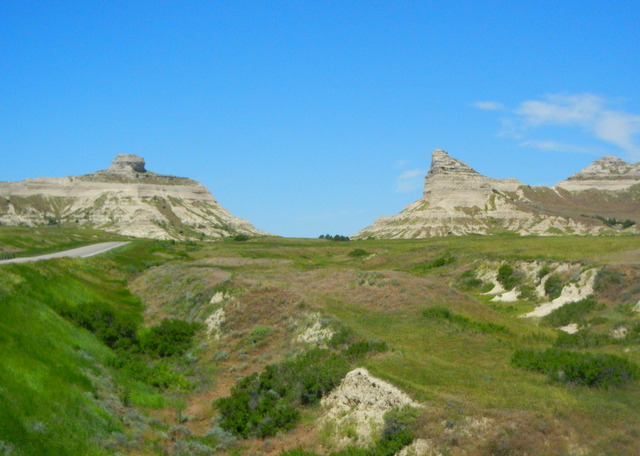
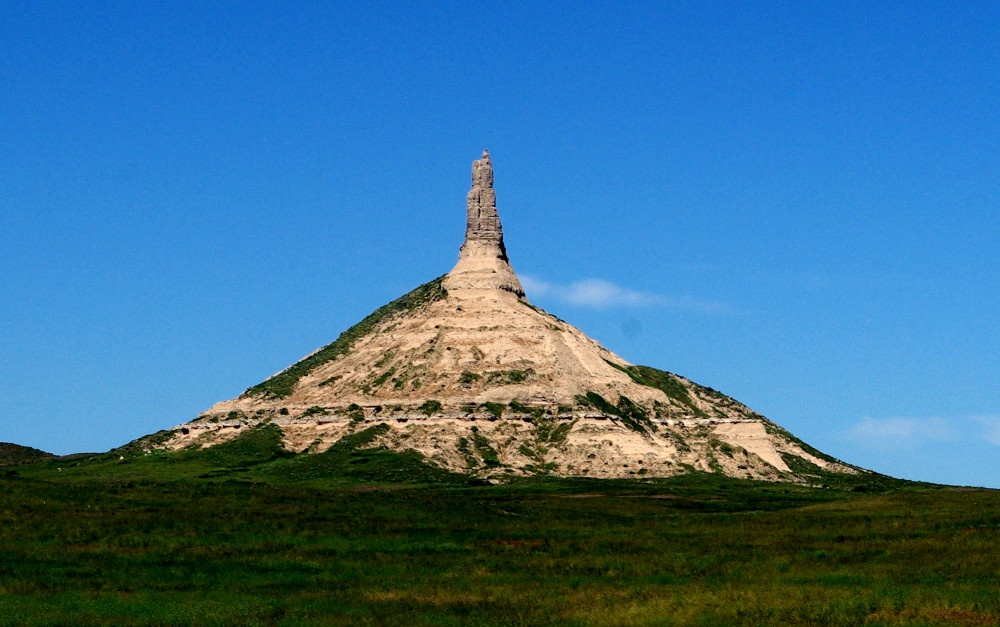
Wednesday, 16th. Several wild horses were seen on the opposite side of the river. Advanced about 20 miles; encamped on the river, opposite to high and uneven bluffs, bearing considerable forests of pine.

Here are the bluffs as I saw them when traveling through Nebraska in 2014. The “considerable forests of pine” have disappeared.

Posted in Bidwell-Bartleson Party | Leave a comment

June 15, 1841

Tuesday, 15th. There was so sudden a change from cool to cold that we were not comfortable in our best apparel. I do not remember that I ever have experienced weather so cold at this season of the year — traveled about 16 miles.

I imagine a Midwesterner would say, “Welcome to the Great Plains, John, where the weather extremes mean that there is never a dull day.” Temperatures can go from oppressively hot to bone-chilling cold in a matter of hours.

By “best apparel” I think Bidwell means not, “our fanciest duds,” but their warmest clothes.

Posted in Bidwell-Bartleson Party | Leave a comment

June 14, 1841

Monday, 14th. The day was so cool and rainy we did not travel.

Briefest entry in the journal.

Posted in Uncategorized | Leave a comment

June 13, 1841 — Death on the Prairie

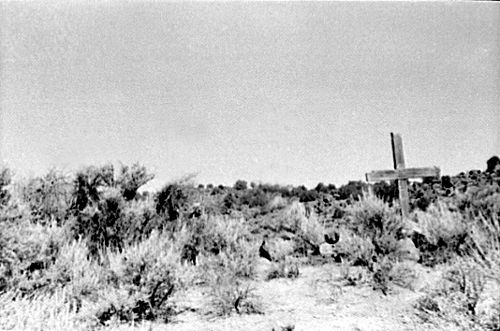
Sunday, 13th. A mournful accident occurred in the camp this morning–a young man by the name of Shotwell while in the act of taking a gun out of the wagon, drew it with the muzzle towards him in such a manner that it went off and shot him near the heart. He lived about an hour and died in the full possession of his senses.

This was the only death during the entire dangerous trip. George Shotwell was “buried in the most decent manner our circumstances would admit of, after which a funeral sermon was preached by Mr. Williams.”

James John vividly describes the same incident:

I was out of camp seeking oxen from the river. I heard the report of a gun and heard a Scream. I went to the camp and saw a man bleeding on the ground. He was taking his gun out of the wagon with the muzzle towards him and it discharged and shot him thru the left side. He lived about an hour and died. We buried him the the sand about a mile from the Camp.

Poor George Shotwell! It was a lesson in gun safety: never grab a gun, loaded or unloaded, by the muzzle. At Fort Laramie “the things of Mr. Shotwell were sold at auction,” and a letter was taken to his family by a returning traveler.

In spite of all their perils and hardships, this was the only death suffered by the Bidwell-Bartleson Party.

Posted in Bidwell-Bartleson Party | Leave a comment

June 12, 1841 — Ash Hollow

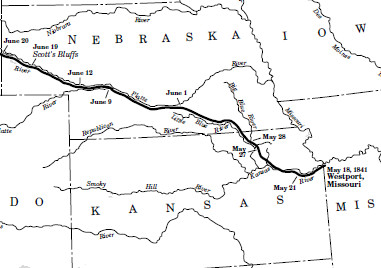
Saturday, 12th. Left the S. fork, and after a march of 12 miles found ourselves on the N. fork. In the afternoon passed a small ash grove of about 23 trees — timber is so scarce that such a grove is worthy of notice. We encamped on the N. fork having come about 18 miles; on leaving the S. fork we left the buffalo also.

The ash grove noted by Bidwell came to be known as Ash Hollow, a notable stopping point on the Oregon-California Trail, with good water, wood, and grass. It is now Ash Hollow State Park in Nebraska and worth visiting to see the trail ruts on steep Windlass Hill.

Posted in Bidwell-Bartleson Party, Uncategorized | 1 Comment

June 11, 1841 — The Fear of Indians

Friday 11th. The oxen had wandered about 1/2 mile from the camp this morning, when a man was sent to bring them in; he soon came running back in great haste, crying “the Indians are driving the oxen off!!” In less than half an hour the oxen were at camp and not an Indian seen–-all this is easily accounted for when we consider how timidity and fear will make every bush, or stone, or stump an Indian, and 40 Indians, thousands. Vast herds of buffalo continued to be seen on the opposite side of the river. Distance today about 20 miles.

No Indians in reality, but fear had created the illusions that they were driving off their cattle. Bidwell is harking back to the Indian scare of June 4th, when “Cheyenne” Dawson came running back, declaring he was being chased by swarms of Indians.

During this period the emigrants lived in fear of attack by hostile Indians. Actually the Bidwell-Bartleson Party had almost no problems with natives. Later, as emigration increased and the plains became crowded with covered wagons, the Indians reacted to this incursion into their lands by becoming wary and unfriendly. Their lands were overrun, the buffalo herds were depleted, and their way of life threatened. But in 1841, with the help of Captain Fitzpatrick, this group had little to worry about.

Posted in Bidwell-Bartleson Party, Uncategorized | Leave a comment

June 10, 1841 — Oxen and Buffalo

Thursday, 10th. This morning the most of the oxen were again at large, owing to the neglect of the owners to the great danger of losing them by the Indians and by them mingling with buffalo, or by their straying so far that it would be impossible to track them on account of the innumerable tracks of the buffalo. Making therefore rather a late start, we continued to ascend the river on the N. side. We traveled about 14 miles and encamped on the river.

Buffalo were seen in countless thousands on the opposite side of the river; from the time we began to journey this morning till we ceased to travel at night, the whole south side of the stream was completely clouded by these huge animals, grazing in the valley and on the hills, ruminating upon the margin of the river, or crowding down to its banks for water.

Posted in Uncategorized | Leave a comment

June 9, 1841 — Fording the Platte

Wednesday, 9th. Spent the day in crossing the S. fork of Platte — a buffalo was killed from a herd that came within 300 yards of the camp. We crossed the river by fording, the water being sufficiently shallow — width of river here about 2/3 of a mile — its waters are muddy like those of the Missouri.

The painting below, by William Henry Jackson, gives a good idea of what fording the river was like for a much larger group of emigrants.

Platte River Crossing, by William Henry Jackson
Posted in Bidwell-Bartleson Party | Leave a comment

June 8, 1841 — Lament for the Buffalo

Tuesday, 8th. There were 8 or 10 buffalo killed today; but not one-tenth of the meat was used; the rest was left to waste upon the prairie. In the afternoon we passed the confluence of the N. & S. forks of the Platte river & encamped, having come about 18 miles; many hundreds of buffaloes were seen at this place.

The scenery of the country on the Platte is rather dull and monotonous, but there are some objects which must ever attract the attention of the observant traveler; I mean the immense quantity of buffalo bones, which are everywhere strewed with great profusion, so that the valley, throughout its whole length and breadth, is nothing but one complete slaughter yard, where the noble animals used to graze, ruminate and multiply in uncounted thousands–but they are fast diminishing. If they continue to decrease in the same ratio that they have for the past 15 or 20 years, they will ere long become totally extinct. It has been but a few years since they left the frontiers of Missouri, and are now fast retreating towards the Rocky Mountains.

The Indians are anxious to preserve them, and it is said of them that they never kill as long as they have any meat remaining, but behold with indignation the shameful and outrageous prodigality of the whites, who slaughter thousands merely for their robes and leave the meat, which is far more delicious than that of tame cattle, to waste or be eaten by wolves and vultures.

buffalowantonlrg
“Wanton Destruction of Buffalo”. By Artist John Reuben Chapin, c 1870

When you think that the massive slaughter of the American bison had only just begun, and that the great Gold Rush migration, and the building of the railroad, was yet to come, you realize how prescient John Bidwell was when he foretold the extermination of the buffalo. Those mighty herds would be brought to the edge of extinction before the slaughter ended and the rescue began.

Posted in Bidwell-Bartleson Party, buffalo | Leave a comment

June 7, 1841

Monday, 7th. Three Indians continued with us. The wind blew very hard towards evening. 3 buffaloes were killed and part of their meat brought to the camp.

The company is starting to see the buffalo (American bison) that roamed the prairie in vast numbers. These will be an important source of meat for the company.

Posted in Bidwell-Bartleson Party, buffalo | Leave a comment