June 1, 1841 — Hailstorm and Wedding

On the trail with John Bidwell:

June. Tuesday, 1st. This morning we hastened to leave our miserable encampment and proceeded directly north, we reached Big Platte river about 12 o’clock. The heat was uncommonly oppressive.  I here discovered the ground was in many places hoary with Glauber Salts, or at least I was unable to distinguish them by taste. This afternoon we had a soaking shower, which was succeeded by a heavy hailstorm.

Glauber Salts are sodium sulfate, an inorganic chemical which today is used in the manufacture of detergents and in paper pulping. In Bidwell’s day it was used as a laxative.

About the hailstorm, the Rev. Williams wrote:

At 2 o’clock commenced a most tremendous bad storm, with wind, which blew down most of the tents, accompanied with rain and lightning and thunder almost all night. I slept but little, the ground being all covered with water. That night dreadful oaths were heard all over the camp ground. O the wickedness of the wicked!

Poor Rev. Williams found it very trying to travel “in the midst of an ignorant and hard-hearted people.” (“Narrative of a Tour from the State of Indiana to the Oregon Territory” in The Bidwell-Bartleson Party, edited by Doyce B Nunis.)

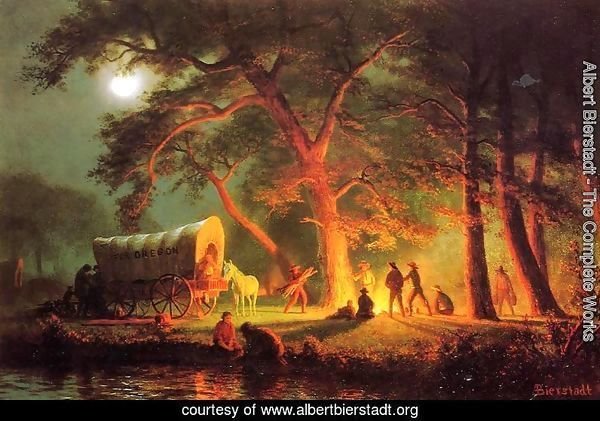
The Impending Storm, by Albert Bierstadt

Bidwell continues his journal entry:

Wonderful! This evening a new family was created! Isaac Kelsey was married to Miss Williams, daughter of R. Williams. The marriage ceremony was performed by the Rev. Pr. Williams, so we now have five families, if we include a widow and child.

Miss Winifred Williams was the daughter of Richard Williams and his wife, whose name is not recorded. Isaac Kelsey, who was also known as Zedidiah, was one of the four Kelsey brothers on the trip. He and Samuel and their families went to Oregon, and Benjamin and Andrew went to California. Isaac was born in 1818, making him one year older than John Bidwell, and 22 or 23 years old when he married on the trail. Very little else is known about the young couple and their further adventures.

Posted in Uncategorized | Leave a comment

May 31, 1841 — Meeting Mountain Men

Monday, 31st. This morning about 10 o’clock we met six wagons with 18 men, with fur and robes on their way from Ft. Larimie [sic] to St. Louis. Ft. Larimie is situated on Larimie’s fork near its junction with the N. fork of Platte, and is about 800 miles from Independence. The wagons were drawn by oxen and mules–the former looked as though they received a thousand lashes every day of their existence! The rusty mountaineers looked as though they never had seen razor, water, soap, or brush. It was very warm, and we travelled till dark before we were able to reach water, and then it was not fit to drink, and then we could not procure any wood, grass scarce.

This illustration by Frederic Remington shows two mountaineers as Bidwell saw them, without “razor, water, soap, or brush.”

The company had left the Kansas River and traveled up the Little Blue, and at this date were situated just beyond the source of the Little Blue and not yet at the Platte River, which they would follow until they reached Ft. Laramie.

The “rusty mountaineers” that Bidwell’s group met were working for one of the fur-trading companies that flourished in the western territories during the first half of the 19th century. St. Louis was the marketplace and supply point for the fur traders and mountain men, and from that point the buffalo robes and beaver pelts were shipped to the East Coast and Europe.

Posted in Uncategorized | Leave a comment

May 30, 1841

Sunday, 30th. Nothing of importance occurred — distance about 15 miles — grass mingled with rushes afforded our animals plenty of food of the best quality. Game appeared to increase, though but one deer and one antelope were brought in.

Another ho-hum entry. I promise it will get more interesting soon. At this point these greenhorns must have thought that traveling to California was easy-peasy.

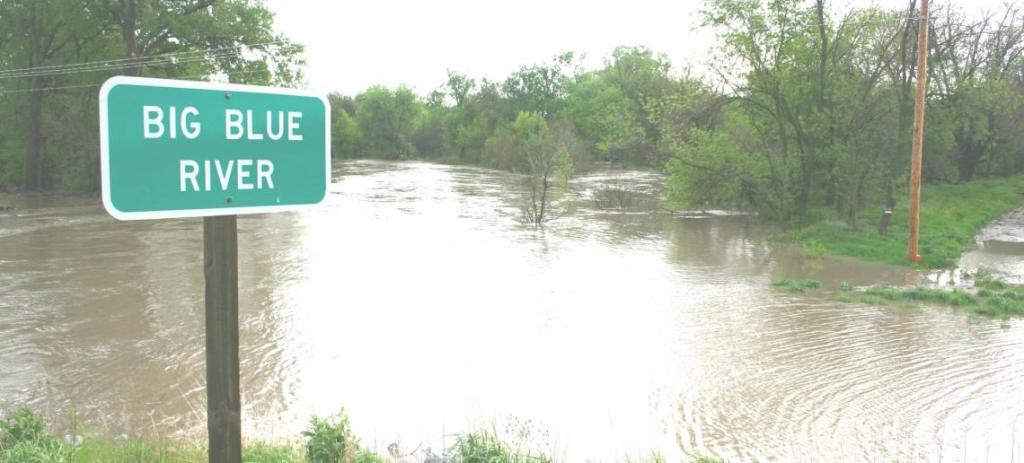
The Big Blue River in flood, May 2005. You can tell it is the Big Blue because it has a sign.
Posted in Uncategorized | Leave a comment

May 29, 1841

Saturday, 29th. We again started about sunrise and travelled not less than 2 miles. One antelope was killed — saw several elk.

They haven’t yet come across herds of buffalo, but other game is plentiful and augments their diet of bacon, beans, and biscuit.

Pronghorn antelope
Posted in Bidwell-Bartleson Party, Uncategorized | 2 Comments

May 28, 1841

Friday, 28th: Started about sunrise, travelled about 5 miles and stopped to take breakfast. The heat was oppressive and we were compelled to go 20 miles farther before we came to either wood or water. The stream on which we camped is a fork of the Kanzas and is well known to all the mountaineers, by the name of the Big Blue; an antelope was killed.

They are in the northeast corner of Kansas, traveling toward Nebraska. (All of this was Indian Territory at the time.) It still sounds like a typical camping trip: the weather is hot and they have to go farther than they expected to find good accommodations.

Posted in Uncategorized | Leave a comment

May 27, 1841

Thursday, 27th: Started late, being detained at repairing the waggons. The day was warm, but the evening mild and pleasant. Encamped in a commodious valley, well-watered by a beautiful little stream which glided smoothly through the scattering grove, come about 15 miles.

Sounds like a typical camping trip: a little delay with the vehicles, but altogether a pleasant day and a lovely camping spot. The next few days will be like this — rather mundane. More exciting events are yet to come.

Posted in Uncategorized | Leave a comment

May 26, 1841

Wednesday, 26th. Two wagons were broke today; about a dozen Pawnees came to our camp, stopped to repair the wagons, having come about 15 miles. A deer was brought in by C. Hopper.

Charles Hopper was a native or North Carolina and an expert hunter. He later brought his family to California and settled in the Napa Valley.

A man by the name of Williams, a Methodist preacher, overtook the company this evening on his way to Oregon Territory. He had not arrived in time to start with the company from the settlements, and had traveled entirely alone, without any gun or other weapon of defense, depending wholly on Providence for protection and support.

The Reverend Mr. Joseph Williams was 64 years old in 1841 when he set out to visit the Protestant missionaries in Oregon. (You may recall that Marcus and Narcissa Whitman had gone to Oregon in 1836 to proselytize the Indians.) He was the oldest member of the Bidwell-Bartleson Party. He left a short record of his experiences on the trail entitled Narrative of a Tour from the State of Indiana to the Oregon Territory in the Years 1841-2.

Williams intended to go west with the members of the Western Emigration Society, but on arriving at Westport found that they had already departed. “With much pain of mind” he went to the Shawnee Mission to consult with his Methodist brethren. There he learned the the company was only four days ahead of him. “I said within myself, surely the Lord is opening my way to go on.”

The Shawnee Methodist Mission, photo c. 1870 Kansas Historical Society https://www.kshs.org/index.php?url=km/items/view/211050

His church brethren tried to dissuade him from going, saying, “It was almost presumptuous for so old a man as I to attempt such a hazardous journey,” but Williams felt the call of God and was determined to answer it. He set off to catch up with the company, traveling with another missionary and “two Indian chiefs of the Caw Tribe.”

On the 26th he rode across the prairie, “happy in my soul,” until about 4 o’clock, when he spotted the company a few miles ahead. He stopped to feed his horse, then traveled on and by evening he joined the company. They told him how narrowly he had missed being captured by Indians. Williams didn’t seem particularly surprised, for he was confident that God was watching over him.

Posted in Uncategorized | Leave a comment

May 25, 1841

Passed the stream without much trouble and made a stretch of about 20 miles when we encamped on the border of a beautiful forest where we found plenty of grass and water. The country over which we passed was similar to that of yesterday.

Wood, water, and grass were the holy trinity of pioneer travelers. They could get along a few days without wood for fuel (and use buffalo chips instead), but they could not do without water and grass for their animals. The journey could not begin until the grass began to grow on the prairie, which is why wagon trains always left in mid-April or early May.

Twenty miles in a day was good traveling. Oxen could only make about two miles an hour, so that’s ten hours on the move. Plenty of time had to be given morning, noon, and evening for the oxen to graze, too.

Posted in Bidwell-Bartleson Party | Leave a comment

May 24, 1841

Monday, 24th. Travelled about 13 miles today over rolling prairies and arrived at the Big Vermillion, a branch of the Kanzas. Here we were obliged to stop, the water being so high as to render it impossible to cross the waggons.

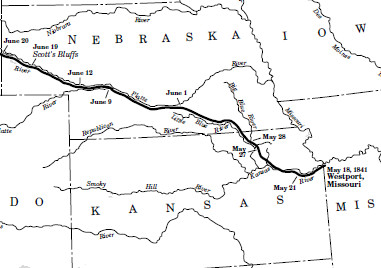
Detail of map from The Bidwell-Bartleson Party, by Doyce B. Nunis. Used by permission.

The river that Bidwell calls the Big Vermillion is the little unlabeled tributary of the Kansas River on this map, located between the dates May 21 and May 27. They are making their way to the Platte River, the highway to the west.

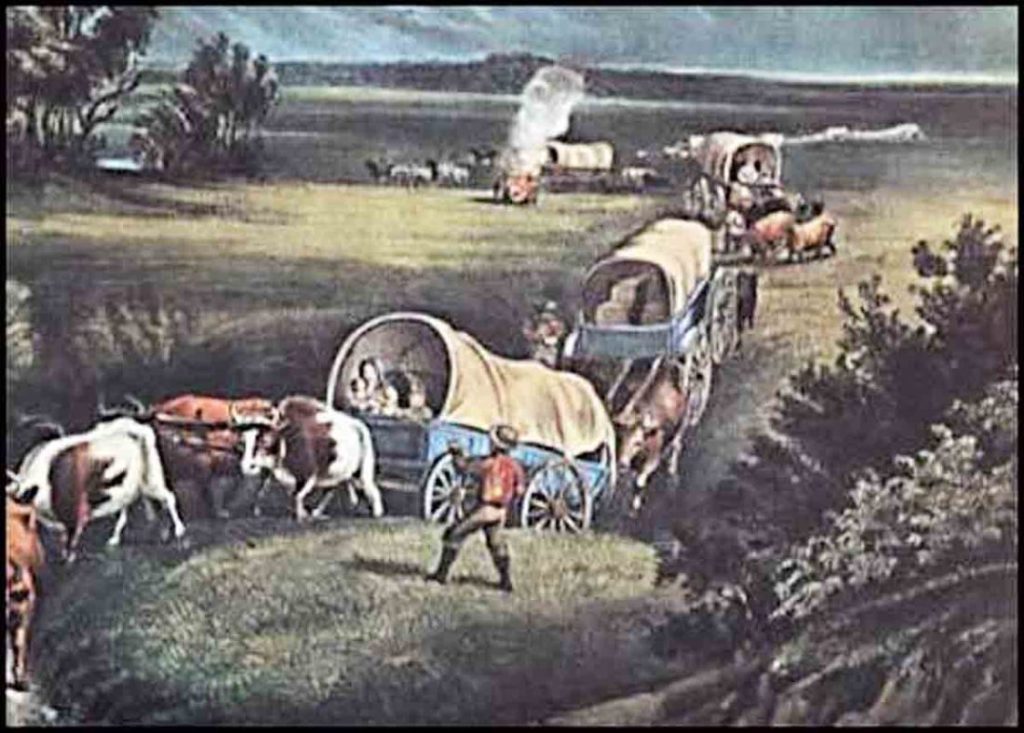
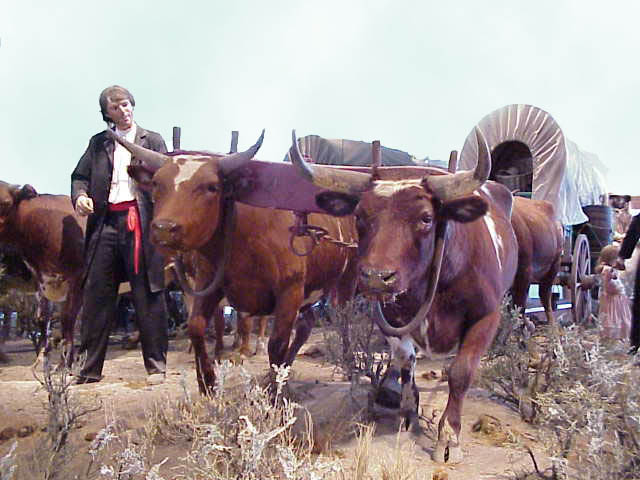
You might be picturing John Bidwell seated on the wagon, driving his oxen, but that was not the way that oxen were driven. They were not guided by reins like horses or mules. The driver walked alongside the lead ox and guided it with a stick. John Bidwell would walk all the way to California.

Posted in Bidwell-Bartleson Party | Leave a comment

May 23, 1841

Sunday, May 23rd: All the oxen were gone this morning excepting nine. There was considerable complaint among the company, some saying at this slow rate of traveling we would have to winter among the Black Hills, and eat our mules etc. We, however, made a start about 9 in the morning, proceeded about nine miles and stopped to wait for Chiles’ wagon which overtook us about 5 P.M.; 14 Pawnees were seen by the wagon, well armed with spears etc. It was supposed they were on an expedition against the Kanzas.

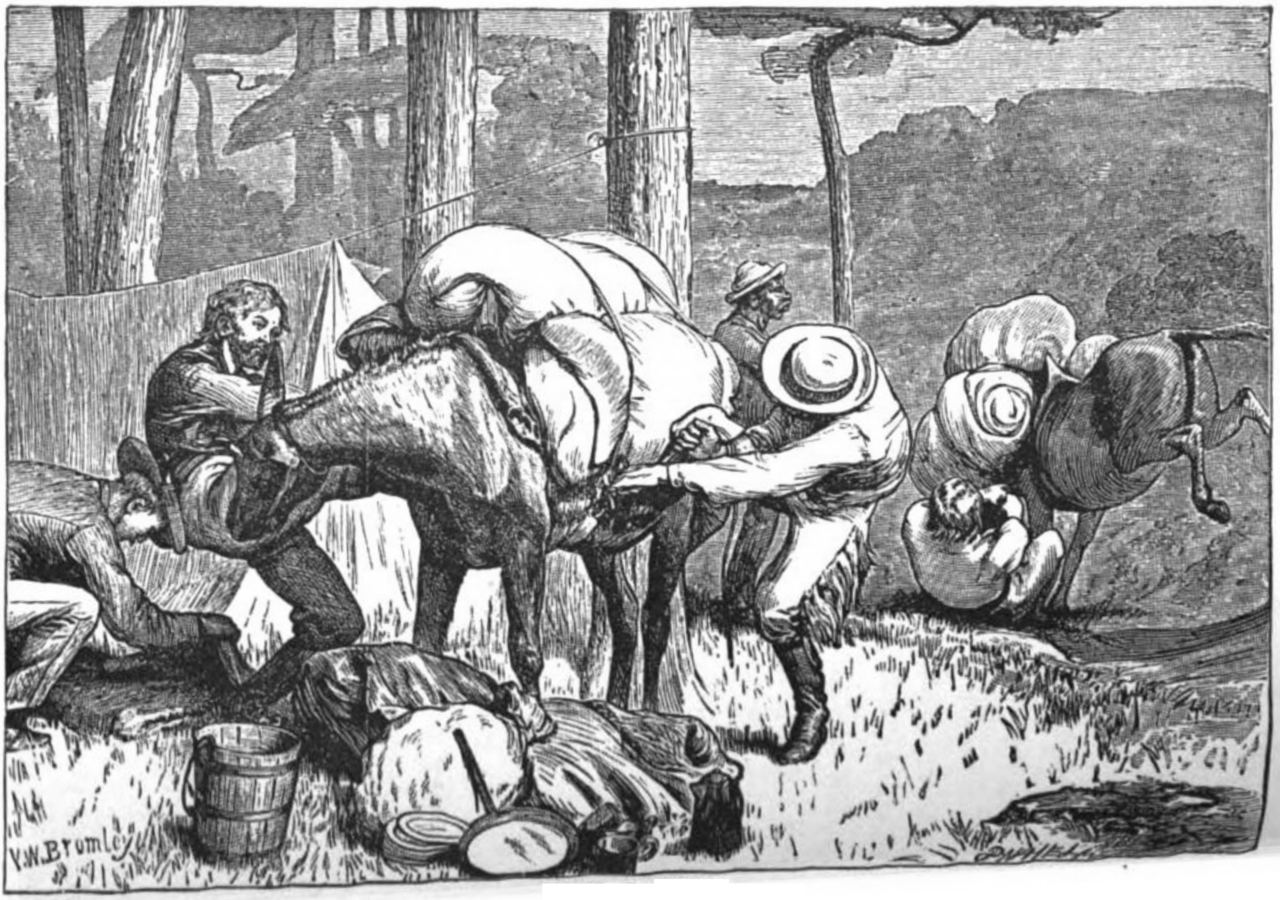
Joseph Chiles was a member of the Western Emigration Society, but a little behind the others in getting started, and had to do some catching up. Once he and the men with him got with the main party, they were probably able to make better time, although the trip was slow going. Fifteen to twenty miles a day was the best they could do. They wouldn’t have to winter in the Black Hills, but the mules were another matter (and another meal).

1280px-Mule_packing

Posted in Uncategorized | Leave a comment